Category Archives: Bible teaching
When is a believer’s name written in the Book of Life?
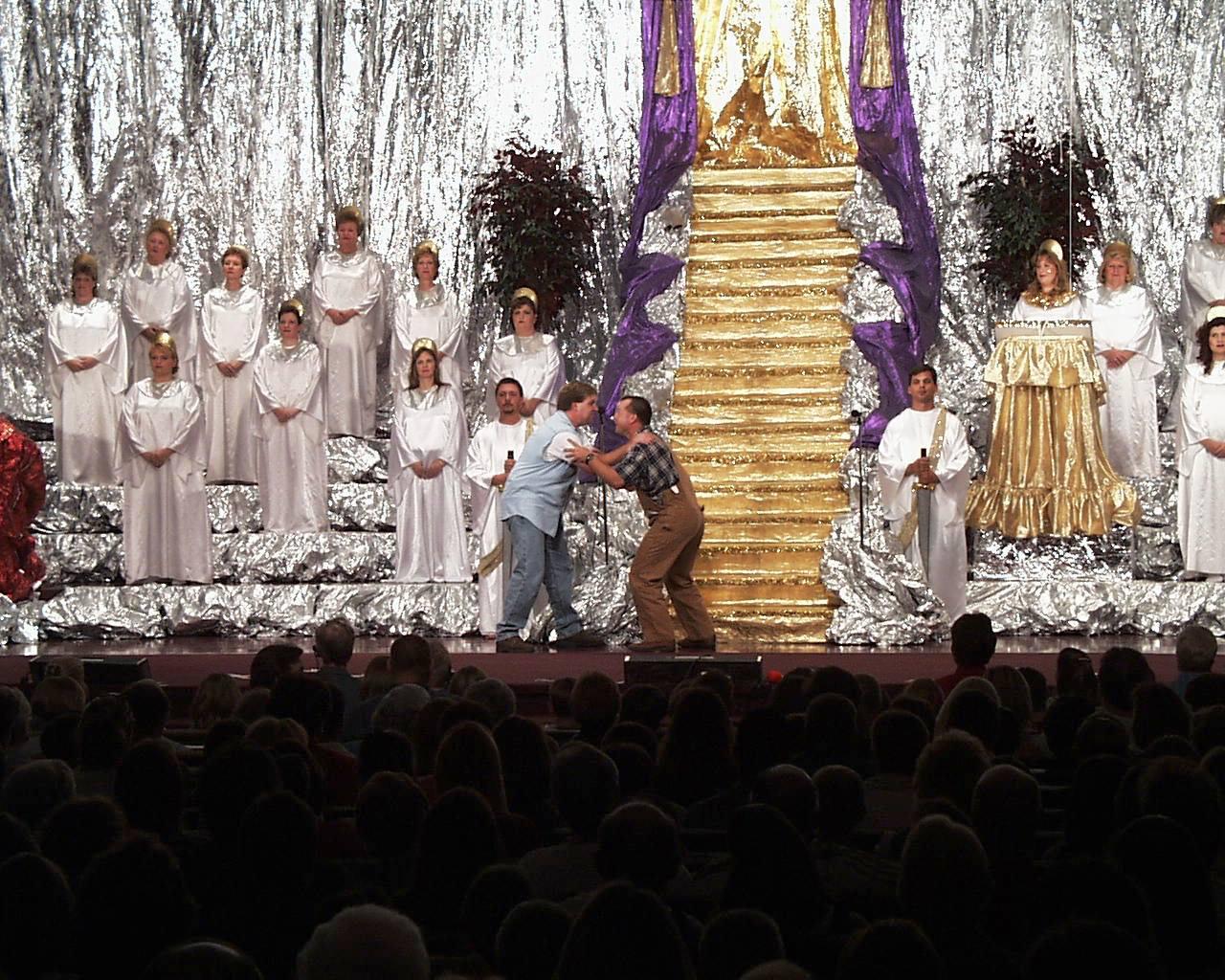
Article copyright by Bob Rogers.
Revelation 20:15 says that everyone whose name was not found written in the book of life was thrown into the lake of fire. From this passage, Christians conclude that God has a record of followers of Jesus Christ– the Book of Life– and that we do not have to fear Judgment Day, because if our names are written in the Book of Life, we will receive the gift of eternal life in heaven by God’s grace.
But exactly when is a believer’s name written in the Book of Life– at birth, or at the time we believe? I have always thought of it as written at the time that we believe in Christ, since it is a record of those who believe. However, I recently learned I was wrong.
We were discussing this in my Bible class recently. My friend Allen Steele pointed out Revelation 13:8 and 17:8. Both passages refer to unbelievers as “everyone whose name was not written from the foundation of the world in the book of life of the Lamb…” If unbelievers names were not written from the foundation of the world in the book of life, then it would follow logically that the names of believers were written from the foundation of the world in the book of life.
If we think this through, it makes perfect sense. After all, God speaks of our salvation as being “chosen in Him, before the foundation of the world” (Ephesians 1:4), and that “those He foreknew He also predestined” (Romans 8:29), since we are “chosen according to the foreknowledge of God the Father” (1 Peter 1:1-2). In other words, God in His omniscience already foreknows what we will do, so He can speak of us as “chosen,” and He already has our names in the book even before we were born.
Does this mean our salvation is predetermined, without any choice on our parts? No, we “sealed” that entry in the book when we believed. As Ephesians 1:13 says, “When you heard the message of truth, the gospel of your salvation, and when you believed in Him, you were also sealed with the promised Holy Spirit.” Thus Revelation 7:4 refers to believers as those “sealed.” So God foreknew who would believe, and already has their names in His book, but when we believe, we “seal” the deal.
Rising Tide: A Way to Understand Prophecy in Revelation

Copyright 2018 by Bob Rogers
For three decades as a preacher and teacher, I have studied and taught the Book of Revelation. I have sought to balance symbolism with the literal return of Jesus Christ. One of the thorniest questions has been, How do we understand the chronological sequence of prophecy in Revelation? The most helpful way to see it is what I call the “Rising Tide” theory. Let me explain why I think this, and then explain the theory.
The problem: As one studies the Revelation, we notice that in numerous places, the prophecies seem to describe the end times long before the end of the book. Revelation 6:17 speaks of how the great day of wrath has come, and that’s in the very first chapter of prophecy after the Lamb breaks open the seals! Revelation 11:19 says that God’s temple in heaven opened, preparing for the end, yet in the next chapter, Revelation 12, the gospel story is repeated from heaven’s viewpoint with the images of the birth and resurrection of Christ. Revelation 14:14-20 speaks of the harvest of God’s judgment (again sounding like the end), but then the following chapters revert back, coming to a climax in Revelation 19 with the rider coming on white horse (Jesus), the beast (antichrist) and false prophet cast into lake of fire. From that point forward, the chronology in chapters 20-22 appears to follow a direct line to the end, with Satan bound a thousand years, then thrown into lake of fire, and a new heaven and new earth, and invitation to respond.
The “Rising Tide” explanation: How are we to find a chronological order of prophecy in all of this? Instead of seeing the prophecies in chapters 6 and following as a straight line chronological order, I think we should interpret them like the waves during the rising tide of the seashore. That is, the prophecies appear to move near the end, then go back and repeat, each time coming close to the end times, just as the rising tide comes in waves to the seashore, receding, then coming farther in, receding again but eventually coming in farther and farther. I believe this interpretation honors the reality of the text, taking seriously the symbolism but also trusting in its truthfulness. Revelation is a powerful book, inspired by God to steadily wash over us with our need to have our names written in His book of life. By repeatedly warning us of the end, instead of just one description of the end, the constant waves of its truth have a greater affect on our hearts to fall down in worship before the Lamb of God, Jesus Christ.
Twisted scripture: “The curse of Canaan,” used to justify racism
Copyright by Bob Rogers

Canaan be cursed. He will be the lowest of slaves to his brothers. – Genesis 9:25, CSB
One of the most despicable distortions of the Bible in all of history, was the use of Genesis 9:25 to justify enslaving the African people.
According to Genesis, shortly after Noah and his sons survived the flood, Noah got drunk and was lying naked in his tent. One of his sons, Ham, saw his father naked and told his two brothers. The two brothers took a cloak and walked backwards into the tent to cover their father while showing him respect by not looking at him. Genesis 9:24-27 says that when Noah awoke and learned what his youngest son had done, he cursed Ham’s descendants by cursing his son Canaan, saying he should be the slave of the descendants of the other sons.
This verse has been used to justify African slavery by those who claimed Canaan was the ancestor of Africans, and that Negroes were destined to be slaves of Caucasians. Since Genesis 10: 6 mentions that one of Ham’s sons was Cush, generally identified with Ethiopia, he has been falsely identified with Ham’s other son Canaan, as though both were African. However, the curse was on Canaan, not Cush, and Genesis 10:15-19 says that the descendants of Canaan included the Jebusites, Amorites and the settlers of Sodom and Gomorrah. All of these are well documented as being in Palestine, not Africa. The Amorites were so evil that Genesis 15:16 says, “the iniquity of the Amorites has not yet reached its full measure.” (This full measure eventually was punished when Joshua entered the land to destroy this people, who were known for such evils as child sacrifice.) As for Sodom and Gomorrah, Genesis 19 tells the story of the destruction of those cities due to their homosexual perversion.
Not only did the curse of Noah apply to Canaan and not Cush, but a prejudice against a descendant of Cush is specifically condemned in scripture. Numbers 12:1-16 tells how Moses own brother and sister, Aaron and Miriam, criticized Moses for marrying a Cushite woman, and the Lord became angry with Aaron and Miriam, cursing Miriam with leprosy for speaking against Moses and his Cushite wife. There are many other scriptures that condemn racism and teach that God does not show favoritism, showing how God accepts people from every race and nation who follow Him (Genesis 12:2-3; 1 Samuel 16:7; Psalm 96:3; Isaiah 2:2; 56:6-7, Jonah 4:11; Acts 10:34-35, Galatians 2:11-14, Colossians 3:11, James 2:1-4, Revelation 7:9).
Thus, not only is it a devilish distortion of scripture to say that Africans were cursed to be slaves, it is also a correct conclusion from scripture to say that those who practice racism against Africans (or any other people) are cursed!
Guest post: How to listen to your pastor’s sermons

Copyright by Larry D. Robertson
(Dr. Larry Robertson is pastor of Hilldale Baptist Church, Clarksville, Tennessee. He writes with humor and wisdom on how to listen to your pastor’s sermons.)
Recently I had all our kiddos with me, and we were leaving the 11:00 service. (I had parked on the back side of our church’s Family Life Center.) One of the boys asked, “Are there any snakes out here?” to which I replied, pointing to the driver’s side of the car, “There are no snakes on *this* side of the vehicle.” Immediately, two boys started tip-toeing and watching the ground on their side very closely.
When we got into the car and headed to lunch, one of the boys sitting on the passenger’s side asked, “Were there really snakes on our side of the car?” I said, “Who told you there were snakes on your side of the vehicle?” He said, “You did.” I said, “I never told you there were snakes on your side of the car. I said there were no snakes on *my* side.” LOL!
I know, I know—I can almost hear some of you saying my name reprovingly, including my middle name, like my Momma used to do when I was in trouble. But we all had a good laugh about it…and a discussion about putting words into another person’s mouth.
We pastors are often surprised by what people *think* we say in sermons. Fortunately, I have recordings of my sermons and my sermon notes to say, “This is what I said, and this is what I meant to say…” but that doesn’t necessarily change people’s opinion of what they think they heard. More often than you might imagine, people will hear a preacher say something—hear it through a filter of pain, past experiences, or presupposition—and read into the preacher’s sermon words that he never said or intended…and then get offended at the imaginary sermon!
Are we preachers capable of getting our tangues tungled? No doubt. Committing faux pas? Absolutely. Preaching almost a whole sermon with Jacob and Esau mixed up in the message? Been there, done that. But most preachers I know really do want to handle the Word of God well as faithful stewards and messengers.
May I offer some suggestions when listening to your pastor break the bread of life, especially when what he says makes you feel uncomfortable?
1st, PRAY FOR HIM. Really, pray for your pastor as he prepares and then stands to deliver the message God has given life to in his heart. A diligent preacher will labor in prayer and the Word many hours to preach a single message. Multiply that by the number of sermons he has to prepare in a week’s time (usually 2-3, sometimes more), along with all the other ministry responsibilities a pastor has. And don’t forget your pastor’s family (if he’s married)!
Preaching is hard. Kudos to the preachers who make it look easy, but even they will tell you that preaching is hard work. Pray for your pastor.
2nd, GIVE HIM THE BENEFIT OF THE DOUBT. I know that sounds trivial, but it really isn’t. If something the preacher says makes you go, “Huh?” maybe he committed a gaffe. Or maybe, just maybe, what you think you heard is not what he said.
A man in my home church told his wife on the way out of worship one Sunday night that he had a problem with what our pastor said in his sermon. It really bothered him. His wife asked what he was talking about, and he said, “…the part about God wanting to give us a new wife. I don’t want a new wife; I love you.” The wife had to laugh; the pastor had said that God wanted to give us a new *life,* not wife!
Don’t assume the worst about your pastor; give him the benefit of the doubt. It really will make a difference in what you hear when he preaches.
3rd, BE VERY CAREFUL ABOUT WANTING A PASTOR WHO ONLY TELLS YOU WHAT YOU WANT TO HEAR. If your beliefs and worldview are never challenged or stretched from the pulpit, your pastor is either not preaching the whole counsel of God or you’re not listening.
Most pastors know when they’re preaching uncomfortable or unpopular topics. But know this—your pastor cares for your soul (Hebrews 13:17). That’s why he’s willing to risk offending you to speak truth into your life; He’s accountable to God for what He preaches. So, beware of itching ears.
4th, BE MERCIFUL WHEN HE DOESN’T LIVE UP TO ALL YOUR EXPECTATIONS. Unless you’ve been in a pastor’s shoes (or perhaps a pastor’s family), you have no idea of the spiritual warfare that comes with being a pastor. No pastor wants to show his vulnerabilities to the sheep God has entrusted him to shepherd. But know this—he has them…we all do. We have our doubts, and we have our struggles. But God’s grace is sufficient to keep fighting the good fight. And on that note, you never really know the battles your pastor’s fought to bring that Word to you come Sunday. So, show him some mercy when he doesn’t live up to the performance of your favorite podcast pastor, who, incidentally, may very well have professional speech writers on his staff to craft his sermons. No kidding.
And finally, PARTICIPATE IN THE PREACHING EVENT BY ACTIVELY LISTENING. But don’t stop there: “Be ye doers of the word, and not hearers only” (James 1:22).
Nothing causes the Word to take root and bear fruit like obedience. In fact, you’d be shocked at the difference in your spirit and life between simply hearing a sermon and living one. Jazz saxophonist Charlie Parker used to say, “If you don’t live it, it won’t come out of your horn.”
Of course, you’ve got to be present to participate. Gathering with God’s people, worshipping in one accord, hearing a Word from God…these are all part of what it means to be God’s church. So, don’t rob yourself by your absence or neglect when God’s Word is preached.
Your pastor is not perfect. But he’s not necessarily wrong just because he says something you don’t like any more than he’s right just because you agree. I offer these suggestions to enhance the relationship you have with your pastor and his preaching.
Am I biased? Perhaps. But do you remember the famous tagline from the old Hair Club for Men commercial? “I’m not just the president of Hair Club for Men, I’m also a client!” Well, I’m not just a preacher, I’m also a disciple—a learner—in need of the Word of God being spoken into my life, too.
Five ways to keep people from tuning out your preaching

Article copyright by Bob Rogers
Just because a person is in the pew doesn’t mean he or she will listen. How do you keep them from tuning out? Here are five ways:
1. Be creative. “It’s a sin to make the word of God boring.” So said one of my seminary professors. I agree. If the congregation knows that every sermon will have the traditional “three points and a poem,” they may tune you out simply because you are predictable. Why not try a different approach from time to time? If the passage is primarily a story, consider telling the story dramatically. If the text seems to have two main points or five main points, why not preach a sermon with that many points? If the passage is poetry, consider using music or other art to illustrate the text. Jim Burnett gives more advice on how to be creative in your preaching here.
2. Speak their language. Sometimes people tune us out because we aren’t speaking to their mindset. Failing to do so is like speaking in English to a French audience. Many women tire of constant illustrations from sports, and the well-educated and young people especially tune out statements that come across as judgmental or condescending. The best way to speak the mindset of your congregation is to know your people. Spending time with them, listening to their stories and opinions, and learning about their hobbies and interests, can make all the difference in the pastor’s preaching. The preacher does not have to agree with them; in fact, sometimes he will need to challenge their thinking, but if he knows them and has earned their trust, he can speak in a way that they will listen. Along these lines, the staff of Facts and Trends have compiled a useful article on how to engage nine different kinds of people with the Bible in this article.
3. Make messages on stewardship positive. One of the most challenging topics for ministers to discuss is stewardship. I have found it useful to do a stewardship emphasis by giving short talks on principles of giving early in the service, and then preach the main sermon on a different subject. This touches on stewardship, yet takes away the excuse that “all the church does is talk about money.” It is also important to keep the subject positive, praising and thanking those who give, and talking about the great ministry of the church that people want to support with their offerings. Todd McMichen has some helpful hints on stewardship messages here.
4. Learn how to defend the faith. Many preachers and teachers recognize the need for apologetics (defending the faith), but often feel inadequate doing it. When you prepare a sermon, stop and think what objections people may have. How might a non-believer or person from a different faith background disagree? Write down the questions of your imaginary skeptic. Then seek to give a reasonable answer to the objections of that imaginary person. A great resource is The Apologetics Study Bible, which has notes right in the text to answer objections of skeptics and explain responses to non-Christian interpretations of scripture. This article by Andy McLean should help, as well.
5. Preach with passion. Passionate preaching is not about using a loud voice; in fact, it may be a low voice. Passionate preaching is from heart-felt conviction. When the congregation can feel that you are deeply convinced of what you are saying, they will be impacted by the Spirit of God. This comes from being personally moved by God by the scripture, and bathing the matter in prayer. That is why there is no substitute for much study and soul-searching prayer in preparation for the sermon.
Guest post: “Pain– The Feeling No One Wants”

Copyright by Rodger Moore
(The following guest post was written by Rodger Moore, who serves as a hospital chaplain at the same facility where I work. He has graciously agreed to share his column with this blog. May his words of wisdom be help to all who deal with pain.)
Lately I have been thinking about the issue of pain– perhaps because of the pain I see and hear of as I visit patients in the hospital. As a matter of fact, it seems as though everyone inside and outside of the hospital is struggling with some pain issue. It’s unusual for pain in one form or another to not be a topic of conversation whenever I visit someone.
Naturally, there are the obvious issues with physical pain of the body, but it doesn’t stop there. There are also the issues of emotional and spiritual pain. Not to diminish physical pain, but more and more it seems that emotional and spiritual pain issues are more prevalent; and in many cases, they can transpose into a physical issue with the body. When you resolve the issues behind emotional and spiritual pain, the power of physical pain is often broken. The physical issue of the body may remain, but its power is shattered. In these instances, the pain can then be better managed and/or more tolerable.
Because of the human condition, pain has become a universal element of life. Think about it; everyone who has existed has struggled with pain in one form or another. Even Jesus experienced pain! (He wept over Jerusalem, went to the Garden of Gethsemane, and ultimately experienced the passion, culminating in the crucifixion.)
We have to learn how to deal with our pain; otherwise, it is only a matter of time until all the negative influences of that pain build chains of bondage– link by link– until we are powerless to manage or break what can become the driving influence of our existence. And then we begin to empty all of it on the people and world around us.
Yes, everyone has pain and it will change you. So, the question becomes, “What are you going to do with your pain?” Will you dump it on others or will you use it to benefit yourself and others? The Apostle Paul was confronted with just such a choice. In the Bible, we find that on three occasions he asked the Lord to remove his “thorn of flesh,” but it was never removed. Instead, God told Paul, “My grace is all you need. My power works best in weakness.” Paul’s response to this wasn’t bitterness or defeat. On the contrary, he decides to rejoice (see 2 Corinthians 12:7-9). What will be your response to the pain you are experiencing?
As I close, I find myself continually referring to the words of 2 Timothy 1:7, “For God has not given us a spirit of fear and timidity, but of power, love and self-discipline.” May the Lord bring the touch of His grace to our pain and may we receive the transforming power of His touch upon our pain. Amen.
Book review: “Preaching By The Book: Developing and Delivering Text-Driven Sermons”

R. Scott Pace, professor of preaching at Southeastern Baptist Theological Seminary, has written this concise, but thorough, manual on how to preach expository sermons.
The chapters are structured — like many sermons– with alliterated titles, under three main parts (The Foundation, The Framework, The Finishing Touches), and chapters under those parts (Inspiration, Investigation, Interpretation, Implementation, Introductions, Illustrations, Invitations, Conclusion). However, a better way to understand this book is found on page 18, where he gives a chart of a seven-step process of sermon development. The rest of the book fleshes out the skeleton of these seven steps. As an experienced preacher myself, I can testify that this is a very helpful, balanced, and Biblical approach. It is helpful because it is practical and applicable. It is balanced between theory and practice, and balanced in cautioning against extremes (such as not using too few or too many illustrations). It is consistently affirmed with Biblical reasons and quotations. The only major omission I noticed was no discussion whatsoever of Bible translations, which is a dilemma for many preachers.
Given the brevity of this book (115 pages of text), I was surprised at how much it covered. He does not go into great detail, yet he covers every important topic in the sermon process. He gives sufficient information and examples where needed, such as on page 62, where he gives a sample outline of a text. He frequently gives practical advice, as on page 15 where he advises the rule of thumb that the preacher dress one degree more formal than his listeners, and on page 106 where he suggests a preacher give those responding to the invitation one word to say as they come forward, to cope with their nervousness.
Overall, this can be an excellent textbook for a class on preaching (supplemented by a professor’s assignments of practicing sermon writing and delivery), a primer for a new preacher, and a tune-up for the seasoned preacher.
I received a complimentary copy of this book from B & H Bloggers. I was not obligated to write a positive review.
What’s your BHAG?

Article copyright by Bob Rogers.
Motivational author Jim Collins coined the term “BHAG” (BEE-hag), or “Big, Hairy, Audacious Goal” to inspire businesses to have a great vision. For example, the BHAG of Microsoft was, “A computer on every desk in every home.” The BHAG of Ford was “democratize the automobile.”
In Romans 15:20, the apostle Paul stated his ambition: “It has always been my ambition to preach the gospel where Christ was not known.” In fact, Paul had a BHAG to accomplish it:
Bold. In verse 15, Paul comments that he had written them boldly. In Ephesians 6:19, he asks the Ephesians to pray for him to be a bold preacher. He was bold. He boldly stood before Greek philosophers, Roman officials, and hostile Jewish synagogues all over his world to proclaim Jesus. Do you have a bold goal for Jesus?
Holy. In verse 16, Paul desires to be “sanctified by the Holy Spirit.” Sanctified means to be holy (set apart) to God. A bold goal does no good if it’s not a godly goal. Repeatedly in Leviticus, God said, “Be holy, because I am holy” (Leviticus 11:44; 20:8, etc.)
Acceptable. Also in verse 16, Paul says his ministry is “an offering acceptable to God.” Likewise in Romans 12:1, Paul urges Christians to offer themselves as living sacrifices, “holy and acceptable to God.” It matters not if our goals are acceptable to people, but it makes all the difference if they are pleasing to God. Are your ambitions acceptable and pleasing to God?
God-driven. In verses 17-19 Paul talks about God, not about himself. He speaks of his pride in Christ, not in himself; he says he doesn’t have anything to speak about except what Christ has done. Martin Niemoller was a German pastor who endured concentration camps in World War II. Two newspaper reporters went to hear him speak when he came to America, but they were disappointed. One said to the other, “Six years in a Nazi camp, and all he has to talk about is Jesus Christ.” May they say the same about you and me!
William Carey, the father of the modern missionary movement, said, “Expect great things from God; attempt great things for God.” What is your BHAG for God?
Why we must have unity in the church

Copyright by Bob Rogers.
Many churches are like the two cats, whose tails were tied together, and thrown over a clothesline. They had union, but no unity. Yet in Romans 15, the apostle Paul insists we must have unity in the church. Why is unity so important?
- Because Christ set the example
Sadly, we pastors are put on a pedestal, and then when we fail or fall, members are disappointed and sometimes divided. Even the best ministers are not perfect examples. The great American evangelist Dwight L. Moody, who was fat, met the great English preacher Charles Spurgeon. Moody asked Spurgeon when he would give up his awful cigars. Spurgeon pointed at Moody’s belly: “When you get rid of this, I’ll get rid of these.” Even the greatest preachers are not perfect: Jesus is our example. And Christ set an example of unity. Thus Romans 15:2-3 says, “Each one of us is to please his neighbor for his good, to build him up. For even Christ did not please himself.”
- Because scripture teaches it
In Romans 15:4 Paul mentions “the Scriptures.” Then in verse 5, he shows how this helps “you to live in harmony with one another.” Listen to the scriptures: John 13:35 says others will “know you are my disciples” by your love for each other. In John 17:22, Jesus prays “they may be one as we are one.” In 1 Corinthians 1:10, Paul appeals that “all of you agree.. that there may be no divisions.” In Philippians 4:2, Paul publicly named two women: “I plead with Euodia and Syntyche to agree with each other in the Lord.”
- Because it glorifies God
In Romans 15:6, Paul says, “so that you may glorify the God and Father of our Lord Jesus Christ with one mind and one voice.” In the next verse, he stresses again how unity glorifies God: “Therefore accept one another, just as Christ also accepted you, to the glory of God.” Thom & Jess Rainer published a study of the 78 million-member generation born between 1980 and 2000: The Millennials. In their book, they said 70% of millennials think that the American church is irrelevant today; the number one reason they gave was that they see religion as divisive and argumentative. But unity glorifies God!
Someone might object, but what if someone is denying the gospel or the inspiration of the Bible? What if someone is immoral? Please do not misunderstand: I am not calling for unity at all costs, but I am calling for unity at great sacrifice! Sadly, many Christians are not willing to swallow their pride and eat humble pie for the sake of unity. We should be willing to make any sacrifice for unity that does not sacrifice truth or morality. It is that important.
Why I don’t preach or teach from the King James Version
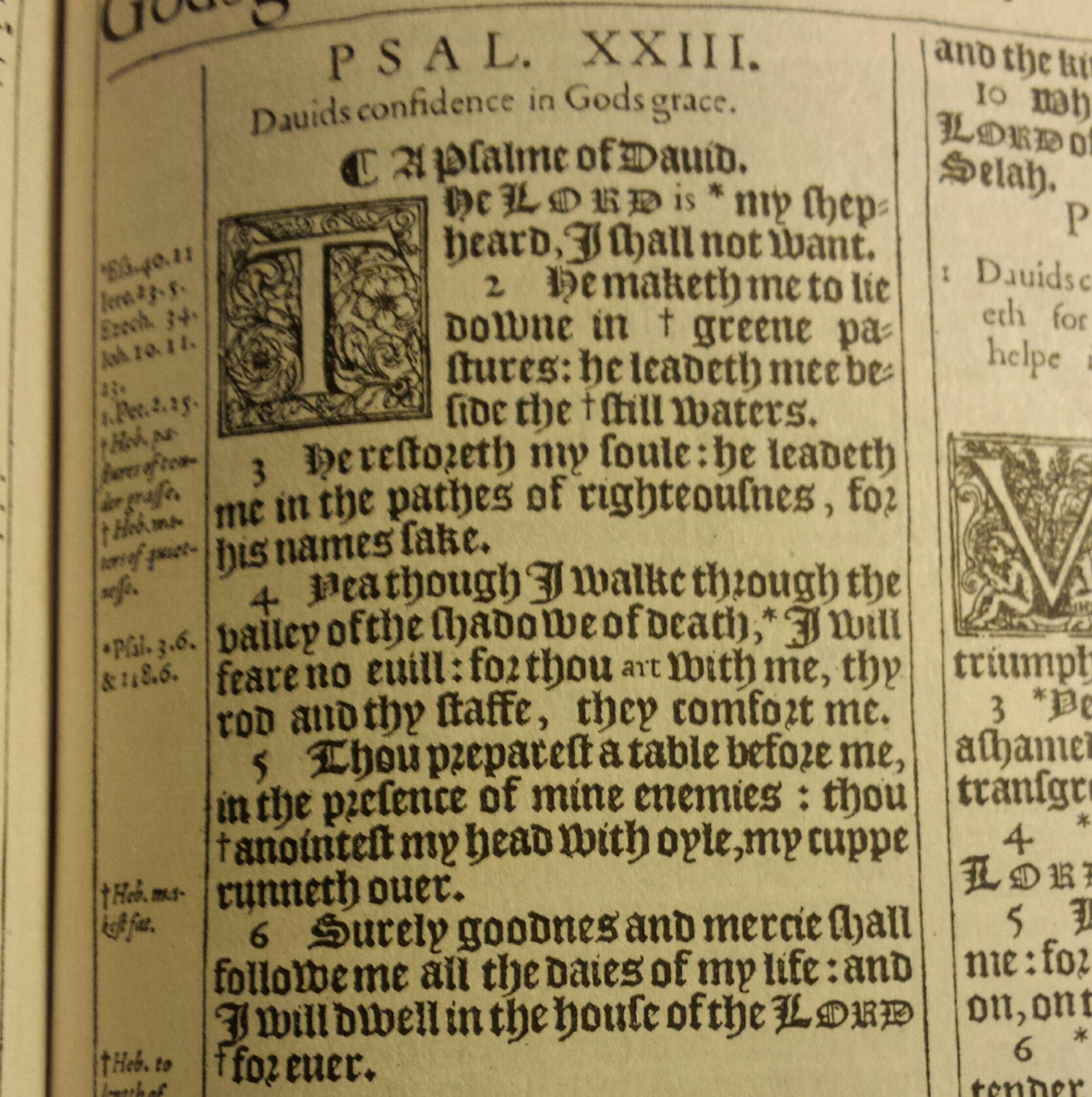
(Photo: Psalm 23 in the original 1611 edition of the King James Version.)
Copyright by Bob Rogers.
I love the King James Version (KJV) of the Bible. It is written in beautiful, literary English. Psalm 23 and many other familiar passages resonate in the KJV. However, I usually do not use the KJV when I preach and teach. Why is that? There are two main reasons.
- The English language has changed over the centuries. Many words that were clear when the KJV was written, are now confusing or offensive to the modern reader, simply because modern English is a different dialect. For example, the KJV uses the word “unicorn” nine times (Numbers 23:22; 24:8; Deuteronomy 33:17; Job 39:9-10; Psalms 22:21; 29:6; 92:10; Isaiah 34:7). Skeptics have made fun of the Bible because of this; however, hundreds of years ago “unicorn” used to mean an animal with one horn, like a rhinoceros. Over time, the word came to refer to a mythical animal, so modern translations use other terms, such as “wild ox.” Exodus 28:40 says to make “girdles and bonnets” for the priests (referring to sashes and headbands), 2 Kings 18:27 refers to men who “drink their own piss;” James 2:3 refers to “gay clothing” (referring to fine clothes), 2 Corinthians 6:12 says, “ye are straitened in your bowels (referring to holding back affection), and Philippians 3:20 says “our conversation is in heaven” because “conversation” meant way of life in Middle English, but today the word means speech, and thus would be completely misunderstood. I could go on and on, but you get the idea.
- The KJV is not based on the best ancient manuscripts. The Old Testament was written in Hebrew and Aramaic, and the New Testament was written in Greek. Bible scholars determined the wording of the original manuscripts by collecting and comparing thousands of ancient manuscripts. However, the oldest and most reliable manuscripts, such as the Dead Sea Scrolls of the Old Testament, were discovered and studied long after the King James Version was translated in 1611. Thus, it is ironic but true that newer translations use older and more dependable manuscripts as the basis for their translation. For example, the KJV includes the longer ending to the Gospel of Mark, which says that believers “shall speak with new tongues; they shall take up serpents…” (Mark 16:17-18, KJV). These verses have been quoted by snake-handling sects, yet the earliest manuscripts of the Gospel of Mark end with Mark 16:8! Another example is 1 John 5:7-8 (a passage mentioning the Trinity), which includes additional words in verse 7, as well as all of verse 8, that are absent from every known Greek manuscript except four manuscripts written in Greek during Middle Ages. It is apparent that a scribe added these words to testify to the Trinity. There are other scriptures that attest to the Trinity, but this is not one of them. (Those KJV Only people who argue that “liberals have taken verses out of the Bible” are ignoring the fact that the chapter and verse number system was added to the text hundreds of years after the original writings, for our convenience in referencing passages.)
All of this begs the question, if not the KJV, what translation should one use? To answer that, I refer you to a previous post I wrote, What Bible translation should I use?
Guest blog post: “Dead… and yet I see”

Article copyright by Brian A. Williamson
(Brian A. Williamson is a hospital chaplain and former pastor in Mississippi. He shares the following reflection on a funeral and on a hospital visit he made with a dying patient, which I found thought-provoking. He follows the reflection with a poem. Feel free to share your comments below.)
I recently attended the funeral of my dear friend Jack’s beloved wife of more than 30 years—Paula. Paula, too, was a close friend of mine, but not like Jack. I’ve told people many times about Jack’s faithful service as a devoted deacon of the first church I served as pastor. Being with Jack in this setting was different… Many times before Jack and I sat with others in a funeral setting, but usually he was the one walking around and ministering to others in the room. He was clearly uncomfortable on this occasion with all the attention he was receiving by those coming to pay their respects and offer condolences—a mark of an incredibly humble man. On this day, I saw no tears fall from his eyes while I marveled at his faith—he clearly knew that his wife’s final hope was realized.
Paula’s casket was beautiful; the drape of orchids, hydrangea, and white with light blue roses was the prettiest I’d ever seen on a casket. The colors of the flowers provided the eyes with a visual symphony in perfect pitch…and all of this matched the colors of the sanctuary of that little country church beautifully; and I thought, “Paula would smile if she could see all of this…” And then it hit me—I wonder, “what if she can?” I looked to and fro amongst all us mourners and supporters, contemplating this thought with a different curiosity than ever before. I thought, she’d cry at her own funeral—there were people everywhere sitting with this family, to support them and mourn with them over the loss of “the Queen of Banana Pudding” as she is known in the church. Paula isn’t used to this much attention, and I imagine she’d be uncomfortable with all this, too. Hmmm… I wonder, “What do dead people see?”
Flashback—I visited a terminal cancer patient in the hospital months ago who told me her only prayer request since being given a terminal diagnosis was to ask God to let her live long enough to see her first grandchild being born. Tearfully, she acknowledged the looming reality that she was dying faster than her daughter’s pregnancy was progressing. Several family members sat somberly with this woman as she lamented her death and God’s flat denial of her request. “Why would God take this from me?” she asked, seeming to genuinely hope that I had a great answer… But, I didn’t. Then she asked, “Do you think God will let me see my granddaughter’s birth even though I’m dead?”
I’d never considered a question the likes of this one before. Is it answerable? I pondered what it might be like once dead; is there Scripture to support such a notion? As I pondered the question further, her family began to offer her spiritual condolences… “Everything’s gonna be ok, why you won’t even care about us…things will be so beautiful in heaven that you won’t even think about us” said one man in a wheelchair. Another chimed in, “That’s right—you’ll just be worshipping the Lord, and you’ll be so consumed by his majesty that you’ll forget about us altogether…” Still another, “When you get to heaven, your sense of time will be like a warp or something; you won’t even think of being in a different place cause when you blink, we’ll all be there with you.” (Really? I thought…you gotta be kiddin’ me!) I thought more about the woman’s question…it was simple…yes or no…no other explanation needed.
“YES” I said; and the room fell quiet instantly, as if someone had thrown open the hatch in space and the vacuum sucked all the wind and words out of the room. My eyes were locked into the dying woman’s eyes as I had come to this conclusion, communicating my sincere faith in my response. She locked her eyes on mine as seconds passed in slow motion—she was processing. She looked interested and hopeful, and I repeated, “Yes. I do think that God will allow you to see the birth of your granddaughter even though you are dead.”
The others in the room leaned back as if lightning was about to strike me as God “took me out” for such heresy. I continued with my thoughts out loud: “It seems to me that God understands the beauty of birth, for God created it; and, God knows the love you have for your daughter as well as your love for the unborn child. If God formed this life and longs for her to spring from her mother’s womb, and I believe that you believe it is so; then, I’m certain that his love for you would not deny you the joy of such an anticipated event that is overflowing with hope and love from you. Because of his love, I believe he will allow you to see what He will see on that blessed day. Even though you will be dead, you will be alive by faith. You’re death won’t make you blind—you will still see. I don’t know how it will work, but I believe it will be so. You and your family will celebrate your granddaughter’s birth together—of this, I have no doubt.”
She held her breath for in silence; then, she believed and exhaled. It was as if the weight of the world had been lifted off the woman’s shoulders. Her mourning tears became happy tears, and the anticipation of the new birth again gave her hope. No one had ever considered the possibility that God had already granted this grieving woman’s prayer request because she continued to die; but, God had.
Though “in Adam” we all die; yet, “in Christ” we all live! In Christ we live and move [and hope] and have our being! In Christ, this woman will live to see the birth of her prized and much-anticipated grandchild! “Dead, and yet I see!” will be her anthem on that day. I can’t explain how it will work or what it will be like, I only know that is the truth.
Dead and yet I see
By: Chaplain Brian Williamson
I’m dead and yet I see, having crossed over to Promised Land,
‘Tis my home now, though it’s hard for you to understand.
Am I dead? Yes…and yet I see, for by my faith I’ve moved along,
Joyfully straining to be happy in life, while longing what lies beyond.
Now more than ever, by my hope in Christ, I see
That painful things in life make sense in eternity.
Dead, but now I see. I know you don’t understand,
But my life isn’t over, and I still see you from Glory Land.
God knew my love for you; and though we now live separately,
I’m closer than you think, beloved; for though I’m dead, yet I see.
Our God gives us hope through the promises contained in Scripture, and by faith in Him, I believe that he would never remove our love for others—if he did, He doesn’t understand.
Movie review: “Paul, Apostle of Christ”

The film Paul, Apostle of Christ, is unlike some recent Bible films that retell the story from scripture. This film creates a fictional story of the Gospel writer Luke (played by Jim Caviezel), who seeks out the apostle Paul (played by James Faulkner) in prison in Rome, to collect stories for the Acts of the Apostle.
All of the story of the film is set in Rome, with Luke going back and forth from visits to Paul in prison, to visits with the Christian community hiding in Rome, led by the Biblical personalities Aquila and Priscilla. Thus, it is a slow-moving plot. However, it uses these scenes to show the violent persecution of Christians by Emperor Nero, and for Paul to flash back to memories of his own persecution of Christians before coming to the faith. The Roman commander of the prison who has a sick daughter becomes involved in the fictional storyline, which serves to further illustrate the Christian faith and martyrdom of Paul.
While the plot moves slowly, this film is not so much about the plot as it is about the characters and what they experienced, and the characters are developed well, helping you feel the emotion and real struggles of trying to have faith in God in a dark and evil world. Faulkner is very convincing as Paul. Aquila and Priscilla also portray a Christian married couple who show respect and love for each other. The acting, costumes, scenery, music and cinematography are outstanding.
Although most of the film is fictional, it seeks to carefully follow what is known from the Bible. For example, the film shows Luke making sure a letter is delivered from Paul to Timothy, and quotes extensively from Paul’s Second Letter to Timothy. A study of the last part of that letter mentioned “Only Luke is with me” (2 Timothy 4:11) and sends greetings to Priscilla and Aquila (2 Timothy 4:19), whom the film depicts as escaping Rome to be with Timothy.
Especially powerful is how the film deals with Paul’s inner struggle with guilt over killing Christians, yet accepting Christ’s grace and forgiveness. This is beautifully resolved at the end of the movie in a particularly moving scene. The film should spark great discussions about what it is like to live out the faith in a non-Christian world.
The Gospel in the Old Testament
Copyright by Bob Rogers
Many Christians can share the Gospel of Christ with verses from the New Testament, but you can also share it using only the Old Testament. Christians commonly think they can only share the Good News of salvation by verses like the “Roman Road” (Romans 3:23, 6:23, 5:8 and 10:9) or other collections of scriptures from the New Testament. However, the Gospel message is to the Bible like the spokes on a wheel, all revolving around that central truth. So below is a collection of the truths of the Gospel, just from the Old Testament:
All have sinned:
1 Kings 8:46a: “There is no one who does not sin…”
Sin separates us from God:
Isaiah 59:2: “Your iniquities are separating you from your God, and your sins have hidden his face from you…”
We cannot earn our own salvation:
Psalm 49:7: “Truly no man can ransom another, or give to God the price of his life, for the ransom of their life is costly and can never suffice.”
Christ died for our sins:
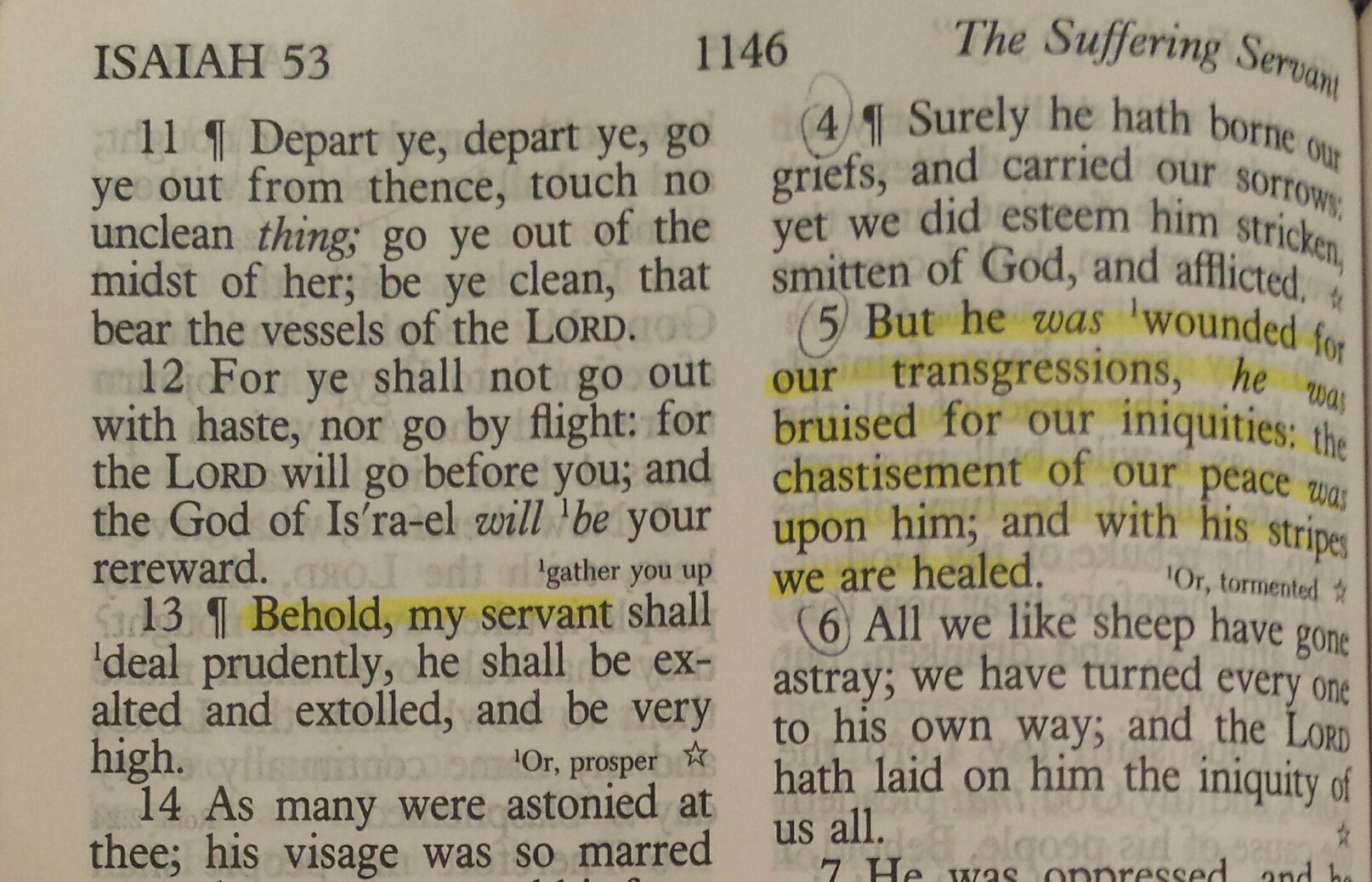
Isaiah 53:5, speaking of the Messiah: “But He was pierced because of our rebellion, crushed because of our iniquities; punishment for our peace was on Him, and we are healed by His wounds.”
“In a single day” (on the cross) God took away guilt of sin:
Zechariah 3:3-4, 8-9 speaks of Joshua the high priest, who represents the people: “Now Joshua was dressed with filthy clothes as he stood before the angel. So the angel of the Lord spoke to those standing before him, ‘Take off his filthy clothes!’ Then he said to him, ‘See, I have removed your iniquity from you…
Listen, High Priest Joshua… I am about to bring my servant, the Branch… and I will take away the iniquity of this land in a single day.”
What “single day” could possibly fulfill this verse than Good Friday, the day Jesus died on the cross to take away sin?
Repent, confess sin, and be forgiven:
Psalm 32:5: “I said, ‘I will confess my transgressions to the Lord,’ and You took away the guilt of my sin.”
Hosea 14:2: “Take words of repentance with you and return to the Lord. Say to Him, “Forgive all our sin…”
Will the Jews Be Saved?

Article copyright by Bob Rogers
There are more Jews in the United States than live in Israel, and more Jews in New York City than Jerusalem. Thus many American Christians have Jewish friends, and wonder about their eternal destiny. Many people believe that Jews will be saved just because they are God’s chosen people, but a study of Romans almost seems to say the opposite.
In Romans 9:6, the apostle Paul said, “For not all who are descended from Israel are Israel.” He said in 9:30-31 that the Gentiles had obtained a righteousness by faith, but Israel pursued a righteousness by the law and failed to obtain it.
In Romans 10, Paul said that the Jews had heard and understood, but failed to believe.
So he comes to Romans 11:1, and asks, “Did God reject his people?” His answer in verse 2: “God did not reject his people, whom he foreknew.” So what does God say will happen to the Jews? Will the Jews be saved?
In Romans 11, Paul answers this question in the present, and in the future.
1. At the present time, only a few Jews are saved (Rom. 11:1-24)
In the first part of the chapter, Paul discusses the situation of the Jews during his time, a situation that we still observe today. The key statement is in verse 5: “at the present time there is a remnant chosen by grace.” They are saved by grace, not race.
Paul himself was a Jew. He stresses this in verse 1, saying, “I am an Israelite myself, a descendant of Abraham, from the tribe of Benjamin.” Paul reminds his readers that there are still Jews like himself who follow Jesus, and that is true to this day, although they are a small percentage of the Jewish population (by some estimates, about 100,000 Jewish people are “Messianic Jews” who follow Jesus as their Messiah.)
Paul senses a danger here, and he issues two warnings to his Gentile readers. He says in verse 13, “I am talking to you Gentiles.” Then he proceeds to use an analogy of an olive tree to explain the relationship between Jews and Gentiles in the story of salvation. This is an appropriate illustration, because an olive tree was often used in scripture as a symbol for Israel. Paul says that the olive tree has some branches broken off, which represents the fact that many Jews have rejected the gospel, and then he says in verse 17, “and you, though a wild olive shoot, have been grafted in among the others…”
Thus we who are Gentiles have no right to be proud. It is only by God’s grace that He has grafted us in to be part of His people. This should remind us that there is no place in the church for anti-Semitism. Throughout the years, people have persecuted Jews, forcing them to move out of their homes, calling them “Christ-killers.” While few of us would do such a hateful thing, how many Americans make jokes about Jewish people being stingy with their money? How dare we say such things about God’s chosen people?
2. In the future, the Jewish people will be saved (Rom. 11:25-32)
So will the Jews be saved? Paul finally brings this question to a climactic answer in verses 25-26. Paul says, “I do not want you to be ignorant of this mystery, brothers, so that you may not be conceited: Israel has experienced a hardening in part until the full number of the Gentiles has come in. And so all Israel will be saved…”
Matthew 24:14 says the gospel must be proclaimed to all nations, and then the end will come. Apparently this verse is referring to the same matter, that God knows how many Gentiles are going to receive Him as Savior, and when that critical mass is reached, a revival will break out among the Jews, as they turn to faith in Christ. In this way, God will fulfill His promises and covenant with Israel. This is confirmed in Revelation 7:4-8, which names the tribes of Israel before the throne of God in heaven.
Over and over again in the Old Testament, God promised that he would not reject the Jewish people. The prophet Samuel said in 1 Samuel 12:22, “For the sake of His great name, the Lord will not reject His people…”
So the answer to our question is yes! In the end times, the Jews will turn to faith in Jesus, and be saved!
The miracle of the Jews
Frederick the Great, king of Prussia from 1740 to 1786, asked for proof that the Bible is true, in a discussion with his court chaplain. Frederick had been influenced by the atheistic French philosopher Voltaire. The king said, “If your Bible is really true, it ought to be easy to prove. So often, when I ask for proof of the Bible, people give me a large book that I have neither the time nor desire to read. If your Bible is really from God, you should be able to demonstrate it simply. Give me proof for the inspiration of the bible in a word.”
“Your Majesty, I can give you the proof you ask for in one word,” replied the chaplain.
Amazed, the king asked, “What is this magic word?”
“Israel,” replied the chaplain. Frederick the Great responded only with silence.
When you think about the history of the people of Israel, it is a miracle of God that they still exist. The descendants of Jacob, or Israel, went down to live in Egypt, and were made into slaves there. But God brought them out of slavery and settled them in the Promised Land. They were conquered again and again, but each time God delivered them from their invaders. Finally, the empire of Assyria destroyed the northern part of Israel, and deported the lost tribes of Israel to other lands, and the empire of Babylon destroyed the southern part of Israel, burned down Jerusalem and the temple, and deported the Jews to Babylon. But after the exile, once again God brought the Jews back to the land. The Greeks tried to exterminate Jewish faith and culture, sacrificing a pig on the altar in the temple, and trying to force the Jews to only speak Greek and adopt Greek culture, but the Jews fought a war for independence under the Maccabees, and restored their land and cleansed the temple. A few years after Jesus’ death and resurrection, the Jews fought a war with Rome in A.D. 70. Again the temple and Jerusalem was destroyed, millions of Jews died, and millions of Jews scattered all over the world. Despite all this, for centuries they maintained their language, faith and culture. They continued to be hounded out of nations, called “Christ-killers,” and persecuted wherever they lived. Then the communists tried to expel them from Russia, and Nazi Germany murdered six million of them in the holocaust. Did that eliminate the Jews? No! Instead, in 1948, the United Nations established Israel as a nation again. Surrounded by millions of Arabs who hate the Jews, Israel has had to fight war after war with their Arab neighbors, but Israel has won each war. In 1967, Israel fought a war simultaneously against Egypt, Jordan and Syria, and defeated them all in just six days, taking the Sinai peninsula from Egypt, the west bank from Jordan, and the Golan Heights from Syria. Today over 5 million Jews live in Israel, along with about 2 million Arabs, and every year more and more Jews are returning to their homeland.
The only explanation for all these events is the grace of God. Or, as Romans 11:29 says, “For God’s gifts and his call are irrevocable.”
This same God who has an amazing plan for his Chosen People has a plan for you. We who are Gentiles are only wild shoots, but God in His grace calls us, as well, to be grafted in to His spiritual tree. You can only come in by faith. One day the full number of Gentiles will come in, and it will be too late for us. As more and more Jews are beginning to turn to Christ, and more unreached people groups are reached, we do not know how long that will be, but one day it will be too late for us. How about you? Will you come to Him by faith while the door remains open?
Five truths about predestination. Truth #5: It’s not God’s will that any perish.

Article copyright by Bob Rogers, Th.D.
(This is the final post in a series on predestination.)
The previous four posts have examined the Bible’s teaching on predestination, like shining a bright light to look closely under a microscope. But this final post is more like turning on all of the lights in the room, as we view the big picture of the overall teaching of scripture. The fifth truth is that it is not God’s will for people to perish.
Ezekiel 33:11 (ESV) says, “Say to them, As I live, declares the Lord GOD, I have no pleasure in the death of the wicked, but that the wicked turn from his way and live; turn back from your evil ways, for why will you die, O house of Israel?”
John 3:17 (ESV) says, “For God did not send his Son into the world to condemn the world, but in order that the world might be saved through him.”
First Timothy 2:3-4 (ESV) says, “This is good, and it is pleasing in the sight of God our Savior, who desires all people to be saved and to come to the knowledge of the truth.”
Second Peter 3:9 (ESV) says, “The Lord is not slow to fulfil his promise as some count slowness, but is patient toward you, not wishing that any should perish, but that all should reach repentance.”
Thus we read repeatedly in scripture that it is not God’s will that anybody perish; rather, God’s will is for all people to repent of sin and be saved by faith in Jesus Christ. God in his foreknowledge is aware that many people will reject the offer of salvation, and they will perish, but that is not God’s will for any individual. As Luke 7:30 (ESV) says, “the Pharisees and the lawyers rejected the purpose of God for themselves…”
Yes, the Bible speaks of those who believe in Jesus Christ as “the elect,” and “predestined.” Jesus could even speak of those who would believe as “my sheep” and those who do not believe as “not my sheep.” Since God already knows they will choose to believe, God can say that he chose them. However, we are not God– you and I do not know who will believe, and we do not know who will be among Jesus’ sheep. All we know is that God wants all people to be saved, and that Jesus invited, “If anyone enters by me, he will be saved… (John 10:9, ESV). Hence, we must accept predestination as a mystery of God’s knowledge and will, and we must share the gospel with urgency. As the apostle Paul wrote, “Therefore, knowing the fear of the Lord, we persuade others” (2 Corinthians 5:11, ESV).


 Bob Rogers