Blog Archives
Top Ten Verses Avoided by Prosperity Preachers

Copyright by Bob Rogers.
Prosperity gospel preachers say that God “just wants you to be happy.” They say, “name it, and claim it.” They promise that if you will plant a “seed” of faith by sending them money, God will make you prosperous. They shout, “by His stripes I am healed,” as if Jesus died on the cross to cure your kidney rather than forgive your sin. They say all that and more, but here are the top ten Bible verses you will not hear a prosperity gospel preacher quote. They avoid these like the plague:
10. I left Trophimus sick at Miletus. – 2 Timothy 4:20b
9. Therefore, so that I would not exalt myself, a thorn in the flesh was given to me, a messenger of Satan to torment me so I would not exalt myself. Concerning this, I pleaded with the Lord three times to take it away from me. But He said to me, “My grace is sufficient for you, for power is perfected in weakness.” – 2 Corinthians 12:7-9
8. Dear friends, don’t be surprised when the fiery ordeal comes among you to test you as if something unusual were happening to you. – 1 Peter 4:12
7. Consider it a great joy, my brothers, whenever you experience various trials, knowing that the testing of your faith produces endurance.- James 1:2
6. My goal is to know Him and the power of His resurrection and the fellowship of His sufferings, being conformed to His death, – Philippians 3:10
5. “It is necessary to pass through many troubles on our way into the kingdom of God.” – Acts 14:22
4. Then He said to them all, “If anyone wants to come with Me, he must deny himself, take up his cross daily, and follow Me.” – Luke 9:23
3. “You will have suffering in this world. Be courageous! I have conquered the world.” – John 16:33b
2. In fact, all those who want to live a godly life in Christ Jesus will be persecuted. – 2 Timothy 3:12
1. “Go, sell all you have and give to the poor, and you will have treasure in heaven. Then come, follow Me.” – Mark 10:21
These ten verses aren’t used by prosperity preachers because it doesn’t fill the pews or their bank accounts. The king of Israel didn’t like this stuff, either. First Kings 22:8 says the king didn’t like the prophet Micaiah because he never prophesied prosperity for him. Of course, the problem is that prosperity preaching appeals to wrong motives. Jesus said, “Where your treasure is, your heart will be also” (Matthew 6:21). Let’s put our treasure in the eternal things of Christ, not the passing pleasures of this world, “where moth and rust destroy, and thieves break in and steal” (Matthew 6:19). When we do, we will have reward in heaven.
Book review: Is Theo of Golden a Christ-figure?

I just finished reading the wildly popular book, Theo of Golden, by Allen Levi. I’m amazed that a book this good is the first novel he has written.
Rich in character development, surprising in the ending plot, this book is a delightful masterpiece. I was drawn in, enchanted, and inspired. There is something for nearly everyone in this book, especially for those who enjoy beauty, art, relationships, and particularly for believers. This book does not preach to us, “be like Theo,” it simply paints a picture that inspires us to humbly be like Theo.
SPOILER ALERT: This next part may give away too much plot, but for discussion with others who have read it, here goes…
I see “Theo,” which comes from the Greek for “God,” as a Christ-figure. Although Levi paints him as (like Christ) fully human and (unlike Christ) with faults and sin in his past, I don’t think we have to take him as an allegory for Christ but as a symbolic reminder of Christ. He suddenly appears among us for a brief period of time, he humbly shows us the way to live, he blesses us and gives to those who will listen, and he dies sacrificially. After his death, people are changed. This point is stressed in the funeral sermon for Theo in which the priest compares the wonderment of the disciples after Jesus’ resurrection with the wonder of the people of Golden at having met Theo.
If you read the book, what do you think?
Book review: “Religious Freedom: A Conservative Primer,” by John D. Wilsey
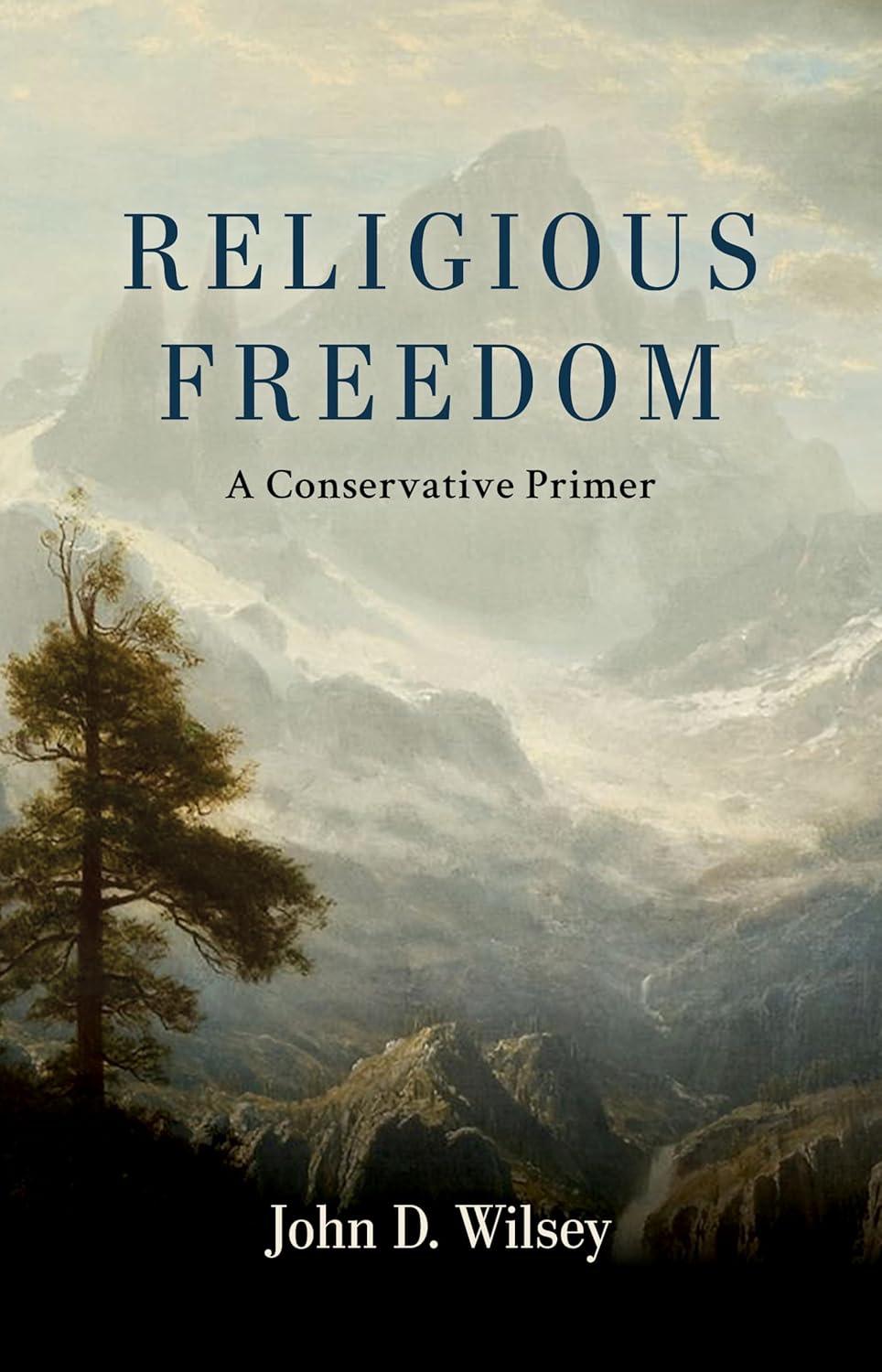
John D. Wilsey, chair of church history at Southern Baptist Theological Seminary, has written one of the most consequential books on religious freedom that I have read.
This is a rigorous philosophical defense of the importance of religious freedom in America as a mediating influence on liberty. Wilsey says that American liberty and equality are good things, but the sinful human nature will lead people to abuse the liberties of minorities, were it not for the moral influence of religion. He draws heavily from Alexis de Tocqueville’s insights in his classic book, Democracy in America.
Wilsey describes himself as an “aspirational conservative.” He defines an aspirational conservative as one who preserves traditions but is not a reactionary who defends all traditions simply for tradition’s sake. Rather, the aspirational conservative is willing to consider when traditions need adjustment and does so judiciously.
Despite the deep-thinking the book requires, Wilsey uses frequent illustrations and writes in a winsome, appealing style. I highly recommend it to anybody who cares about America’s political and religious future.
As If Heaven Had Ordained It

“Not one word of all the good promises that the Lord had made to the house of Israel had failed; all came to pass.” – Joshua 21:45
When the Continental Congress gathered in Philadelphia in 1774 to unite against the British, they decided to open their proceedings in scripture and prayer. An Episcopalian minister named Jacob Duché was chosen. Before his prayer, rumors arrived that the British had attacked Boston. A frightened and receptive audience awaited as Duché read Psalms 35:1: “Contend, O LORD, with those who contend with me; fight against those who fight against me!” It was the assigned reading for the day in the Episcopal lectionary, but John Adams says members of the Continental Congress were stunned when they heard the words. Adams wrote, “It seemed as if Heaven had ordained that psalm to be read on that morning.” Have you had such an experience where the scripture seemed perfect for what you were going through at the time? I have several such scriptures marked in my Bible. Once when I was anxious about a situation at work, I read Psalm 34:4, “I sought the LORD, and he answered me and delivered me from all my fears.” That verse gave me sudden comfort. Eventually, everything worked out. Another verse that has helped me when facing a difficult decision is the promise of James 1:5, “If any of you lacks wisdom, let him ask God, who gives generously to all without reproach, and it will be given him.” Praying over that promise, God has given me direction time after time. Once when I was a hospital chaplain, I visited a patient writhing in pain, asking me to pray. As I was about to pray, two nurses entered and gave her tablets to take for pain, then left the room. Immediately I began to pray, and I sensed God telling me to quote Psalm 23, so I did. Even before I finished the psalm, she grew peaceful and still. I finished quoting the psalm, added a few more words asking God for healing, and then I looked up. The patient was resting. Her sister-in-law looked at me, eyes wide in amazement. I said, “That pain medicine hasn’t had time to work, has it?” The sister-in-law said, “No, but Psalm 23 did!” What scripture has given you guidance, comfort, or strength “as if Heaven had ordained” it?
Prayer
Lord, my heart is full of anxieties and desires, but your word is full of good promises and timely guidance. As I read scripture, show me how it applies to my life as if Heaven had ordained it for this day.
Book review: “Crusaders” by Dan Jones

Dan Jones. Crusaders: The Epic History of the Wars for the Holy Lands. Viking, 2019.
I have read several books on the Crusades, but this is the best I’ve read so far. Dan Jones has written numerous books on the Europeans in the Middle Ages, so this is his area of expertise. His work is thoroughly researched, but he also writes in an engaging style, opening most chapters with vignettes about colorful personalities, and he peppers the book with fascinating quotes and interesting details.
The title Crusaders (instead of “Crusades”) is deliberate, because, as Jones explains in his preface, he focuses on the personalities like Richard the Lionheart, telling stories of the combatants (mostly Christian, but he also gives coverage to prominent Muslim warriors, including a chapter on Saladin). Yet he tells the story in chronological order, which helps the reader to follow the facts.
With so much blood and horrendous violence, Jones could easily depict the Crusaders as pure evil, but as a good historian he leaves it to the reader to make moral judgments, even reminding the reader at times that as bad as the violence was, it was normal for all sides at that time in history. He simply tells the facts and quotes the sources that describe the characters, whether evil or holy, or, as many were, a mixture of both. The book truly helps the reader understand the reasons why the Crusades happened as they did by helping the reader understand life in the Middle Ages. Until I read this book, I didn’t fully understand why the Fourth Crusaders plundered Constantinople instead of invading Muslim territory, but now I understand the economic motivations of the Venetians.
The old adages about history repeating itself and not learning lessons from history are evident in these stories. One example is the defeat of the Fifth Crusade on the Nile River because they didn’t consider the geography of when the Nile would flood and stop their advance. Another example was how Emperor Frederick II was able to gain more by negotiation than the previous Crusaders had gained by war, because he spoke Arabic and was able to gain their trust.
Jones explains that the Crusades included the “Reconquista,” the seven hundred years of battles for Spain to retake the Iberian Peninsula from the Muslims, which finally ended in 1492. Thus, instead of seeing the Crusades as a total failure, since the Crusaders were expelled from the Holy Land after the fall of Acre in 1291, he sees the battle for Spain as a success for the crusaders. He even cities numerous occasions when crusaders on their way to the Holy Land would stop off in Spain and help them win a battle, then sail on for Jerusalem. The author explains how, even as Europe lost interest in raising large international armies to fight Muslims in the Holy Land, the crusading spirit continued and degenerated into hunting down heretics in southern France, fighting pagan tribes in the Balkans, and even papal battles against Christian rulers who refused to submit to the pope.
I wish that Jones had explained more of the results of the Crusades. He does allude to how it gave power to the pope, and he ends the book by explaining the anti-Christian bitterness that remains among Muslims in the Middle East. He could have said more about how it affected Muslim treatment of Christian minorities in the Middle East, and how the contact opened doors of economic, cultural, and intellectual trade between East and West, even helping bring Arabic numerals and Aristotle’s philosophy to the West.
Sadly, Jones points out that the Crusades never fully ended, as Osama bin Laden referred to President George W. Bush as “the Chief Crusader… under the banner of the cross.” As ISIS leader Abu Bakr al-Baghdadi said, “the battle of Islam and its people against the crusaders and their followers is a long battle.”
Preaching to the spirits in prison. An interpretation of 1 Peter 3:18-20
Copyright by Bob Rogers, Th.D.

For Christ also suffered for sins once for all, the righteous for the unrighteous, that He might bring you to God, after being put to death in the fleshly realm but made alive in the spiritual realm. In that state He also went and made a proclamation to the spirits in prison who in the past were disobedient, when God patiently waited in the days of Noah while an ark was being prepared. – 1 Peter 3:18-20, HCSB
There are three facts about 1 Peter 3:18-20 which cannot be ignored:
- There was a story in a Jewish book called First Enoch about Enoch (Genesis 5:21-24) who made a journey to the supernatural beings who seduced human women (Genesis 6:1-4). This was at the time of Noah (Genesis 6:5-8). In First Enoch, Enoch is said to preach condemnation on these beings.
- First Enoch was well known in the first century, for Jude 9-10 and Jude 14 and 2 Peter 2:4-5 refer to stories which are in the older book of First Enoch, as does this passage.
- In Greek, verse 19 begins with three words which are transliterated in English letters: en o kai, which in Greek manuscripts would be run together: enokai. Compare that to the name Enoch.
What does all this mean? 1 Peter is well-known for clever arrangements of words. It seems that he is making a pun on the name Enoch in verse 19 because he is referring to a story about Enoch known to his readers.
First Peter 3:18 says that after Jesus died and was buried, he was “made alive in the spiritual realm.” Yet before His resurrection was physically displayed on Easter, He took care of some other-worldly business. He made a journey to the lower world of the dead (see Romans 10:7, Ephesians 4:9), where He “made a proclamation to the spirits in prison” (verse 19). The term “spirits” is never used to mean dead men, so it must refer to the fallen angels of Noah’s day, whom God had bound in prison (Jude 6, 1 Peter 2:4, Revelation 20:1-2, First Enoch 10).
Nowhere does Peter say that Jesus went to hell as punishment for our sins. The journey was to “Tartarus” (2 Peter 2:4, incorrectly translated “hell” in some translations). Tartarus was a Greek name for a place they believed all dead went, good and bad, like Hebrew word Sheol in the Old Testament. This journey was not forced upon Jesus; He went rather than suffer agony while in the grave.
Peter’s readers lived in a world where belief in evil spirits was universal. Some saw the Roman persecution coming, and they longed for protection from the evil spirits of the Romans which they feared might overcome the power of Christ. Peter comforted them with the news that Christ had defeated the most horrible of all spirits, the greatly feared fallen spirits of Noah’s day. In folklore, these spirits were considered to be the most wicked of all spirits.
First Peter 3:19 says Christ made proclamation to these spirits. This does not mean He was giving those who died before the time of His crucifixion a chance to believe the gospel, for he was speaking to spirits, not men. It does not even mean he was presenting the gospel to the spirits, for this Greek word can be used simply to “declare” or “proclaim” (the translation used in many versions, see also Revelation 5:2) with no implication of the gospel being presented. No, Jesus was announcing that He had defeated them! Thus, in verse 22, Peter says He ascended to heaven “with angels, authorities, and powers subject to Him.”
This proclamation of victory over the fallen angels was reassurance to Peter’s readers that they shouldn’t fear evil powers around them, for Christ is more powerful.
A second interpretation of 1 Peter 3:18-20 is worth considering. This view says that Jesus did not descend at all, but that in the same spirit of Jesus which has always existed, He had preached to the evil men of Noah’s day and given them a chance to repent. This takes verse 19 to refer to “in the spiritual realm” in verse 18.
This view appears to answer some questions people have, because it claims that the people living before the time of Jesus’ crucifixion had the same opportunity to repent as we do, for the spirit of Christ has always been around to give them the message, whether it be seen in Noah or Moses or a prophet.
This view is correct in noting that verse 19 simply says, “He went,” not “He descended.” It is also less complicated than the other view.
However, this second explanation seems to take things out of order. In verse 18, Peter refers to the cross, and in verse 22, he refers to the ascension. Verses 19-20 should refer to something in between, not to Jesus’ spirit back in the days of Noah.
Whatever interpretation we+9 follow, we would do well to remember to present it in “gentleness and respect” (1 Peter 3:15).
Further reading: Ernest Best, 1 Peter in the New Century Bible Commentary Series (Grand Rapids, MI: Eerdmans, 1971), 135-146.
E.G. Selwyn, The First Epistle of St. Peter, 2nd ed. (Grand Rapids, MI: Baker Book House, 1946), 197-202.
Ray Summers, “1 Peter” in volume 12 of The Broadman Bible Commentary (Nashville: Broadman Press, 1972), 163-164.
A Prayer for Christmas Worship

Copyright by Bob Rogers.
“A voice was heard in Ramah, weeping and loud wailing, Rachel weeping for her children, and she did not want to be comforted, because they were gone.” – Matthew 2:19
O sweet little Jesus boy,
Mary magnified the Lord at your birth,
Yet Rachel was heard weeping, refusing all comfort.
Wise men lavished you with gold,
And sweaty shepherds came to gawk.
Today we are a mix of joy and sorrow, health and sickness, knowledge and ignorance.
Yet we are here before You.
We are worshipers, we are hypocrites, we are strugglers, we are doubters,
Yet we are here before You.
Take our golden goodness, gawking greediness, magnificent joy, and mournful sadness.
and mold our mess to be like You, for you are the God of Mary and Rachel.
In the name of Jesus our Messiah and Lord we pray. Amen.

Prayer to hear God’s whisper

Copyright by Bob Rogers.
Almighty God, I have no trouble hearing You speak in the fire, the storm, and the earthquake, but sometimes I miss Your still, small voice. Gently nudge me by Your Spirit to step out of my cave of self-focus and hear Your quiet voice. Help me to draw so close to You, that I can hear Your whisper and I can even feel the warmth of Your breath. In the Name of the Word made flesh I pray. Amen.
Psalm 23 in rhyme

Copyright by Robert C. Rogers.
My shepherd is the Lord,
There is nothing that I lack.
He leads me by river fords,
On green pastures I lay back.
He makes my life new
And leads me on right paths.
Dark valleys I get through
With His rod and His staff.
A table for me You prepare
Before those that I oppose.
Your pour oil upon my hair;
My cup fills up and overflows.
You follow me with goodness and grace
For the rest of my earthly days.
I will dwell in my Heavenly place
By Your city forever amazed.
Prayer to experience God’s presence

Copyright by Bob Rogers.
Almighty God, I come into Your presence… I am silent before You… I close my eyes; I am listening for You to speak… My mind is focused on You; surround me with Your providential hand… Seep into my soul; penetrate me with Your peace… I breathe in Your grace, and breathe out Your praise. In Your holy Name I pray. Amen.
Prayer in a national tragedy

Copyright by Bob Rogers.
Lord, our hearts are broken. The images of death scar our minds. The cries of pain pierce our ears. We are numb and speechless with the horror of evil. God, have mercy on our nation. Have mercy on our world. Help us to overcome evil with good, even as You did in Your cross and resurrection. In the Name of the One who took the nails for us. Amen.
Prayer for a servant attitude

Copyright by Bob Rogers.
Lord, forgive me when I make my encounters with others all about myself.
You said that You came not to be served, but to serve and give Your life a ransom for many (Mark 10:45). Teach me not to tell my story before listening to the stories of others. Teach me not to pray for myself until I have prayed for others. Teach me not to grab a gift for myself until I have handed a gift to others. May I never use other people for my ends, but rather, may I give away my life for their good. In Jesus’ Name. Amen.
A prayer for bad politicians

Copyright by Bob Rogers.
O God, I cry out to You for my nation. You told us to pray for kings and all those in authority, but how do I pray for bad politicians? The wicked restrict the righteous, and justice comes out perverted. God, do something new! Lord, You remove kings and establish kings; You even used an unbelieving King, Cyrus of Persia, to rescue Your people from exile. Knowing this, Lord, I ask that you either remove bad leaders from their positions, or work through bad leaders to do good. Lord, I will watch and pray for You to work through our nation. I will keep my eye on our leaders to pray for them, but I will keep my faith in You, for my hope is in You, not in politicians. Lord, I ask that You to give me wisdom to vote my values, that You give me courage to volunteer my time and that You give me generosity to donate my money to those who are overcoming evil with good. In the Name of the Righteous Judge. Amen.
Based on Ezekiel 9:8; 1 Timothy 2:1-2; Habakkuk 1:2, 5; Isaiah 44:28-45:1, Daniel 2:21; Habakkuk 2:1; Matthew 26:41; Romans 12:21.
For a Biblical study on this subject, see: https://bobrogers.me/2016/11/06/how-to-pray-for-corrupt-politicians/
A prayer to experience God’s presence

Copyright by Bob Rogers.
O God of the universe, I want to experience Your presence. You spoke to Moses in a burning bush, and spoke to Elijah in a still, small voice. You called Samuel from his bed during the night, and You called Paul in broad daylight on the road to Damascus. Teach me to look for You in things great and small, day and night. I want to hear from You when I read Your word, and when I hear a child share a simple truth. I want to see You in the lightning across the sky, and in the smile of a new friend. I want to feel You when I sing in the sanctuary and when I hug someone in pain. May I experience Your presence, and pass on that experience to those I meet this day. In the name of the One who walked on water, yet needed someone to wash his dirty feet, Jesus Christ my Lord.


 Bob Rogers