Category Archives: Bible teaching
New devotional through Psalms & Proverbs in a year
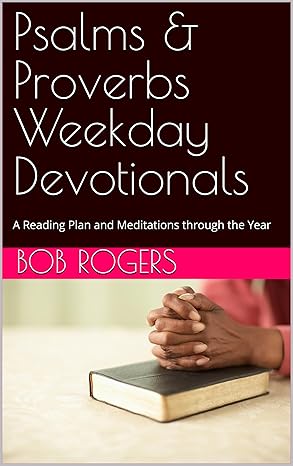
Psalms & Proverbs Weekday Devotionals is my new e-Book with a daily reading plan to read through Psalms and Proverbs weekdays, Monday through Friday, in a year, accompanied by short devotional thoughts to edify your reading. Readings are arranged by weeks and days, not tied to months of the year, so you may begin at any time of the year.
Here is a sample, showing the first reading:
Week 1, Day 1
Read Psalm 1
Psalms 1:1 literally says the one who is blessed does not “walk,” or “stand,” or “sit” with the wicked. There is a progression here of lingering longer and longer with evil. That’s usually how we fall into sin– gradually. I know I have fallen into sin that way. The solution is in verse 2: Meditate on God’s Word both day and night! I pray these daily psalms and proverbs will protect you from sin and guide you with wisdom.
Read Proverbs 1:1-6
Proverbs 1:5 says a wise man will listen and increase his learning. James 1:19 says, “Everyone must be quick to hear, slow to speak…” An excellent resolution is to become a better listener in the New Year.
The e-Book is 164 pages. Buy it for just $2.99 on Amazon here.
As If Heaven Had Ordained It

“Not one word of all the good promises that the Lord had made to the house of Israel had failed; all came to pass.” – Joshua 21:45
When the Continental Congress gathered in Philadelphia in 1774 to unite against the British, they decided to open their proceedings in scripture and prayer. An Episcopalian minister named Jacob Duché was chosen. Before his prayer, rumors arrived that the British had attacked Boston. A frightened and receptive audience awaited as Duché read Psalms 35:1: “Contend, O LORD, with those who contend with me; fight against those who fight against me!” It was the assigned reading for the day in the Episcopal lectionary, but John Adams says members of the Continental Congress were stunned when they heard the words. Adams wrote, “It seemed as if Heaven had ordained that psalm to be read on that morning.” Have you had such an experience where the scripture seemed perfect for what you were going through at the time? I have several such scriptures marked in my Bible. Once when I was anxious about a situation at work, I read Psalm 34:4, “I sought the LORD, and he answered me and delivered me from all my fears.” That verse gave me sudden comfort. Eventually, everything worked out. Another verse that has helped me when facing a difficult decision is the promise of James 1:5, “If any of you lacks wisdom, let him ask God, who gives generously to all without reproach, and it will be given him.” Praying over that promise, God has given me direction time after time. Once when I was a hospital chaplain, I visited a patient writhing in pain, asking me to pray. As I was about to pray, two nurses entered and gave her tablets to take for pain, then left the room. Immediately I began to pray, and I sensed God telling me to quote Psalm 23, so I did. Even before I finished the psalm, she grew peaceful and still. I finished quoting the psalm, added a few more words asking God for healing, and then I looked up. The patient was resting. Her sister-in-law looked at me, eyes wide in amazement. I said, “That pain medicine hasn’t had time to work, has it?” The sister-in-law said, “No, but Psalm 23 did!” What scripture has given you guidance, comfort, or strength “as if Heaven had ordained” it?
Prayer
Lord, my heart is full of anxieties and desires, but your word is full of good promises and timely guidance. As I read scripture, show me how it applies to my life as if Heaven had ordained it for this day.
A challenge to Calvinism: M.T. Martin and the controversy that rocked Mississippi Baptists in the 1890s
Copyright by Robert C. Rogers and the Mississippi Baptist Convention Board.
In 1893, a controversy began in the Mississippi Baptist Association and eventually spread across the state. Jesse Boyd wrote, “Its rise was gradual, its force cumulative, its aftermath bitter, and its resultant breach slow in healing.”1 While it may have been a quibble over words rather than a serious breach of Baptist doctrine, it illustrates how Mississippi Baptists clashed over Calvinist doctrine by the end of the 19th century.
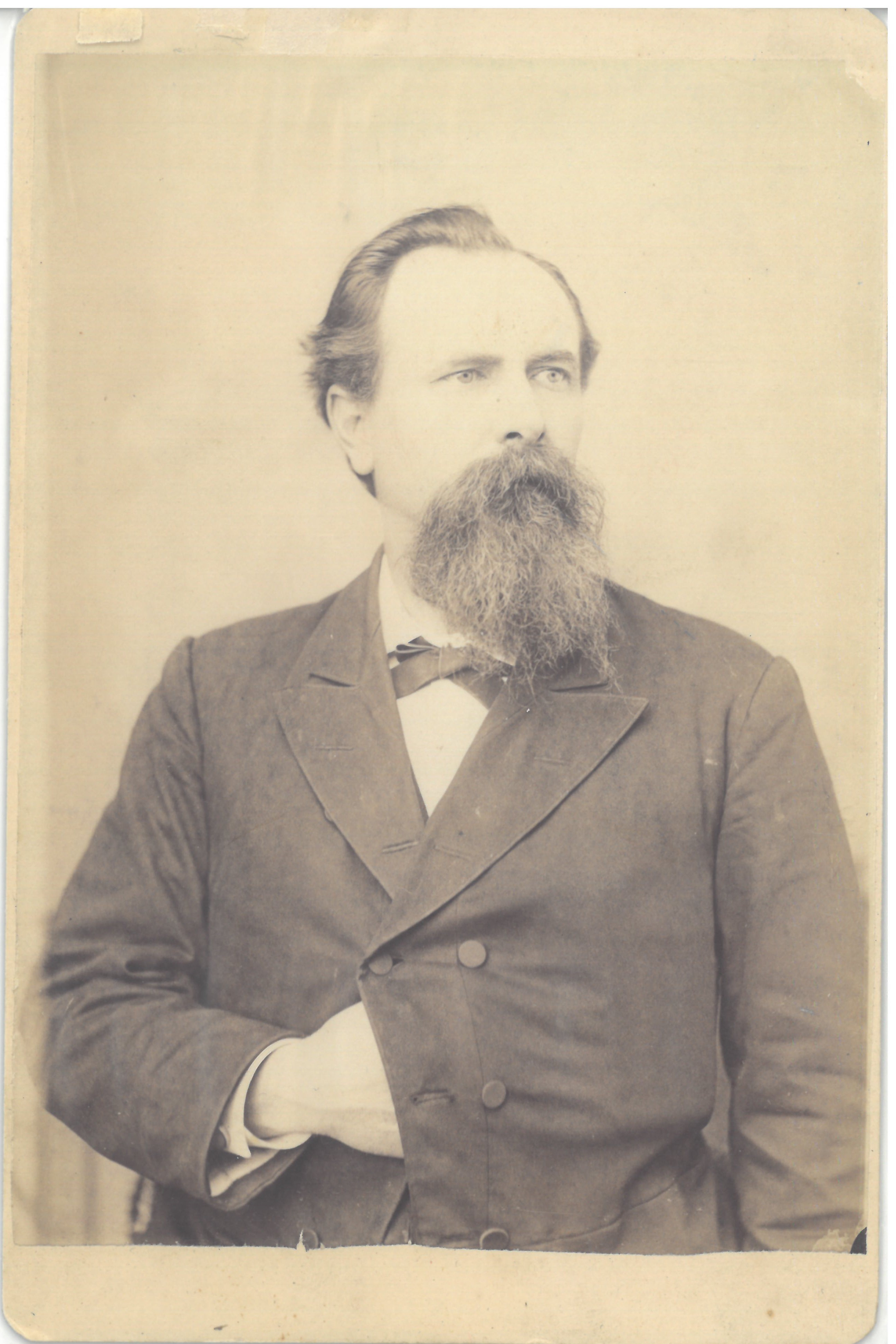
M. Thomas Martin was professor of mathematics at Mississippi College from 1871-80, and he also served as the business manager of The Baptist Record from 1877-81. He moved to Texas in 1883, where he had great success as an evangelist for nearly a decade, reporting some 4,000 professions of faith. However, his methods of evangelism drew critics in Texas. According to J.H. Lane, while Martin was still in Texas, “the church in Waco, Texas, of which Dr. B. H. Carroll is pastor, tried Bro. Martin some years ago, and found him way out of line, for which he was deposed from the ministry.” In 1892 Martin returned to Mississippi and became pastor of Galilee Baptist Church, Gloster (Amite). Martin preached the annual sermon at the Mississippi association in 1893. His sermon had such an effect on those present, that the clerk entered in the minutes, “Immediately after the sermon, forty persons came forward and said that they had peace with God, and full assurance for the first time.” The following year, Mississippi association reported on Martin’s mission work in reviving four churches, during which he baptized 19 people, and another 60 in his own pastorate. Soon Mississippi Baptists echoed the Texas critics that he was “way out of line,” not because he baptized so many, but because so many were “rebaptisms.”2
The crux of the controversy was Martin’s emphasis on “full assurance,” which often led people who had previously professed faith and been baptized, to question their salvation and seek baptism again. In 1895, the Mississippi association called Martin’s teachings “heresy” and censured Martin and Galilee for practicing rebaptism “to an unlimited extent, unwarranted by Scriptures.” When the association met again in 1896, resolutions were presented against Galilee for not taking action against their pastor, but other representatives said they had no authority to meddle in matters of local church autonomy. As a compromise, the association passed a resolution requesting that The Baptist Record publish articles by Martin explaining his views, alongside articles by the association opposing those views, “that our denomination may be… enabled to judge whether his teachings be orthodox or not.” The editor of The Baptist Record honored the request, and Martin’s views appeared in the paper the following year. The association enlisted R.A. Venable to write against him, but Venable declined to do so. Martin also published a pamphlet entitled The Doctrinal Views of M.T. Martin. When these two publications appeared, what had been little more than a dust devil of controversy in one association, developed into a hurricane encompassing the entire state.3
Most of Martin’s teachings on salvation were common among Baptists. Even his opponent, J.H. Lane, admitted, “Some of Bro. Martin’s doctrine is sound.” Martin taught that the Holy Spirit causes people to be aware that they are lost, and the Spirit enables people to repent and believe in Christ. He taught that people are saved by grace alone, through faith, rather than works, and when people are saved, they should be baptized as an act of Christian obedience. Martin said that salvation does not depend on one’s feelings, and that children of God have no reason to question their assurance of salvation.
These teachings were not controversial. What was controversial, however, was what Lane called “doctrine that is not Baptist,” and what T.C. Schilling said “is not in accord with Baptists.” Martin said if a man doubted his Christian experience, then he was never true a believer.
He considered such doubt to be evidence that one’s spiritual experience was not genuine, and the person needed to be baptized again. “If you have trusted the Lord Jesus Christ,” Martin would say, “you will be the first one to know it, and the last one to give it up.” He frequently said, “We do wrong to comfort those who doubt their salvation, because we seek to comfort those whom the Lord has not comforted.” Therefore, Martin called for people who questioned their salvation to receive baptism regardless of whether they had been baptized before. “I believe in real believer’s baptism, and I do not believe that one is a believer until he has discarded all self-righteousness, and has looked to Christ as his only hope forever… I believe that every case of re-baptism should stand on its own merits, and be left with the pastor and the church.”4
The 1897 session of the Mississippi association took further action against Martinism. They withdrew fellowship from Zion Hill Baptist Church (Amite) for endorsing Martin and urged Baptists not “to recognize him as a Baptist minister.” The association urged churches under the influence of Martinism to return to the “old faith of Baptists,” and if not, they would forfeit membership. When the state convention met in 1897, some wanted to leave the issue alone, but others forced it. The convention voted to appoint a committee to report “upon the subject of ‘Martinism.’” Following their report, the convention adopted a resolution of censure by a vote of 101-16, saying, “Resolved, That this Convention does not endorse, but condemns, the doctrinal views of Prof. M. T. Martin.” While a strong majority condemned Martinism, a significant minority of Baptists in the state disagreed. From 1895 to 1900, the Mississippi association declined from 31 to 22 churches, and from 3,042 to 2,208 members. In 1905, the state convention adopted a resolution expressing regret for the censure of Martin in 1897.5
Earl Kelly observed two interesting doctrinal facts that the controversy over Martinism revealed about Mississippi Baptists during this period: “First, the Augustinian conception of grace was held by the majority of Mississippi Baptists; and second, Arminianism was beginning to make serious inroads into the previously Calvinistic theology of these Baptists.” It is significant that Mississippi association referred to Martinism as a rejection of “the old faith of Baptists,” and that when J.R. Sample defended Martin, Lane pointed out that Sample was formerly a Methodist.6
(Dr. Rogers is the author of Mississippi Baptists: A History of Southern Baptists in the Magnolia State, to be published in 2025.)
SOURCES:
1 Jesse L. Boyd, A Popular History of the Baptists of Mississippi (Jackson: The Baptist Press, 1930), 178-179.
2 Boyd, 196-197; Minutes, Mississippi Baptist Association, 1893; 7; Z. T Leavell and T. J. Bailey, A Complete History of Mississippi Baptists from the Earliest Times, vol. 1 (Jackson: Mississippi Baptist Publishing Company, 1904), 68-69; The Baptist Record, May 6, 1897.
3 Minutes, Mississippi Baptist Association, 1895; 1896, 9.
4 Boyd, 179-180; The Baptist Record, March 18, 1897, May 6, 1897, June 24, 1897, 2.
5 Minutes, Mississippi Baptist Association, 1897, 6, 14; Minutes, Mississippi Baptist Convention, 1897, 13, 17, 18, 22, 31; 1905, 47-48; Leavell and Bailey, vol. 1, 70; Boyd, 198. Martin died of a heart attack while riding a train in Louisiana in 1898, and he was buried in Gloster.
6 Earnest Earl Kelly, “A History of the Mississippi Baptist Convention from Its Conception to 1900.” (Unpublished Doctoral Thesis, Southern Baptist Theological Seminary, Lousville, Kentucky, 1953), 114; The Baptist Record, May 6, 1897.
Preaching to the spirits in prison. An interpretation of 1 Peter 3:18-20
Copyright by Bob Rogers, Th.D.

For Christ also suffered for sins once for all, the righteous for the unrighteous, that He might bring you to God, after being put to death in the fleshly realm but made alive in the spiritual realm. In that state He also went and made a proclamation to the spirits in prison who in the past were disobedient, when God patiently waited in the days of Noah while an ark was being prepared. – 1 Peter 3:18-20, HCSB
There are three facts about 1 Peter 3:18-20 which cannot be ignored:
- There was a story in a Jewish book called First Enoch about Enoch (Genesis 5:21-24) who made a journey to the supernatural beings who seduced human women (Genesis 6:1-4). This was at the time of Noah (Genesis 6:5-8). In First Enoch, Enoch is said to preach condemnation on these beings.
- First Enoch was well known in the first century, for Jude 9-10 and Jude 14 and 2 Peter 2:4-5 refer to stories which are in the older book of First Enoch, as does this passage.
- In Greek, verse 19 begins with three words which are transliterated in English letters: en o kai, which in Greek manuscripts would be run together: enokai. Compare that to the name Enoch.
What does all this mean? 1 Peter is well-known for clever arrangements of words. It seems that he is making a pun on the name Enoch in verse 19 because he is referring to a story about Enoch known to his readers.
First Peter 3:18 says that after Jesus died and was buried, he was “made alive in the spiritual realm.” Yet before His resurrection was physically displayed on Easter, He took care of some other-worldly business. He made a journey to the lower world of the dead (see Romans 10:7, Ephesians 4:9), where He “made a proclamation to the spirits in prison” (verse 19). The term “spirits” is never used to mean dead men, so it must refer to the fallen angels of Noah’s day, whom God had bound in prison (Jude 6, 1 Peter 2:4, Revelation 20:1-2, First Enoch 10).
Nowhere does Peter say that Jesus went to hell as punishment for our sins. The journey was to “Tartarus” (2 Peter 2:4, incorrectly translated “hell” in some translations). Tartarus was a Greek name for a place they believed all dead went, good and bad, like Hebrew word Sheol in the Old Testament. This journey was not forced upon Jesus; He went rather than suffer agony while in the grave.
Peter’s readers lived in a world where belief in evil spirits was universal. Some saw the Roman persecution coming, and they longed for protection from the evil spirits of the Romans which they feared might overcome the power of Christ. Peter comforted them with the news that Christ had defeated the most horrible of all spirits, the greatly feared fallen spirits of Noah’s day. In folklore, these spirits were considered to be the most wicked of all spirits.
First Peter 3:19 says Christ made proclamation to these spirits. This does not mean He was giving those who died before the time of His crucifixion a chance to believe the gospel, for he was speaking to spirits, not men. It does not even mean he was presenting the gospel to the spirits, for this Greek word can be used simply to “declare” or “proclaim” (the translation used in many versions, see also Revelation 5:2) with no implication of the gospel being presented. No, Jesus was announcing that He had defeated them! Thus, in verse 22, Peter says He ascended to heaven “with angels, authorities, and powers subject to Him.”
This proclamation of victory over the fallen angels was reassurance to Peter’s readers that they shouldn’t fear evil powers around them, for Christ is more powerful.
A second interpretation of 1 Peter 3:18-20 is worth considering. This view says that Jesus did not descend at all, but that in the same spirit of Jesus which has always existed, He had preached to the evil men of Noah’s day and given them a chance to repent. This takes verse 19 to refer to “in the spiritual realm” in verse 18.
This view appears to answer some questions people have, because it claims that the people living before the time of Jesus’ crucifixion had the same opportunity to repent as we do, for the spirit of Christ has always been around to give them the message, whether it be seen in Noah or Moses or a prophet.
This view is correct in noting that verse 19 simply says, “He went,” not “He descended.” It is also less complicated than the other view.
However, this second explanation seems to take things out of order. In verse 18, Peter refers to the cross, and in verse 22, he refers to the ascension. Verses 19-20 should refer to something in between, not to Jesus’ spirit back in the days of Noah.
Whatever interpretation we+9 follow, we would do well to remember to present it in “gentleness and respect” (1 Peter 3:15).
Further reading: Ernest Best, 1 Peter in the New Century Bible Commentary Series (Grand Rapids, MI: Eerdmans, 1971), 135-146.
E.G. Selwyn, The First Epistle of St. Peter, 2nd ed. (Grand Rapids, MI: Baker Book House, 1946), 197-202.
Ray Summers, “1 Peter” in volume 12 of The Broadman Bible Commentary (Nashville: Broadman Press, 1972), 163-164.
Guest post: What happens to people who die having never heard about Jesus?
Copyright by Wayne VanHorn.

Dr. Wayne VanHorn is Dean at the School of Christian Studies and Arts at Mississippi College. This post was first shared on his Facebook page and is shared here with his permission.
I remember the first time someone asked me, “What happens to all those people who die having never heard about Jesus?” They did not think it was fair for them to go to hell because they happened to be born at the wrong time and place to be in the path of Christian witnesses. Admittedly, I was stumped. I had to do some Bible study and some serious thinking before I could let this question go. Over the years, a few things have happened or come to mind that help me answer the question more substantively.
1. I met a man from in-land China. He grew up in Communism whereas I grew up in Church. He was fed a steady diet of atheistic propaganda: no God, no Jesus, etc. while I was taken to church every time the door was open. One day my Chinese friend was listening to the radio. Poor atmospheric conditions in one part of the world some how enabled an evangelistic radio message to skip across the atmosphere; my Chinese friend heard about Jesus “accidentally.” With no Bible, no Church, no preacher, no missionary, or any other evangelic witness, my Chinese friend heard the Gospel, accepted Jesus, and devoted his life to telling his countrymen about the same Lord who is my Savior. I met “Peter” (we could not pronounce his Chinese name) at New Orleans Seminary. This encounter reminded me that just because I do not know how people in remote areas can hear the Gospel does not mean that they do not hear the Gospel.
2. I came across Titus 2:11, “For the grace of God has appeared, bringing salvation to all men” (NASB) or as the KJV reads, “For the grace of God that bringeth salvation hath appeared to all men.” Once again I realized God is at work in ways I might not know about, might not understand, might be oblivious to, etc.
3. As I studied the Bible, I learned more and more of a loving God, who has gone out of His way to make it possible for sinners to repent and to return to Him.
4. In his book, True for You But Not for Me, Paul Copan wrote, “Third, God’s loving and just character assures us that he won’t condemn anyone for being born at the wrong place and time.” (Copan, p. 189)
5. The Greek text of Titus 2:11, “Ἐπεφάνη γὰρ ἡ χάρις τοῦ θεοῦ σωτήριος πᾶσιν ἀνθρώποις” (Tit 2:11 NA27) utilizes the dative- locative-instrumental form of the adjective “all” and of the noun “men” or “people.” This means God’s salvation-bringing grace has appeared: a. to all people b. for all people. While I cannot fully understand just how God does that, it is not beyond HIS ability to do it.
6. Any impulse or concern I have regarding the un-evangelized is probably God prompting me to share His Gospel with others.
7. Jesus is the only way to salvation, to God, and to heaven, if not, Jesus died in vain. If any religion or any devotion or any sincerely held religious view will save people, Jesus’ did not need to endure the cross and despise the shame. BUT He did endure the cross and He did despise the shame for the joy set before Him (Heb. 12:2). So don’t worry about the un-evangelized, pray for them and witness to them whenever you get a chance. But whatever else you do, don’t let an atheist talk you out of your faith because he/she says it’s unfair that some people will go to hell because they did not get to hear about Jesus. Let me know what you think.
Nine principles of Biblical interpretation
Copyright by Bob Rogers, Th.D.

CONTEXT – How does this verse fit with the verses before and after, and the whole chapter?
LITERARY STYLE – What kind of writing is this? Is it poetry, history, a letter, law, prophecy, etc.?
GRAMMAR – What does the subject and verb of the sentence indicate is the writer’s main point? Note figures of speech, etc.
PARALLEL PASSAGES – The Bible is its own best interpreter, so compare what the rest of scripture says on the subject.
CLEAR MEANING – Clear passages should clarify obscure passages.
HISTORICAL BACKGROUND – When, where and why was this written? What was going on at the time in history? What was the writer saying to people in his day and time?
TRANSLATION – Compare translations, to discern the best English word or phrase.
SPIRITUAL DISCERNMENT – What has the Holy Spirit told you here, as you read and prayed over it?
CHURCH TRADITION – How have Christians around the world and throughout history interpreted this?
Psalm 23 in rhyme

Copyright by Robert C. Rogers.
My shepherd is the Lord,
There is nothing that I lack.
He leads me by river fords,
On green pastures I lay back.
He makes my life new
And leads me on right paths.
Dark valleys I get through
With His rod and His staff.
A table for me You prepare
Before those that I oppose.
Your pour oil upon my hair;
My cup fills up and overflows.
You follow me with goodness and grace
For the rest of my earthly days.
I will dwell in my Heavenly place
By Your city forever amazed.
The Lord’s Prayer, Revisited

Copyright by Bob Rogers.
After this manner therefore pray – Matthew 6:9, KJV. Jesus did not command us to pray the Lord’s Prayer literally, as He worded it. Rather, He said to pray “after this manner,” or “like this.” In other words, He gave it as a model prayer for us to pray in our own words. Inspired by that thought, I revisited the prayer to write my own prayer “after this manner,” seeking to express His words in my own words. Here is my attempt. May it nudge you to be fresh and sincere as you pray the Model Prayer.
God, You are our intimate Father
Yet You are the transcendent Holy One.
Since You are King in heaven,
May we submit to your Lordship on earth.
We need your physical gift of food,
We need your spiritual gift of forgiveness,
And we need your social gift of grace to forgive others.
Take us by the hand, and lead us away
Far from the devil, that we may not stray.
We crown You, we submit to You, we honor You forever.
Amen.
How Mississippi Baptists came to oppose alcohol in the early 1800s

Copyright by Robert C. Rogers and the Mississippi Baptist Convention Board.
Baptists have not always been as adamantly opposed to alcohol as they are today; rather, their view developed over several decades in the early 1800s. This can be illustrated in the story of how Mississippi Baptists gradually took a stronger stand against liquor during the decades from the 1820s through the 1850s. In 1820, Providence Baptist Church in what is now Forrest County discussed the question, “Is it lawful, according to scripture, for a member of a church to retail spiritous liquors?” The church could not agree on a position in regard to the matter. This attitude would begin to change in the 1820s, however. In 1826, the influential Congregationalist pastor Lyman Beecher began a series of sermons against the dangers of drunkenness and urged the necessity of abstinence from the alcohol. He called on Christians to sign pledges to abstain from alcohol, igniting the temperance movement in America. The question came before the Mississippi Baptist Association in 1827, and it was stated that it “considers drunkenness one of the most injurious and worst vices in the community.” In 1830, the Pearl River Baptist Association admonished any churches hosting their meetings, “provide no ardent spirits for the association when she may hereafter meet, as we do not want it.” In 1831, Pearl River Association thanked the host church for obeying their request, and in 1832, the association humbly prayed “the public, that they will not come up to our Association with their beer, Cider, Cakes, and Mellons, as they greatly disturb the congregation.” Likewise in 1832, Mississippi Association resolved, “That this Association do discountenance all traffic in spirituous liquors, beer, cider, or bread, within such a distance of our meetings as in any wise disturb our peace and worship; and we do, therefore, earnestly request all persons to refrain from the same.”1
It had always been common for Baptists to discipline members for drunkenness, but as the temperance movement grew in America, Mississippi Baptists moved gradually from a policy of tolerating mild use of alcohol, toward a policy of complete abstinence from alcohol. A Committee on Temperance made an enthusiastic report in 1838 of “the steady progress of the Temperance Reformation in different parts of Mississippi and Louisiana; prejudices and opposition are fasting melting away.” In 1839, D. B. Crawford gave a report to the Mississippi Baptist Convention on temperance which stated, “That notwithstanding, a few years since, the greater portion of our beloved and fast growing state, was under the influence of the habitual use of that liquid fire, which in its nature is so well calculated to ruin the fortunes, the lives and the souls of men, and spread devastation and ruin over the whole of our land; yet we rejoice to learn, that the cause of temperance is steadily advancing in the different parts of our State… We do therefore most earnestly and affectionately recommend to the members of our churches… to carry on and advance the great cause of temperance: 1. By abstaining entirely from the habitual use of all intoxicating liquors. 2. By using all the influence they may have, to unite others in this good work of advancing the noble enterprise contemplated by the friends of temperance.” Local churches consistently disciplined members for drunkenness, but they were slower to oppose the sale or use of alcohol. For example, in May 1844, “a query was proposed” at Providence Baptist Church in Forrest County on the issue of distributing alcohol. After discussion, the church took a vote on its opposition to “members of this church retailing or trafficking in Spirituous Liquors.” It is significant that in the handwritten church minutes, the clerk wrote that the motion “unanimously carried in opposition,” but then crossed out the word “unanimously.” In January 1845, Providence Church voted that “the voice of the church be taken to reconsider” the matter of liquor. The motion passed, but then tabled the issue, and did not come back up. In March of that year, a member acknowledged his “excessive use of arden[t] spirits” and his acknowledgement was accepted, and he was “exonerated.”2
. In 1846, the Mississippi Baptist Association’s leadership was opposed to alcohol, but was still attempting to prohibit the use of alcohol at its own meetings. The Association passed a resolution saying, “We respectfully request the brethren and friends who may entertain this body at its future meetings, to refrain from presenting ardent spirits in their accommodations.” By the 1850s, the State Convention was calling not only for abstinence, but for legal action, as well. In 1853, the Convention adopted the report of the “Temperance” Committee that said, “The time has arrived when the only true policy for the advocates of Temperance to pursue, is… to secure the enactment by the Legislature of a law, utterly prohibiting the sale of ardent spirits in any quantities whatsoever.” They endorsed the enactment of the “The Maine Liquor Law” in Mississippi. Two years before, in 1851, Maine had become the first State to pass a prohibition of alcohol. Thus during the antebellum period Mississippi Baptists gradually came to favor abstinence and prohibition of alcohol.3
SOURCES:
1 Aaron Menikoff, Politics and Piety: Baptist Social Reform in America, 1770-1860 (Eugene, OR: Pickwick Publications, 2014), 162-163; T.C. Schilling, Abstract History of the Mississippi Baptist Association for One Hundred Years From its Preliminary Organization in 1806 to the Centennial Session in 1906 (New Orleans, 1908), 50; Minutes, Pearl River Baptist Association, 1830, 1831, 1832.
2 Minutes, Mississippi Baptist Convention, 1838, 1839; Minutes, Providence Baptist Church, Forrest County, Mississippi, May 11, 1844, January 11, 1845, March 8, 1845.
3 T. M. Bond, A Republication of the Minutes of the Mississippi Baptist Association (New Orleans: Hinton & Co., 1849), 250; Minutes, Mississippi Baptist Convention, 1853, 26; “The Unintended Consequences of Prohibition: Introduction,” Washington State University, accessed online 17 April 2022 at http://digitalexhibits.wsulibs.wsu.edu/exhibits/show/prohibition-in-the-u-s/introduction.
Easter jazz

Copyright by Bob Rogers.
“Who will roll away the stone?” Mark 16:3
“Who will roll away the stone?” the women asked as they approached Jesus’ tomb. Their Savior had died, their hopes were gone, and their heads hang in despair as the question lingered in the air. Can you relate to that?
We have stones that need to be rolled away, too. Our way is blocked with giant stones with names like cancer and COVID-19, stones with names like debt and divorce, names like shame and sorrow, and the actual names of people like the crazy co-worker, the insane in-law, the nosy neighbor.
Like the women that first Easter Sunday morning, we too wonder, “Who will roll away the stone?”
In many ways, the message of Easter is like jazz music. Jazz music originated with African-American musicians in New Orleans around 1900, and it often expresses discordant notes of pain that are then resolved with the swing of sweet notes of joy.
Easter is like jazz music. The people loved Jesus for His compassion for the outcast, His inspiring teaching of love, and His healing of the sick. Imagine their despair when Jesus was arrested, flogged, spat upon, mocked with a purple robe and crown of thorns, beat upon the head, forced to carry His cross to Calvary, the Place of the Skull, and then the nails slammed through his hands and feet, and forced to hang there naked and suffering, No wonder Jesus cried, “My God, my God, why have You forsaken Me?” It’s bad enough when you and I feel forsaken by God, but here was the Son of God feeling forsaken by God! That despair was shared by Jesus’ disciples. The disciples were hiding out in a room, afraid for their future, fearing they would be next.
But that was on Friday. Very early on Sunday morning, everything changed. The stone was rolled away, an angel in white clothes had bright news, that although they came thinking they would see a dead corpse, instead they saw an empty tomb, because Jesus was crucified, but now He has risen! The One who had been nailed to a cross was now raised from the grave, the One who had been whipped was now being worshiped.
His story was also their story. The wondering women had their stone moved, the shamed Simon Peter discovered that his Savior was alive. Notice verse 7 says to tell the disciples “and Peter.” The frightened disciples became bold preachers of the gospel.
What a crazy change in three days! No wonder they were overwhelmed with emotion.
Verse 5 says they were “amazed” and “alarmed.” Verse 8 says “trembling” and “astonishment overwhelmed them” and that they were “afraid.”
That’s why I say Easter is like jazz— it moves from discord to resolution, from pain to joy, and it requires a certain mystery and faith. Somebody asked Louis Armstrong what jazz music was, and he said, “If you have to ask, you don’t know!”
But you can know the Easter jazz. You can believe in Jesus Christ. His story was their story and it can be your story and mine.
The apostle Paul put it this way in Ephesians 2:1, 4-6: “And you were dead in your trespasses and sins… But God, who is rich and mercy, because of His great love that He had for us, made us alive with Christ, even though you were dead in trespasses. You are saved by grace! He also raised us up with Him and seated us with Him in the heavens in Christ Jesus.”
Listen to 1 Corinthians 15:19-20, 51-52: “If we have put our hope in Christ for this life only, we should be pitied more than anyone. But as it is, Christ has been raised from the dead, the firstfruits of those who have fallen asleep… Listen, I am telling you a mystery: We will not all fall asleep, but we will all be changed, in a moment, in the twinkling of an eye, at the last trumpet. For the trumpet will sound, and the dead will be raised incorruptible, and we will be changed.”
Easter does not mean that we will no longer have problems. The music of our lives will continue to have bent notes and broken cords. But because of His resurrection, the discord will be resolved with the sweet sound of hope for all of us who believe.
What stones do you need to have rolled away? What hope do you need to hear? Shh! Listen closely. I think I hear Jesus playing jazz!
How to get ready for Easter

Copyright by Bob Rogers.
When I served as a Baptist pastor in Rincon, Georgia, I had the unique experience of putting on a white wig and an old robe borrowed from a Methodist, to give a dramatic presentation of the founding pastor of the oldest Lutheran Church in North America. The historic pastor’s name was Johann Boltzius, and his church was Jerusalem Lutheran Church, founded in 1734 in the Ebenezer Community in Effingham County, Georgia, some 30 miles north of Savannah.
School children came from all over Georgia to the retreat center at Ebenezer to learn Georgia history. They visited Savannah, and they also came to the old Jerusalem Lutheran Church, whose sanctuary was built in 1769, to hear me tell the story, in costume, of Boltzius who served a congregation that fled to the New World from Salzburg, Austria, in search of religious freedom.
After the presentation, students were given an opportunity to ask “Pastor Boltzius” questions. One day in March, a student asked me why it was so dark in the church. With a gleam in my eye, I explained that it was Lent, a season in which members of that church remembered Jesus’ death on the cross for our sins. Members of the church fasted, prayed, and thought of other ways to make sacrifices in memory of Jesus, and during this time, they kept the window shutters closed. In fact, on Good Friday, they came into the church and sang songs about Jesus’ death, and then blew out all of the candles and went home in total darkness. The students reflected on that quietly, and I paused. Then I waved my hand at the shutters and shouted, “But on Easter Sunday morning, they threw open the shutters, let the light in, and celebrated, because Jesus is alive!”
Whether or not your church observes the tradition of Lent, it is an important reminder of how any Christian can get ready for Easter, by first reflecting on the suffering of Christ. I encourage you to read the story of the crucifixion from the Gospels of Matthew, Mark, Luke and John. Spend time alone, silent, reflecting on it. Fast and pray. Think about your own sin, your own struggles, your own sorrows, and how the suffering of Christ forgives, redeems and renews you. Meditate on the dark, and the light will brighten you more when it comes. Like that church in Georgia that threw open their shutters, if we will remember how dark it was when Christ died, we will appreciate all the more how glorious it was that He arose!
How Christians can respond to rejection

Copyright by Bob Rogers.
Everybody has to deal with rejection. Even Jesus Christ was rejected by his hometown of Nazareth. They didn’t like it when He declared His Messianic mission would include Gentiles, so they tried to throw him off the local cliff (see Luke 4:23-29).
In one of the greatest face-to-face confrontations in history, Jesus faced their rejection and “passed right through the crowd and went on His way” (Luke 4:30). That’s how He handled it, how do we?
Let’s be clear about something. You and I are not Jesus, so we first need to examine our own actions and motives in the light of scripture, to make sure our rejection isn’t a deserved rebuke for ungodly behavior. Peter writes, that if we are ridiculed “for the name of Christ” we are blessed, yet cautions “let none of you sufer as a murderer, a thief, an evildoer, or a meddler” (1 Peter 4:15-16). Most of us would be okay if he hadn’t added “meddler.” So before anything else, let’s take an honest look at why we are rejected.
If, after taking an honest look at ourselves, we know that our rejection is because we have lived for Christ, and done so with integrity, then what? Scripture tells us three ways that Christians can face rejection: rejoice, remember and rely.
- Rejoice (Matthew 5:10-12). Jesus concluded the “Beatitudes” by telling His followers that when we are rejected, we should rejoice: “Blessed are those who are persecuted because of righteousness, for the kingdom of heaven is theirs. You are blessed when they insult you and persecute you and falsely say every kind of evil against you becaue of me. Be glad and rejoice, because your reward is great in heaven. For that is how they persecuted the prophets who were before you.” We naturally want to get angry, defensive, or feel hurt, but Jesus tells us we should rejoice, because it shows we are on the right side! The early apostles did exactly that! When the Jewish Sanhedrin ordered them not to preach about Jesus, they left, “rejoicing that they were counted worthy to be treated shamefully on behalf of the Name” (Acts 5:41).
- Remember (John 15:19-21). Jesus reminded His disciples, “If the world hates you, understand that it hated me before it hated you. If you were of the world, the world would love you as its own. However, because you are not of the world, because I have chosen you out of it, the world hates you. Remember the word I spoke to you: ‘A servant is not greater than his master.’ If they persecuted me, they will also persecute you.” So whenever we are rejected, we don’t need to be surprised; we should remember that we were told to expect that it comes with the territory.
- Rely (2 Corinthians 1:8-11). The Apostle Paul is a great role model for handling persecution. He explained how it taught him to rely on God: “We don’t want you to be unaware, brothers and sisters, of our affliction that took place in Asia. We were completely overwhelmed– beyond our strength– so that we even despaired of life itself. Indeed, we felt that we had received the sentence of death, so that we would not trust in ourselves but in God who raises the dead. He has delivered us from such a terrible death, and he will deliver us. We have put our hope in him that he will deliver us again.”
Tony Evans says that whenever somebody rejects him because of the color of his skin, he remembers who he is in Christ. God says he is a child of the king. Thus, if they reject him, they are refusing royal blood in their presence. What a good example for us when people reject us because of our faith. Remembering that, we can rely on God, and rejoice!
A Christmas poem for Isaiah 9:6
Copyright by Bob Rogers.

Next to the “Hallelujah Chorus,” one of the most familiar pieces from George Frederic Handel’s “Messiah,” is the song, “For Unto Us a Child Is Born.” The melody proclaims each of the titles of the Christ from Isaiah 9:6, like royal trumpet blasts for each phrase: “Wonderful! Counselor! The Mighty God! The Everlasting Father! The Prince of Peace!”
If we take time to reflect on what these joyous trumpet blasts of isaiah 9:6 mean, we can experience a musical interlude and transition to a gentle harp, reassuring our souls. I wrote it in poetic form, like this:
As Wonderful Counselor, Christ takes away our gloom.
As Mighty God, Christ takes away our doom.
As Everlasting Father, Christ adopts believers, all.
As Prince of Peace, Christ takes down the wall.
May these truths harmonize with your heart and bring you great comfort and joy this Christmas Day and every day.
How big is your Jesus?
Article copyright by Bob Rogers.
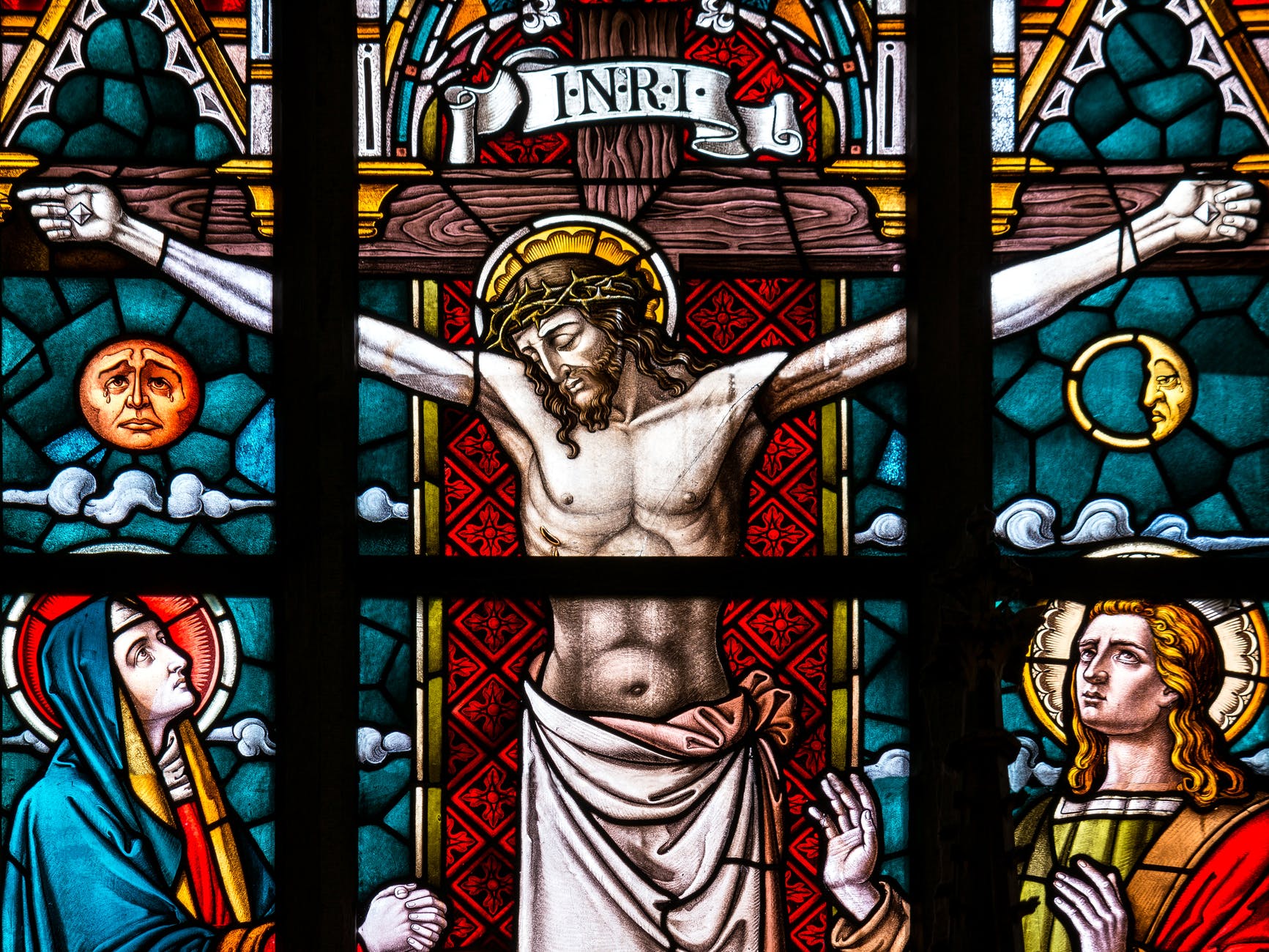
A lady told me that her granddaughter visited her church and saw the large stained glass window picture of Jesus. She said, “Granny, your church has a BIG Jesus!”
What a great statement! Does your church have a “big Jesus”? Are the sermons Christ-centered? Does your worship lift up His Name? Do the leaders prayerfully ask, “What would Jesus do?” before they do what they do?
Christian, what about your personal faith? Do you have a big Jesus? He’s not a little bitty idol that you put on the shelf and take out when you need a little favor. He’s not mini-god for minor problems. He is the Almighty God, Everlasting Father, Prince of Peace, Good Shepherd, Great Physician, the Alpha and the Omega.
The apostle Paul prayed that the church at Ephesus would have a big Jesus. Here is how he put it:
I also pray that you will understand the incredible greatness of God’s power for us who believe him. This is the same mighty power that raised Christ from the dead and seated him in the place of honor at God’s right hand in the heavenly realms. Now he is far above any ruler or authority or power or leader or anything else—not only in this world but also in the world to come. God has put all things under the authority of Christ and has made him head over all things for the benefit of the church. And the church is his body; it is made full and complete by Christ, who fills all things everywhere with himself. – Ephesians 1:19-23, NLT
Now that is a big Jesus! He is available to every church and every believer. How big is your Jesus?
David was the “comeback kid”
Article copyright by Bob Rogers.
In the Hebrew scriptures, Abraham may have been the father of faith, and Moses the giver of the law, but David was the “comeback kid.” Look at all the times David made a comeback:
David overcame his size (1 Samuel 16). He was the youngest son of Jesse, yet the prophet Samuel chose to anoint him as the next king.

David overcame his giant (1 Samuel 17). He faced down the giant Goliath when others fled, and won!
David overcame his defeat (1 Samuel 30). When the Amalekites raided his camp and kidnapped his wives, David’s men were ready to kill him. But David found strength in the Lord, and led his men to victory, recovering his family and all that had been taken from them.
David overcame his sin (1 Samuel 11-12). He abused his power to exploit the beautiful Bathsheba, then ordered her husband put on the front lines to die. Yet when confronted by the prophet Nathan for his adultery and murder, David confessed his sin, repented, and experienced the grace of God’s forgiveness.
David overcame his sorrow (1 Samuel 12). Despite his repentance, David suffered the consequences of his sin in the death of his infant child. Yet when he realized the child had died, David rose from his grief and worshiped his God.
David overcame a rebellion (1 Samuel 15-17). His own son Absalom led a revolt against the king, but David was able to win the battle and retake his throne.
David overcame his pride (1 Samuel 24). Proud of his mighty army, he took a census of his troops. This brought on the judgment of God, but again David humbled himself and was forgiven.
Are you despairing, distressed, defiled and defeated? Like David, find your strength in God. His grace can give you a comeback, too!


 Bob Rogers