Blog Archives
Praying over Christmas cards: A post-Christmas tradition

Copyright by Bob Rogers.
Many people enjoy displaying the Christmas cards that they receive during the holiday season, but what do they do with them after the New Year begins? Stick them in a drawer? Throw them away? Several years ago, my wife Mary and I adopted a simple tradition of praying over our Christmas cards in the New Year.
When we receive Christmas cards, we enjoy looking at them, and then put them in a basket. We place the basket on our dinner table, and sometime in early January, we begin to pray for the people who sent each card, one card at a time, one week at a time. Here’s how we do it: On Monday evening when we sit down to eat dinner, we draw a Christmas card from the basket and look to see who sent it. We share memories of that person or family, and needs they may have. Then as we say the blessing for our meal, we include that household in our prayers. We pray for them at each dinner that week. The next week, we draw the next card from the basket, praying for that family each day of that week. We continue the process throughout the year, and sometime in the fall we empty the basket, as we finish praying for all of the people who sent us cards. Then the basket is ready to refill during the next Christmas season!
Many times we have drawn a card and prayed for somebody at just the time that we know that person has a special need. At other times, we have prayed for them with no idea what they are going through, only to learn later that the timing was perfect. Of course, there is no bad time to pray for another person! This simple tradition has been a blessing to us, too. During the busy Christmas season, we have little time to savor each Christmas card when we first receive them, but later in the year, we have a whole week to reflect on each and every one. It’s an easy and meaningful tradition that you could adopt in your own home.
Four lessons learned from the prayers of Jesus

Article copyright by Bob Rogers.
Here are four lessons I have learned from a thorough study of Jesus’ prayer life:
1. The priority of prayer. He made prayer a high priority. Mark 1:35; Luke 5:16; 6:12-13; 11:1. If prayer was so important for Jesus, how much more necessary is it for us?
2. The privacy of prayer. He constantly prayed in private. Matthew 14:22-23; Mark 1:35; Luke 5:16; 9:18. Oh, how we need to get alone with God like Jesus did.
3. The pinnacle prayer principle. He loved to pray on mountains: Matthew 14:23; Mark 6:46; Luke 6:12; 9:28. However, the fact that He often withdrew to “deserted places” (Luke 5:16) shows that the important thing was to be alone in God’s creation. Your place in nature may be a lake, a small garden, or front porch, or backyard swing. Even if you live in a crowded city, you can find a balcony or quiet room to focus your thoughts on God. The point is that Jesus knew that He had to be in a place where His total attention was upon the Father.
4. The people prayer principle. The more people, the shorter the prayer, the fewer people, the longer the prayer. His public prayers were short. Luke 10:21; John 11:41-42; Matthew 27:46. He condemned long prayers for show in Mark 12:40. His longest recorded prayer, John 17, was with a small group, while His longest prayer of all was totally alone (Luke 6:12). Too often we reverse this and pray too long in public and don’t pray enough in private.
Why we can’t be disciples of Christ without the church

Article copyright by Bob Rogers.
Many people say that they believe in Jesus but don’t believe in the church. Yet I submit that it is impossible to be a disciple of Christ apart from the church. Why do I say that?
1. We can’t use our spiritual gifts without the church. The Bible teaches that the Holy Spirit gives spiritual gifts to all believers, but it is always in the context of the church. It says in 1 Corinthians 12:7-12 that every believer is given a spiritual gift for the common good, because we are all part of the body of Christ.
2. We can’t show we are disciples without the church. Jesus said, “By this all men will know that you are My disciples, if you have love for one another” (John 13:35). I may know I’m a disciple but I can’t show I’m a disciple if I sit at home alone and don’t show love for fellow believers.
3. We can’t experience God’s greatest presence without the church. Matthew 18:19-20 tells Christians to agree together in prayer, and where two or three are gathered that way, God is there.
4. We can’t take communion without the church. By definition, the Lord’s Supper is meal of Christians gathered together to remember the body and blood of Christ given for us upon the cross. In 1 Corinthians 11:17-26, the apostle Paul continually uses the phrase “come together” to describe observance of the Lord’s Supper. Since we cannot take communion without expressing unity with the church, it follows that refusal to express communion with the church is a refusal to express communion with Christ.
Christ died for the church. Christ is the builder of the church. Christ is the head of the church. Christ is the shepherd of the church. Christ is the groom for His bride, the church. Christ is coming again for the church, and the gates of Hades will not prevail against His church!
How to join prayer with Bible reading, using Psalm 119

Article copyright 2017 by Bob Rogers
“I rise before dawn and cry out for help (prayer);
I put my hope in Your word (scripture).” – Psalm 119:147, HCSB
Prayer and daily Bible reading are both stronger if they are done together, as Psalm 119:147 indicates above by listing them together. In fact, one may use key verses from Psalm 119 to prepare the heart before reading scripture, and to reflect in prayer after reading scripture. Here are the verses, all of them from Psalm 119, a psalm that delights in the Word of God. I encourage you to use the first four verses of preparation, to guide a short prayer time before your daily Bible reading. Then read the scripture. After your Bible reading, instead of setting the scripture aside, keep your Bible in front of you as you then pray the last four verses of application.
1) Preparation. Before reading scripture ask God to:
• V. 18 – open my eyes: “Open my eyes so that I may contemplate wonderful things from Your instruction.”
• V. 66- teach me: “Lord… teach me Your statutes.”
• V. 105 – direct me: “Your word is a lamp for my feet and a light on my path.”
• V. 125- give me discernment: “I am Your servant; give me understanding so that I may know Your decrees.”
2) Application. After reading scripture reflect in prayer on:
• V. 11- a sin to confess: “I have treasured Your word in my heart that I may not sin against You.”
• V. 38- a promise to claim: “Confirm what You said to Your servant…”
• V. 60- a command to obey: “I hurried, not hesitating, to keep Your commands.”
• V. 112- a resolution to make: “I am resolved to obey Your statutes to the very end.”
Print this guide and keep it by your Bible, or write this in the margin of your Bible at Psalm 119, and use it daily in reading scripture. May it aid you to engage your heart, mind and will in your daily devotions.
Bishop Jackson’s Inauguration Prayer for President Trump
Here are the words of Bishop Wayne T. Jackson’s prayer, offered at the inauguration of President Donald J. Trump, January 20, 2017:
We thank You, Father, for letting us share this great moment together. Let us not take for granted the air we breathe, or the life You’ve given us. We were all created by You with one blood, all nations to dwell on this land together. We’re not enemies; we’re brothers and sisters. We’re not adversaries, but we’re allies. We’re not foes, but we’re friends. Let us be healed by the power of Your love, and united by the bond of Your Spirit.
Today, we pray for our 45th president, the vice-president, and their families. Give them the wisdom to guide this great nation, the strength to protect it, and the hands to heal it. We bless President Donald J. Trump. We ask that You give him the wisdom of Solomon, the vision of Joseph, and the meekness of Christ. Solomon, who kept peace among many nations, Joseph, who dreamed better for the people, and Christ who accepted us all. Oh Lord, mend our hearts, and stitch together the fabric of this great country.
In the spirit of the legendary gospel songwriter, Mahalia Jackson,
Deep in my heart, I do believe/ the Lord will see us through, I do believe / We are on our way to victory, I do believe/ we will walk hand in hand, I do believe / We shall live in peace, I do believe/ Oh, deep in my heart, I do believe / America, we shall overcome.
And may the Lord bless and keep America, and make His face shine upon us, and be gracious unto us, and give us peace. In the mighty name of Jesus. Amen.
_________________________________
Read “5 reasons to pray for President Trump (even if you didn’t vote for him)” here: https://bobrogers.me/2017/01/20/bishop-jacksons-inauguration-prayer-for-president-trump/
5 reasons to pray for President Trump (even if you didn’t vote for him)

Article copyright 2017 by Bob Rogers
You and I should pray for President Trump, whether we voted for him or not. Here’s five reasons why:
1. Scripture commands it. Scripture commands us to pray for our leaders. The apostle Paul said, “I urge that petitions, prayers, intercessions and thanksgivings be made for everyone, for kings and for all those who are in authority…” (1 Timothy 2:1-2, HCSB).
2. The Old Testament prophets modeled it. The Old Testament prophets modeled this kind of praying for us. Isaiah said that the Lord “wondered that there was no intercessor” (Isaiah 49:16), Jeremiah wept over the nation, and Ezekiel called for someone to “stand in the gap” (Ezekiel 22:30) on behalf of the nation.
3. The early Christians modeled it. The apostle Peter wrote, “Honor everyone. Love the brotherhood. Fear God. Honor the Emperor” (1 Peter 2:17, HCSB). If first century Christians could pray for a Roman emperor who threw them to the lions, cannot we pray for an elected president with whom we may disagree?
4. When the president does well, we all do well. The prophet Jeremiah wrote a letter to Jewish exiles in Babylon, encouraging them to pray for the king and city that had taken them into exile. He gave them a word from the Lord: “Seek the welfare of the city I have deported you to. Pray to the Lord on its behalf, for when it has prosperity, you will prosper” (Jeremiah 29:7, HCSB). The words “welfare” and “prosper” translate the rich Hebrew word shalom, which means peace and prosperity.
5. God calls us to live in peace, not division. Notice that when Paul urged us to pray for political leaders, he also gave us a reason: “… so that we may lead a tranquil and quiet life in all godliness and dignity” (1 Timothy 2:2b). During the presidency of Barack Obama, African-American pastor Tony Evans pointed out, “What many conservative Christians fail to realize … is that when our first black president, Barack Obama, is dishonored through caricatures, name-calling, or disrespectful talk by white Americans, it merely creates a greater chasm between the races.” (Tony Evans, Oneness Embraced, p. 52). Rev. Evans was exactly right– and the same principle that applied to Obama then applies to Trump now. Evans illustrates what the apostle Paul was talking about– angry words instead of words of prayer for President Trump create chaotic lives, not tranquil lives. One preacher pointed that that if we would pray for the president instead of complain about the president, maybe he would do better.
So I am praying for President Trump, just as I prayed for President Obama and those before them. Will you join me?
If you are wondering what to pray, here are the words prayed by Bishop Wayne T. Jackson at the inauguration of President Trump: https://bobrogers.me/2017/01/20/bishop-jacksons-inauguration-prayer-for-president-trump/
Here are some good thoughts on praying at the inauguration, from the Billy Graham Evangelistic Association: https://billygraham.org/story/inauguration-prayers-billy-graham-franklin-graham/?utm_source=BGEA+facebook&utm_medium=post&utm_campaign=FB+General+Post&utm_content=BGEA+FB+Page&SOURCE=BY150FGEN
How do I deal with the suicide of someone I love?

Article copyright 2017 by Bob Rogers
“What then shall we say to these things? If God is for us, who can be against us?
Who shall separate us from the love of Christ? Shall tribulation, or distress, or persecution, or famine, or nakedness, or danger, or sword?
No, in all these things we are more than conquerors through him who loved us. For I am sure that neither death nor life, nor angels nor rulers, nor things present nor things to come, nor powers, nor height nor depth, nor anything else in all creation, will be able to separate us from the love of God in Christ Jesus our Lord.” — Romans 8:31,35, 37-39 (ESV)
Why did he or she commit suicide? Could I have done something to prevent it? Most of us have asked these questions when someone we love has committed suicide. While there are no easy answers, the Bible gives us help in this time of grief.
Let me suggest several truths that can help.
1) Guard against being judgmental.
This is not a time to judge the friends, family, and certainly not a time to judge the one who took his or her life. No one knows the pressures or problems another person faces. Jesus taught us, “Judge not, lest you be judged.” (Matthew 7:1, KJV) It will not help to judge others, nor to judge yourself.
You may have repeated the word “if.” If only I (or someone else) had said something or done something different, perhaps she or he would not have taken that precious life. Martha used the word “if.” In John 11, Mary and Martha’s brother Lazarus was dying and they sent for Jesus to heal him, but Lazarus died before Jesus arrived. In John 11:21, “Martha said to Jesus, ‘Lord, if you had been here, my brother would not have died.'” But “if” is about the past. “If” cannot bring the loved one back, and it will not help us in the present.
Instead of asking “why?” or wondering “if,” we need to ask “what.” What can I do now? Jesus told Martha what she needed: “I am the resurrection and the life. Whoever believes in me, though he die, yet shall he live.” (John 11:25, ESV)
So instead of asking, “why,” let’s ask “what.” What can we do to be better because of this?
2) Hold on to our hope in Christ.
There is no point in ignoring the elephant in the room. So let’s address the matter directly. Is suicide a sin? Yes, it is. Is suicide the unpardonable sin? No, it is not. There are so many reasons why we should not take our own lives, which I will discuss in a moment, but the Bible does not teach that suicide cannot be forgiven. Mark 3:28-30 says that all sins can be forgiven, except for blasphemy against the Holy Spirit. Blasphemy against the Holy Spirit refers to rejecting the Spirit’s call on us to follow Christ; this is not referring to taking one’s own life.
Our salvation is not based on the way we die, but based on the One who died for us.
3) God brings good out of the bad.
When Jesus died on the cross, the disciples thought their world had come to an end, and Jesus had been defeated. But instead, God was using it to forgive our sins, and then God raised Jesus from the dead to pave the way for us to have eternal life. God is in the business of bringing good out of bad!
Suicide is a permanent solution to a temporary problem. Jesus Christ is the permanent solution who makes our problems temporary!
“So we do not lose heart. Though our outer self is wasting away, our inner self is being renewed day by day. For this light momentary affliction is preparing for us an eternal weight of glory beyond all comparison, as we look not to the things that are seen but to the things that are unseen. For the things that are seen are transient, but he things that are unseen are eternal.” (2 Corinthians 4:16-18, ESV)
4) Let’s examine our own lives.
Life is a gift. We should not waste our lives by suddenly taking it, or by wasting it slowly by degrees, with meaningless living. Make your days count. Hug your children. Hug your parents. Say, “I love you.” Listen to one another. Reach out for help when you are in despair. Talk about your problems. We have a choice to be bitter or better because of this. If we can draw closer together as a community and with our families, we can be better.
Storms will come in our lives, but those who withstand are those who have strong roots. Years ago, a powerful storm blew down an oak tree in front of the youth center at the church where I was pastor. It crushed the roof and did major damage. Thankfully, it happened at night when nobody was inside. The reason it happened was that tree did not have deep roots. A tree that has deep roots can withstand a bigger storm.
The way you get deep roots is by a personal relationships with Jesus Christ as your Lord and Savior. As you grow in your relationship with Him by faith, your roots get deeper and deeper, and you are more able to stand against the storms of life.
We will never understand all of the reasons why there is tragedy in life, but if we are rooted in Christ, we can hold on despite the tragedies we face.
The contemporary Christian group, 4Him, wrote a song about the tragic death of a friend, saying,
“When the reasons aren’t clear to me
When it all is a mystery
I want to know why.
And though down here I may not understand
I won’t let go of the Unseen Hand
For it holds the reasons why.”
Hold on to that Unseen Hand, my friend. He will be there for you.
You can get into spiritual shape

Article Copyright 2017 by Bob Rogers
Once I met a guy in the gym who had muscles of steel. I was amazed when he told me that he used to be fat, until he decided to get into shape.
First Timothy 4:7-8 says, “Train yourself in godliness, for the training of the body has a limited benefit, but godliness is beneficial in every way, since it holds promise for the present life and also for the life to come.” Many of us are spiritually fat. But just as my friend got physically fit, you can get into spiritual shape. Here’s how:
I. Put your heart into it.
Dotsie Bausch was riding a mountain bike one day when a group of competitive road cyclists flew past her. Dotsie chased them and stayed on their heels for two miles. That night, she told a friend, “This cycling thing, I’m actually pretty decent at it.” Four years later she was on the U.S. national cycling team. Her heart was all in. (Evan Miller, “Dotsie Bausch: Cycling,” Guideposts, July 2012, p. 47-49.)
Ezekiel 18:31. “Throw off all the transgressions you have committed, and get yourselves a new heart and a new spirit.” You must put your heart into it.
II. Remove hindrances.
In football, the offense has a big obstacle. It’s called the defense.
In the spiritual life, sinful obstacles block us, too.
Hebrews 12:1: “… let us lay aside every weight and the sin that so easily ensnares us, Let us run with endurance the race that lies before us.”
Choose to remove the hindrances to your spiritual life, especially sinful lifestyles that have been dragging you down. Do it!
III. Exercise your spirit daily.
There are two major types of exercise: cardiovascular exercise, also known as aerobic exercise, and strength training, which is usually by lifting weights. Healthy athletes have a balance of both. Likewise, you need a balance of spiritual exercises, often called the “spiritual disciplines.” These include Bible reading and prayer, but they also include meditation and memorization of scripture, service and stewardship, worship and witness. A healthy spiritual life develops from regular practice of these spiritual disciplines.
As the apostle Paul says in 1 Corinthians 9:26-27: “Therefore I do not run like one who runs aimlessly or box like one beating the air. Instead, I discipline my body and bring it under strict control, so that after preaching to others, I myself will not be disqualified.”
IV. Keep your eyes on the prize.
Hebrews 12:2 says, “Keeping our eyes on Jesus, the source and perfecter of our faith…”
In 2008, I was about 35 pounds overweight. I was breathing hard just walking to the second floor. My pants were too tight. I didn’t like how I looked. I made a decision to change, and put my heart into it. It was a lifestyle change, as I got serious about exercise, eating right, and sticking with it. Over a year, I took off the weight. Today, nine years later, I have maintained my lower weight and healthier lifestyle.
I had tried fad diets before, but I finally had success when I kept my focus on a goal and stuck with it.
In a much greater way, the same principle applies to your spiritual life.
How about you? Are you getting into spiritual shape? It’s got to start with a change of heart. Are you ready to begin the journey?
Top blog posts in 2016
In case you missed them, here were my top blog posts and top new blog posts in 2016, in order of the most visits:
TOP THREE POSTS OF 2016:
1. Blessing the food: ways to say “Grace”: https://bobrogers.me/2013/10/25/blessing-the-food-ways-to-say-grace-before-meals/
2. Four great truths from the creation account in Genesis: https://bobrogers.me/2013/10/14/four-great-truths-from-the-creation-account-in-genesis/
3. Why I am changing Bible translations: https://bobrogers.me/2012/04/17/why-i-am-changing-bible-translations/
TOP THREE NEW POSTS OF 2016:
1. In this weird political year, be a patriotic prayer warrior! https://bobrogers.me/2016/05/05/be-a-patriotic-prayer-warrior/
2. Twisted scripture: “by His stripes, we are healed”: https://bobrogers.me/2016/08/07/twisted-scripture-by-his-stripes-we-are-healed/
3. Twisted scripture: “God doesn’t put on you more than you can handle”: https://bobrogers.me/2016/06/10/twisted-scripture-god-doesnt-put-on-you-more-than-you-can-handle/
How to pray for corrupt politicians

Article Copyright by Bob Rogers
Fiddler on the Roof is a film about changing culture and faith among Russian Jewish families in 1905. In one scene, the village Rabbi was asked if there was a blessing for the czar, who had persecuted the Jews. He replied, “The Lord bless and keep the czar– far away from us!”
We may chuckle at the story, but we still wonder how do we actually pray for bad leaders. We feel a tension between the Biblical command to pray for all those in authority (1 Timothy 2:1-4), and the fact that some of those in authority live ungodly lives and support unrighteous policies.
Cry out to God
Ezekiel cried out to the Lord in distress on behalf of the righteous remnant. “I fell facedown and cried out, ‘Oh, Lord GOD! Are You going to destroy the entire remnant of Israel when You pour out Your wrath on Jerusalem?” (Ezekiel 9:8; see also 11:13). There is nothing wrong with crying out to God about your heart-felt concern. Ezekiel did. But don’t stop there.
Pray for God to work through bad leaders
Habakkuk cried out to the Lord about evil rulers. In Habakkuk 1:2, the prophet described life under the wicked King Jehoiakim this way: “This is why the law is ineffective and justice never emerges. For the wicked restrict the righteous; therefore justice comes out perverted.” Sounds like a modern news report, doesn’t it? God’s first answer to this dilemma comes in the next verses, saying, “Look at the nations and observe– be utterly astounded! For something is taking place in your days that you will not believe when you hear about it” (Habakkuk 1:5). He goes on to describe how God would bring judgment on Jerusalem through the Babylonians.
God often uses nations and rulers for His purpose, even evil rulers. God can hit straight with a crooked stick anytime He wishes. He used King Cyrus of Persia (Isaiah 44:28-45:1) to bring the Jews home from captivity. Daniel 2:21 says, “He removes kings and establishes kings. He gives wisdom to the wise and knowledge to those who have understanding.” Acts 2:23 shows how God even used evil leaders in the crucifixion of Jesus Christ: “Though He was delivered up according to God’s determined plan and foreknowledge, you used lawless people to nail Him to a cross and kill Him.”
Therefore, we can pray for God to work through bad leaders. John F. Kennedy had many extramarital affairs, but God used his courage to stand against communist Russia in Cuba. Richard Nixon was corrupted by the Watergate scandal, yet God used him to open doors with China. We may pray for bad leaders by praying for good to overcome evil, despite their failures and sins.
Watch and pray
Returning to Habakkuk, we find two principles of prayer: expectancy, and faith. First is the principle of expectancy: the prophet finally resolved to be a “watchman” in prayer: “I will stand at my guard post and station myself on the lookout tower. I will watch to see what He will say to me and what I should reply about my complaint” (Habakkuk 2:1). Likewise, we are to watch what happens with rulers, and continually pray, expecting that God will do something. The second principle is faith. The Lord encouraged the prophet to keep watching, and waiting, and then God revealed one of the greatest doctrines of the Bible: “But the righteous one will live by his faith” (Habakkuk 2:4). This verse is quoted repeatedly in the New Testament, reminding us that our salvation comes by faith and trust in the Lord, and Him alone (Romans 1:17, Galatians 2:11 and Hebrews 10:38). As Jesus said, “Watch and pray” (Matthew 26:41; Luke 22:46).
Ask God what you can do
Contemporary Christian singer Matthew West sings about how he saw all kinds of suffering and injustice in the world which disgusted him. Then the singer cried out, “‘God, why don’t you do something?’ He said, ‘I did, I created you!'” (“Do Something” by Matthew West, from the album, Into the Light).
Isaiah gives a similar response to our prayers complaining about bad government. Isaiah prophesied that the Lord would answer their cries when He saw social injustice in the land (Isaiah 58:3-10). The people were fasting and praying for justice. In this passage, God responded to the prayer by calling on His people to put feet to their own prayers. “Isn’t the fast I choose: To break the chains of wickedness… Is it not to share your bread with the hungry, to bring the poor and homeless into your house, to clothe the naked when you see him, and not to ignore your own flesh and blood? Then your light will appear like the dawn… and the LORD’s glory will be your rear guard” (Isaiah 48:6-8). God hears our prayers for justice to overcome evil, and He nudges us to get personally involved in fighting injustice. Pray for bad leaders by deciding to do something good yourself! You can vote for pro-life candidates, but don’t stop there; volunteer at a crisis pregnancy center. You can vote for candidates who support the police and who fight for racial justice, but don’t stop there; show your kindness and speak up against mistreatment of the police and mistreatment of those of other races.
Conclusion
So what does all of this mean to us today? It means that no matter who occupies the White House, the State House or the courthouse, God is on His throne, and He is in control. It means that while we pray for and support godly leaders, we also pray for God to work His will through ungodly leaders. It means that we put our trust in the Lord, not in earthly leaders. It means that instead of just complaining about evil, we need to ask God what good we can do ourselves. Then we need to get up from our prayers, and do something good in the name of Jesus.
Prayer for Bad Politicians
O God, I cry out to You for my nation. You told us to pray for kings and all those in authority, but how do I pray for bad politicians? The wicked restrict the righteous, and justice comes out perverted. God, do something new! Lord, You remove kings and establish kings; You even used an unbelieving King, Cyrus of Persia, to rescue Your people from exile. Knowing this, Lord, I ask that you either remove bad leaders from their positions, or work through bad leaders to do good. Lord, I will watch and pray for You to work through our nation. I will keep my eye on our leaders to pray for them, but I will keep my faith in You, for my hope is in You, not in politicians. Lord, I ask that You to give me wisdom to vote my values, that You give me courage to volunteer my time and that You give me generosity to donate my money to those who are overcoming evil with good. In the Name of the Righteous Judge. Amen.
Guest post: “What a hospital chaplain learned about ICU waiting when his own father died”
Copyright 2016 by Brian Williamson

(NOTE: Brian Williamson is an experienced hospital chaplain, but recently he experienced the other side of ministry, spending many hours in the waiting room of the Intensive Care Unit –ICU– as his own father died. In this post, he shares his observations, in hopes that it can help those of us who visit the sick and their families, especially those in ICU.)
These are some notes I prepared from my experiences in the ICU waiting room as a family member when my father was dying. Since I work extensively in this area as a hospital chaplain, the new experience from a personal perspective has given me insights into how I can better minister to folks going through something like this. Since my observations are filled with my own feelings, they could be negatively or positively impacted by what I’m feeling and/or experiencing. I’ve offered them to my friend and co-worker, Bob Rogers to share with others. My hope is that they will be insightful and helpful to others. So, take them for what you think they’re worth.
1. ICU family members (yes, I was guilty!) are pivoting/hinging on every little idea of their loved one getting better. You want your loved one to “be” better, so if something is “a little better” (such as a lab result, an O2 sat, blood gas, etc.) then you accentuate that and project it to everything else. This may not be the case… (“He squeezed my hand, so I know he’s getting better!” “The kidneys are looking good.” Some nurses might say, “the numbers are a little better today,” or “We turned the O2 down to 60%, so that’s a little better…” {never mind the tea-colored urine, the 9 medicines in the IV bags, the ventilator set on “C-full control” and the doctor is just hoping that you won’t have to turn it back up, etc., etc.})
2. People in the waiting room—family members, staff, pastors, etc.—tell you what to believe and what to say; and you’re usually polite enough to not slap them when they do; or to argue with them, because you know they won’t understand.
3. There is no shortage of people who want to tell you what it’s like for them. They ask you what’s going on with your loved one, but then they interrupt you to tell you “their story.” When they finish, they usually have forgotten that they haven’t heard your story.
4. Very few people really want to hear your story or talk about your memories; or what’s important to you. Fallacious clichés such as, “I know how you feel” and “I know what that’s like” are the status quo. The reality is that people in the ICU waiting room have their own pain and struggles to deal with. You feel connected to them; but, when your story starts to “go south,” they distance from you as if what you’re experiencing is contagious. If you’re loved one begins to worsen, they leave you alone and whisper to other waiting room people about what’s happening with your patient.
5. Many preachers, ministers, etc., form circles with families that block traffic in the middle of the aisles, then pray loudly—and pray, and pray and pray. Most of them leave after the prayer, and then it’s very interesting what people talk about after the minister leaves.
6. When someone is on the ventilator they have to be sedated (usually). The sedation helps keep the person relaxed so the machine can be beneficial. BUT…what I didn’t know is that every 12 hrs, the sedation has to be turned off in order to “let the person wake up a little bit.” This test helps the hospital be aware of mental changes. During the time the sedation is off, the nurse assesses the patient’s ability to respond to instructions like “squeeze my fingers,” “blink your eyes,” “wiggle your toes,” etc. In other words, you awake every 12 hrs to a tube down your throat that makes you cough and gag, you become just awake enough to know you’re not able to breathe. This can be quite punishing to the patient.
7. Silence is golden. Nurses work hard at saying the right thing and “keeping you company,” which is very special and sometimes greatly appreciated; but, I think that being quiet while being with someone is usually more valuable as their loved one is dying. One of the best questions I heard a nurse ask was, “Would you like some privacy or would you like me to stay with you a little longer?” The worst question I heard was asked by a nurse as I sat in a chair in the pod outside my dad’s room, just after his death… “Uh, you’re the chaplain, right? Well, I was wondering, “How do you feel about monogamy in marriage?”
8. Always visiting during visiting hours may not be the best idea for clergy members. Families get precious few minutes every few hours that could end up being the last minutes they have with their loved one alive. Experiment with waiting room visits followed by in-room visits. I suggest taking someone for a walk around the building, to the canteen, to the coffee shop or somewhere outside. If they ask you to “go back” with them, then go. If not, don’t.
9. There’s lots of praying going on, even though you can’t hear it.
(This is Bob again. From reading Brian’s observations, five lessons come to mind for ministry to families in ICU waiting rooms: 1. Be quiet and really listen, 2. Don’t offer pat answers, 3. Keep vocal prayers soft and short, 4. Don’t be afraid of silence, and 5. Don’t abandon them when they hurt the most. What are your thoughts? Feel free to comment below.)
Book review: “Snoop: A Spiritual Memoir of a Vietnam Army Grunt”
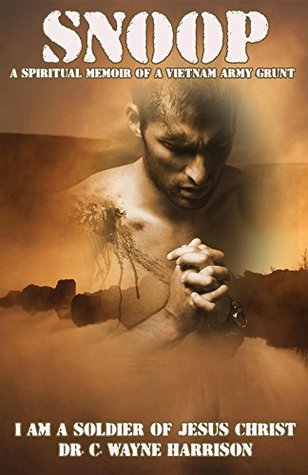
Snoop: A Spiritual Memoir of a Vietnam Army Grunt (Published by Parables, 2016), by C. Wayne Harrison, is a 98-page book that tells stories of war, grouped together for devotional reflection. That may sound like an unusual approach, but Harrison makes it work.
Harrison was a private in the U.S. Army, who fought in the jungles in the Vietnam War in 1969-1970. Today he is Baptist minister in Booneville, Mississippi. In ten short chapters, he recalls his desire to be a soldier and relates in vivid detail the horrors he experienced in the war. Although the stories tend to move chronologically from early in his life through his year in Vietnam, the chapters are more thematic in nature, with titles such as, “The Heart of a Soldier,” “The Hands of a Soldier,” “The Hardships of a Soldier,” etc. Each chapter opens with a passage from the Bible, then focuses on stories that relate to the theme of the chapter, followed by some discussion questions and a prayer.
The reader identifies with the young man, who is nicknamed “Snoop” because of his lapel pin of Snoopy, the dog who imagined he was a fighter pilot, in the “Peanuts” comic strip. Some descriptions of war in the book may be disturbing to young readers, and the stories certainly are sobering even to mature readers. I believe Harrison’s writing will connect well with soldiers who read the book, and would make an excellent resource for military chaplains or anybody, especially soldiers, who are willing to reflect on God’s purpose for their lives.
The book is well-written, using excellent images and descriptions, and is easy to read, although I noticed a typo on p. 64, where the word “scar” was spelled “scare.” There are black-and-white photos of Harrison as a young soldier in the back of the book. In interest of full disclosure, I received a complimentary copy of this book from the author, with no obligation to write a favorable review.
Twisted scripture: “by His stripes we are healed”
Copyright 2016 by Bob Rogers

(NOTE: This is the fifth blog post in a series on scriptures commonly misinterpreted.)
But He was wounded for our transgressions,
He was bruised for our iniquities;
The chastisement for our peace was upon Him,
And by His stripes we are healed. – Isaiah 53:5, NKJV
I often meet people praying for the sick who claim Isaiah 53:5 as a promise that God will heal any sickness if they pray for it in faith. Their logic is straightforward: the prophet said that the Messiah would be crucified for our sins, “and by His stripes we are healed.” Thus, they conclude, the verse is saying that Jesus’ cross has two effects: first, Christ paid for our sins, and second, He also heals our diseases, if we pray in faith. After all, they reason, didn’t Jesus say, “Your faith has made you well?” (Mark 5:34).
Is this really what Isaiah 53:5 is teaching? Does it teach a two-part effect of the cross: a healing from both sin and sickness? This interpretation fails to take into consideration the kind of Hebrew poetic writing used here, often called Hebrew parallelism. That is, the Hebrew poet frequently says the same thing twice in slightly different ways, for emphasis. We see this in many psalms, such as, “While I live I will praise the Lord; I will sing praises to my God while I have being” (Psalm 146:2). If this is Hebrew parallelism, then the second part means the same thing as the first part, and the first part says the Messiah was wounded for our transgressions, not our sickness. But what if this is not Hebrew parallelism?
Here is where we need to apply a very important but often neglected principle of Bible interpretation: scripture itself is the best interpreter of other scripture. So what does the rest of the Bible say on this subject?
The New Testament frequently discusses the effect of the cross of Jesus Christ. Romans 3:24-25 speaks of how Jesus’ blood justifies us from sin, redeems us from sin, and presents Jesus as a sacrifice for our sin. Ephesians 1:7 says His blood gives us forgiveness from our sin. Colossians 1:20-22 says Jesus made peace through the blood of His cross, in order to present you “holy and blameless” before God. Many other scriptures talk about how the cross of Christ offers salvation from sin, but nowhere does the New Testament say that the cross of Christ brings healing from sickness.
Is Isaiah 53:5 directly quoted anywhere else in the Bible? Yes, it is, in 1 Peter 2:24. Here it is:
“Who Himself bore our sins in His own body on the tree, that we, having died to sins, might live for righteousness—by whose stripes you were healed.”
If Isaiah 53:5 was intended to be a prophecy that Jesus’ cross would heal from sickness as well as sin, then when Peter quoted that very same verse, surely Peter would have mentioned the effect of the cross on sickness. Yet it is not there. Read the verse again. It says Jesus “bore our sins in His own body…” It continues, “that we, having died to sins, might live for righteousness.” After making reference to sin twice, Peter then quoted Isaiah 53:5: “by whose stripes you were healed.” There is no question what kind of healing Peter understood Isaiah to mean. He already said it twice: healing from our sins.
Remember this important principle: the best interpreter of scripture is other scripture, not a human preacher or teacher. Should we pray for the sick? Yes, we are commanded to do so (Matthew 10:8; James 5:14). Is God able to heal the sick? Yes, and He often chooses to do so, although not always (Acts 5:16; 2 Corinthians 12:7-10). However, does Isaiah 53:5 teach that the cross of Christ is a promise of physical healing for us to claim in faith? Based on the interpretation of scripture itself, we can only conclude that it is a promise for one type of healing– the greatest kind of all– from our sin.
Twisted scripture: I can do all things through Christ who strengthens me
Copyright by Bob Rogers

(NOTE: This is the third in a series of blog posts I am doing on some of the most commonly twisted and misinterpreted verses in the Bible.)
“I can do all things through Christ who strengthens me.” – Philippians 4:13, NKJV
Philippians 4:13 is one of the most beloved verses in the Bible. Sports teams emblazon it on their uniforms to inspire them to win games, and business people quote it to inspire their sales force. So what is the problem with that? A closer look at the verse shows that such interpretations violate the cardinal rule of Bible interpretation: context. So let’s put the verse back into its context and unpack it.
The apostle Paul was in jail when he wrote the letter to the Philippians. He stated in the letter that he could die there for the gospel (Philippians 1:12-13, 20-21). In the last chapter of the letter, Paul talked about his suffering in prison, and said, “…for I have learned to be content in whatever circumstances I am. I know both how to have a little, and I know how to have a lot. In any and all circumstances I have learned the secret of being content–whether well-fed or hungry whether in abundance or in need. I am able to do all things through Him who strengthens me” (Philippians 4:11-13, HCSB). From the context, it is obvious that Paul was not talking about winning games or setting sales records. In fact, he didn’t even ask to change his circumstances, to break out of jail. Instead, he was talking about contentment in the midst of his circumstances.
Taken out of context, people often stress the phrase “I am able to do all things,” as if this is a guarantee that we can climb the highest mountain and swim the deepest sea. But taken in the context of Paul’s contentment, despite his imprisonment, the whole verse makes sense. The emphasis of the verse is not about being able to do anything, but on being able to do all things (including handling bad things) through Christ. That is, whatever I face in the physical world, I can face it with with the spiritual strength that Christ gives me.
Understanding the context should not spoil the inspiring words of Philippians 4:13, nor even ban it from a theme for sports teams or business people. It can. It can inspire the team that has lost to get up and go again. It can inspire the business that has failed not to quit. Just remember that this verse is more about Christ than self, more about hope than hype, and more about rising from the bottom than about climbing to the top.
Twisted scripture: “God doesn’t put on you more than you can handle”
Article copyright by Bob Rogers

(NOTE: This is the second in a series of blog posts I am doing on some of the most commonly twisted and misinterpreted verses in the Bible.)
As a hospital chaplain, I seek to guide patients to find the spiritual strength to handle their problems. After hearing their story, I sometimes ask, “How are you handling that?” Many people will reply, “Well, God doesn’t put on you more than you can handle.” Others will say, “The Bible says God doesn’t give us more than we can bear.” That sounds nice, but it’s not what the Bible says! People get this idea from a misreading of 1 Corinthians 10:13. Here is what the entire verse says [italics mine]:
“No temptation has overtake you except such as is common to man; but God is faithful, who will not allow you to be tempted beyond what you are able, but with the temptation will also make a way of escape, that you may be able to bear it.” – 1 Corinthians 10:13, NKJV
Many people seem to think that this verse says that God will not allow you to be tested beyond what you can bear. But read the verse again. Is that what it says? No! It says God will not allow you to be tempted beyond what you are able. Some people correctly argue that the Greek word can be translated “tested” or “tried,” instead of “tempted.” However, almost all translations prefer the word “tempted” in this verse. Why? Because of the context. A rule of thumb for Bible interpretation is to read the context. So when we read the whole chapter, we see that 1 Corinthians 10 is about temptation. The first part of the chapter gives a series of warnings against falling into disobedience through unbelief. Verse 12 warns, “So, whoever thinks he stands must be careful not to fall.” Fall into what? Temptation. And verse 14 says the solution to the temptation is to “flee.” So the context of 1 Corinthians 10:13 shows that it is about temptation.
But if 1 Corinthians 10:13 does not say God won’t put on us more than we can bear, do other verses teach this? Ironically, Paul says in 2 Corinthians 1:8 that “we were so utterly burdened beyond our strength that we despaired of life itself.” In other words, God put more on him than he could handle! But he goes on to say in the next verse, “But that was to make us rely not on ourselves but on God who raises the dead.” The scripture frequently says that when we cannot handle things, God can give us the strength we need (See 1 Samuel 30:6; Philippians 4:13). (Unfortunately, Philippians 4:13 is also misinterpreted, and we’ll discuss how in the next blog post.)
Here is the bottom line: God is not saying that we won’t face more than we can handle, but He is saying that He will give us the spiritual strength to handle whatever we face.


 Bob Rogers