Blog Archives
Thursday, Day of Blood Covenant

Article copyright by Bob Rogers.
Many things happened on Thursday of Holy Week. It is often called “Maundy Thursday” because John 13:1-17 records Him washing the disciples’ feet and giving them a command (Latin mandatum, French mande’) to follow His example. The other three Gospels, including Mark, tell how Jesus and His disciples observed the Passover, during which Jesus instituted the new ordinance of the Lord’s Supper. Then they went to the Garden of Gethsemane, where Jesus agonized in prayer over His coming cross. While in Gethsemane, Jesus was betrayed by Judas Iscariot and handed over to the Jewish temple police, who took Him before the Jewish Sanhedrin for an illegal night trial.
Many valuable lessons can be learned from Thursday, such as the example of humility and service in washing feet and the example of praying in God’s will in the Garden of Gethsemane. But let’s focus on the lesson about covenant and commitment.
In Mark 14:24 Jesus says, “This is my blood of the covenant, which is poured out for many.”
We who follow Christ are called to enter into a covenant with Him. That means we make a commitment to follow Him. It is a divine transaction. Jesus pours out His blood; we receive Him by faith and commit ourselves to follow Him the rest of our lives. He made a complete commitment to us by dying for us; He invites us to commit to Him by living for Him.
While in college, Jim Denison was a summer missionary in East Malaysia. During one of the worship services, a teenage girl shared her testimony and was baptized in the simple bathtub baptistery of the church, which met in a warehouse. Denison noticed some worn-out luggage leaning against the wall, and asked a church member why it was there. The member pointed to the girl who was baptized and said, “Her father said that if she was baptized as a Christian she could never go home again. So she brought her luggage.” (The Book of Acts, BaptistWay Bible Study for Texas, 2000, p. 46). Now that, my friends, is entering into a covenant with Christ.
Thursday, the day of covenant, teaches us to commit to Christ.
Wednesday, Day of Rest

Article copyright by Bob Rogers
At first glance, it seems that nothing is recorded between Jesus’ day of confrontation on Tuesday, and Jesus’ celebration of the Passover on Thursday night.
While it is possible that Jesus did nothing much on Wednesday, a closer look at the text indicates that a couple of things did happen that day. Mark 14:1 says it was “two days” before the Passover. Passover would begin at sundown on Thursday night, so this means the events in Mark 14:1-11 were between sundown Tuesday and sundown Wednesday. Perhaps these things took place on Tuesday night, and Jesus really did do nothing on Wednesday. Or perhaps the events took place on Wednesday. Either way, what happened next foreshadowed the ominous death of Christ on the cross. Mark 14:1-2 says that the Jewish religious leaders were looking for a way to arrest and kill Jesus, and then verses 10-11 say that one of Jesus’ disciples, Judas Iscariot, went to the religious leaders and agreed to betray Jesus. What happened in between shows that Jesus knew exactly what was coming, and that it was all in God’s purpose.
Mark 14:3-9 tells the touching story of how a woman (often thought to be Mary Magdalene), anointed Jesus with an expensive perfume. To show how expensive it was, it was worth 300 denarii, and Mark 6:37 said that just 200 denarii would be enough to feed 5,000 people. Some of the people there expressed indignation that the perfume was “wasted,” but Jesus said to leave her alone. It was after this that Judas went to betray Jesus. But Jesus knew exactly what was coming. That’s why Jesus said, “She has anointed My body in advance for burial.”
This should remind us that nothing spent on Jesus is ever wasted. We can never give to Jesus more than He has given to us. Isaac Watts said it well in his hymn, “When I Survey the Wondrous Cross”:
Were the whole realm of nature mine,
That were a present far too small;
Love so amazing, so divine,
Demands my soul, my life, my all.
As I mentioned earlier, it is very likely that the anointing happened on Tuesday night after sundown, not on Wednesday. If so, this would would remind us that something else is not a waste– a day of rest! It would mean that on the most important week of His life, Jesus took a day off! Jesus knew the importance of getting rest. In Mark 6:31, Jesus says, “Come with Me by yourselves to a quiet place and get some rest.” Do you have a regular time when you turn off the TV, cell phone and computer, and just spend time resting, praying, reading God’s Word, and listening to God? The Ten Commandments include a command to take a day of Sabbath rest. It is never a waste to take that day to reflect, pray, and worship.
Nothing spent on Jesus is a waste.
Tuesday, Day of Confrontation

Copyright by Bob Rogers
Tuesday of the final week of Christ was a long and active day of Jesus teaching in the temple. On that day he had constant confrontations with the Jewish religious leaders. Everything recorded from Mark 11:20 through Mark 14:11 happened on Tuesday:
*the fig tree that Jesus cursed is found withered,
*the Jewish religious leaders demand to know what authority Jesus has to cleanse the temple and do all that he does,
*Jesus tells a parable about tenants in a vineyard that implies that the Jewish religious leaders have rejected God’s Son, making them so angry they wanted to arrest Him.
*They try to trap Him with a question about paying taxes to Caesar and about marriage in the resurrection.
*Jesus turns the questions around on them, and then proclaims to the disciples that every stone in the temple will be thrown down and warns them to be on guard against persecution, false prophets and false Messiahs.
Do you notice a pattern here? Jesus and the religious leaders are in constant confrontation. Finally, at the end of the day, we read that as the religious leaders were continuing to look for a way to arrest Jesus and kill Him, a woman anointed Jesus’ body with a very expensive perfume. Jesus knew where this was all heading, which is why He said that she was anointing His body for burial.
What an exhausting day of confrontation Tuesday was! From the beginning to the end of the day, it was full of conflict. Mark 11:28 records at the beginning of Tuesday the confrontational question of the religious leaders who were enraged by Jesus cleansing the temple: “By what authority are you doing these things?… And who gave you authority to do this?” Mark 14:10-11 records at the end of Tuesday how enraged Judas Iscariot was, who apparently was so disappointed in Jesus for being a humble, peaceful, sacrificial Messiah, that Judas went to the religious leaders to betray Jesus to them.
The problem they all had, from the beginning to the end of the day, was an unwillingness to submit to the Lordship of Jesus. We may not like to think of ourselves as in conflict with Christ, but whenever we say to Him, ‘No, Lord,” we aren’t really making Him Lord. Are we willing to submit ourselves to Him, or do we continue to argue with Him?
Tuesday, the day of confrontation, teaches us to make Christ Lord of our lives.
Children’s book review: The Quiet Crazy Easter Day


The Quiet Crazy Easter Day by Jill Roman Lord (B & H Kids) is a 22-page, colorful children’s storyboard book that is perfect for the Easter season. The word “quiet” is crossed out in the title, because the theme of the book is how likely it was that all of God’s creatures rejoiced at Jesus’ resurrection.
Using rhythm and rhyme, the book book imagines how every creature, from ladybugs to ladies and eagles to angels burst into howls and shouts of praise. The book should be fun to read, and easy to understand, although perhaps one line could have replaced “distinctive” with a simpler word such as “special.” The illustrations by Kelly Breemer are bright, clear, and use a full range of colors that fit very well with the theme.
I highly recommend this book as a cheerful way to teach children the true meaning of Easter, while also teaching about different animals and the sounds they make.
Disclosure statment: I received a complimentary copy of this book upon promise of review. I was under no obligation to write a favorable review.
Monday, Day of Cleansing

Article copyright by Bob Rogers
Mark 11:15-19 says that Jesus returned to the temple on Monday of Holy Week, and when he found the money changers and people selling animals in the temple complex, he overturned their tables, and ran them out, cleansing the temple.
Mark 11:12-14 specifies that Jesus did this on the day after Palm Sunday. He does it with authority, demanding that the house of prayer should not be turned into a hiding place for thieves. All of this buying and selling was going on in the court of the Gentiles, the only place that Gentiles were allowed to worship near the temple. So their merchandise was a distraction from others being able to pray.
Just as Jesus cleansed the temple that day, He wants to cleanse our lives today.
Psalm 24:3 asks, “Who may ascend the hill of the Lord? Who may stand in his holy place?” The answer comes in the next verse: “He who has clean hands and a pure heart, who does not lift up his soul to an idol, or swear by what is false.”
Do my actions prevent others from worshiping God? Am I a distraction? Then I must repent and change my ways. For many Christians, the 40 days before Easter are a time of repentance and reflection, called Lent. Truly, for all Christians, Monday of Holy Week should be a day for us to take a hard look at our own lives, and ask ourselves if we are a keeping anybody from seeing Jesus, and repent.
Monday, the day of cleansing, teaches us to cleanse our lives.
An invitation to conversation with Almighty God

The LORD would speak with Moses face to face, just as a man speaks with his friend… – Exodus 33:11
Years ago, I got to shake hands with the president of the United States. I was serving as a pastor near Savannah, Georgia, and President George W. Bush was coming to Savannah to speak. As part of the event, I was asked to say a prayer before the president arrived, and then I was allowed to sit on the front row when the president spoke. After his speech, he walked through the crowd quickly, shaking hands with people on the front row. He was headed in my direction! I watched as Secret Service agents went before and behind him. Cameras were flashing. The news media were everywhere. He was stopping briefly to shake hands and speak to each person. As he made his way closer, I thought about what I would say. I didn’t want to say anything stupid. I could imagine putting my foot in my mouth and getting it broadcast on the evening news: “Local pastor makes a fool of himself with the President.” I knew there was no time for a long conversation, either. Finally, President Bush got to me. As if in slow motion, I took the hand of “W,” and said, “I pray for you every day.” He replied, “Thanks; it’s working!” Two seconds later, he was moving down the line.
Now here is a thought that blows my mind: Moses talked to the Creator of the Universe face to face like God was his best buddy! It wasn’t a quick phrase, like my conversation with the president. No, Moses spent time with Yahweh, the personal God of Israel, in a long, leisurely conversation. They hung out together.
Here’s another thought that blows my mind: Jesus, my Savior, wants to talk to me like that! Jesus told His disciples, “I have called you friends” (John 15:15), shortly after encouraging them to “abide” or “remain” with him (John 15:4). The president of the United States did not have time to remain with me and talk to me like a friend, yet Jesus, my Savior, calls me “friend” and invites me to remain and spend time with him.
What would I have done if the president had said, “Bob, can I come over for dinner and talk with you a while?” I would have called my wife and said, “You got a few minutes to get the house ready for the president!” But I have One far greater inviting me to start my day in conversation with Him. How can I do otherwise?
The women in Jesus’ family tree

The Gospel of Matthew opens with the family tree of Jesus, from Abraham through Joseph and Mary. In typical Hebrew fashion, it lists the men, not the women, who “begat” (KJV) or “fathered” each son. Yet of the 42 generations listed, Matthew inserts references to four women other than Mary, the mother of Jesus: Tamar, Rahab, Ruth, and Bathsheba (who is only called “Uriah’s wife”). Why are these women mentioned?
Matthew is writing to a very religious Jewish audience, and by inserting these names in the genealogy of the Messiah, he is showing us two encouraging truths.
All our welcome. All of the women were foreigners: Tamar was a Canaanite (Genesis 38:6), Rahab was from Jericho (Joshua 2:1-22), Ruth was from Moab (Ruth 1:4), and Bathsheba was a Hittite (2 Samuel 11:3). To a Jewish audience, he was reminding the Chosen People that God welcomes all people to follow Jesus as the Messiah and Savior of the world.
He came to save sinners. Three of the women were notorious for sexual sin. Tamar seduced her father-in-law Judah (Genesis 38), Rahab was a prostitute (Joshua 2:1), and Bathsheba committed adultery with King David (2 Samuel 11-12), which is why she is referred to by Matthew as “Uriah’s wife,” as a reminder of that adultery.
No wonder the angel said to Joseph in Matthew 1:21, “She will give birth to a son, and you are to name Him Jesus, because He will save His people from their sins.”
I’m so glad Jesus’ genealogy included those four women, because it reminds me that He includes me, a non-Jewish sinner in need of a Messiah and Savior.
Charles Spurgeon said in commenting on Matthew 1:21, “The first link between my soul and Christ is not my goodness but my badness, not my merit but my misery, not my standing but my falling, not my riches but my need. He comes to visit his people– not to admire their beauties but to remove their deformities, not to reward their virtues but to forgive their sins.”
A Christmas Prayer

God the Father, who gave us Your Son,
What shall I render You for the gift of gifts?
Here is wonder of wonders:
He came down below to raise me above,
was born, like me that I might become like Him.
Here is love:
when I cannot rise to Him He draws near on wings of grace, to raise me to Himself.
Here is power:
when Deity and humanity were infinitely apart He united them in indissoluble unity, the uncreated with the created.
Here is wisdom:
when I was undone, with no will to return to Him, and no intellect to devise recovery,
He came, God in flesh, to save me completely,
as man to die my death.
O God, as the watchful shepherds enlarge my mind,
to hear good news of great joy, and hearing to praise You,
Let me with Simeon clasp the newborn Child to my heart,
embrace Him with undying faith.
In Him You have given me so much that heaven can give no more.
———————————————————————–
Adapted from The Valley of Vision: A Collection of Puritan Prayers and Devotions, edited by Arthur Bennett.
Why we must have unity in the church

Copyright by Bob Rogers.
Many churches are like the two cats, whose tails were tied together, and thrown over a clothesline. They had union, but no unity. Yet in Romans 15, the apostle Paul insists we must have unity in the church. Why is unity so important?
- Because Christ set the example
Sadly, we pastors are put on a pedestal, and then when we fail or fall, members are disappointed and sometimes divided. Even the best ministers are not perfect examples. The great American evangelist Dwight L. Moody, who was fat, met the great English preacher Charles Spurgeon. Moody asked Spurgeon when he would give up his awful cigars. Spurgeon pointed at Moody’s belly: “When you get rid of this, I’ll get rid of these.” Even the greatest preachers are not perfect: Jesus is our example. And Christ set an example of unity. Thus Romans 15:2-3 says, “Each one of us is to please his neighbor for his good, to build him up. For even Christ did not please himself.”
- Because scripture teaches it
In Romans 15:4 Paul mentions “the Scriptures.” Then in verse 5, he shows how this helps “you to live in harmony with one another.” Listen to the scriptures: John 13:35 says others will “know you are my disciples” by your love for each other. In John 17:22, Jesus prays “they may be one as we are one.” In 1 Corinthians 1:10, Paul appeals that “all of you agree.. that there may be no divisions.” In Philippians 4:2, Paul publicly named two women: “I plead with Euodia and Syntyche to agree with each other in the Lord.”
- Because it glorifies God
In Romans 15:6, Paul says, “so that you may glorify the God and Father of our Lord Jesus Christ with one mind and one voice.” In the next verse, he stresses again how unity glorifies God: “Therefore accept one another, just as Christ also accepted you, to the glory of God.” Thom & Jess Rainer published a study of the 78 million-member generation born between 1980 and 2000: The Millennials. In their book, they said 70% of millennials think that the American church is irrelevant today; the number one reason they gave was that they see religion as divisive and argumentative. But unity glorifies God!
Someone might object, but what if someone is denying the gospel or the inspiration of the Bible? What if someone is immoral? Please do not misunderstand: I am not calling for unity at all costs, but I am calling for unity at great sacrifice! Sadly, many Christians are not willing to swallow their pride and eat humble pie for the sake of unity. We should be willing to make any sacrifice for unity that does not sacrifice truth or morality. It is that important.
The Gospel in the Old Testament
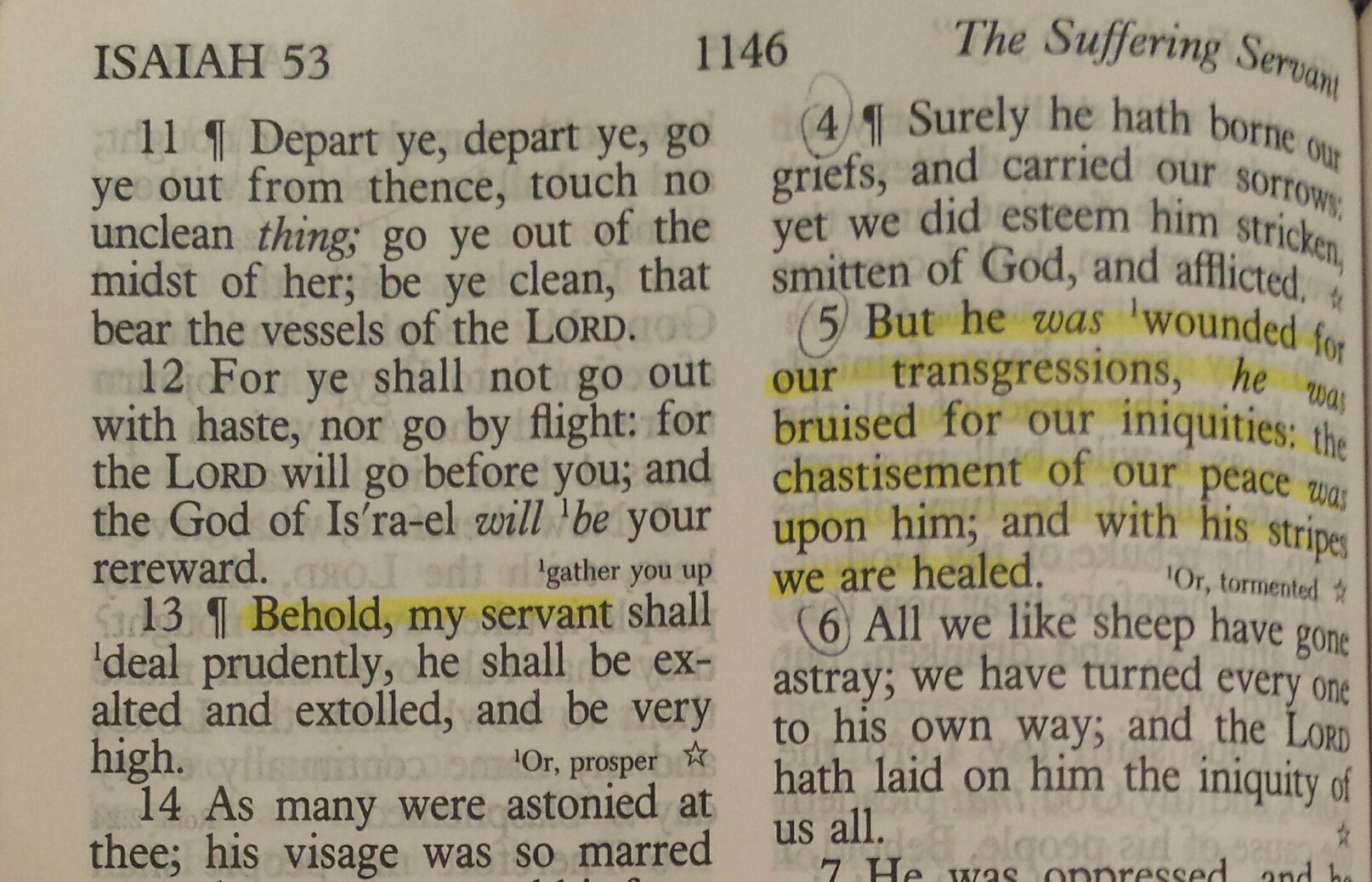
Copyright by Bob Rogers
Many Christians can share the Gospel of Christ with verses from the New Testament, but you can also share it using only the Old Testament. Christians commonly think they can only share the Good News of salvation by verses like the “Roman Road” (Romans 3:23, 6:23, 5:8 and 10:9) or other collections of scriptures from the New Testament. However, the Gospel message is to the Bible like the spokes on a wheel, all revolving around that central truth. So below is a collection of the truths of the Gospel, just from the Old Testament:
All have sinned:
1 Kings 8:46a: “There is no one who does not sin…”
Sin separates us from God:
Isaiah 59:2: “Your iniquities are separating you from your God, and your sins have hidden his face from you…”
We cannot earn our own salvation:
Psalm 49:7: “Truly no man can ransom another, or give to God the price of his life, for the ransom of their life is costly and can never suffice.”
Christ died for our sins:
Isaiah 53:5, speaking of the Messiah: “But He was pierced because of our rebellion, crushed because of our iniquities; punishment for our peace was on Him, and we are healed by His wounds.”
“In a single day” (on the cross) God took away guilt of sin:
Zechariah 3:3-4, 8-9 speaks of Joshua the high priest, who represents the people: “Now Joshua was dressed with filthy clothes as he stood before the angel. So the angel of the Lord spoke to those standing before him, ‘Take off his filthy clothes!’ Then he said to him, ‘See, I have removed your iniquity from you…
Listen, High Priest Joshua… I am about to bring my servant, the Branch… and I will take away the iniquity of this land in a single day.”
What “single day” could possibly fulfill this verse than Good Friday, the day Jesus died on the cross to take away sin?
Repent, confess sin, and be forgiven:
Psalm 32:5: “I said, ‘I will confess my transgressions to the Lord,’ and You took away the guilt of my sin.”
Hosea 14:2: “Take words of repentance with you and return to the Lord. Say to Him, “Forgive all our sin…”
Five truths about predestination. Truth #4: predestination is according to foreknowledge.

Article copyright by Bob Rogers, Th.D.
(This is the fourth in a series of five articles about predestination.)
Some people object to the idea of predestination because they think it takes away human responsibility and free will. Yet the Bible says predestination is “according to foreknowledge.” In other words, God can speak of something as destined to happen, because God already knows the future.
Romans 8:29 (ESV) says, “For those whom he foreknew he also predestined…” Peter said, “To those… chosen according to the foreknowledge of God the Father…” (1 Peter 1:1-2, CSB). This concept is plainly stated in the Gospel of John. Jesus said, “No one can come to me unless it is granted him by the Father” (John 6:65, ESV). That sounds like predestination, doesn’t it? But read the verse before it: “For Jesus knew from the beginning who those were who did not believe…” (John 6:64, ESV). There it is again—foreknowledge!
Let me illustrate it like this. Once I was a passenger on an airplane coming into the airport in Savannah, Georgia, which is near Interstate 95. As we descended, I could see a wreck on I-95 that was several miles to the north. I knew that the northbound cars immediately below me were going to come upon that wreck, because I could see farther that they could see. In a similar way, since God exists beyond time, and knows the future, he can speak of it as certain to happen (predestined). He already knows what we will do, but we are still free and responsible for what we do.
What we learn from great leaders in the Bible

Article copyright by Bob Rogers.
Five leaders of the Bible come to mind as role models for us: Abraham, Moses, David, Peter and Paul.
Abraham was willing to take risks. He was told to go to a land the Lord would show him. Are you willing to take the risk to go where you’ve never gone before, for the good of those you serve and lead?
Moses was willing to stand alone on his convictions against Pharaoh and later against his own fellow Israelites when they rebelled against the Lord. Are you?
David was willing to face a giant. Are you ready to take on giant tasks?
Peter was willing to admit his mistakes and change, after denying the Lord and after denying fellowship with Gentiles. That’s an important quality in leaders to be willing to admit when we are wrong and change.
Paul was able to get a vision and follow it. When he saw a vision of a man of Macedonia saying, “Come over here and help us,” Paul took the gospel into the continent of Europe for the first time. Do you, like Paul, have a vision for your work, and see the big picture?
As helpful as these five role models are, I have not mentioned the greatest example: Jesus Christ. Jesus was willing to sacrifice Himself for the good of others. Jesus said, “Greater love has no man than this, that a man lay down his life for his friends.” (John 15:13). If you and I will follow the example of Jesus, and be willing to sacrifice our own desires and put others before ourselves, then God will bless our leadership. After all, Jesus knows better than anybody, that life can be as tough as nails.
How can believers respond to doubters?

Recently I taught a Bible study on the story of “Doubting Thomas” to my Bible class at church, and again at a local prison. We read in John 20:24-29 how Thomas said he would not believe Jesus was alive unless he saw the nail prints in His hands and put his hand into His side where He was pierced. Then Jesus appeared to Thomas and encouraged him to do just that! Thomas responded with his confession of faith, “My Lord and my God!”
I asked both classes, What lessons do we learn about responding to doubters from how Jesus responded to “Doubting” Thomas?
The Bible class at church gave six answers:
1. Don’t “blast” them; don’t attack them for their doubt
2. Show them what they need; give them evidence, books to read, etc.
3. Allow the Holy Spirit to lead
4. Be loving, compassionate, not judgmental
5. Pray for them
6. Plant the seeds and be patient
The Bible study group in prison added two more answers:
7. Share my own testimony
8. Live my life in a way that shows Jesus is real.
How about you? What have you found that is helpful to respond to those who doubt the faith? What has helped you in times of doubt?
Guest blog: Why We Don’t Do Elf on the Shelf

(This guest blog is written by my daughter, Melissa Rogers Dalton. She and her husband Steven have two sons and live in Virginia, where she is an elementary school teacher, with an endorsement as a Reading Specialist.)
Article copyright by Melissa Rogers Dalton
When I first learned about the idea of Elf on the Shelf a few years ago, I was completely sucked in. I didn’t have any kids yet, but the idea of setting up an elf with all of these great little tricks greatly appealed to the prankster inside of me that has become dormant since my college days.
I mean, how cute are these!
Once Keagan was finally old enough to enjoy it, I brought it up to Steven and he immediately shut it down. He knows that I have a tendency to get overly involved in things like this and could picture me staying up way too late every night trying to concoct the perfect scheme for the next morning. Yeah, he knows me way too well… ;-)
But over the past two years, I’ve decided he was right to say no for a completely different reason.
Teaching our children that they have to be good in order to receive gifts is completely opposite of what the gospel preaches and, therefore, goes against everything Christmas stands for.
You see, Jesus was sent to Earth because we couldn’t find our way back to God on our own. He is our Rescuer and Redeemer, and there is NOTHING we can do to earn his gift. Actually, the definition of “gift” says “a thing given willingly to someone without payment; a present.”
So this whole myth about Santa and his naughty or nice lists really should disappear.
I’m sure some well-meaning parent created it somewhere along the line because kids at this point of the year start going a little crazy, but we have to put an end to it. Even as adults, we struggle with remembering/understanding that our actions are not the path to heaven. Just listen for two seconds, and you’ll hear it all around. I had a coworker tell me just a few days ago that she was going to hell for saying something mean about someone else. Technically, yes you can, but stopping it isn’t going to get you to heaven either.
All we have to do is realize that we are beyond unworthy, but God sent us the perfect gift of His son to come, live, and ultimately pay the penalty for our sins with His life so that we could be reunited with Christ someday. Then we just accept that gift by choosing to follow Christ. That’s it. Our works will never be enough.
If you have an elf and want to continue your fun with it, by all means go ahead. I love seeing what creative schemes you create. But PLEASE stop telling your kids that they won’t receive Christmas this year if they don’t behave. Instead, preach the true gospel to them. If you need any ideas for ways to bring it down to their level without missing the importance, I highly recommend the Jesus Storybook Bible.
The reason I like this particular Bible for kids is because they end every story by bringing it around to Jesus and the gospel. It doesn’t matter if the story is about Leah or the actual birth of Christ. They all talk about the Rescuer coming to save us so that kids can understand that everything in the Bible points to Him. They aren’t just individual cool stories that happen to be in the same book.
There is also a FREE Advent Calendar that goes along with this Bible (it includes the actual scripture references as well if you don’t have/want this Bible). I know it may be too late for this year, but I plan on using it next year.
Merry Christmas, and God Bless!
Three ways religion deceives

Copyright by Bob Rogers.
Billy Graham has said, “People in the South have been exposed to so much religion that many of them have been inoculated against getting the real thing!”
In Romans 2:17-3:18, the apostle Paul points out three deceptions of having religion without a relationship with Jesus:
1. The deception of spiritual pride (2:17-24). Muhammad Ali once got on an airplane, and the flight attendant told him to buckle his seat belt. He said, “Superman don’t need no seat belt.” She replied, “Superman don’t need no airplane.” It’s easy to be proud of how spiritual we are, and forget that we are nothing without Christ. Paul talks about how the Jewish people were proud of their spirituality, but failed to practice what they preached. Substitute the word “religious” for “Jew” and it can apply to any of us.
2. The deception of depending on ritual (2:25-3:4). Some people think that because they are baptized, go to church, receive communion, etc., that they are right with God. It ain’t necessarily so! The Jews were proud of their circumcision. It was the mark of their identity. But they forgot that God wanted a circumcision of the heart (v. 29; see also Deuteronomy 30:6). While there are advantages to religious faith, like having the Word of God and our church (3:1-4), it can deceive us into thinking it saves us. Only Jesus can save.
3. The deception of presuming on grace (3:5-8). Once the great Reformer, Martin Luther, saw a drunk in the alley. The drunk said, “You’re Martin Luther! I’m one of your disciples!” Luther replied, “You must be one of mine, because you are none of Christ’s.” Luther preached salvation by grace, but he knew that a truly saved person would show it in his life.
Paul was falsely accused of teaching that salvation by grace meant you could live in immorality and it didn’t matter. Paul was not saying that at all. While we preach grace, we must not be deceived into playing games with our religious theology. As 2 Corinthians 6:1 says, Don’t receive God’s grace in vain. A person who truly receives grace by faith will have a new heart’s desire to follow Christ.
Jefferson Bethke puts it this way:
“Religion says do,
Jesus says done.
Religion says slave,
Jesus says son.
Religion puts you in shackles but Jesus sets you free.
Religion makes you blind, but Jesus lets you see.”


 Bob Rogers