Category Archives: Prayer
Prayers for Holy Week

Copyright by Bob Rogers.
Lord Jesus, You entered Jerusalem in triumph, receiving the praises of “Hosanna!” from the crowd. Then You cleansed the temple and healed the sick. When the priests challenged Your authority, You said scripture foretold praises from the children (Matthew 21:1-17). Lord Jesus, I am Your servant. I bow before You and recognize Your Lordship over my life. I give You praise, my God and my King! Heal me, change me, lead me.
Oh, Lord, when You came to Jerusalem, You cleansed the temple. Would You cleanse my heart today of all that displeases You?
In the Garden of Gethsemane, Jesus prayed so fervently, His sweat became like drops of blood, yet His disciples fell asleep. Jesus said, “Get up and pray, so that you won’t fall into temptation.” (Luke 22:46). Lord, may my prayer life be so strong that it weakens my temptation.
Lord Jesus, they stripped You naked, flogged You, slapped You, spat on You, mocked You, beat You on the head, forced You to carry Your cross to Your execution, nailed Your hands and feet to the cross, and when You died, they thrust a spear into Your side. Or did they? In truth, I should change the word “they” to “I”! Did not I do all of that to You? It is because of my sin that You suffered. I stripped You, I flogged You, I slapped You, I spat on You, I mocked You, I beat You, my sin caused You to carry Your cross and take the nails and spear for my forgiveness. Oh, Jesus, my heart gently lifts the crown of thorns from Your head, and with all my soul, I place a golden crown on Your bloodied brow, and I bow at Your nail-scarred feet.
Lord, when You died on the cross, You tore down the barrier between God and mankind. I am overwhelmed that Your grace has given me access by faith into the very presence of God. May I never take Your death for granted. As You died for me, I will live for You. (Mark 15:37-38)
Lord Jesus, You were mocked and crucified for my sins. I can never repay Your sacrifice, but I shall not be afraid to be mocked or punished for the sake of Your name. (Matthew 27:31)
Lord Jesus, from the cross You cried, ‘Into Your hands I entrust My spirit.” (Luke 23:46). Help me to pray that same prayer with my dying breath. Into Your hands I entrust my body, my soul, my spirit.
The resurrected Christ walked with two disciples to Emmaus, yet they did not recognize Him until he blessed and broke the bread. “Then their eyes were opened” (Luke 24:31), and they told others “how He was made know to them in the breaking of the bread” (Luke 24:35). Lord, open my eyes when I break the bread of communion. Remind me again how my sin made it necessary for Your body to be broken and Your blood to be shed. As I share the bread, may I share Your presence and grace with those around me.
Chaplain’s address, COVID-19 Candlelight Service

I delivered the following address at the COVID-19 Candlelight Service service at Forrest General Hospital, Hattiesburg, Mississippi, on March 11, 2021, marking the one-year anniversary of the first case of COVID-19 in Mississippi:
Can anything ever separate us from Christ’s love? Does it mean he no longer loves us if we have trouble or calamity, or are persecuted, or hungry, or destitute, or in danger, or threatened with death? No, despite all these things, overwhelming victory is ours through Christ, who loved us. And I am convinced that nothing can ever separate us from God’s love… – Romans 8:35, 37-38, NLT.
We are here today to look back and remember, to look around in unity, and to look forward in hope.
We look back and remember. We look at our calendars, and we remember that one year ago today, the first case of COVID-19 was diagnosed in Mississippi. We look back over that year, and remember those who died, those who
survived, their families and friends, and how all of us have been affected. Let us reflect back at how all of us have been changed, in ways often painful, but we are not defeated– “overwhelming victory is ours through Christ, who loved us.” So we light a candle to remember.
We look around in unity. We look around this room, look at our co-workers, look to our families and our community, and we see that we are standing together. We are all unique individuals, but we come together, because we have a
common calling to care for people. In a few minutes, we will light candles together. Let us look around and draw strength from one another. “Nothing can ever separate us from God’s love.” So we light a candle in unity.
We look forward in hope. We look forward, just as the darkness is broken at dawn by the rising sun. In a few weeks, we will celebrate Easter, when we who are Christians celebrate the rising of the Son of God. We have many reasons for hope. Amazingly, in less than a year since the first case of COVID, there are now three vaccines available, the number of virus cases is declining, and look at us—we are still here. We have made it “through the valley of the shadow of death.” So we light a candle of hope.
Yea, though I walk through the valley of the shadow of death, I will fear no evil: for thou art with me. – Psalm 23:4, KJV
A Prayer for President-elect Joe Biden

Copyright by Bob Rogers.
Heavenly Father, our hope is in You, not our earthly leaders. But the Bible tells us that you place people in power and remove them from power, and that we are to pray for all those in authority, that we may live peaceful lives.
I pray that You will give President-elect Biden the wisdom of Solomon and courage of David as he seeks to lead our country. May he listen to You, not the voices of those who may seek to control him, and may he seek Your will, for the good of our nation.
Lord, he has promised equality for all and to root out racism; may he do just that. As he seeks justice and protection for the oppressed, may he remember the most vulnerable of all, the unborn. As he said that we are not just to keep the faith, but to “spread the faith,” may he respect and protect those of us who actively keep and spread our faith.
Help us, Father, to unite and heal as a nation; heal us both of the COVID contagion and the contagion of angry words. May we listen to one another and listen most of all to You. In Jesus’ Name. Amen.
An invitation to conversation with Almighty God

The LORD would speak with Moses face to face, just as a man speaks with his friend… – Exodus 33:11
Years ago, I got to shake hands with the president of the United States. I was serving as a pastor near Savannah, Georgia, and President George W. Bush was coming to Savannah to speak. As part of the event, I was asked to say a prayer before the president arrived, and then I was allowed to sit on the front row when the president spoke. After his speech, he walked through the crowd quickly, shaking hands with people on the front row. He was headed in my direction! I watched as Secret Service agents went before and behind him. Cameras were flashing. The news media were everywhere. He was stopping briefly to shake hands and speak to each person. As he made his way closer, I thought about what I would say. I didn’t want to say anything stupid. I could imagine putting my foot in my mouth and getting it broadcast on the evening news: “Local pastor makes a fool of himself with the President.” I knew there was no time for a long conversation, either. Finally, President Bush got to me. As if in slow motion, I took the hand of “W,” and said, “I pray for you every day.” He replied, “Thanks; it’s working!” Two seconds later, he was moving down the line.
Now here is a thought that blows my mind: Moses talked to the Creator of the Universe face to face like God was his best buddy! It wasn’t a quick phrase, like my conversation with the president. No, Moses spent time with Yahweh, the personal God of Israel, in a long, leisurely conversation. They hung out together.
Here’s another thought that blows my mind: Jesus, my Savior, wants to talk to me like that! Jesus told His disciples, “I have called you friends” (John 15:15), shortly after encouraging them to “abide” or “remain” with him (John 15:4). The president of the United States did not have time to remain with me and talk to me like a friend, yet Jesus, my Savior, calls me “friend” and invites me to remain and spend time with him.
What would I have done if the president had said, “Bob, can I come over for dinner and talk with you a while?” I would have called my wife and said, “You got a few minutes to get the house ready for the president!” But I have One far greater inviting me to start my day in conversation with Him. How can I do otherwise?
Table grace: 27 prayers to bless the food before meals

Copyright by Bob Rogers
Jesus blessed the food and gave thanks for it when He fed the 5,000, but the Bible doesn’t tell us the words that He prayed. So what should you say when you pray before a meal? That’s up to you, but in case you would like some ideas, here are 27 prayers that I have collected over the years. Where I know the source, I list it in parentheses:
CLASSIC, TRADITIONAL PRAYERS
“Lord, bless this food to our nourishment, and us to Your service. In Jesus’ name, Amen.” (Traditional prayer I heard in my Baptist family.)
“Bless us, O Lord, and these Thy gifts which we are about to receive, through Thy bounty through Christ our Lord we pray. Amen.” (Traditional Roman Catholic prayer.)
“Christ God, bless the food and drink of Thy servants, for Thou art holy, always, now and ever, and to the ages. Amen.” (Traditional Eastern Orthodox prayer.)
“Thank you, Lord, for the food we are about to receive, and for the nourishment to our bodies. For Christ’s sake, Amen.”
“Humble our hearts, Oh Lord, and make us thankful for these and all our blessings. In Christ name Amen.” (Shared by Brenda Holloway and Darren Thomas)
PRAYERS MENTIONING FAMILY AND FRIENDS
“Heavenly Father, bless this food, and bless our friends and family who’ve come to dine with us today. Amen.”
“God, we give you thanks for the delicious food on our table, for the loved ones gathered around, and for you, who make it all possible. We are humbly grateful. Amen.” (Norman Vincent Peale, A Prayer for Every Need)
“Dear Lord, we’ve gathered to share good times, good conversation, good friends, and good food, which we thank you for all. Amen.”
“Bless the food before us, the family beside us, and the love between us.” (Shared by Lynda Easterling Stinson)
PRAYERS REMEMBERING THOSE IN NEED
“Give us grateful hearts, O Father, for all thy mercies, and make us mindful of the needs of others; through Jesus Christ our Lord. Amen.” (1928 Book of Common Prayer)
“For food in a world where many are in hunger; For faith in a world where many walk in fear; For friends in a world where many walk alone; We give you thanks, O Lord. Amen.” (Huron Hunger Fund, Anglican Church of Canada)
“Oh Lord, make us grateful for this food that we are about to receive, as we remember those who do not have enough to eat. Amen.”
PRAYERS MENTIONING THOSE WHO PREPARED THE FOOD
“Thank you, Lord for this food, and bless the hands that prepared it. In Jesus’ Name, Amen.” (Traditional prayer I heard in my family.)
“God, many hands made this meal possible. Farmers grew it. Truckers drove it. Grocers sold it. We prepared it. Bless all those hands, and help us always remember our dependence on you. Amen.” (Norman Vincent Peale, A Prayer for Every Need)
“You are mighty Lord, and all providing. We thank you for this food we have been given for nourishment and delight. We ask a special blessing to those who prepared this meal with love and care tonight. Amen.”
CHILDREN’S PRAYERS
“God is great, God is good. Let us thank Him for our food. By His hands, we are fed. Give us, Lord, our daily bread. Amen.” (Traditional children’s rhyme.)
To the tune of Frere Jacques (“Brother John”): “God our Father, God our Father, We thank you, We thank you, For our many blessings, For our many blessings, A-men, A-men.”
“ABCDEFG Thank you, God, for feeding me.”
To the tune of Superman Theme: “Thank you God for giving us food. Thank you God for giving us food. [Both hands pointed up.] For daily bread, that we are fed. [One hand moves to the hip on ‘daily bread’ and then alternate with other hand on ‘we are fed.’] Thank you God [hands up], for giving us food” [hands move to the hips and voice deepens.](Shared by Joseph & Beth Copeck)
“Thank You for the food we eat, yum yum! Thank You for the friends we meet, ho ho! Thank You for the birds that sing, a-ling a-ling! Thank You, Lord, for everything, Amen!” (Robin Anker Peterson of Perth, Scotland, sang this happily to his young children.)
PRAYERS IN OTHER LANGUAGES
“Some hae meat and cannae eat. Some nae meat but want it. We hae meat and we can eat and sae the Lord be thankit.” (Some have meat and cannot eat. Some no meat but want it. We have meat and we can eat and so the Lord be thanked.) (Scottish blessing.)
“Alles das wir haben (All that we have), Alles ist gegaben (All of it is a gift), Es kommt, O Gott, von dir (It comes, O God, from you), Wir danken dir dafuer. (We thank you for it.)” (German blessing.)
“Cristo, pan de vida (Christ, bread of life) Ven y bendice esta comida. Amen. (Come and bless this food.)” (Spanish blessing.)
WITTY, PITHY PRAYERS
“Good food, good meat, good Lord, let’s eat. Amen.”
“Lord, bless this bunch as they munch their lunch.”
“Grace in the kitchen, Grace in the hall, please O God, don’t let them get it all.” (Shared by Buddy Wasson)
“Lazarus rose, Moses led, Noah built, Jesus fed. Amen.” (Debbie T. Alsup)
YOUR PRAYERS
What prayers do you pray before meals? Please share one in the comments below, and I may add it to the list. After all, we need to keep our prayers as fresh as the food we thank God for giving to us.
Book review: “The Valley of Vision”

I rarely do this in a book review, but I give five stars to The Valley of Vision: A Collection of Puritan Prayers & Devotions, by Arthur Bennett. A former pastor, Darryl Craft, introduced me to this amazing book of prayers when he quoted it in worship. I decided to buy a copy and spend this year slowly reading them in morning devotions.
To say this is a popular, influential book is an understatement. First published in Edinburgh, Scotland in 1975, it has been through numerous printings in the U.K. and USA. Collected and edited by British author Arthur Bennett, The Valley of Vision contains over 200 prayers of Puritans such as Richard Baxter, David Brainerd, John Bunyan, Isaac Watts, and Charles Spurgeon (whom Bennett calls “the last of the Puritans”). However, Arthur does not identify the authors of the individual prayers. The prayers are grouped by sections under ten subjects such as the Trinity, redemption, penitence, and service. The final section are a collection of morning and evening prayers for each day of the week. These prayers use poetic rhythm and repetition to deliver a powerful emotional punch. For example, the prayer “Spiritus Sanctus” (p. 27) begins, “O Holy Spirit, as the sun is full of light, the ocean full of water, Heaven full of glory, so may my heart be full of thee…” Others use poetic imagery, as the prayer “Humility in Service” (p. 178), which includes the line, “O bury my sins in the ocean of Jesus’ blood…”
Modern readers may find many of the prayers to be extremely self-deprecating and so full of humility that the reader appears too hard on himself. For example, “After Prayer” (p. 150), says, “Let me be as slow to forgive myself as thou art ready to forgive me.” I would question the spiritual healthiness of being slow to forgive oneself. Yet with that caution, modern culture has gone so far in the opposite direction, that most modern Christians could benefit from a healthy dose of feeling the heaviness of sin.
If you want to be inspired to pray with conviction, read this book, but read it slowly, to savor every morsel. Then read it again. That’s what I plan to do.
A Christmas Prayer

God the Father, who gave us Your Son,
What shall I render You for the gift of gifts?
Here is wonder of wonders:
He came down below to raise me above,
was born, like me that I might become like Him.
Here is love:
when I cannot rise to Him He draws near on wings of grace, to raise me to Himself.
Here is power:
when Deity and humanity were infinitely apart He united them in indissoluble unity, the uncreated with the created.
Here is wisdom:
when I was undone, with no will to return to Him, and no intellect to devise recovery,
He came, God in flesh, to save me completely,
as man to die my death.
O God, as the watchful shepherds enlarge my mind,
to hear good news of great joy, and hearing to praise You,
Let me with Simeon clasp the newborn Child to my heart,
embrace Him with undying faith.
In Him You have given me so much that heaven can give no more.
———————————————————————–
Adapted from The Valley of Vision: A Collection of Puritan Prayers and Devotions, edited by Arthur Bennett.
Book review: The Best Yearly Devotionals

Many people like to get a book with devotional readings for the entire year. If you are shopping for an annual devotional book, the two classic, all-time best, in my opinion, are Experiencing God Day-by-Day, by Henry T. Blackaby and Richard Blackaby, and My Utmost for His Highest, by Oswald Chambers (I recommend spending a little extra to get the updated edition of Chambers, because his work was originally written in 1917, and the language of the original can be difficult to follow.) Both of these devotionals are strongly rooted in the scripture, with penetrating insights that will drive you to deeper prayer and faithfulness.
Another excellent classic, Morning and Evening, by Charles Spurgeon, provides readings for morning and evening every day. A Year with C.S. Lewis provides great selections from Lewis’s writings for every day of the year. The Songs of Jesus, by Timothy Keller, has a year of brief, Christ-centered daily devotionals through the Psalms. The prayers Keller offers are particularly inspiring. Keller has also published a devotional on the Proverbs (which includes some passages from Ecclesiastes and Job), God’s Wisdom for Navigating Life. It groups wisdom sayings by topics, and does an excellent job of balancing different perspectives of practical, moral, and social issues. New Morning Mercies, by Paul David Tripp, takes daily tweets and elaborates with wise, biblical words on living in God’s grace; although Tripp’s devotions are longer than most, it’s well worth your time. All of the above devotionals will cause you to think deeply and inspire you.
My brother Todd highly recommends the two-volumes of devotionals by D.A. Carson, For the Love of God. It is designed to go with a two-year daily Bible reading plan, and goes into depth. It is not light reading.
If you want a lighter devotional, Daily Guideposts, published annually by Guideposts magazine, include many inspiring stories by a different author every day. They are well-written, although they lack as much substance as the other devotionals mentioned above.
My Daily Pursuit by A.W. Tozer is a collection of thoughts from Tozer’s sermons, which I plan to read through in 2021, so look for an update next year.
Jesus Calling by Sarah Young is an extremely popular devotional that uses the literary device of speaking to the reader as if it is the words of Jesus Himself. The devotionals in Jesus Calling are brief but quite encouraging, especially to those who need to find peace in their lives. However, the devotional has been criticized because the author claims she received the messages directly from Jesus, and some authors have pointed out minor errors in her book that prove not all messages were directly from God. (For more on this controversy, check the excellent book review by Tim Challies here.) Despite these criticisms, I think her devotional is very helpful, and to her credit, Young includes scripture references at the end of each devotional. Young also has published spin-off devotionals that are similar, such as Dear Jesus.
Voices of the Faithful, edited by Beth Moore, has devotional stories by missionaries.
If you are looking for a devotional for married couples, Our Love Is Here to Stay: A Daily Devotional for Couples, by Tony and Lois Evans, is the best one I have read on the subject. It is well-written, interesting, and full of practical wisdom.
Praying over Christmas cards: A post-Christmas tradition
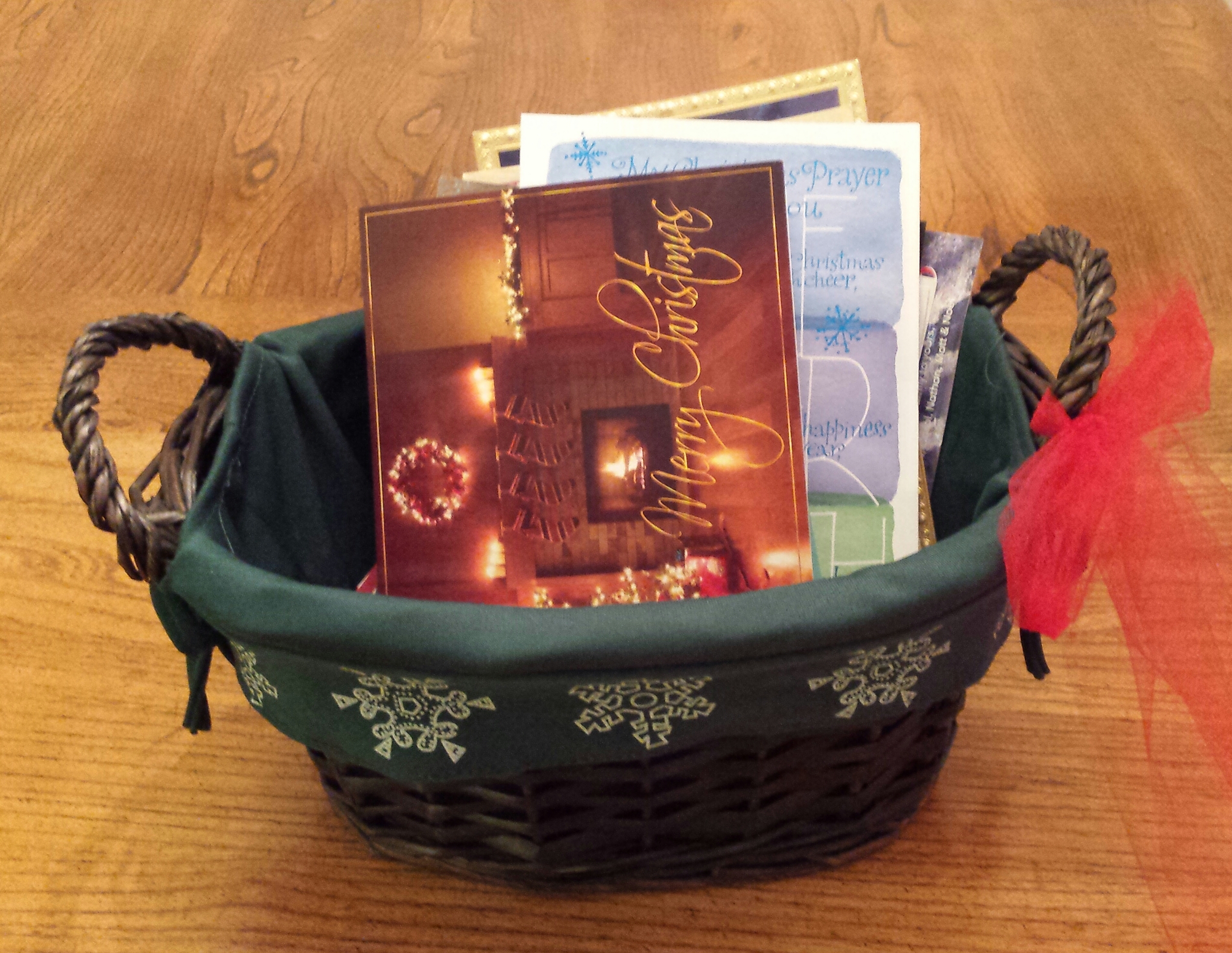
Copyright by Bob Rogers.
Many people enjoy displaying the Christmas cards that they receive during the holiday season, but what do they do with them after the New Year begins? Stick them in a drawer? Throw them away? Several years ago, my wife Mary and I adopted a simple tradition of praying over our Christmas cards in the New Year.
When we receive Christmas cards, we enjoy looking at them, and then put them in a basket. We place the basket on our dinner table, and sometime in early January, we begin to pray for the people who sent each card, one card at a time, one week at a time. Here’s how we do it: On Monday evening when we sit down to eat dinner, we draw a Christmas card from the basket and look to see who sent it. We share memories of that person or family, and needs they may have. Then as we say the blessing for our meal, we include that household in our prayers. We pray for them at each dinner that week. The next week, we draw the next card from the basket, praying for that family each day of that week. We continue the process throughout the year, and sometime in the fall we empty the basket, as we finish praying for all of the people who sent us cards. Then the basket is ready to refill during the next Christmas season!
Many times we have drawn a card and prayed for somebody at just the time that we know that person has a special need. At other times, we have prayed for them with no idea what they are going through, only to learn later that the timing was perfect. Of course, there is no bad time to pray for another person! This simple tradition has been a blessing to us, too. During the busy Christmas season, we have little time to savor each Christmas card when we first receive them, but later in the year, we have a whole week to reflect on each and every one. It’s an easy and meaningful tradition that you could adopt in your own home.
Four lessons learned from the prayers of Jesus

Article copyright by Bob Rogers.
Here are four lessons I have learned from a thorough study of Jesus’ prayer life:
1. The priority of prayer. He made prayer a high priority. Mark 1:35; Luke 5:16; 6:12-13; 11:1. If prayer was so important for Jesus, how much more necessary is it for us?
2. The privacy of prayer. He constantly prayed in private. Matthew 14:22-23; Mark 1:35; Luke 5:16; 9:18. Oh, how we need to get alone with God like Jesus did.
3. The pinnacle prayer principle. He loved to pray on mountains: Matthew 14:23; Mark 6:46; Luke 6:12; 9:28. However, the fact that He often withdrew to “deserted places” (Luke 5:16) shows that the important thing was to be alone in God’s creation. Your place in nature may be a lake, a small garden, or front porch, or backyard swing. Even if you live in a crowded city, you can find a balcony or quiet room to focus your thoughts on God. The point is that Jesus knew that He had to be in a place where His total attention was upon the Father.
4. The people prayer principle. The more people, the shorter the prayer, the fewer people, the longer the prayer. His public prayers were short. Luke 10:21; John 11:41-42; Matthew 27:46. He condemned long prayers for show in Mark 12:40. His longest recorded prayer, John 17, was with a small group, while His longest prayer of all was totally alone (Luke 6:12). Too often we reverse this and pray too long in public and don’t pray enough in private.
How to join prayer with Bible reading, using Psalm 119

Article copyright 2017 by Bob Rogers
“I rise before dawn and cry out for help (prayer);
I put my hope in Your word (scripture).” – Psalm 119:147, HCSB
Prayer and daily Bible reading are both stronger if they are done together, as Psalm 119:147 indicates above by listing them together. In fact, one may use key verses from Psalm 119 to prepare the heart before reading scripture, and to reflect in prayer after reading scripture. Here are the verses, all of them from Psalm 119, a psalm that delights in the Word of God. I encourage you to use the first four verses of preparation, to guide a short prayer time before your daily Bible reading. Then read the scripture. After your Bible reading, instead of setting the scripture aside, keep your Bible in front of you as you then pray the last four verses of application.
1) Preparation. Before reading scripture ask God to:
• V. 18 – open my eyes: “Open my eyes so that I may contemplate wonderful things from Your instruction.”
• V. 66- teach me: “Lord… teach me Your statutes.”
• V. 105 – direct me: “Your word is a lamp for my feet and a light on my path.”
• V. 125- give me discernment: “I am Your servant; give me understanding so that I may know Your decrees.”
2) Application. After reading scripture reflect in prayer on:
• V. 11- a sin to confess: “I have treasured Your word in my heart that I may not sin against You.”
• V. 38- a promise to claim: “Confirm what You said to Your servant…”
• V. 60- a command to obey: “I hurried, not hesitating, to keep Your commands.”
• V. 112- a resolution to make: “I am resolved to obey Your statutes to the very end.”
Print this guide and keep it by your Bible, or write this in the margin of your Bible at Psalm 119, and use it daily in reading scripture. May it aid you to engage your heart, mind and will in your daily devotions.
Bishop Jackson’s Inauguration Prayer for President Trump
Here are the words of Bishop Wayne T. Jackson’s prayer, offered at the inauguration of President Donald J. Trump, January 20, 2017:
We thank You, Father, for letting us share this great moment together. Let us not take for granted the air we breathe, or the life You’ve given us. We were all created by You with one blood, all nations to dwell on this land together. We’re not enemies; we’re brothers and sisters. We’re not adversaries, but we’re allies. We’re not foes, but we’re friends. Let us be healed by the power of Your love, and united by the bond of Your Spirit.
Today, we pray for our 45th president, the vice-president, and their families. Give them the wisdom to guide this great nation, the strength to protect it, and the hands to heal it. We bless President Donald J. Trump. We ask that You give him the wisdom of Solomon, the vision of Joseph, and the meekness of Christ. Solomon, who kept peace among many nations, Joseph, who dreamed better for the people, and Christ who accepted us all. Oh Lord, mend our hearts, and stitch together the fabric of this great country.
In the spirit of the legendary gospel songwriter, Mahalia Jackson,
Deep in my heart, I do believe/ the Lord will see us through, I do believe / We are on our way to victory, I do believe/ we will walk hand in hand, I do believe / We shall live in peace, I do believe/ Oh, deep in my heart, I do believe / America, we shall overcome.
And may the Lord bless and keep America, and make His face shine upon us, and be gracious unto us, and give us peace. In the mighty name of Jesus. Amen.
_________________________________
Read “5 reasons to pray for President Trump (even if you didn’t vote for him)” here: https://bobrogers.me/2017/01/20/bishop-jacksons-inauguration-prayer-for-president-trump/
5 reasons to pray for President Trump (even if you didn’t vote for him)

Article copyright 2017 by Bob Rogers
You and I should pray for President Trump, whether we voted for him or not. Here’s five reasons why:
1. Scripture commands it. Scripture commands us to pray for our leaders. The apostle Paul said, “I urge that petitions, prayers, intercessions and thanksgivings be made for everyone, for kings and for all those who are in authority…” (1 Timothy 2:1-2, HCSB).
2. The Old Testament prophets modeled it. The Old Testament prophets modeled this kind of praying for us. Isaiah said that the Lord “wondered that there was no intercessor” (Isaiah 49:16), Jeremiah wept over the nation, and Ezekiel called for someone to “stand in the gap” (Ezekiel 22:30) on behalf of the nation.
3. The early Christians modeled it. The apostle Peter wrote, “Honor everyone. Love the brotherhood. Fear God. Honor the Emperor” (1 Peter 2:17, HCSB). If first century Christians could pray for a Roman emperor who threw them to the lions, cannot we pray for an elected president with whom we may disagree?
4. When the president does well, we all do well. The prophet Jeremiah wrote a letter to Jewish exiles in Babylon, encouraging them to pray for the king and city that had taken them into exile. He gave them a word from the Lord: “Seek the welfare of the city I have deported you to. Pray to the Lord on its behalf, for when it has prosperity, you will prosper” (Jeremiah 29:7, HCSB). The words “welfare” and “prosper” translate the rich Hebrew word shalom, which means peace and prosperity.
5. God calls us to live in peace, not division. Notice that when Paul urged us to pray for political leaders, he also gave us a reason: “… so that we may lead a tranquil and quiet life in all godliness and dignity” (1 Timothy 2:2b). During the presidency of Barack Obama, African-American pastor Tony Evans pointed out, “What many conservative Christians fail to realize … is that when our first black president, Barack Obama, is dishonored through caricatures, name-calling, or disrespectful talk by white Americans, it merely creates a greater chasm between the races.” (Tony Evans, Oneness Embraced, p. 52). Rev. Evans was exactly right– and the same principle that applied to Obama then applies to Trump now. Evans illustrates what the apostle Paul was talking about– angry words instead of words of prayer for President Trump create chaotic lives, not tranquil lives. One preacher pointed that that if we would pray for the president instead of complain about the president, maybe he would do better.
So I am praying for President Trump, just as I prayed for President Obama and those before them. Will you join me?
If you are wondering what to pray, here are the words prayed by Bishop Wayne T. Jackson at the inauguration of President Trump: https://bobrogers.me/2017/01/20/bishop-jacksons-inauguration-prayer-for-president-trump/
Here are some good thoughts on praying at the inauguration, from the Billy Graham Evangelistic Association: https://billygraham.org/story/inauguration-prayers-billy-graham-franklin-graham/?utm_source=BGEA+facebook&utm_medium=post&utm_campaign=FB+General+Post&utm_content=BGEA+FB+Page&SOURCE=BY150FGEN
You can get into spiritual shape

Article Copyright 2017 by Bob Rogers
Once I met a guy in the gym who had muscles of steel. I was amazed when he told me that he used to be fat, until he decided to get into shape.
First Timothy 4:7-8 says, “Train yourself in godliness, for the training of the body has a limited benefit, but godliness is beneficial in every way, since it holds promise for the present life and also for the life to come.” Many of us are spiritually fat. But just as my friend got physically fit, you can get into spiritual shape. Here’s how:
I. Put your heart into it.
Dotsie Bausch was riding a mountain bike one day when a group of competitive road cyclists flew past her. Dotsie chased them and stayed on their heels for two miles. That night, she told a friend, “This cycling thing, I’m actually pretty decent at it.” Four years later she was on the U.S. national cycling team. Her heart was all in. (Evan Miller, “Dotsie Bausch: Cycling,” Guideposts, July 2012, p. 47-49.)
Ezekiel 18:31. “Throw off all the transgressions you have committed, and get yourselves a new heart and a new spirit.” You must put your heart into it.
II. Remove hindrances.
In football, the offense has a big obstacle. It’s called the defense.
In the spiritual life, sinful obstacles block us, too.
Hebrews 12:1: “… let us lay aside every weight and the sin that so easily ensnares us, Let us run with endurance the race that lies before us.”
Choose to remove the hindrances to your spiritual life, especially sinful lifestyles that have been dragging you down. Do it!
III. Exercise your spirit daily.
There are two major types of exercise: cardiovascular exercise, also known as aerobic exercise, and strength training, which is usually by lifting weights. Healthy athletes have a balance of both. Likewise, you need a balance of spiritual exercises, often called the “spiritual disciplines.” These include Bible reading and prayer, but they also include meditation and memorization of scripture, service and stewardship, worship and witness. A healthy spiritual life develops from regular practice of these spiritual disciplines.
As the apostle Paul says in 1 Corinthians 9:26-27: “Therefore I do not run like one who runs aimlessly or box like one beating the air. Instead, I discipline my body and bring it under strict control, so that after preaching to others, I myself will not be disqualified.”
IV. Keep your eyes on the prize.
Hebrews 12:2 says, “Keeping our eyes on Jesus, the source and perfecter of our faith…”
In 2008, I was about 35 pounds overweight. I was breathing hard just walking to the second floor. My pants were too tight. I didn’t like how I looked. I made a decision to change, and put my heart into it. It was a lifestyle change, as I got serious about exercise, eating right, and sticking with it. Over a year, I took off the weight. Today, nine years later, I have maintained my lower weight and healthier lifestyle.
I had tried fad diets before, but I finally had success when I kept my focus on a goal and stuck with it.
In a much greater way, the same principle applies to your spiritual life.
How about you? Are you getting into spiritual shape? It’s got to start with a change of heart. Are you ready to begin the journey?
How to pray for corrupt politicians

Article Copyright by Bob Rogers
Fiddler on the Roof is a film about changing culture and faith among Russian Jewish families in 1905. In one scene, the village Rabbi was asked if there was a blessing for the czar, who had persecuted the Jews. He replied, “The Lord bless and keep the czar– far away from us!”
We may chuckle at the story, but we still wonder how do we actually pray for bad leaders. We feel a tension between the Biblical command to pray for all those in authority (1 Timothy 2:1-4), and the fact that some of those in authority live ungodly lives and support unrighteous policies.
Cry out to God
Ezekiel cried out to the Lord in distress on behalf of the righteous remnant. “I fell facedown and cried out, ‘Oh, Lord GOD! Are You going to destroy the entire remnant of Israel when You pour out Your wrath on Jerusalem?” (Ezekiel 9:8; see also 11:13). There is nothing wrong with crying out to God about your heart-felt concern. Ezekiel did. But don’t stop there.
Pray for God to work through bad leaders
Habakkuk cried out to the Lord about evil rulers. In Habakkuk 1:2, the prophet described life under the wicked King Jehoiakim this way: “This is why the law is ineffective and justice never emerges. For the wicked restrict the righteous; therefore justice comes out perverted.” Sounds like a modern news report, doesn’t it? God’s first answer to this dilemma comes in the next verses, saying, “Look at the nations and observe– be utterly astounded! For something is taking place in your days that you will not believe when you hear about it” (Habakkuk 1:5). He goes on to describe how God would bring judgment on Jerusalem through the Babylonians.
God often uses nations and rulers for His purpose, even evil rulers. God can hit straight with a crooked stick anytime He wishes. He used King Cyrus of Persia (Isaiah 44:28-45:1) to bring the Jews home from captivity. Daniel 2:21 says, “He removes kings and establishes kings. He gives wisdom to the wise and knowledge to those who have understanding.” Acts 2:23 shows how God even used evil leaders in the crucifixion of Jesus Christ: “Though He was delivered up according to God’s determined plan and foreknowledge, you used lawless people to nail Him to a cross and kill Him.”
Therefore, we can pray for God to work through bad leaders. John F. Kennedy had many extramarital affairs, but God used his courage to stand against communist Russia in Cuba. Richard Nixon was corrupted by the Watergate scandal, yet God used him to open doors with China. We may pray for bad leaders by praying for good to overcome evil, despite their failures and sins.
Watch and pray
Returning to Habakkuk, we find two principles of prayer: expectancy, and faith. First is the principle of expectancy: the prophet finally resolved to be a “watchman” in prayer: “I will stand at my guard post and station myself on the lookout tower. I will watch to see what He will say to me and what I should reply about my complaint” (Habakkuk 2:1). Likewise, we are to watch what happens with rulers, and continually pray, expecting that God will do something. The second principle is faith. The Lord encouraged the prophet to keep watching, and waiting, and then God revealed one of the greatest doctrines of the Bible: “But the righteous one will live by his faith” (Habakkuk 2:4). This verse is quoted repeatedly in the New Testament, reminding us that our salvation comes by faith and trust in the Lord, and Him alone (Romans 1:17, Galatians 2:11 and Hebrews 10:38). As Jesus said, “Watch and pray” (Matthew 26:41; Luke 22:46).
Ask God what you can do
Contemporary Christian singer Matthew West sings about how he saw all kinds of suffering and injustice in the world which disgusted him. Then the singer cried out, “‘God, why don’t you do something?’ He said, ‘I did, I created you!'” (“Do Something” by Matthew West, from the album, Into the Light).
Isaiah gives a similar response to our prayers complaining about bad government. Isaiah prophesied that the Lord would answer their cries when He saw social injustice in the land (Isaiah 58:3-10). The people were fasting and praying for justice. In this passage, God responded to the prayer by calling on His people to put feet to their own prayers. “Isn’t the fast I choose: To break the chains of wickedness… Is it not to share your bread with the hungry, to bring the poor and homeless into your house, to clothe the naked when you see him, and not to ignore your own flesh and blood? Then your light will appear like the dawn… and the LORD’s glory will be your rear guard” (Isaiah 48:6-8). God hears our prayers for justice to overcome evil, and He nudges us to get personally involved in fighting injustice. Pray for bad leaders by deciding to do something good yourself! You can vote for pro-life candidates, but don’t stop there; volunteer at a crisis pregnancy center. You can vote for candidates who support the police and who fight for racial justice, but don’t stop there; show your kindness and speak up against mistreatment of the police and mistreatment of those of other races.
Conclusion
So what does all of this mean to us today? It means that no matter who occupies the White House, the State House or the courthouse, God is on His throne, and He is in control. It means that while we pray for and support godly leaders, we also pray for God to work His will through ungodly leaders. It means that we put our trust in the Lord, not in earthly leaders. It means that instead of just complaining about evil, we need to ask God what good we can do ourselves. Then we need to get up from our prayers, and do something good in the name of Jesus.
Prayer for Bad Politicians
O God, I cry out to You for my nation. You told us to pray for kings and all those in authority, but how do I pray for bad politicians? The wicked restrict the righteous, and justice comes out perverted. God, do something new! Lord, You remove kings and establish kings; You even used an unbelieving King, Cyrus of Persia, to rescue Your people from exile. Knowing this, Lord, I ask that you either remove bad leaders from their positions, or work through bad leaders to do good. Lord, I will watch and pray for You to work through our nation. I will keep my eye on our leaders to pray for them, but I will keep my faith in You, for my hope is in You, not in politicians. Lord, I ask that You to give me wisdom to vote my values, that You give me courage to volunteer my time and that You give me generosity to donate my money to those who are overcoming evil with good. In the Name of the Righteous Judge. Amen.


 Bob Rogers