Blog Archives
7 signs of a healthy church

Copyright 2017 by Bob Rogers
Outreach magazine publishes a list of the 100 largest churches in America and the 100 fastest-growing churches in America.
But when we read about the church in the New Testament, we don’t read Paul reporting to the church that when he left Ephesus they were running 200 in Sunday worship. Instead of talking about numerical growth, he emphasizes spiritual growth. So why don’t we?
Instead of so much emphasis on church growth, we should talk about church health. So what makes a church healthy, anyway? Paul gives us a full description in Ephesians 4:11-16.
1. Leaders who equip
“And He personally gave some to be apostles, some prophets, some evangelists, some pastors and teachers…” (Ephesians 4:11, HCSB)
Just as healthy medicine requires a good doctor to make a diagnosis, healthy churches have leaders who equip their members.
In this verse, the last two leadership gifts are indispensable to local church health. In Greek, the terms go together, “pastor-teacher.”
Pastors (translated “shepherds” in the ESV) bring guidance and comfort to the flock of God.
Teachers instruct the church in correct understanding of the Bible and Christian living.
Notice in verse 12 that these leaders have the purpose of training, or equipping, the church to do their work.
If a church is going to be healthy, it must have a pastor/teacher who is feeding the congregation God’s Word on a consistent basis.
2. Members who serve
“… for the training of the saints in the work of ministry, to build up the body of Christ…” (Ephesians 4:12, HCSB)
Just as good hospitals have nurses everywhere who serve, healthy churches have members who serve. Churches that grow rapidly from sensational entertainment often burst like a balloon and wither away. But when members serve, they reproduce healthy growth.
The “saints” are all the believers. “Saint” means a “holy one,” and every believer is called to be holy and set aside for God’s service.
It says the saints are trained by the leaders so that the saints can do the work of the ministry. So all members are called to serve.
3. Unity in the faith
“… until we all reach unity in the faith and in the knowledge of God’s Son…” (Ephesians 4:13a, HCSB)
Just as medical staff work in coordination during a surgery, healthy churches are united and cooperate. Unhealthy churches are divided and refuse to cooperate. Notice the two ways he says we are to be united: by doctrinal faith (“in the faith”) and by personal faith (“and in the knowledge of God’s Son”).
Remember the lesson from Noah’s Ark. It may stink sometimes, but we have to stay together, because we’re all in the same boat!
4. Growth measured by Christ-likeness
“… growing into a mature man with a stature measured by Christ’s fullness.” (Ephesians 4:13b, HCSB)
We take vital signs to check physical health: temperature, pulse, respiration, blood pressure. Too often, churches measure themselves by numerical growth, but that’s the wrong vital sign. A tumor can grow, but it isn’t healthy. And some churches explode and then die down. Others grow and grow in numbers, but they are attracting people for entertainment or because their standards are lax, and people are not being discipled.
Notice that verse 13 gives the correct measurement of real growth: “a stature measured by Christ’s fullness.” That is our measurement of growth: are we like Christ? If our budget grows but we spend our budget on a bowling alley for church members instead of helping the hurting and sharing the gospel, we may be growing in numbers but not in Christ-likeness.
Healthy churches measure growth by being more like Christ.
5. Teaching that provides stability
“Then we will no longer be little children, tossed by the waves and blown around by every wind of teaching, by human cunning with cleverness in the techniques of deceit.” (Ephesians 4:14, HCSB)
The last thing a sick person needs is a “quack” doctor. Likewise, a healthy church guards against heresy and false teaching. Instead, the Bible is so consistently taught, that the members aren’t tricked by “quack” preachers and teachers.
Years ago, a powerful wind storm blew an oak tree on the youth building of the church where I was pastor. The tree had shallow roots, and when the winds came, it fell. A healthy church that teaches the Bible is like a healthy tree with deep roots. It doesn’t fall under the pressure of false teaching.
6. Honest and loving relationships
“But speaking the truth in love, let us grow in every way into Him who is the head– Christ.” (Ephesians 4:15, HCSB)
People often say to their physician, “tell it to me straight, doc.” They want a doctor they can trust who cares enough to be honest with them. Healthy churches have honest and loving relationships. “Speaking the truth in love” means that we are honest with each other, we speak the truth, but we are also loving when we do it. We don’t just try to please each other. If something’s wrong, we deal with it, but we always seek to deal with it in love. That’s challenging, but it’s vital to having a healthy church.
7. An environment that encourages involvement
“From Him the whole body, fitted and knit together by every supporting ligament, promotes the growth of the body for building up itself in love by the proper working of each individual part.” (Ephesians 4:16, HCSB)
A hospital strives to maintain a healthy environment, washing hands, putting on gloves, etc. Healthy churches create an environment that encourages involvement. “From Him (Jesus) the whole body, fitted and knit together… promotes the growth of the body…”
Many people think that it doesn’t matter if they are involved in the church or not, that the church won’t miss them if they are gone. Nothing could be farther from the truth.
A healthy church is a church where misfits can fit in. A healthy church is a place where the displaced can find a place.
This world is in desperate need of healthy churches in every community. Christian, are you allowing God’s Spirit to work through you to make and keep your church healthy?
How do I deal with the suicide of someone I love?

Article copyright 2017 by Bob Rogers
“What then shall we say to these things? If God is for us, who can be against us?
Who shall separate us from the love of Christ? Shall tribulation, or distress, or persecution, or famine, or nakedness, or danger, or sword?
No, in all these things we are more than conquerors through him who loved us. For I am sure that neither death nor life, nor angels nor rulers, nor things present nor things to come, nor powers, nor height nor depth, nor anything else in all creation, will be able to separate us from the love of God in Christ Jesus our Lord.” — Romans 8:31,35, 37-39 (ESV)
Why did he or she commit suicide? Could I have done something to prevent it? Most of us have asked these questions when someone we love has committed suicide. While there are no easy answers, the Bible gives us help in this time of grief.
Let me suggest several truths that can help.
1) Guard against being judgmental.
This is not a time to judge the friends, family, and certainly not a time to judge the one who took his or her life. No one knows the pressures or problems another person faces. Jesus taught us, “Judge not, lest you be judged.” (Matthew 7:1, KJV) It will not help to judge others, nor to judge yourself.
You may have repeated the word “if.” If only I (or someone else) had said something or done something different, perhaps she or he would not have taken that precious life. Martha used the word “if.” In John 11, Mary and Martha’s brother Lazarus was dying and they sent for Jesus to heal him, but Lazarus died before Jesus arrived. In John 11:21, “Martha said to Jesus, ‘Lord, if you had been here, my brother would not have died.'” But “if” is about the past. “If” cannot bring the loved one back, and it will not help us in the present.
Instead of asking “why?” or wondering “if,” we need to ask “what.” What can I do now? Jesus told Martha what she needed: “I am the resurrection and the life. Whoever believes in me, though he die, yet shall he live.” (John 11:25, ESV)
So instead of asking, “why,” let’s ask “what.” What can we do to be better because of this?
2) Hold on to our hope in Christ.
There is no point in ignoring the elephant in the room. So let’s address the matter directly. Is suicide a sin? Yes, it is. Is suicide the unpardonable sin? No, it is not. There are so many reasons why we should not take our own lives, which I will discuss in a moment, but the Bible does not teach that suicide cannot be forgiven. Mark 3:28-30 says that all sins can be forgiven, except for blasphemy against the Holy Spirit. Blasphemy against the Holy Spirit refers to rejecting the Spirit’s call on us to follow Christ; this is not referring to taking one’s own life.
Our salvation is not based on the way we die, but based on the One who died for us.
3) God brings good out of the bad.
When Jesus died on the cross, the disciples thought their world had come to an end, and Jesus had been defeated. But instead, God was using it to forgive our sins, and then God raised Jesus from the dead to pave the way for us to have eternal life. God is in the business of bringing good out of bad!
Suicide is a permanent solution to a temporary problem. Jesus Christ is the permanent solution who makes our problems temporary!
“So we do not lose heart. Though our outer self is wasting away, our inner self is being renewed day by day. For this light momentary affliction is preparing for us an eternal weight of glory beyond all comparison, as we look not to the things that are seen but to the things that are unseen. For the things that are seen are transient, but he things that are unseen are eternal.” (2 Corinthians 4:16-18, ESV)
4) Let’s examine our own lives.
Life is a gift. We should not waste our lives by suddenly taking it, or by wasting it slowly by degrees, with meaningless living. Make your days count. Hug your children. Hug your parents. Say, “I love you.” Listen to one another. Reach out for help when you are in despair. Talk about your problems. We have a choice to be bitter or better because of this. If we can draw closer together as a community and with our families, we can be better.
Storms will come in our lives, but those who withstand are those who have strong roots. Years ago, a powerful storm blew down an oak tree in front of the youth center at the church where I was pastor. It crushed the roof and did major damage. Thankfully, it happened at night when nobody was inside. The reason it happened was that tree did not have deep roots. A tree that has deep roots can withstand a bigger storm.
The way you get deep roots is by a personal relationships with Jesus Christ as your Lord and Savior. As you grow in your relationship with Him by faith, your roots get deeper and deeper, and you are more able to stand against the storms of life.
We will never understand all of the reasons why there is tragedy in life, but if we are rooted in Christ, we can hold on despite the tragedies we face.
The contemporary Christian group, 4Him, wrote a song about the tragic death of a friend, saying,
“When the reasons aren’t clear to me
When it all is a mystery
I want to know why.
And though down here I may not understand
I won’t let go of the Unseen Hand
For it holds the reasons why.”
Hold on to that Unseen Hand, my friend. He will be there for you.
Top blog posts in 2016
In case you missed them, here were my top blog posts and top new blog posts in 2016, in order of the most visits:
TOP THREE POSTS OF 2016:
1. Blessing the food: ways to say “Grace”: https://bobrogers.me/2013/10/25/blessing-the-food-ways-to-say-grace-before-meals/
2. Four great truths from the creation account in Genesis: https://bobrogers.me/2013/10/14/four-great-truths-from-the-creation-account-in-genesis/
3. Why I am changing Bible translations: https://bobrogers.me/2012/04/17/why-i-am-changing-bible-translations/
TOP THREE NEW POSTS OF 2016:
1. In this weird political year, be a patriotic prayer warrior! https://bobrogers.me/2016/05/05/be-a-patriotic-prayer-warrior/
2. Twisted scripture: “by His stripes, we are healed”: https://bobrogers.me/2016/08/07/twisted-scripture-by-his-stripes-we-are-healed/
3. Twisted scripture: “God doesn’t put on you more than you can handle”: https://bobrogers.me/2016/06/10/twisted-scripture-god-doesnt-put-on-you-more-than-you-can-handle/
The wonder of the Christ child

Article copyright 2016 by Bob Rogers
Barbara Robinson writes in her book, The Best Christmas Pageant Ever, about a Sunday School Christmas pageant. One child heard from Isaiah 9:6 that the Christ child’s name would be “Wonderful Counselor, Mighty God, Everlasting Father, Prince of Peace.” Wide-eyed, she responded, “He’d never get out of the first grade if he had to write all that.”
Perhaps we need to return to this familiar prophetic title with the same wonder of a child. We will see:
As Wonderful Counselor, Christ takes away our gloom.
As Mighty God, Christ takes away our doom.
As Everlasting Father, Christ adopts us all.
As Prince of Peace, Christ takes down the wall.
In the verses before Isaiah 9:6, we see how meaningful this really is…
I. Wonderful Counselor takes away our gloom
Isaiah 9:1 says “the gloom of the distressed will not be like that of the former times.” In this world, we often live in gloom and sorrow, but Christ takes it away. Our Wonderful Counselor listens with compassion, helps us see matters in a new light, confronts us with the truth, and guides us in the right way.
II. Mighty God takes away our doom
Isaiah 9:2 says, “The people walking in darkness have seen a great light; on those living in the land of the shadow of death a light has dawned.” Because of our sin, we are living in the land of death, headed to a sinner’s hell. But the Christ child is more than a sweet baby; He is God in flesh, and able to save us from our sins by His sacrifice on the cross. He came to earth, so that we may go to heaven.
III. Everlasting Father adopts us all
Isaiah 9:4 speaks of the oppression and burdens of the people, who have no one to protect them. But God is a good Father, and His Son Jesus has come to adopt us all. When I say, “adopts us all,” I don’t mean to imply universal salvation; I’m speaking poetically of all who trust the blood of Christ, and then are adopted into God’s family, as if we were blood brothers and sisters. “I will not leave you as orphans,” Jesus promised in John 14:18.
IV. Prince of Peace takes down the wall
Isaiah 9:5 speaks of the blood of war, from which Christ came to bring peace. He takes down the wall of sin (Isaiah 59:2), so that nothing separates us from God (Romans 8:38-39). He takes down the wall that separates us from our brothers and sisters in Christ: “For He is our peace, who made both groups one and tore down the dividing wall of hostility” (Ephesians 2:14).
When missionary Don Richardson was trying to explain the gospel to a remote tribe, they could not understand the incarnation of God in flesh or the atonement of Christ upon the cross. But then he learned that when tribes wanted to make peace, they would exchange children to grow up in the other tribe. That was it! He explained that Jesus is our “Peace Child,” the Son of God, born as a Son of Man to make peace through His flesh.
Isaiah prophesied of the Messiah’s birth long ago. As you celebrate His birth, you can also be born again by faith (John 3:3). Have you?
God’s Christmas letters to you

Article copyright 2016 by Bob Rogers
People enjoy getting Christmas cards and personal letters from old friends at Christmas. But did you know that God has Christmas letters for you, as well? We can easily spell C-H-R-I-S-T-M-A-S from the New Testament:
C- Clay. “We have this treasure in jars of clay” (2 Corinthians 4:7). As amazing as wrapping Jesus’ body in human flesh, is that He passes on the treasure of this gospel to humans to share, in our fleshly “jars of clay.”
H- Humble. “He humbled Himself, taking on the form of a man” (Philippians 2:5-11). Jesus chose to empty His glory for a time, mysteriously humbling Himself in human form.
R- Rich. “He was rich but for your sake became poor” (2 Corinthians 8:9). The Creator of the universe was born in a stable to offer the riches of salvation to us.
I- Image. “He is the image of the invisible God” (Colossians 1:15). Jesus is God in flesh!
S- Son. “God sent His Son.” (Galatians 4:4).
T- Thanks. “Thanks be to God for His indescribable gift” (2 Corinthians 9:15). No gift you get for Christmas can be better than God’s gift of Jesus.
M- Manger. “And this will be a sign for you: you will find a baby wrapped in swaddling cloths and lying in a manger” (Luke 2:12.
A- Angel. “And the angel answered her, ‘The Holy Spirit will come upon you… therefore the child to be born will be called holy– The Son of God'” (Luke 1:35).
S- Savior. “For unto you is born this day in the city of David a Savior, who is Christ the Lord” (Luke 2:11).
Do dogs have a soul and go to heaven?

Copyright 2016 by Bob Rogers
Question from Anna:
I hope I can get your opinion on this: do dogs have a soul and do they go to heaven?
Answer from Dr. Rogers:
Anna, Genesis 1:27 says that humans are made in God’s image, and Genesis 2:7 says that when God made Adam, the man became a living soul. However, nowhere does the Bible say that animals have souls.
Several passages in scripture imply that animals will be in heaven, such as Isaiah 11:6 which describes a future paradise of the wolf and lamb, leopard and goat, calf and lion living together in peace. Revelation 21:1 says there will be a new heaven and new earth in the last days, so I believe God will have animals in heaven for the enjoyment of mankind. However, animals are not made in the image of God nor do they have souls like human beings, for only human beings can have a personal relationship with God through faith in Jesus Christ.
What does the Bible teach about living together?

Copyright by Bob Rogers
Question from April:
Can you tell me where it talks about living together before marriage? Not sex. Just living together? We are talking with my son this weekend and we can’t find it. Thank you ;)
Answer from Dr. Rogers:
I don’t believe there are many couples living together who aren’t also having sex. But the sin is the sexual immorality before marriage. Hebrews 13:4 says, “Marriage must be respected by all, and the marriage bed kept undefiled.”
If a couple were in the same household under the supervision of parents, it might be different, although just sleeping in the same house puts them in a very tempting situation.
The other problem with living together, is that even if a couple was not sexually active, everybody would assume they were, and Ephesians 5:3 says that there should not even be a “hint” of sexually immorality among you. So it harms their Christian testimony.
In addition to the Biblical reasons, there are psychological and social reasons why cohabitation is a bad idea. Couples think they are “trying out” marriage by living together, but it is impossible to “try out” marriage, because marriage is a commitment, and there is no commitment to living together. Either party can leave at any time, so it is not really a test of marriage. And studies show that people who live together before marriage are 50% more likely to get divorced than those who do not. Why is this? Well, if they don’t respect the bonds of marriage before marriage, why should they respect the bonds of marriage after they are married?
There are other legal problems that result from living together unmarried. If your significant other is critically ill and unable to communicate, and the family needs to make medical decisions about their care, such as whether or not to remove your loved one from life support, you will have no legal rights, because you are not legal family. And if your significant other dies, you will have no inheritance rights, since you are not married. Simply put, if you make no commitment, then you have no rights!
How to pray for corrupt politicians

Article Copyright by Bob Rogers
Fiddler on the Roof is a film about changing culture and faith among Russian Jewish families in 1905. In one scene, the village Rabbi was asked if there was a blessing for the czar, who had persecuted the Jews. He replied, “The Lord bless and keep the czar– far away from us!”
We may chuckle at the story, but we still wonder how do we actually pray for bad leaders. We feel a tension between the Biblical command to pray for all those in authority (1 Timothy 2:1-4), and the fact that some of those in authority live ungodly lives and support unrighteous policies.
Cry out to God
Ezekiel cried out to the Lord in distress on behalf of the righteous remnant. “I fell facedown and cried out, ‘Oh, Lord GOD! Are You going to destroy the entire remnant of Israel when You pour out Your wrath on Jerusalem?” (Ezekiel 9:8; see also 11:13). There is nothing wrong with crying out to God about your heart-felt concern. Ezekiel did. But don’t stop there.
Pray for God to work through bad leaders
Habakkuk cried out to the Lord about evil rulers. In Habakkuk 1:2, the prophet described life under the wicked King Jehoiakim this way: “This is why the law is ineffective and justice never emerges. For the wicked restrict the righteous; therefore justice comes out perverted.” Sounds like a modern news report, doesn’t it? God’s first answer to this dilemma comes in the next verses, saying, “Look at the nations and observe– be utterly astounded! For something is taking place in your days that you will not believe when you hear about it” (Habakkuk 1:5). He goes on to describe how God would bring judgment on Jerusalem through the Babylonians.
God often uses nations and rulers for His purpose, even evil rulers. God can hit straight with a crooked stick anytime He wishes. He used King Cyrus of Persia (Isaiah 44:28-45:1) to bring the Jews home from captivity. Daniel 2:21 says, “He removes kings and establishes kings. He gives wisdom to the wise and knowledge to those who have understanding.” Acts 2:23 shows how God even used evil leaders in the crucifixion of Jesus Christ: “Though He was delivered up according to God’s determined plan and foreknowledge, you used lawless people to nail Him to a cross and kill Him.”
Therefore, we can pray for God to work through bad leaders. John F. Kennedy had many extramarital affairs, but God used his courage to stand against communist Russia in Cuba. Richard Nixon was corrupted by the Watergate scandal, yet God used him to open doors with China. We may pray for bad leaders by praying for good to overcome evil, despite their failures and sins.
Watch and pray
Returning to Habakkuk, we find two principles of prayer: expectancy, and faith. First is the principle of expectancy: the prophet finally resolved to be a “watchman” in prayer: “I will stand at my guard post and station myself on the lookout tower. I will watch to see what He will say to me and what I should reply about my complaint” (Habakkuk 2:1). Likewise, we are to watch what happens with rulers, and continually pray, expecting that God will do something. The second principle is faith. The Lord encouraged the prophet to keep watching, and waiting, and then God revealed one of the greatest doctrines of the Bible: “But the righteous one will live by his faith” (Habakkuk 2:4). This verse is quoted repeatedly in the New Testament, reminding us that our salvation comes by faith and trust in the Lord, and Him alone (Romans 1:17, Galatians 2:11 and Hebrews 10:38). As Jesus said, “Watch and pray” (Matthew 26:41; Luke 22:46).
Ask God what you can do
Contemporary Christian singer Matthew West sings about how he saw all kinds of suffering and injustice in the world which disgusted him. Then the singer cried out, “‘God, why don’t you do something?’ He said, ‘I did, I created you!'” (“Do Something” by Matthew West, from the album, Into the Light).
Isaiah gives a similar response to our prayers complaining about bad government. Isaiah prophesied that the Lord would answer their cries when He saw social injustice in the land (Isaiah 58:3-10). The people were fasting and praying for justice. In this passage, God responded to the prayer by calling on His people to put feet to their own prayers. “Isn’t the fast I choose: To break the chains of wickedness… Is it not to share your bread with the hungry, to bring the poor and homeless into your house, to clothe the naked when you see him, and not to ignore your own flesh and blood? Then your light will appear like the dawn… and the LORD’s glory will be your rear guard” (Isaiah 48:6-8). God hears our prayers for justice to overcome evil, and He nudges us to get personally involved in fighting injustice. Pray for bad leaders by deciding to do something good yourself! You can vote for pro-life candidates, but don’t stop there; volunteer at a crisis pregnancy center. You can vote for candidates who support the police and who fight for racial justice, but don’t stop there; show your kindness and speak up against mistreatment of the police and mistreatment of those of other races.
Conclusion
So what does all of this mean to us today? It means that no matter who occupies the White House, the State House or the courthouse, God is on His throne, and He is in control. It means that while we pray for and support godly leaders, we also pray for God to work His will through ungodly leaders. It means that we put our trust in the Lord, not in earthly leaders. It means that instead of just complaining about evil, we need to ask God what good we can do ourselves. Then we need to get up from our prayers, and do something good in the name of Jesus.
Prayer for Bad Politicians
O God, I cry out to You for my nation. You told us to pray for kings and all those in authority, but how do I pray for bad politicians? The wicked restrict the righteous, and justice comes out perverted. God, do something new! Lord, You remove kings and establish kings; You even used an unbelieving King, Cyrus of Persia, to rescue Your people from exile. Knowing this, Lord, I ask that you either remove bad leaders from their positions, or work through bad leaders to do good. Lord, I will watch and pray for You to work through our nation. I will keep my eye on our leaders to pray for them, but I will keep my faith in You, for my hope is in You, not in politicians. Lord, I ask that You to give me wisdom to vote my values, that You give me courage to volunteer my time and that You give me generosity to donate my money to those who are overcoming evil with good. In the Name of the Righteous Judge. Amen.
The right question to ask of Job

Copyright 2016 by Bob Rogers
“Should we accept only good from God and not adversity?” (Job 2:10, HCSB)
Last week, I met a man who wanted to give up on life. I asked him if he knew the story of Job, from the Bible. He said he had a Bible somewhere, but had never heard of Job. So I gave him the short version of the story: Job was a good man who worshiped God, but he lost everything. Bandits stole his property, a storm killed his children, and then his skin broke out in painful sores. His wife told him, “Curse God and die.” When I said this, my new friend raised his eyebrows, and wanted to know what happened next. I explained that Job refused to curse God. Then his three friends came to comfort him, but instead of comforting him, they tried to defend God. They said Job must have sinned, and that was why God was allowing him to suffer. Job objected, saying he didn’t deserve his suffering. In the end, God spoke to Job, and restored his fortunes.
The wrong question to ask of Job
Many people go to the book of Job looking for the answer to why people suffer. Unfortunately, the only answers they find are negative:
Job’s suffering was not because God was angry or punishing him. Bildad, one of Job’s friends, accused him of this. He implied that Job must have forgotten God, so God forgot him (Job 8:13). But Bildad was wrong! God specifically said in Job 1:8 and 2:3, “Have you considered My servant Job? No one else on earth is like him, a man of perfect integrity, who fears God and turns away from evil.”
Job’s suffering was not because Job sinned. Bildad said that Job’s children died because of their sin (8:3), and Zophar, another one of Job’s friends, accused Job himself of being so sinful that “God has chosen to overlook some of your sins” (11:6). But they were wrong! Job 2:10 says, “Throughout all of this Job did not sin in what he said.”
Job’s suffering was not answered by God, either. After the long debates between Job and his friends, the Lord Himself answered Job from the whirlwind in chapters 38-41. But if you read those chapters to find an answer to suffering, you will be disappointed. It’s not there. Instead, God turns the questions on those who have been asking questions. “Where were you when I established the earth? Tell Me, if you have understanding,” God asks (38:4). Then the Lord lists the amazing traits of His creation, and asks if Job can explain all of that. The point is blunt: We do not know all there is to know. Only God does. We cannot understand God. As the Lord proclaimed through the prophet Isaiah, “For as heaven is higher than earth, so My ways are higher than your ways, and My thoughts than your thoughts” (Isaiah 55:9).
So what is the answer to suffering? The Book of Job doesn’t answer that question. In fact, it’s the wrong question to ask.
The right question to ask of Job
The question to ask is not, Why is there suffering? The question to ask is, What do suffering people need to do? The Book of Job has hope-filled answers to this question.
First, hold on to faith. Despite his losses and sorrow, Job fell to the ground and worshiped, saying, “Naked I came from my mother’s womb, and naked I will leave this life. The Lord gives, and the Lord takes away. Praise the name of Yahweh” (1:21). Later, in the middle of his debates with his friends, Job says, “Even if He kills me, I will hope in Him.” This doesn’t fit with the so-called “prosperity gospel” that says if you just have faith, all will go well. No, this is a real-world faith, that holds on to God’s hand, even when it cannot see His plan.
Second, live in integrity. Satan, the old accuser before the Lord, said that Job would curse God if Job suffered. But Satan was wrong. This is one of the major points of the book. The word “integrity” is repeatedly used to describe Job. Notice the question Job’s wife asks: “Do you still retain your integrity? Curse God and die!” (2:9) But Job rejects her suggestion as foolish, saying, “Should we accept only good from God and not adversity?” (2:10) We read in James 2:2-4 to consider it joy when we face trials, because God uses it to produce maturity in us. It has been my observation as a hospital chaplain, that suffering generally reveals the attitude that is already in a person. I’ve seen people handle horrible physical problems with grace and peace, while others with lesser physical ailments complain and are bitter. We choose how we will respond. Job set a standard, choosing to live in integrity.
Third, hope in the Savior. One of the greatest cries of faith comes in the midst of the greatest pain, when Job says, “Even now my witness is in heaven, and my advocate is in the heights!… But I know my living Redeemer, and He will stand on the dust at last. Even after my skin has been destroyed, yet I will see God in my flesh” (16:19; 19:25-26). Long before Jesus Christ came, Job caught a vision of the Redeemer, who would die on the cross for our sins, and be our advocate before God the Father (Romans 8:34; 1 Timothy 2:5).
There is an fable about a poor man who had a valuable horse. People told him that he should sell his horse, so he wouldn’t be poor, but he refused. Then the horse ran away, and the people asked, “Why didn’t you sell it when you could? The man said, “Don’t say that. All you can say is the horse ran away.” Later, the horse returned, with 20 wild horses, and the man suddenly became the owner of 21 valuable horses. This time they said, “We were wrong! Now we know why the horse ran away; it was to bring you riches later.” The man said, “Don’t say that. All you can say is the horse returned with more horses.” Then the man’s son broke his leg, trying to tame one of the wild horses. The people said, “Why did you keep the wild horses? Now your son has a broken leg.” The man said, “Don’t say that. All you can say is my son broke his leg.” Then their country went to war against a larger, more powerful nation, and the army came to their town, forcing all of the young men to join the army, except for the son of the man with the wild horses. The people said, “Now we know why his leg was broken, to spare him from dying in the war.” Once again, the man said, “Don’t say that. We don’t know why. All we can say is my son did not have to go to war.”
Thus the question we need to ask is not why? but what? Not, Why do people suffer? but What do suffering people need to do? Even if we knew the answer to why, it would not help us do anything different. But the answer to the second question gives us hope and purpose that we can put into action. Because our Redeemer lives, we even after our skin is destroyed, we shall see God!
Book review: “Snoop: A Spiritual Memoir of a Vietnam Army Grunt”
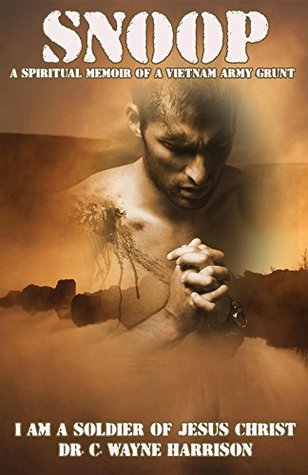
Snoop: A Spiritual Memoir of a Vietnam Army Grunt (Published by Parables, 2016), by C. Wayne Harrison, is a 98-page book that tells stories of war, grouped together for devotional reflection. That may sound like an unusual approach, but Harrison makes it work.
Harrison was a private in the U.S. Army, who fought in the jungles in the Vietnam War in 1969-1970. Today he is Baptist minister in Booneville, Mississippi. In ten short chapters, he recalls his desire to be a soldier and relates in vivid detail the horrors he experienced in the war. Although the stories tend to move chronologically from early in his life through his year in Vietnam, the chapters are more thematic in nature, with titles such as, “The Heart of a Soldier,” “The Hands of a Soldier,” “The Hardships of a Soldier,” etc. Each chapter opens with a passage from the Bible, then focuses on stories that relate to the theme of the chapter, followed by some discussion questions and a prayer.
The reader identifies with the young man, who is nicknamed “Snoop” because of his lapel pin of Snoopy, the dog who imagined he was a fighter pilot, in the “Peanuts” comic strip. Some descriptions of war in the book may be disturbing to young readers, and the stories certainly are sobering even to mature readers. I believe Harrison’s writing will connect well with soldiers who read the book, and would make an excellent resource for military chaplains or anybody, especially soldiers, who are willing to reflect on God’s purpose for their lives.
The book is well-written, using excellent images and descriptions, and is easy to read, although I noticed a typo on p. 64, where the word “scar” was spelled “scare.” There are black-and-white photos of Harrison as a young soldier in the back of the book. In interest of full disclosure, I received a complimentary copy of this book from the author, with no obligation to write a favorable review.
Twisted scripture: “by His stripes we are healed”
Copyright 2016 by Bob Rogers

(NOTE: This is the fifth blog post in a series on scriptures commonly misinterpreted.)
But He was wounded for our transgressions,
He was bruised for our iniquities;
The chastisement for our peace was upon Him,
And by His stripes we are healed. – Isaiah 53:5, NKJV
I often meet people praying for the sick who claim Isaiah 53:5 as a promise that God will heal any sickness if they pray for it in faith. Their logic is straightforward: the prophet said that the Messiah would be crucified for our sins, “and by His stripes we are healed.” Thus, they conclude, the verse is saying that Jesus’ cross has two effects: first, Christ paid for our sins, and second, He also heals our diseases, if we pray in faith. After all, they reason, didn’t Jesus say, “Your faith has made you well?” (Mark 5:34).
Is this really what Isaiah 53:5 is teaching? Does it teach a two-part effect of the cross: a healing from both sin and sickness? This interpretation fails to take into consideration the kind of Hebrew poetic writing used here, often called Hebrew parallelism. That is, the Hebrew poet frequently says the same thing twice in slightly different ways, for emphasis. We see this in many psalms, such as, “While I live I will praise the Lord; I will sing praises to my God while I have being” (Psalm 146:2). If this is Hebrew parallelism, then the second part means the same thing as the first part, and the first part says the Messiah was wounded for our transgressions, not our sickness. But what if this is not Hebrew parallelism?
Here is where we need to apply a very important but often neglected principle of Bible interpretation: scripture itself is the best interpreter of other scripture. So what does the rest of the Bible say on this subject?
The New Testament frequently discusses the effect of the cross of Jesus Christ. Romans 3:24-25 speaks of how Jesus’ blood justifies us from sin, redeems us from sin, and presents Jesus as a sacrifice for our sin. Ephesians 1:7 says His blood gives us forgiveness from our sin. Colossians 1:20-22 says Jesus made peace through the blood of His cross, in order to present you “holy and blameless” before God. Many other scriptures talk about how the cross of Christ offers salvation from sin, but nowhere does the New Testament say that the cross of Christ brings healing from sickness.
Is Isaiah 53:5 directly quoted anywhere else in the Bible? Yes, it is, in 1 Peter 2:24. Here it is:
“Who Himself bore our sins in His own body on the tree, that we, having died to sins, might live for righteousness—by whose stripes you were healed.”
If Isaiah 53:5 was intended to be a prophecy that Jesus’ cross would heal from sickness as well as sin, then when Peter quoted that very same verse, surely Peter would have mentioned the effect of the cross on sickness. Yet it is not there. Read the verse again. It says Jesus “bore our sins in His own body…” It continues, “that we, having died to sins, might live for righteousness.” After making reference to sin twice, Peter then quoted Isaiah 53:5: “by whose stripes you were healed.” There is no question what kind of healing Peter understood Isaiah to mean. He already said it twice: healing from our sins.
Remember this important principle: the best interpreter of scripture is other scripture, not a human preacher or teacher. Should we pray for the sick? Yes, we are commanded to do so (Matthew 10:8; James 5:14). Is God able to heal the sick? Yes, and He often chooses to do so, although not always (Acts 5:16; 2 Corinthians 12:7-10). However, does Isaiah 53:5 teach that the cross of Christ is a promise of physical healing for us to claim in faith? Based on the interpretation of scripture itself, we can only conclude that it is a promise for one type of healing– the greatest kind of all– from our sin.
Twisted scripture: “the truth shall make you free”
Copyright 2016 by Bob Rogers

(NOTE: This is the fourth blog post in a series on scriptures commonly misinterpreted.)
President James A. Garfield said, “The truth will set you free, but first it will make you miserable.” The president was making a humorous allusion to the famous words of Jesus in John 8:32.
Unfortunately, this Bible verse is often taken out of context John 8:32: “And you shall know the truth, and the truth shall make you free.” This verse is engraved on courthouse entrances, implying that if a wise court can grant freedom by finding truth. This verse is cited by educators to say that knowledge is freedom, and it is quoted by investigative reporters who believe that freedom can be found in digging up the truth. While all of these are worthy goals, these interpretations ignore the verse immediately before it. So let’s read it again, this time in context:
Then Jesus said to those Jews who believed Him, “If you abide in My word, you are My disciples indeed. And you shall know the truth, and the truth shall make you free.” (John 8:31-32, NKJV)
What a difference verse 31 makes! This verse gives us the audience to whom Jesus was speaking, and the conditions Jesus laid down to know truth and freedom. Notice what they are:
1. The audience. The audience who first heard these words were believers. Jesus “said to those Jews who believed Him…” Thus this promise is not intended for the general public. It is a promise for those who believe in Jesus Christ. Yet there is more.
2. The conditions. Jesus laid down two conditions to knowing truth and freedom. They link together like links in a chain. First, “If you abide in My word.” The first link is to continually study and obey the words of Christ. The second link results from the first: discipleship. He said, “you are My disciples indeed.” Note the word “indeed.” That is, if we study and obey Christ, then we are real disciples. The third link is in verse 32: “And you shall know the truth.” What is that truth? When Jesus was on trial before the Roman governor, He said, “Everyone who is of the truth listens to My voice” (John 18:37). The governor asked, “What is truth?” Jesus had already answered that question in John 14:6: “I am the way, the truth, and the life.” The fourth link results from the third, of knowing the truth: “And the truth shall make you free.” As we have seen, the truth is Jesus. No wonder Christ said of Himself a few sentences later, “Therefore if the Son makes you free, you shall be free indeed” (John 8:36).
So there you have it. If you believe in Jesus, then abide in Him. Study His word and obey it. If you do, you will be a real disciple. And if you are a real disciple, then you will really know the truth, for the truth is Jesus. And when you really know the truth in Jesus, you will truly be free.
Free from what? From from the power of death and the devil, from deception, and from deeds of sin. (See Hebrews 2:14, 1 John 2:11, 2 Corinthians 10:5, Galatians 5:13).
Engraved on the Statue of Liberty is a poem by Emma Lazarus that says, “Give me your tired, your poor, your huddled masses yearning to breathe free.” Millions of people have passed by the Statue of Liberty as they came into New York harbor, seeking freedom in America. But Jesus Christ has a better offer. He says to those who believe in Him, “If you abide in My word, you are My disciples indeed. And you shall know the truth, and the truth shall make you free.” Real freedom comes from real discipleship, following the real Savior.
Twisted scripture: I can do all things through Christ who strengthens me
Copyright by Bob Rogers

(NOTE: This is the third in a series of blog posts I am doing on some of the most commonly twisted and misinterpreted verses in the Bible.)
“I can do all things through Christ who strengthens me.” – Philippians 4:13, NKJV
Philippians 4:13 is one of the most beloved verses in the Bible. Sports teams emblazon it on their uniforms to inspire them to win games, and business people quote it to inspire their sales force. So what is the problem with that? A closer look at the verse shows that such interpretations violate the cardinal rule of Bible interpretation: context. So let’s put the verse back into its context and unpack it.
The apostle Paul was in jail when he wrote the letter to the Philippians. He stated in the letter that he could die there for the gospel (Philippians 1:12-13, 20-21). In the last chapter of the letter, Paul talked about his suffering in prison, and said, “…for I have learned to be content in whatever circumstances I am. I know both how to have a little, and I know how to have a lot. In any and all circumstances I have learned the secret of being content–whether well-fed or hungry whether in abundance or in need. I am able to do all things through Him who strengthens me” (Philippians 4:11-13, HCSB). From the context, it is obvious that Paul was not talking about winning games or setting sales records. In fact, he didn’t even ask to change his circumstances, to break out of jail. Instead, he was talking about contentment in the midst of his circumstances.
Taken out of context, people often stress the phrase “I am able to do all things,” as if this is a guarantee that we can climb the highest mountain and swim the deepest sea. But taken in the context of Paul’s contentment, despite his imprisonment, the whole verse makes sense. The emphasis of the verse is not about being able to do anything, but on being able to do all things (including handling bad things) through Christ. That is, whatever I face in the physical world, I can face it with with the spiritual strength that Christ gives me.
Understanding the context should not spoil the inspiring words of Philippians 4:13, nor even ban it from a theme for sports teams or business people. It can. It can inspire the team that has lost to get up and go again. It can inspire the business that has failed not to quit. Just remember that this verse is more about Christ than self, more about hope than hype, and more about rising from the bottom than about climbing to the top.
What makes a happy Father’s Day
Copyright 2016 by Bob Rogers

A man came home late from work, exhausted, and went to his son’s room to tell him goodnight. His son sat up in bed and asked, “Daddy, how much money do you make?” Irritated by such a question, he said, “Enough!” But the boy wasn’t satisfied and asked, “I mean how much do you make an hour?” He grumbled, “They pay me $25 an hour.” The boy then asked, “Can I borrow $10?” The father gruffly replied, “No! Now go to sleep!”
The following morning, the overworked dad apologized to his son and handed him a $10 bill. The little guy excitedly ran to his room, and soon returned with his piggy bank. He spilled all of his pennies, dimes and nickels on the breakfast table in front of his father. He said, “I’ve got $15 in my piggy bank.” Then he added the $10 bill to the pile and said, “Here’s $25, Daddy. Can I buy an hour of your time?”
This Father’s Day, let’s remember that our families want a relationship with us more than they want our money. And the greatest example is the relationship that Jesus, Son of God, has with God the Father. This is beautifully expressed by Jesus’ words in John 5:19-23. There we read that Jesus and the Father worked in perfect harmony, as Jesus said, “For whatever the Father does, the Son also does these things in the same way” (John 5:19). Too often, families are like a choir whose members are all are singing a different tune in a different key and rhythm. The result is a discordant chaos. The Father-Son relationship puts harmony to sheet music for the rest of us. Their relationship also proved its love by showing honor. Jesus said, “For the Father loves the Son and shows Him everything He is doing…So that all people will honor the Son just as they honor the Father…” (John 5:20, 23). Too often for us, the very mention of “family” causes a person to get a knot in his or her stomach, because of painful memories, hurtful words, and feelings of rejection. However, the Father-Son relationship is a picture of what love feels like. When Jesus was baptized, the Father proudly proclaimed, “This is My Beloved Son!” (Matthew 3:17). If God had a refrigerator, Jesus’ photos would be all over it.
Jesus said, “whatever the Father does, the Son does these things in the same way.” His way is a relationship path all of us should follow. That’s what makes for a happy Father’s Day!
Twisted scripture: “God doesn’t put on you more than you can handle”
Article copyright by Bob Rogers

(NOTE: This is the second in a series of blog posts I am doing on some of the most commonly twisted and misinterpreted verses in the Bible.)
As a hospital chaplain, I seek to guide patients to find the spiritual strength to handle their problems. After hearing their story, I sometimes ask, “How are you handling that?” Many people will reply, “Well, God doesn’t put on you more than you can handle.” Others will say, “The Bible says God doesn’t give us more than we can bear.” That sounds nice, but it’s not what the Bible says! People get this idea from a misreading of 1 Corinthians 10:13. Here is what the entire verse says [italics mine]:
“No temptation has overtake you except such as is common to man; but God is faithful, who will not allow you to be tempted beyond what you are able, but with the temptation will also make a way of escape, that you may be able to bear it.” – 1 Corinthians 10:13, NKJV
Many people seem to think that this verse says that God will not allow you to be tested beyond what you can bear. But read the verse again. Is that what it says? No! It says God will not allow you to be tempted beyond what you are able. Some people correctly argue that the Greek word can be translated “tested” or “tried,” instead of “tempted.” However, almost all translations prefer the word “tempted” in this verse. Why? Because of the context. A rule of thumb for Bible interpretation is to read the context. So when we read the whole chapter, we see that 1 Corinthians 10 is about temptation. The first part of the chapter gives a series of warnings against falling into disobedience through unbelief. Verse 12 warns, “So, whoever thinks he stands must be careful not to fall.” Fall into what? Temptation. And verse 14 says the solution to the temptation is to “flee.” So the context of 1 Corinthians 10:13 shows that it is about temptation.
But if 1 Corinthians 10:13 does not say God won’t put on us more than we can bear, do other verses teach this? Ironically, Paul says in 2 Corinthians 1:8 that “we were so utterly burdened beyond our strength that we despaired of life itself.” In other words, God put more on him than he could handle! But he goes on to say in the next verse, “But that was to make us rely not on ourselves but on God who raises the dead.” The scripture frequently says that when we cannot handle things, God can give us the strength we need (See 1 Samuel 30:6; Philippians 4:13). (Unfortunately, Philippians 4:13 is also misinterpreted, and we’ll discuss how in the next blog post.)
Here is the bottom line: God is not saying that we won’t face more than we can handle, but He is saying that He will give us the spiritual strength to handle whatever we face.


 Bob Rogers