Houses of worship: Bethel Lutheran Church, Springfield, Georgia
 Copyright 2014 by Bob Rogers
Continuing my series of photo blogs of houses of worship I like, we see a great example of a wonderful Lutheran tradition. Notice the red door at on the sanctuary of Bethel Lutheran Church, Springfield, Georgia. Local Lutherans tell me that many Lutherans paint their church doors red because one must go through the blood of Jesus to enter the church. That’s great theology, and the classic all-American white wooden structure to this congregation is outstanding for its simple beauty.
Houses of worship: Church of the Holy Family, Columbus, Georgia

Copyright 2014 by Bob Rogers
I continue my series of photo blogs of houses of worship that I like with a Roman Catholic church. The Church of the Holy Family is a traditional Catholic sanctuary located in downtown Columbus, Georgia. It caught my eye as a majestic example of modern church architecture in the Gothic style, so popular in Europe and among Catholic churches.
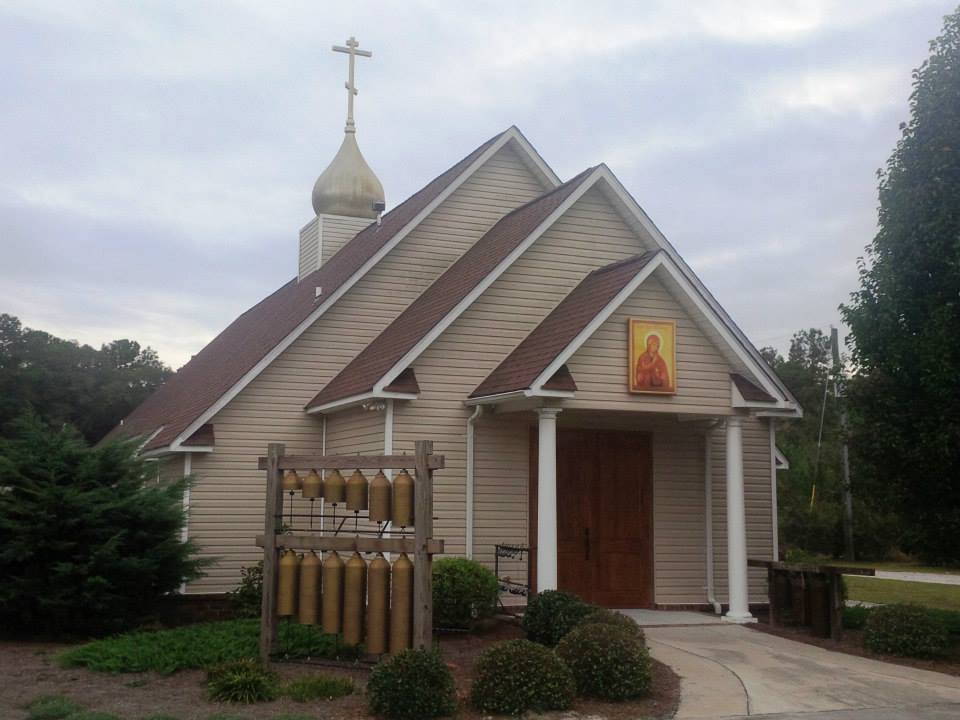
Houses of worship: St. Mary Magdalene Christian Orthodox Church, Rincon, Georgia
Copyright 2014 by Bob Rogers
I continue my series of photo blogs of houses of worship that I like, with a very unique worship center. The sanctuary of St. Mary Magdalene Christian Orthodox Church looks like it might be in Russia, but it’s actually located in a rural area just outside of the small city of Rincon, Georgia. This building shows that a congregation does not have to be large to build an absolutely gorgeous building. Notice the dome and cross, a popular design among Eastern Orthodox churches, and the icon above the front door, as well as the musical pipes on the front lawn.
Houses of worship: Tabernacle Methodist Church, Virginia Beach, Virginia
 Copyright 2014 by Bob Rogers
This is the second installment in my photo blogs of houses of worship whose architecture I like. Tabernacle United Methodist Church is located in the Sandbridge area of Virginia Beach, Virginia.
This sanctuary is a white wood design that was popular among many Protestants in the 19th century, particularly Methodists. (This building was built in 1830). I particularly like how the building has an entrance that juts forward and then continues upward into a steeple. This congregation has also kept their building spotlessly clean and carefully landscaped. This is one of most eye-catching country churches that I have ever photographed.
Houses of worship: Richburg Baptist Church, Hattiesburg, Mississippi

Copyright 2014 by Bob Rogers
I love taking photos of houses of worship. Over the next few days, I will post some of my favorites, and share what I like about them.
I’ll begin with Richburg Baptist Church, Hattiesburg, Mississippi. This is a classic red brick worship center, especially popular among Baptists. Like many in this style, it has red bricks, with a white column porch in front. Yet this congregation added some other nice touches to that basic design. Notice the stained glass, the cross cut-out in the steeple, and the arched bell tower in front of the worship center, with a cross on top. Simple, yet beautiful.
Why it is reasonable to believe that God exists, Part Two
 A few days ago I posted here an essay explaining why it is reasonable to believe in God. With today’s post, we will look at three more specific reasons to believe in God’s existence.
I. First reason: The First Cause. (Psalm 90:2)
Psalm 90:2 says, “Before the mountains were born, before You gave birth to the earth and the world, from eternity to eternity, You are God.” So God has always existed, but the universe has not always existed. The universe had a beginning, when God created it out of nothing.
But why should we believe this? We have clear evidence that the universe has not always existed. Instead, it began to exist. If it began to exist, what started it? What was the first cause? The answer is God!
Someone might ask, “How do we know the universe has not always existed? How do we know that it started sometime in the past?” We know this from logic, and science also confirms it.
Think about it. It is logically impossible for the past to go into infinity. It is impossible to count down from infinity to one. There is always an infinite distance to travel, so we never arrive. In the same way, if the past went on into infinity, we could never arrive at the present. But here we are! So there must have been a beginning. (Douglas Groothuis, Christian Apologetics, p. 219-223)
Science has also given us reason to believe in a first cause. In 1929, astronomer Edward Hubble discovered that a dozen galaxies near earth were moving away from us at high speeds. Scientists today agree that the universe is expanding, because it had a beginning, which they often call the “Big Bang.” Scientists don’t know what caused the big bang, they just know it happened. But as Christians, we know that caused the Big Bang. God spoke, and bang! It happened.
The Big Bang Theory is not the only scientific reason to believe in a first cause. There is also the second law of thermodynamics. This scientific law states that the energy in the universe is slowly but surely being used up. Like a fire that eventually burns out, all the energy in the universe is eventually going to disappear. Now here’s where it gets interesting. If the universe existed for eternity in the past, then it would have already used up all the energy by now. But here we are, with energy still available to use. So the universe is not eternal; it had a beginning in the past. What other way is there to explain this beginning, except that an all-powerful, supernatural person was the first cause? (Groothuis, p. 224-226)
The only answer atheists can have to this, is to argue that the universe was caused by nothing but a pure accidental explosion. Not only does it take more faith to believe the beautiful complexity of the universe had no cause, but such belief would also mean that everything in life is meaningless, and has no cause or reason. So would you prefer to believe that an all-powerful Creator spoke the word and brought the universe into being with a purpose, or would you prefer to believe that everything began from no cause, and life has no meaning? The choice is yours, but thank God we have a better choice than to live a meaningless life that began by nothing and has no purpose. Instead, it makes far more sense to believe that there was a First Cause, a supernatural Being, who brought the universe into existence, and that our lives do have purpose and meaning.
II. Second reason: Self-Consciousness. (Genesis 2:9; Romans 7:22)
Those who believe in Darwinian evolution, think that the human being is a mere biological collection of atoms that assembled by chance over a long period of time.
The Bible, on the other hand, says that God formed mankind from the earth, and we became a “living being.” (Genesis 2:9). Romans 7:22 talks about understanding something “in my inner self.” Whether or not you believe the Bible, we all know that we have an inner self, a self-consciousness. As the philosopher Rene Descartes said, “I think, therefore I am.” I have an awareness of my own self; I have something within myself that makes me to be me.
But where in the human body is my consciousness located? Where is my self-awareness? No scientist has located it. Nobody can tell you that in this part of the brain, or any other place on the human body, is the location of self-consciousness. Nobody can tell you where it is, yet we know we have it.
And if I am only a biological collection of chemicals, then how do we explain the human appreciation for beauty, music, poetry and art, and how do you explain love?
If you are an atheist, there is no explanation for it. But if you believe in God, the answer is simple: God put it there.
III. Third reason: Religious Experience (John 9:25)
The man born blind who was healed by Jesus could testify to a changed life, and nobody could dispute his experience. In John 9:25 we read, “He [the blind man] replied, ‘Whether he [Jesus] is a sinner or not, I don’t know. One thing I do know. I was blind but now I see!'”
In Isaiah 6:1-5, Isaiah had a face-to-face encounter with the Lord in the temple; in Acts 9:1-9, Saul met the Lord on the road to Damascus and had a life-changing conversion experience.
This series of blog posts was originally presented as a series of sermons at the church I was serving in near Savannah, Georgia. When I presented the message, a student at Armstrong Atlantic State University, came forward at the end of the early worship service to publicly profess her faith, and at the second morning service, she gave her testimony to the congregation. She told how she did not believe in the existence of God, but she began to seek God. She heard all of the same arguments for the existence of God that we have talked about last week and this week, but she was still undecided about whether she believed. Then she decided to go with the Baptist Collegiate Ministry at Armstrong Atlantic State University on a mission trip to Haiti. That week, she prayed, and said, “God, if you are there, will you reveal Yourself to me.” Later in the week, she was walking through a voodoo area of Haiti, where all of the statues had been destroyed by the earthquake, and she looked up and saw a statue of Jesus on the cross. Her friend had been encouraging her to have faith in God, and right then she looked up and saw the statue. She decided that if she turned away then, she would never believe. That experience finally brought her to belief in God and faith in Jesus Christ.
The religious experience of millions of people is a powerful evidence for God. People can deny the existence of God, but they cannot deny the fact that millions of people of every time, language and culture have believed in God and claimed to have an experience with God. When the white men first came to the New World, they found Native Americans who had never had contact with Western society, yet they believed in a Great Spirit.
Atheists sometimes claim that people who believe in God are ignorant, or even neurotic. But they have a more difficult time making this claim when confronted with the fact that so many great leaders like George Washington and Abraham Lincoln believed in God, great musicians like Ludwig von Beethoven and Johann Sebastian Bach believed in God, great artists like Leonardo da Vinci believed in God and great scientists like Werner Van Braun believed in God. My late uncle, Dr. R.A. Clinton, Jr., was a rocket scientist who worked alongside Van Braun in building a satellite at the space center in Huntsville, Alabama. My uncle later became the leading American expert on Russian missile technology. Yet brilliant as he was, Uncle R.A. was also a believer, who taught Sunday School at First Baptist Church of Huntsville for over 25 years.
Atheists often claim that much harm and cruelty has been done in the name of God. However, atheists must also face the fact that millions of people were massacred by atheist dictators like Joseph Stalin and Mao-tse Tung. Atheists are correct that people with distorted views of God have done great harm, whether they were misguided people who claimed to follow Christ, as in the Crusades, or the brutal terrorists of ISIS. This points to the fact that it is not enough to believe in the existence of God; one needs to know the personal God who has revealed Himself to us in Jesus Christ, and truly obey Him. True followers of Christ have fed millions of hungry and in the name of God millions of sick have been nursed to health. After Hurricane Katrina, there were no atheist relief organizations to help, but thousands of churches and Christian organizations came to help. The life-changing experience of the God of the Bible, Jesus Christ, is the greatest reason I know to believe in God. How about you? Do you believe?
Why it is reasonable to believe that God exists, Part One
 Many atheists today not only don’t believe in God, but they act like they are mad at God. Richard Dawkins’ The God Delusion and Christopher Hitchens’ God Is Not Great are two of the bestselling books on God, and they are written by atheists!
Peter Hitchens, the brother of atheist author Christopher Hitchens, describes this attitude as a “rage against God.” He describes how one atheist “thanked God that he no longer believed in Him.” (Peter Hitchens, The Rage Against God, p.19)
It makes you wonder why they fight so hard against somebody they don’t believe in, doesn’t it?
However, there are other atheists and agnostics who seem to have genuine struggles with believing in God. Timothy Keller is a Presbyterian pastor in New York City. He had a brilliant young scientist who struggled with this. He had a feeling that God existed, but as a scientist, he wanted proof that God exists. He said, “I can’t believe unless I find at least one absolutely airtight proof for God.” Finally, the young man began to realize that proof wasn’t necessary. What he needed was clues. If we have enough clues, we can believe. (Timothy Keller, The Reason for God, p. 127-128) After all, a jury is not required to have absolute proof to convict a criminal, they are only required to have evidence that is “beyond all reasonable doubt.”
So, can we know that God exists, beyond all reasonable doubt? Yes, I believe we can.
It is reasonable to believe that God exists.
Atheists often ridicule people who believe in God as ignorant and stupid. “I don’t believe in God, I believe in myself,” says the atheist. G. K. Chesterton points out that most people who are in lunatic asylums believe in themselves, too. (Gilbert K. Chesteron, Orthodoxy, p. 175.) A man can believe he is a chicken and believe in himself. A woman can perform for the judges of “American Idol” and believe in herself. That doesn’t make their beliefs true.
I submit to you that it is more reasonable to believe in God.
Every argument that atheists use can be turned on them, and in addition there are many, many reasons that can be given to believe in God.
For example, atheists claim that belief in God is wish-fulfillment. They say that people wish there is a God, so they dream him up. But we can reply that atheism is wish-fulfillment. Atheists wish away any moral responsibility by wishing God did not exist so that they don’t have to be accountable to Him.
Again, atheists claim that belief in God is “the opiate of the people.” That is, they are saying that people escape reality by believing in God. But we can reply that atheism is the opiate of the conscience. In other words, atheists try to escape moral guilt for their sin by saying there is no God (Art Lindsley, C.S. Lewis’s Case for Christ, p. 130). Bob Gass says, “An atheist can’t find God for the same reason a thief can’t find a policeman.”
So every argument that atheists use against faith can be turned on its head. What’s more, there are many, many arguments that can be used in favor of faith in God. Peter Kreeft and Ronald K. Tacelli list 20 of them. (Peter Kreeft and Ronald K. Tacelli, Handbook of Christian Apologetics, pp. 48-86.) For the sake of time, I will give you three good reasons in this essay, and three more next time. First, we will look at these reasons: a reason from logic, a reason from design, and a reason from morality and conscience.
A. Logic. (“The fool says in his heart, ‘God does not exist.'” Psalm 14:1, HCSB)
There are many logical and philosophical arguments for the existence of God.
During the Middle Ages, a philosopher named Anselm had an interesting argument for God. It’s called the ontological argument. It goes like this: He said that the fact that the idea of God exists in our minds indicates that He is real. After all, God is the greatest being there is, so if He exists in your mind, then He must also exist in reality, because reality is greater than your mind, and if He is in your mind and He is the greatest being, then He must also exist in the real world! (Douglas Groothuis, Christian Apologetics, p. 187-188)
Over the years, people have debated back and forth whether Anselm’s argument is true or not. But even if Anselm’s logic does not prove that God exists, it is impossible to prove that God does not exist!
Proving that God does not exist is like proving that there is no gold in Alaska. It is much easier to prove that there is gold in Alaska. All one has to do is to find one speck of gold dust. But to prove there is no gold in Alaska, one would have to dig up every cubic inch of the largest state in the nation.
In a similar way, what would you have to know to prove there is no God? You would have to know everything! Once the famous atheist Madalyn Murray O’Hair was debating Jerry Root. Root asked her, “How much of that which there is to be know do you claim to know, 10%?” She laughed and said, “Okay, 10%.” Then he asked, “Is it possible that God might exist and be part of the 90% of reality that you admittedly don’t know?” She paused and was silent for about a minute. Then she said, “No,” and quickly moved on to another question. She did not want to admit the obvious—that unless you have all knowledge, you cannot prove that God does not exist. (Art Lindsley, C.S. Lewis’s Case for Christ, p. 85-86)
In fact, it is absolutely impossible to prove that God does not exist, unless you can prove that the idea of God is nonsense or a contradiction, and nobody has been able to do.
No wonder Psalm 14:1 says, “The fool says in his heart, ‘There is no God.'”
B. Design (“For His invisible attributes, that is, His eternal power and divine nature, have been clearly seen since the creation of the world, being understood through what He has made. As a result, people are without excuse.” – Romans 1:20, HCSB)
In December 2004, Great Britain’s most famous atheist, Antony Flew, decided at age 81 that he could no longer deny the existence of God. What caused him to change his mind? It was the complexity of the scientific evidence discovered in nature, especially the amazing evidence of DNA, that made him decide that it had to designed by an intelligent Creator.
“I think that the most impressive arguments for God’s existence are those that are supported by recent scientific discoveries,” Flew said. “… I think the argument to Intelligent Design is enormously stronger than it was when I first met it.” (“Famous atheist now believes in God,” Associated Press, December 9, 2004; David Roach, “Famed atheist sees evidence for God, cites recent discoveries,” Baptist Press, December 13, 2004.)
The design of God’s creation, from the tiniest protein to the most complex galaxy is another reason to believe in the existence of God. Romans 1:20 says, “For since the creation of the world God’s invisible qualities–his eternal power and divine nature–have been clearly seen, being understood from what has been made, so that men are without excuse.”
Atheists reply that the amazing complexity of nature happened by chance over millions, even billions of years. But as Antony Flew finally decided, it takes more faith to believe in chance than to believe God designed it! Why? Suppose a combination lock has numbers ranging from 00 to 99, and only one sequence of turns can open the lock (e.g., 34-98-25-09-71.) There are 10 billion possible combinations, but only one can open the lock. Saying that nature happened by pure chance is like saying that I randomly twirled the combination lock until it opened. It could happen by chance, but it might take a while. Let’s see, 10 billion seconds is a long time, isn’t it? Multiply that by every species that would have to randomly mutate into another species, and you get an idea of how unlikely it is that nature became so complex by pure chance. On the other hand, if someone turned the lock a few times and opened it on the first try, we would assume it was not by chance, right? In the same way, when we look at the complexity of creation, we can reason that it didn’t happen by chance, either, but God made it. (William Demski, The Design Revolution, p. 87)
C. Morality and conscience (“For I am Yahweh your God, so you must consecrate yourselves and be holy because I am holy.” – Leviticus 11:44, HCSB)
So we have seen that it is impossible to prove there is no God, and it is reasonable to believe in God because God has placed an awareness of Himself in each of us, but it is also reasonable to believe in God because of the scientific evidence of creation. Now let me give you a third reason to believe in God: the moral compass in your own conscience.
Leviticus 11:44 says, “I am the LORD your God; consecrate yourselves and be holy, because I am holy.” Because God is holy, he calls us to be holy. We believe in morality because there is a God who is holy and good, who put that universal moral code in our souls and expects us to do right.
Atheists never get tired of telling us that everything happened by chance. We should ask them, then where did morality come from? Did we just happen to decide by chance that feeding the hungry is good and committing adultery is wrong? No, reasonable people recognize that morality is a quality within our souls. Peter Kreeft says that the “moral conscience is the voice of God within the soul” (Peter Kreeft and Ronald K. Tacelli, Handbook of Christian Apologetics, p. 73).
Many postmodernists would say that there is no God and no absolute right and wrong because everybody has to find his or her own truth. They would claim that what is moral for you may not be moral for me. Thus they would claim that morality does not mean there is a God, because different people have different morality.
We would disagree, saying there is a universal moral code, because everybody knows that murder is wrong, and stealing is wrong, and child abuse is wrong, and that feeding the hungry and healing the sick is good. But for the sake of the argument, suppose the postmodernists were right, that everybody has to find his or her own right and wrong. They would still have to admit that there is still one moral absolute: we all need to follow our own consciences. But where did you get a conscience, and why do you have to obey it? It must have been given to you by someone higher and greater than yourself, if you’re supposed to obey it. That Someone is God.
You see, if atheists are right, then there can be no moral absolutes and there is no reason to obey the conscience (Peter Kreeft and Ronald K. Tacelli, Handbook of Christian Apologetics, p. 72-77). Most atheists are peaceful people, but most atheists live in predominantly theistic cultures, where a moral standard influences believers and unbelievers alike. But it is a fearful thing to think of what the world would be like if the predominant view was atheism, and the culture felt no accountability to a Supreme Being. I believe we have already seen how violent this could be in history, through the French Revolution, Joseph Stalin in Russia and Mao Tse-tung in China.
We have seen that it is impossible to prove that God does not exist. We have also seen that it is reasonable to believe that God does exist. It is logical because the idea of God exists in every human, because God reveals Himself in the design of creation, and because of the existence of morality. In the next essay, we will look at three more reasons: that something had to cause the world to begin, that something causes us to be conscious of our existence, and the personal experiences people have had with God. We will cover those in more detail next time. But let me conclude with this simple question: Since it is reasonable to believe that God exists, why would you not seek to know God?
Jeremiah 29:12-13 says, “Then you will call upon me and come and pray to me, and I will listen to you. You will seek me and find me when you seek me with all your heart.”
If you were going to seek God, where would you look? What is the best-known book in the world that more people have consulted to know God, more than any other book? It’s the Bible, isn’t it?
And when you read this book, what person rises to the top as the theme of this book? He is God’s one and only Son, Jesus Christ, isn’t He? Listen to what Jesus Himself said about seeking God in Matthew 7:7-8: “Ask and it will be given to you; seek and you will find; knock and the door will be opened to you. For everyone who asks receives; he who seeks finds; and to him who knocks, the door will be opened.”
If you look for God, you will find Him revealed in Jesus Christ. Jesus is like the magnifying glass of faith. When I put a magnifying glass over a book, the tiny letters come into focus as they become larger and clearer, and letters around the edges become distorted and unclear. When I seek God, I discover that Jesus is the magnifying glass that brings God into focus. In Jesus I see God in the flesh. In Jesus I see God’s love lived out by His sacrificial death on the cross. In Jesus I find how I can believe in God. (Philip Yancey, Reaching for the Invisible God, p. 139.)
I pray that you will seek God through His Son, Jesus, Christ.
X
X
X
X
(If you see an advertisement below this post, please understand that I have no control over these ads, and that I do not necessarily endorse the product.)
Why should God answer my prayer for help? A study of Psalm 143
Copyright 2014 by Bob Rogers

“Hear my prayer, O LORD, give ear to my pleas for mercy!” – Psalm 143:1, ESV
Your life is a mess, and you cry out to God for help. Have you ever stopped to consider why God should answer your prayer? In Psalm 143, David shows us how to pray for help for the right reasons. This is not a method to manipulate God; this is a supplication that submits to the Almighty.
In the psalm, David asks God to hear his cry. He talks about how his enemies are hot on his trail, and how he is so weary and worn out that he is ready to give up. Then he concludes his prayer with the right way to appeal to Yahweh.
First, notice the wrong reasons to ask God for help.
1) Not because I’m good. “No one living is righteous before You,” David says to the Lord (v. 2). God isn’t going to answer me because I’m good, because I’m not.
2) Not because I beg him. In verses 4-6, David sounds pitiful, saying his spirit faints and his spirit fails. Yet, as we shall see, all of this begging is not the reason that God answers.
3) Not because I need him. In verse 7, David says he’s afraid he’s going to end up at the bottom of the pit. Yes, God cares about our needs, yet even this is not the reason God comes to my aid, because, as we shall see, it’s not about me.
Second, notice the right reasons to ask God for help.
1) Because God is good. “Let your good Spirit lead me on level ground!” (v. 10). The Hebrew word used here means “good, gracious, beautiful and pleasant.” God answers because God is good, not because we are good (no one is righteous– v. 2).
2) Because God glorifies His name. “For your name’s sake, LORD, preserve my life!” (v. 11). Whenever you see “LORD” in all capital letters, it translates the given name of God, Yahweh. God answers our prayer for help to glorify His holy name, that He might draw people to faith in Him.
3) Because God is faithful to His covenant love. “And in your steadfast love you will cut off my enemies…” (v. 12). The phrase “steadfast love” translates one word in Hebrew, chesed, the word for God’s love that He gives in His grace to His people, not because we deserve it, but because He promised to do it when He made a covenant with His people. David also uses this word in verse 8, saying, “Let me hear in the morning of your steadfast love.”
So if you are crying out to God to help you, ask for the right reasons. Don’t ask because you’re good, because you’re not. Ask because God is good. Don’t ask to help because you want it; ask because it will glorify God. Don’t ask for help because you need it; ask God to help because God has promised to be faithful to you and love you. Don’t tell God what a big problem you have, tell your problem what a big God you have, and stand back and watch Him work in ways you never dreamed.
Guest blog: “Defeating Giants” by Melissa Hanberry

David took Goliath’s life with a stony missile and a conquered sword. Those are the tools of the trade we associate with his victory. But his first step in winning the battle was winning the war of words. “You come to me with a sword, a spear, and a javelin, but I come to you in the name of the Lord of hosts, the God of the armies of Israel, whom you have taunted.” (1 Sam 17:45) And there were two more weapons with David that day. Those sticks didn’t escape Goliath’s attention, so they shouldn’t escape mine. David’s rod and staff? The same rod and staff of Psalm 23:4? Maybe David carried them to battle for comfort, a tangible reminder of the Good Shepherd who counts, rescues, and protects His own. Today they remind me that our battle with cancer is not fought on one plane with one weapon alone. In the same way a shepherd numbers his sheep as each passes beneath the rod, He numbers the very hairs on Maggie’s head and bids us not to fear (Luke 12:7). And with the staff, He searches and rescues me from the end of my own path. With such a Shepherd, my valley of darkest shadows becomes my place of deepest trust and sweetest victory.
Prayers for the sick

Article copyright by Bob Rogers.
Perhaps more than any other kind of prayer, people pray for the sick. Yet many are at a loss as to what to say in their prayers.
Honest, simple prayers are best. The Bible teaches us to be honest and straightforward with God in our prayers. King Hezekiah just reminded God of his service to the Lord, and wept. God heard his prayer and his tears and answered his prayer. (2 Kings 20). Mary and Martha prayed a simple prayer to Jesus when their brother Lazarus was sick. They just presented him to the Lord, saying, “Lord, the one You love is sick.” (John 11:3) Lazarus died, and they may have felt their prayer was not heard. Yet a few days later, Jesus raised Lazarus from the dead! Let that be a reminder to us that what matters in our prayer for the sick is the One to whom we pray, not the words that we say.
Pray in faith. It is also important to remember that when we pray, we must pray in faith, believing God really has power to do amazing things in answer to our prayer. James 5:15 says, “The prayer of faith will save the sick person.” If we only think prayer is positive thinking to make us feel good, we might as well just dispense with the pretense that we are talking to Almighty God, and say, “Hey, cheer up! Think good thoughts!” Most of us know that such pop psychology as a denial of reality. We know there truly is a Person greater than us, a Supreme Creator, who revealed His love to us in the Person of Jesus Christ.
With that said, people still struggle with how to put their heart-felt faith into words. So with the above in mind, here are some prayers that I have prayed for the sick, or have heard others pray. May they be an encouragement to others to pray in faith to the Great Physician.
General prayers
“Heavenly Father, we thank You for the medicine and knowledge used by the doctors and nurses, but we realize that these are gifts from You, for You are our Great Physician and Healer. Please give wisdom to the doctors as they seek the best treatment, give compassion to the nurses as they care for their patients, give stamina to the family who are caring for their loved ones, and give to the patient Your peace that passes all understanding, that guards our hearts and minds in Christ Jesus.”
“Heavenly Father, how we thank You that we may call You ‘Father,’ just as Jesus taught us to pray, ‘Our Father who art in heaven,’ because You watch over us, provide for us, and we have a relationship with You through Your Son, Jesus Christ. Just as a child crawls up into the lap of his (or her) father and asks for help, we come to you as our Father, and ask that You continue to bless this Your child, giving him (or her) healing, according to Your will, and Your peaceful presence. Watch over his (or her) family in this time that they are by his (or her) side.”
“Jesus, we present to You the name of this one who is sick. We present them to You. like Mary and Martha, when their brother Lazarus was sick, and they simply said, ‘Lord, the one You love is sick.’ So Lord, the one You love is sick! We trust You to heal in your way and your time, not ours. We trust that You are here, even when we don’t see it. You didn’t come to Lazarus when Mary and Martha expected, but when You did come, You did more than they expected! We trust that You care, even when we don’t feel it. You wept at the tomb of Lazarus, even though You knew that You were going to raise him from the dead. So here we are, with the one You love. This one is sick. We put thir need in Your holy hands, even as we put ourselves in Your hands. In Jesus’ Name, Amen.”
“Heavenly Father, we lift the name of this patient before Your throne of grace, and we thank You that it is a throne because you are King of kings, and it is a throne of grace because you are a God of grace and mercy. We ask that you would work in such a wonderful way, that Your Name would be glorified, our faith would be edified, and the old devil would be horrified. As our prayers go up, may your blessings come down.”
“Father, we thank You for Your power to heal, for You created our bodies. We thank You for Your presence in our time of sickness, to bring us strength and encouragement. We thank You for the prayers of our family and friends, who lift up this one who is sick to Your throne of grace. In Jesus’ Name. Amen.” – Nathan Barber (adapted)
“God, my loved one is ill. I ask for your healing power to come upon them. You give us life and you have the power to renew life. I believe in your power to heal. Open my loved one to whatever for your healing power takes. And help me remember that, no matter what happens, you are the same yesterday, today and forever. You are always with us. Amen.” – Norman Vincent Peale
“Jesus, when You walked this earth, you often touched the sick and healed their bodies. We also know that you did more than heal bodies—you brought healing to the spirit and soul, forgiveness to sinners, and reconciliation to enemies. Today we ask that you heal this one who is sick in any and every way that he needs—touch his body, soul and spirit with your healing power. And we will give You the glory for all that you will do. In Jesus’ Name we pray. Amen.”
“O Great Physician, we call on You to bless our loved one who is sick. She (or he) is in pain and not well yet physically, yet we know that You are working. We see You working through the doctors, nurses, therapists and all the other medical staff. We see You working through the medicine. We see You working through the love of this family by her side, and her church family who are lifting her up in prayer. We see You providing Your peace and assurance through Your Holy Spirit. Now we ask for your healing, all according to Your plan. If You choose to heal her body, we will thank You. If you choose to heal her spirit, we will thank You. Bless her and her family with Your special touch. In the name of Jesus, our Lord and Savior, we pray.”
“O thou who hearest prayer, we pray thee to be very kind and merciful to thy child, whose body suffers in pain and weakness. Grant unto him patience and tranquility of mind; peace, purity, and courage of soul; the strong will to live; and a heart ready to trust thee waking or sleeping. Bless all the means used for his recovery, and all who minister to him in his suffering. Restore him speedily to health, if it please thee, and above all things grant him that which thou knowest to be best for him, and keep him thine for evermore; through Jesus Christ our Saviour. Amen.” – Henry Van Dyke
“I pray, God, that You will refuse Satan’s requests when he accuses people (as with Job), I ask You, God, to let nothing hinder Your good plans in their lives, and that You use their situation for Your glory, to bring them and those around them closer to You, and that You heal them if that be what’s best for them.” – Emily Jordan Leggett
“Lord, we ask for Your will to be done in every situation, for wisdom for doctors, strength for families and the one who is sick. We ask for healing, for guidance in every situation, for peace and comfort, for Your Spirit to fill each and every person involved, that Your wrap Your arms around them, that they will know without a doubt that You’re with them. We thank You, Lord, for being our provider, our comforter, our strong tower, our peace, our refuge and our strength in time of need. And we thank You, Lord, for being all of everything for the ones who need healing. We ask for Your army of angels to protect them and may Your will be done. In Jesus name.” – Crystal Hallauer Basdeo (adapted)
Prayer for yourself when you are the one sick
Lord, it is hard to pray when I feel sick. My head aches, and I can’t think straight. My body is wracked with pain, and it keeps me from focusing on You. All that I know to do is to come before You, and say, “Here I am.” I need Your strength in my sickness. Take this frail body of mine, and do Your will. Please show me mercy, and heal my body and soul. Even if my flesh fails, I am resolved to worship You. In the Name of the Great Physician, Jesus Christ, my Lord, I pray. Amen.
Lord, I know that You are the One who removes sickness.1 Jesus, You healed the sick wherever You went.2 So I trust my sickness to You, and ask for healing. Remind me, also, that there is something worse than sickness. I know that a man’s spirit can endure sickness, but who can endure a broken spirit?3 So I pray that my sickness will be for the glory of God.4 and I pray that even in my sickness, I will find peace to my soul.5 Biblical references: 1 Deuteronomy 7:15, 2 Matthew 9:35, 3 Proverbs 18:14; Lamentations 3:17, 4 John 11:5, 5 1 Thessalonians 5:23
Prayers for the caregivers
“Heavenly Father, You are the Great Physician. We thank You for the healing of body and soul that you do through our medical workers. They could do nothing by themselves, but with You, all things are possible. We thank You for the knowledge and compassion You have given to the physicians and nurses, and many others who do the work of healing. The battle is sometimes long, and the enemy seeks to discourage them and defeat them, but we know that we are more than conquerors through Jesus Christ, our Lord and Savior. Just as Aarom and Hur held up the arms of Moses until the battle was won, we lift up our prayrs on behalf of each medical worker. Strengthen their hands, refresh their hearts, and lift up their eyes to You, our Ultimate Healder. In Jesus’ Name, we pray. Amen.”
“Thank you, God, for my doctor and nurses. Thank you for their skills and training. Thank you for their patience with me when I am irritable because I don’t feel well. Give them the insight they need to diagnose my illness and determine the right treatment. Steady their hands and give them the power to heal in your name. Amen.” – Norman Vincent Peale (adapted)
“Heavenly Father, we thank You for the knowledge You have given to the doctors, the compassion of the nurses, and the faithful love of this patient’s family. We realize they are able to do what they do because You have given them the ability. We ask that you bless each caregiver, so they can be a blessing to this one who is sick.”
Before surgery
“Heavenly Father, we know that you are a good Father, who provides for us, guides us, and leads us in the right way. As the Great Physician, would you guide the attending physicians. As the Prince of Peace, would you give your assurance and peace. As the Good Shepherd, would you guide every decision that is made. We pray this in the mighty Name of our Risen Savior, Jesus Christ.”
“Heavenly Father, this Your servant is preparing for surgery. She’s nervous about it, Father. Would you calm her spirit with your peace that passes all understanding? We thank You for the skill and knowledge of the surgeon, and we ask You to guide the surgeon’s hands to complete a successful surgery. We ask that you give this servant of Yours a full recovery, and the patience that she will need during the time of recovery. Please use that time to draw her closer to You, as she must depend on You more than ever before. We thank you for her family who are here by her side. She is so blessed to have so many people caring for her right now. We thank you for how you work all things together for good to those who love the Lord and are called according to His purpose. We pray this in Jesus’ Name. Amen.”
“Our Father, as we face this new experience we come to You for peace and strength. We have confidence in Your healing power and in the doctor. You gave the very life which we have, and since we belong to You, we have trust and faith. We thank You for the understanding that we are constantly surrounded by Your loving, healing care. May Your power be felt through invisible forces. May this operation be successful that this Your child may return to health and useful living; for the sake of Christ and in His Spirit. Amen.” – Edmond Holt Babbitt (adapted)
For someone in pain
“Jesus, you said, ‘Come unto Me, all ye that are burdened and heavy-laden, and I will give you rest.’ You said, ‘My yoke is easy, and my burden is light.’ We ask that You would lift this heavy burden of pain with your lightness and brightness. We pray this in the Name of Jesus, the Prince of Peace.”
For someone not expected to recover
“My flesh and my heart may fail, but God is the strength of my heart, my portion forever.” – Psalm 73:26
“Oh, Lord, Your Word says in the Shepherd’s Psalm that You prepare a table before us in the presence of our enemies. Lord, in the midst of this enemy of sickness, would you prepare a table of peace, comfort, grace and mercy? We ask that you will pour out your blessings, and we will let You define the blessing.”
“Dear Lord, we do not understand the reason for suffering. We wish we knew the answer to the question, ‘Why?’ But even though we do not have the answer to the question, ‘Why?’, we will not let go of Your hand, for we know that You hold the answer. We will trust You now in the dark, because we know that the Lord is our light and our salvation. We pray this in the name of Jesus Christ, who shed His precious blood on the cross to forgive us, and rose from the dead to give us eternal life. Amen.”
“Heavenly Father, our hearts are broken over the sickness of the one we love. We know that You love him even more than we do. We know that even at this late hour, you are fully able to heal him. But we also know that for every follower of Jesus, there is a spiritual healing that is greater than any physical healing. We know that you have created a place where there is no more suffering, crying or pain. So we ask for peace to accept whatever healing You choose to give him. If You choose to heal him physically now, we will rejoice and glorify You. If You choose to heal him spiritually now, we will rejoice and glorify You, because of our firm hope in the resurrection, through Jesus Christ our Lord. Amen.”
“Our Father, you have given our loved one to us, and You love her even as we do. In confidence and trust we give her back to You. We know that she is Yours. As we climb the steep ascent of faith, please speak peace to our hearts. Take from us all bitterness and mistrust. Although we do not know the answer to many of life’s questions, we do know that we may live in Your love. As we yield ourselves to You, we are confident that You will give Yourself to us; through Him who loved us and gave Himself for us. Amen.” – Edmond Holt Babbitt (adapted)
X
X
X
X
(If you see an ad below this post, please understand that I have no control over these ads, and that I do not necessarily endorse the product.)
Book review: “Rooms” by James Rubart
 Rooms by James Rubart is a Christian novel about a wealthy young Seattle software developer who gets a cryptic note saying that he has inherited a house on the Oregon coast from an uncle he doesn’t remember. When he goes to claim his house, he finds that he has inherited a house with weird rooms that God is using to change his life.
Some people have compared this book to The Shack, since both books call a man to a house and force him to deal with the pain of his past. However, there are many differences between the two books. Rubart is a more experienced and better writer. He uses vivid descriptions that paint a clear picture of the characters and events. Rubart does not delve into any questionable theological teachings, the way the author of The Shack does. However, The Shack is more emotionally satisfying as an answer to the problem of suffering. Rooms deals with pain, forgiveness, and includes a good romantic story, but it reads more like a science fiction novel, and for some reason, I found it harder to suspend belief and accept the alternate lives and time travel that takes place in the novel. Rooms is also very long, but I’m glad I stayed with it to the end, as the plot picks up pace, and comes to a fascinating and satisfying conclusion.
I listened to the audio version of the book, which was 9 CD’s. It made a good book to pass the time on long trips from Georgia to Mississippi.
X
X
X
X
(If you see an ad below this post, please understand that I have no control over these ads, and that I do not necessarily endorse the product.)
Book review: “Immersed: 40 Days to a Deeper Faith”

Immersed: 40 Days to a Deeper Faith, is a daily devotional designed to develop deeper Christian disciples, written by Doug Munton, pastor of First Baptist Church of O’Fallon, Illinois. It is divided into six chapters designed for each week, and each chapter has seven daily readings, except the last chapter, which has five readings, bringing the total to 40 daily readings. Each reading is about two and a quarter pages in length. The book may be read alone as a daily devotional, or read in conjunction with a small group discussion or church-wide campaign. I read one reading each day for 40 days, as suggested, but on my own without a group discussion. Each daily reading comments on a particular scripture verse, which he explains and applies to daily life, and concludes with points to ponder and reference to two chapters of the Bible as a suggested daily Bible reading. The seven weeks of devotionals cover the subjects of God’s Word, personal renewal, following Christ in difficult times, recognizing blessings and blessing others, choosing a missional life, and living out your faith in the real world.
Munton writes in a conversational style, filled with everyday illustrations, making it easy to read. However, don’t assume this is just light reading. He has many keen insights that often sent me to my knees in prayer, reflection, and got me on my feet to take action.
Munton has a gift for memorable illustrations. The story on Day 22 is a beautiful example. Munton tells how his father learned to count his blessings, while alone on a mountain during the Korean War. Then (spoiler alert) Munton shares how after his father died, they found a photo of his Dad in uniform in Korea. His mother pointed to the mountain behind him in the photo and said, “that is the hill where your father counted his blessings” (p. 110). Munton also knows how to turn a phrase and is full of provocative quotations. He says, “our hope is not that our problems will be absent but that our Lord will be present” (p. 80). He says, “the mission of Jesus– and, therefore, the mission of His disciples– is about more than helping nice people be nicer. It is about helping dead people find life” (p. 140). He says, “We can never be worthy of salvation but we can live worthily in salvation” (p. 176).
Each daily reading ends with reference to two chapters of the Bible suggested for daily scripture reading, designed to take the reader through The Gospel of John, The Acts of the Apostles, and Proverbs. While I agree that it is an important part of discipleship to read through books of the Bible, I wonder if it might have been better to if Munton had done the daily Bible readings differently. Most of his assigned daily Bible readings do not relate to the daily devotionals. However, since each daily devotional is built around a key Bible verse, it seems to me it would have been better to assign the reader to read the whole Biblical chapter that includes the focus verse of each day’s devotional, giving greater context to the excellent devotionals that Munton writes.
Despite that minor critique, this book is one of the best resources I have read for personal discipleship. I highly recommend it.
Copies can be found online at amazon.com, or at discounted bulk prices directly from the author at http://www.dougmunton.com.
In the interest of full disclosure, Munton is a personal friend of mine, and I received a complimentary copy of his book, but I was under no obligation to write a favorable review.
Poem: “Awake in Bed”
Copyright 2014 by Bob Rogers
Note: I wrote this poem originally as a teenager in 1975, but to this day, I continue to struggle with the same feeling that it expresses.

When I plop wearily into bed
Lights out at the end of the day
I suddenly begin to remember
All of the things I forgot to say
All of the things I forgot to do, too.
The simple reason for my every view
I remembered I had left unsaid
What later popped into my head.
These thoughts come slowly, like
the gradual approach of a far-off light.
And they always manage to come to me
in the midst of the night.
X
X
X
X
(If you see an ad below this post, please be aware that I have no control over these ads, and that I do not necessarily endorse the product.)
Book review: “Dead Lawyers Tell No Tales”
 If you like John Grisham, you will probably like Randy Singer. I have read many of Singer’s legal suspense novels, and I found his plot twists to be consistently good, often better than Grisham. Singer is a Christian writer who avoids profanity and has a Christian worldview to his books. As a Christian myself, I really like that. But if you are not a Christian, don’t let that put you off, especially in Dead Lawyers Tell No Tales. Although his previous novels are not “preachy,” this novel is even less so. Singer simply weaves a captivating story of redemption. Landon Reed, a former SEC football quarterback who went to jail for taking a bribe to throw a game, wants to redeem himself by becoming a lawyer and helping others. He is an imperfect man who nearly falls again, and then gets caught up in a law firm where somebody is slowly killing every lawyer at the firm.
From beginning to end the plot kept my interest. Each short chapter seemed to end with something that made me want to read the next chapter and learn how the plot would resolve. Singer is a lawyer himself, and is able to describe complicated legal situations with clarity and detail. But what made this story engrossing in the first half was the theme of forgiveness and a second chance. In the second half, the plot accelerated and I couldn’t put down the book until I finished. This is probably Randy Singer’s best book to date.
X
X
X
(If you see an ad below this post, please understand that I have no control over these ads, and that I do not necessarily endorse the product.)
Who Needs My Kindness?
Copyright 2014 by Bob Rogers
 The fifth fruit of the Holy Spirit, listed in Galatians 5:22, is kindness. We know what kindness is, but have we stopped to think about who needs to receive our kindness? Undoubtedly, everybody needs it, but scripture names some specific groups of people in particular need of kindness:
1. My wife. Colossians 3:19 says, “Husbands, love your wives and don’t be bitter toward them.” Sadly, men tend to come as across harsh with their wives, often without realizing it. The stronger male physique and deeper voice of the male can be intimidating, which is why 1 Peter 3:7 commands, “Husbands, in the same way, live with your wives with an understanding of their weaker nature, yet showing them honor as co-heirs of the grace of life, so that your prayers will not be hindered.”
2. My fellow believers. Ephesians 4:32 says, “Be kind and compassionate to one another.”
3. The poor. Proverbs 19:17 says, “Kindness to the poor is a loan to the LORD.” Jesus tells a parable of righteous sheep and unrighteous goats, and the distinguishing mark of the sheep is how they show kindness, particularly to the poor. Christ said to the sheep that they were blessed to inherit the kingdom, “For I was hungry and you gave Me something to eat; I was thirsty and you gave Me something to drink… I was naked and you clothed Me…” (Matthew 25:35-36). In the same passage, Jesus adds three other people groups who need our kindness:
4. Strangers (Matthew 25:35). This is an often overlooked theme of the Old Testament Law, to always show kindness to strangers and foreigners. Deuteronomy 10:19 says, ‘You also must love the foreigner, since you were foreigners in the land of Egypt.” Many Americans who are unkind to immigrants seem to forget that most of our ancestors originally came from another continent.
5. The sick. (Matthew 25:36). The head chaplain at the hospital where I work recently said to the other chaplains, “Guys, remember when you have a bad day, that our worst day is better than the best day of most of our patients.” When people are seriously sick, their worlds are turned upside-down, and their emotions are on edge. How they need our kindness.
6. Prisoners (Matthew 25:36). Most of us find this last group the most difficult to show kindness. After all, if they’re in prison, don’t they deserve their punishment? Probably, but maybe not. However, for Jesus, the issue is not what they deserve, but what they need. All of us deserve punishment for our sin, for we have all broken God’s laws. But we need grace. Let’s show it to those in prison, as well.
Mark Twain said, “Kindness is the language which the deaf can hear and the blind can see.” The Bible teaches that it is especially the most vulnerable people in society, such as the deaf and blind, the poor, the sick, and those in prison, to whom we should show extra kindness.
So instead of asking who deserves our kindness today, let’s ask, Who needs my kindness today?
X
X
X
X
(If you see an ad below this post, please understand that I have no control over the ads, and that I do not necessarily endorse the product.)


 Bob Rogers