Category Archives: Christian Living
Finding Christ in our Christmas songs
 Copyright 2013 by Bob Rogers
What is the most popular Christmas song in America? Billboard magazine’s list of the top ten Christmas songs of 2012 is probably our best source. This is not based on opinion, but is based on airplay on the radio, sales, and online streaming. Here is the list (Source: http://wgna.com/the-most-popular-christmas-songs-of-2012/):
10. Last Christmas- Wham!
9. Christmas Eve (Sarajevo 12/24)- Trans-Siberian Orchestra
8. It’s The Most Wonderful Time Of The Year- Andy Williams
7. White Christmas- Bing Crosby
6. Jingle Bell Rock- Bobby Helms
5. A Holly Jolly Christmas- Burl Ives
4. Feliz Navidad- Jose Feliciano
3. The Christmas Song (Chestnuts)- Nat King Cole
2. Rockin’ Around The Christmas Tree- Brenda Lee
1. All I Want For Christmas Is You- Mariah Carey
Did you notice who is completely missing from the top ten? Jesus! Christ is not only not in the top 10 songs, he’s not even mentioned in the rest of the top 20.
In a world that sings about Christmas without Christ, God is calling the church of Jesus Christ back to the tradition of Christmas carols.
I. The history of Christmas carols
While many Americans sing about Santa, chestnuts and a white Christmas, Christians all over the world have sung about the birth of Jesus Christ for centuries. As early as the fourth century, Ambrose, the archbishop of Milan, wrote a hymn for Christmas to teach that God truly became a man, in response to heretics who denied Jesus’ incarnation.
Singing Christmas carols was popularized by St. Francis of Assisi during the Middle Ages in Europe, and was also encouraged by the Protestant Reformers, such as Martin Luther. As early as the 15th century, groups of singers would go from house to house in England and sing Christmas carols. Christmas carols in English first appear in a 1426 work of John Awdlay, chaplain from Shropshire, who lists twenty five “caroles of Cristemas”, probably sung by groups of “wassailers,” who went from house to house and enjoyed “wassail,” ale, or apple cider, and other desserts given to them at each home. Thus we get the line, “here we go a wassailing among the leaves so green,” and since the homes often fed the carolers, we also get the line, “bring out the figgy pudding, we won’t go until we get some.” It was only later that carols begun to be sung in church, and to be specifically associated with Christmas.
Two of the oldest Christmas carols still sung today are “O Come, all ye faithful,” which was originally written in the 13th century, and “Good Christian Men, Rejoice” which was first composed in the 14th century.
Perhaps the three most popular Christmas carols in English are “Joy to the World,” “Hark! The Herald Angels Sing” and “Silent Night.” The first two were sung in the American colonies even before the United States was a nation, but the third one came from Austria.
“Joy to the World” was written by Isaac Watts in 1719. It is based on Psalm 98, and its tune comes from one of the songs in Handel’s Messiah. Originally this song was intended to refer to Jesus’ Second Coming, but it has come to be associated mostly with His first coming at Christmas.
“Hark the Herald Angels Sing” was written by the great Methodist founder Charles Wesley in 1739, and the words were revised by the great evangelist of the Great Awakening, George Whitefield. A hundred years later, the classical composer Felix Mendelssohn composed the tune that is popular today when people sing “Hark the Herald Angels Sing.”
“Silent Night” was originally written in German and first sung on Christmas Eve, 1818, at St. Nicholas Church in the village of Oberndorf, near Salzburg, Austria. The organist, Franz Gruber, discovered that the organ wasn’t working at the church. The priest, Joseph Mohr, had composed the words in German to “Silent Night” two years before. So he shared it with Gruber, who composed the tune to be sung by guitar. When Karl Mauracher came to repair the organ, he heard the story of how the song was composed in an emergency and sung without the organ, and Mauracher spread the song everywhere that he went. The song came to America by German-speaking congregations. Originally the words were “Stille Nacht, Heilige Nacht.” The English words we sing today were translated by John Freeman Young. “Silent Night” has been translated into 140 languages. (Sources: Wikipedia and Companion to Baptist Hymnal by William Reynolds.)
I wish we had time to talk about many other popular Christmas carols like “O Holy Night,” including some newer songs like “Mary Did You Know?” Many families bake a birthday cake and sing “Happy Birthday” to Jesus on Christmas morning, which is a wonderful way to teach the true meaning of Christmas to children. Which brings us back to the original story itself, because the first Christmas carols are found in the Bible itself.
II. The songs of the first Christmas
Really, singing Christmas carols goes all the way back to the first Christmas, because Luke’s Gospel records four different songs as he gives the Christmas story. Let’s look at the lessons we get from these original Christmas carols.
A Mary’s song says that Christ came to love the forgotten (Luke 1:46-55)
When Mary was told that she would be the mother of the Messiah, she broke out into a song of praise, found in Luke 1:46-55. It is often called “The Magnificat” because she began, “My soul magnifies the Lord…”
The song emphasizes how God has remembered the forgotten and lifts up the lowly. In verse 48-49 she sings with amazement that God chose her, a simple girl from Nazareth: “He has looked with favor on the humble condition of His slave. Surely, from now on all generations will call me blessed.” And notice what she sings in verse 52: “He has toppled the mighty from their thrones and exalted the lowly.”
Mary’s song reminds us that in Christ, God remembers the forgotten. Mary was a poor girl, and Jesus was born in a feeding trough. The song should remind us to stop and give a donation to the Salvation Army when we go shopping, to help Toys for Tots, and share with Operation Christmas Child and Backpacks for Appalachia. The Christmas child shoe boxes and backpacks are a wonderful way to share Jesus with the poor at Christmas.
B. Zechariah’s song says that Christ came to save us (Luke 1:67-79)
Not only was Jesus’ birth a miracle, but the birth of John the Baptist, who was the forerunner of Christ, was also a miracle, because his parents were way too old to be having children. Yet an angel appeared to Zechariah to tell him that his wife Elizabeth would have a child in her old age. When John the Baptist was born to them, Zechariah broke out into a song of praise. It is found in Luke 1:67-79.
Zechariah’s song emphasizes that Christ came to save us. Luke 1:68-69 says, “Praise the Lord, the God of Israel, because He has visited and provided redemption for His people. He has raised up a horn of salvation for us in the house of David.” In the Bible, a horn was a symbol of strength. The Messiah was to come from the family line of King David. So Zechariah was singing about the same thing his son would prophesy when John the Baptist saw Jesus, and John proclaimed, “Here is the Lamb of God who takes away the sin of the world!” (John 1:29).
Zechariah’s song reminds us that Christ came to save us from sin.
C. The angel’s song says that Christ came to give us peace (Luke 2:13-14)
When the angel announced the birth of Jesus to the shepherds, he was suddenly surrounded by a great angel choir that sang the best-known of the songs that first Christmas. We read it in Luke 2:13-14. It is called “Gloria in Excelsis Deo” because it begins with the words, “Glory to God in the highest.”
The angel’s song spoke about Christ, the Prince of Peace, coming to bring us peace. Most of us know this song from the King James Version, which says, “Glory to God in the highest, and on earth peace, Good will towards men.” Many of us react to that like the poet Henry Wadsworth Longfellow, who wrote the words to “I Heard the Bells on Christmas Day” during the Civil War. He wrote,
And in despair I bowed my head:
“There is no peace on earth,” I said,
“For hate is strong and mocks the song
Of peace on earth, good will to men.”
The good news is that the most reliable ancient manuscripts do not say what the KJV says. That is why the HCSB translates it, “peace on earth to people He favors!” You see, Jesus’ coming is not a general guarantee that everybody will have peace. The more accurate translation does not say peace to all men, but peace to people He favors. That is, peace is available to those who receive God’s grace, or favor, through faith in Christ. As Romans 5:1 says, “Therefore, since we have been declared righteous by faith, we have peace with God through our Lord Jesus Christ.” On Christmas Eve, 1914, during World War I, the British, French and German armies laid down their arms and visited with one another in peace, and they all sang “Silent Night” in their own languages, as they all knew the song. The message about the Prince of Peace made all the difference, even in the midst of war.
Have you found the peace of Christ? The angel’s song reminds us that Christ came to give us peace, a peace we receive by faith in Him.
D. Simeon’s song says that to keep Christmas with us, we must share it (Luke 2:29-32)
There is one more Christmas song in Luke’s Gospel. Officially, it was after Christmas, since it happened a few days later. A lot of people get the post-Christmas blues after Christmas is over. They get kind of sad, taking down the Christmas tree and putting away the decorations. And we rarely sing Christmas carols after Christmas Day. But Simeon did.
A few days after Jesus was born, Mary and Joseph took Jesus to Jerusalem to dedicate Him to the Lord in the temple. There they met a prophet named Simeon, who had been waiting all of his life for the Messiah to come and save His people. Luke 2:26 says it had been revealed to him by the Holy Spirit that he would not die before he saw the Messiah. When he saw Jesus with Mary and Joseph, Simeon took Him in his arms and sang the fourth Christmas carol. In that song, Simeon reminded us that to keep Christmas with us, we must share it. We read the song in Luke 2:29-32.
Simeon sang, “For my eyes have seen Your salvation. You have prepared it in the presence of all peoples—a light for revelation to the Gentiles and glory to Your people Israel.”
Simeon knew that the salvation that is offered in Jesus Christ was prepared for “all peoples,” both Gentiles and Jews, and he wanted everybody to know that the baby Jesus that he was holding in his arms was the Savior.
Simeon’s song reminds us, to keep Christmas all year long, keep on sharing the good news.
Christmas carols that celebrate Jesus may not be in the top 20, but people still recognize the songs and enjoy hearing them this season of the year, which is all the more reason for us to play carols in our homes and cars and places we work. It’s a simple way to share the good news.
And how we need to renew the tradition of going Christmas caroling! I have a suspicion that if Zechariah and Simeon and Mary were with us today, they would be going door-to-door caroling, with some shepherds right behind them and angels overhead.
Years ago, a small group of carolers went door-to-door in a wealthy neighborhood of Beverly Hills, California. They rang a doorbell, and the man of the house answered, all in a hurry. He said, “Look, I appreciate the sentiment, but I really don’t have time for this. The house is a mess and we’re trying to get out the door to go shopping. Come by some other day.” As he shut the door, Bing Crosby and his family said, “Okay,” and left.
God sent His Son at Christmas. Don’t be so busy you miss the song.
If you see a video ad below this past, please be aware that I have no control over these ads, and that I do not necessarily endorse the product.
Advice on gift-giving from the best one I know
Copyright by Bob Rogers
“Entering the house, they saw the child with Mary His mother, and falling on their knees, they worshiped Him. Then they opened their treasures and presented Him with gifts: gold, frankincense, and myrrh.” Matthew 2:11, HCSB
Advice from a great gift-giver

My sister, Nancy Rogers, is the best gift-giver I know. I have always noticed how thoughtful she is in selecting gifts for others. So I called her up and asked for her advice, and here is what she told me:
Nancy said, “I think about what that person would enjoy. It depends on who the person is. If they have similar tastes to me, or a woman my age, then I ask myself if I would like that. Then, I ask, would it appeal to that person, not to me. So I ask myself, how would they react when they open this gift? Like a person who loves cats, I might think they would like a cat figurine, but then I think about how this person does not collect items and so even though they like cats, they don’t collect figurines. So I give it some time and thought. I learn about the person. The gift may not be that expensive, but it doesn’t matter; what matters is that I was thinking about his or her interests, because you can’t buy affection.”
What about giving money and gift cards?
What about giving money and gift cards? Nancy said, “I think giving cash and gift cards can be just fine. I have a goddaughter who lives on a tight budget. For her, money is very helpful to do something for herself. So I gave her $50 for her birthday. She wrote me a note and said she went and got her hair done, and nails done, something she would not have spent on her tight budget. If I had given her a pair of earrings that cost the same amount of money, it would mean less to her. If had given money to my boss who makes more money than me, it would not have meant as much to him. If my friend listens to music all of the time and likes to get music on his iPod from iTunes, and I give him an iTunes gift card. But doing so, I’m saying that I’m thinking about him because he will download music with it.
“When it comes to gift giving, the magic thing is not the dollar value. It’s showing the other person that you care about them and value them by thinking about what they would like. It’s about the receiver, the care and thought. One year when I had no money, I baked cookies and put them in plastic bags and put handwritten notes with the cookies, and it went over fine, because I tried to personalize it. A lot of times, a card you make yourself or a blank card that you write a note in, means even more.”
Special advice for men giving to women
Does she have any advice for men buying for their girlfriend or wife? “When a man is buying for a woman, I have two pieces of advice. Number one, ask the best friend and listen to what she says. The best friend knows! Tell her the budget range, and she will give you the best suggestion, hands down. Number two, when in doubt, give her jewelry! Women will buy inexpensive costume jewelry for themselves, but a lot of women won’t buy nice jewelry for themselves. But you need to know the style and taste your woman has in jewelry. Does she wear silver or gold? Are her ears pierced? You may even want to take the best friend with you to help you pick it out. If you buy expensive gold earrings for a woman who wears silver jewelry and does not have pierced ears, you have shown that you do not care enough about her to learn what she likes, even though you spent a lot of money.
The extra benefit of gift-giving
“What you will discover when you start putting time and thought into your gift-giving, is that gift-giving will become more enjoyable for you. You will look forward to seeing how the other person reacts and how they know that you showed that you care by selecting something just for them. After all, giving gifts is an expression of our love, and if we love someone, we will put some thought into what we give them.”
If you see a video ad below this post, please be aware that I have no control over these ads, and I do not necessarily endorse the product.
Finding Christ in the Christmas tree

Article copyright by Bob Rogers
All over the world, people are putting up Christmas trees this time of the year.
In southern California in 2013, a 90-foot Christmas tree was erected at the Fashion Island shopping center in Newport Beach, covered with strobe lights and Disney-themed music for the thousands of shoppers. (Emily Foxhall, “90-foot Christmas tree arrives at Newport Beach’s Fashion Island,” Los Angeles Times, November 8, 2013.)
All over the world, people are putting up Christmas trees for the holiday. But what does this have to do with the birth of Jesus? Is it just a pagan practice, or can we find Christ in the Christmas tree?
I. The origins of the Christmas tree
Where did the tradition of the Christmas tree come from?
There are many different stories, since ancient peoples have made use of trees and even worshipped them. One of my favorite stories is of St. Boniface, the missionary to the Germans in the 8th century. Boniface told them about Jesus Christ, but they worshipped a great oak tree. So Boniface boldly went to the oak with an axe and began to chop it down. They were ready to kill him, when a great wind came and blew the tree down. After that, the Germans converted to Christianity in large numbers.
Some legends tell that St. Boniface later decorated a fir tree to represent Jesus instead of their pagan gods. It is uncertain whether this is true.
During the Middle Ages, there was a popular medieval play in western Germany about Adam and Eve and a “paradise tree,” which was a fir tree hung with apples, that represented the Garden of Eden. Germans set up paradise trees in their homes on December 24, the feast day of Adam and Eve. They hung wafers on it, representing the bread of Christ in the Lord’s Supper, and then later they hang cookies, and often put candles, symbols of Christ as the light. (“Christmas tree.” Encyclopaedia Britannica. Encyclopeaedia Britannica Ultimate Reference Suite. Chicago: Encylopaedia Britannica, 2012.)
Meanwhile, in the 15th and 16th century in Latvia, Estonia and northern Germany, there was a tradition of bringing an evergreen tree to the town square on Chritmas Eve, dancing around it, and letting it burn. Eventually people in Germany began to light a tree on Christmas Eve with candles. Lutheran tradition says that the Protestant reformer Martin Luther helped popularize the lighting of an evergreen tree at Christmas all over Germany.
II. Modern Christmas tree traditions
German settlers brought the Christmas tree to North America as early as the 17th century.
Prince Albert of Germany, the husband of Queen Victoria of England, introduced the Christmas tree into England in the early 19th century. By the 19th century, Christmas trees were popular all over the world. In Victorian England, trees were decorated with toys and small gifts, candles and candy. Blown-glass ornaments became popular in the 1870s. By 1890, strings of electric tree lights became popular to hang on trees. In the 1960s, artificial Christmas trees made out of aluminum became popular, but these were soon replaced by artificial trees that look realistic.
Many families still enjoy going together to get their own real Christmas tree. John and Pam Carper’s family have a tradition for the past five or six years, of traveling to a North Carolina Christmas tree farm, to cut a Fraser fir to bring back to Georgia for Christmas. James & Kerri Gilyard also have a tradition of getting a real tree, which they do right after Thanksgiving. Their tradition is to put on the lights first, then the ornaments, with the memorable and breakable ones up higher. Last of all, they put an angel on top.
Many families will choose a special ornament for each member of the family. We have an ornament for each child on the year that they were born. Kevin & Sharon Kendall choose a special ornament each year for each child in the family. They enjoy looking at the ornaments to see what dates they got each ornament.
That brings us back to our question. As nice as these traditions are, what if anything does a Christmas tree have to do with the birth of Jesus? Let’s open our Bibles and see.
III. God’s Christmas tree
- Israel was symbolized by a tree (Isaiah 5; Ezekiel 17; Daniel 4:10-12)
In ancient Israel, a tree symbolized God’s people Israel. Isaiah 5 gives a parable of a vineyard that was planted but failed to produce good fruit, and so it is torn down. Isaiah says, “For the vineyard of the Lord of Hosts is the house of Israel, and the men of Judah, the plant He delighted in.” (Isaiah 5:7, HCSB).
Ezekiel 17 gives another parable comparing Israel to a tree, saying God will plant a sprig on a mountain. “I will plant it on Israel’s high mountain so that it may bear branches, produce fruit, and become a majestic cedar… Then all the trees of the field will know that I am Yahweh.”
Thus Psalm 1:3 speaks of the righteous man as like a tree planted by water, and in Matthew 3:10, John the Baptists says every tree that doesn’t produce is cut down.
Daniel 4 tells how God used a vision of a tree to warn King Nebuchadnezzar of Babylon to beware of his pride. He told about a tree that reached to the sky, but it was cut down, and Daniel said, “That tree is you, the king.” (Daniel 4:22).
So a tree often symbolized Israel, although it could also symbolize the life of others.
- Christ is symbolized by a tree of life (Isaiah 11:1-10) and a tree of death (1 Peter 2:24)
So if we stay with the symbolism of life in a tree, notice what we read in the prophecy of Isaiah 11: “Then a shoot will grow from the stump of Jesse, and a branch from his roots will bear fruit… On that day the root of Jesse will stand as a banner for the peoples. The nations will seek Him, and His resting place will be glorious.” (Isaiah 11:1, 10, HCSB).
Jesse was the name of the father of King David, so this passage is referring to the Messiah who would be a descendant of David. Notice the description of the Messiah in verses 2 and following:
“The Spirit of the Lord will rest on Him—
A Spirit of wisdom and understanding,
A Spirit of counsel and strength,
A Spirit of knowledge and the fear of the Lord…”
From the beginning to the end of the Bible, we read of a tree of life. In the Garden of Eden, Genesis 2:9 speaks of a tree of life, and in Revelation 22:2 we read that in heaven, “The tree of life was on both sides of the river, bearing 12 kinds of fruit, producing its fruit every month. The leaves of the tree are for the healing of the nations…”
Jesus is symbolized by this tree of life, for Christ gives us life. And how? Because he is also represented by a tree of death by his death on the cross!
Crucifixion was so horrible it was illegal to crucify a Roman citizen, and Jews saw it as a curse. Deuteronomy 21:23 says that anybody executed on a tree is cursed, and Galatians 3:13 repeats this. So when Jesus was nailed to the cross, which of course was made from a tree, the Jews thought He was cursed.
Yet look what we read in 1 Peter 2:24: “He Himself bore our sins in His body on the tree, so that, having died to sins, we might live for righteousness, for you have been healed by His wounds.”
Thus the tree of life became the tree of death so that by faith in Christ, we could enjoy life.
The best Christmas gift was not under a tree, but hung upon a tree, the tree of Calvary.
In 1957, Frances Kipps Spencer at Ascension Lutheran Church in Danville, Virginia, came up with the idea of the Chrismon tree. She wanted a way to display a Christmas tree in her church that had Christian symbols, instead of gaudy, bright lights. So she covered the tree with monogrammed letters, and other Christian symbols, such as the cross, fish, crown, etc. Today, many churches display a “Chrismon tree,” which is a Christmas tree that only has Christian symbols on it.
Why don’t we have our own traditions to see and show Christ in the Christmas tree? Put an angel or a star on the top. Display a manger scene under the tree. Put a nail on a ribbon, and hang it on the tree to remember the tree upon which Jesus was nailed. Make a Chrismon tree full of Christian symbols. When your family, friends and neighbors see your tree, you can share the meaning of the symbols.
But there is something even more important than what we do with our Christmas trees. That is what we do with our lives. Let us show Christ in a Christmas tree traditions, but even more, let us show Christ in the way we carry the cross of Christ in our daily lives.
If you see a video ad below this post, please understand that I have no control over these ads, and that I do not necessarily endorse the product.
Book review on discipleship: “Growing Up”
 Copyright 2013 by Bob Rogers
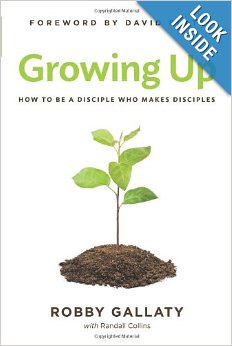
Robby Gallaty’s life was radically changed from drug-dealer to the pastor of a growing church. He credits the transformation not only to his conversion experience, but also to the process of personal discipleship he enjoyed under David Platt and others. His book, Growing Up: How to Be a Disciple Who Makes Disciples, shares his passion for discipleship that he is living out as pastor of Brainerd Baptist Church in Chattanooga, Tennessee.
Gallaty gives a strong Biblical argument for the need for discipleship. The focal point of his book is the suggestion that instead of depending on Sunday School classes to do discipleship, churches should have small, closed discipleship groups with a leader and 3 or 4 other people of the same gender. He uses the name “D-group” for such discipleship groups. He prefers such small groups over discipleship by one-on-one mentors, saying one-on-one mentoring is harder to reproduce and may turn into a counseling relationship instead of a discipleship process. While he gives good reasons for the D-group, he seems to overstate the case that his is the best way. After all, Gallaty himself was mentored one-on-one by David Platt, while Jim Putnam’s book, Real-Life Discipleship, describes some effective discipleship with small groups that are larger than the size that Gallaty suggests.
Nevertheless, Growing Up is a useful resource for church leaders wishing to get serious about discipleship. The book is filled with practical advice about growing in one’s prayer life, Bible study, evangelism, and discipling others. Gallaty is fond of acronyms. The last six chapters of his book form the acronymn for the discipleship process: “CLOSER” which stands for Communicate, Learn, Obey, Store, Evangelize and Renew. He suggests the “HEAR” method of Bible study: Highlight, Explain, Apply and Respond. He says the D-group needs “FAT” belivers: Faithful, Available and Teachable.
While I would argue that D-groups are not the only way to do it, the fact remains that Gallaty is actually leading his church to do something, rather than just talk about it. I would highly recommend Growing Up as a resource that church leaders can use to implement true discipleship in their churches. It is “REAL” (Realistic, Easy to Read, Applicable, and Life-changing).
In the interest of full disclosure, let me state that I received a free copy of this book for review, but I was under no obligation to write a positive review.
If you see a video ad below this post, please understand that I have no control over the content in these ads, and I do not necessarily endorse the product.
Is gluttony as bad as drunkenness?
 We rarely equate beer with banana pudding, but scripture says nearly as much about gluttony as it does about drunkenness. The Bible teaches that all addictions have the same basic effect: they destroy your mind, your money and your mood.
Look at the warnings in Proverbs against these two addictions: drunkenness and gluttony.
1. Your mind. Your mind will be led astray and deceived.
“Wine is a mocker, beer a brawler, and whoever staggers because of them is not wise.” (Proverbs 20:1, HCSB).
“If you are the type who eats too much too fast, do whatever is necessary to curb your enthusiasm for food.” (Proverbs 23:2, The Voice Translation)
2. Your money. Your addiction will drain your finances and leave you poor. “Don’t associate with those who drink too much wine or with those who gorge themselves on meat. For the drunkard and the glutton will become poor…” (Proverbs 23:20-21, HCSB)
3. Your mood. You will suffer sorrow and disgrace. You will descend into depression if you persist in feeding your addiction.
“Who has woe? Who has sorrow? Who has strife? … Who has needless bruises? Who has bloodshot eyes? Those who linger over wine…” (Proverbs 23:29-30, NIV).
“…a companion of gluttons humiliates his father.” (Proverbs 28:7, HCSB).
We are not able to overcome our addictions until we first see how much they hurt us and others. The reason we become addicted to something is because we like how it makes us feel. Do we want to lose control of our minds? Do we want to lose our money? Do we want to descend into depression? If not, then we need to break free from our addictions, whatever they are. The first step is to recognize that the problem is real. We need to stop making excuses like, “I’m just a social drinker,” or, “It’s only food, and I have to eat.” The second step is to call on the Higher Power of Jesus Christ to give us victory. For most people with addictions, we will need a third step of counseling and/or a support group.
Don’t wait—do it today!
NOTE: If you see a video ad below this post, I do not necessarily endorse the product.
Fearing Friday the 13th

Photo by cottonbro on Pexels.com
Do you suffer from paraskevidekatriaphobia? It is the most widespread superstition in America, better known as fear of Friday the 13th.
People are so superstitious about the number 13, “the Devil’s dozen,” that tall buildings rarely have a 13th floor, but simply go from 12th to 14th.
Where did this fear of Friday the 13th come from? The website www.urbanlegends.about.com claims it has origins in the Bible, since Jesus and the 12 disciples made up 13 people who ate the Last Supper, and then Jesus was crucified the next day, on a Friday.
So should we fear Friday the 13th? Well, if we’re going to fear that day, maybe we should add Monday the 8th to our phobia file.
Yes, let’s fear Monday, the 8th. Since Genesis says God created mankind on the 6th day, the rested on the 7th, and then Adam and Eve took the forbidden fruit and fell into sin, I wonder if they did it the next day, on Monday the 8th? Maybe we should stay indoors on Monday the 8th!
Or how about February 17th? Genesis 7:11-12 says that beginning on the 17th day of the second month, the rains began to come for 40 days and forty nights, flooding the earth. Sounds like we’d better batten down the hatches three days after Valentine’s.
Jerusalem was burned down by the king of Babylon on the seventh day of the fifth month, according to 2 Kings 25:8-9, so perhaps we should stay indoors on May 7th!
Now, just in case some reader takes me seriously and starts marking all of these dates on the calendar with black ink, let me hasten to say that even if Jesus did die on Friday, the 13th, it was not a Black Friday. In fact, Christians call the date of His crucifixion “Good Friday” for a good reason: his death paid for our sin so that all who believe can go to heaven.
So personally, I’m celebrating Jesus on Friday the 13th.
Book review: “Out of Control”
 Ben Young & Samuel Adams’s book, Out of Control, has a very long subtitle: Finding Peace for the Physically Exhausted and Spiritually Strung Out. But the subtitle is accurate. They describe how our culture is out of control because rather than letting the greater efficiency afforded by technology such as cell phones and computers give us more time to rest, we have instead tried to cram even more activity into shorter time.
Young and Adams describe seven symptoms of an “out of control” lifestyle: out of shape (physical), out of sorts (emotional/mental), out of touch (relational), out of time, out of focus, out of balance and out of order (spiritual). Then they confront the lies that keep us out of control, particularly the idea of pleasing the world to be successful and the idea that getting rest is laziness.
The rest of the book takes a pleasantly surprising turn, as it is NOT another “how-to” book with seven easy steps. Instead, they dig into the spiritual disciplines of the Bible, and encourage the reader to practice a real “Sabbath” and take time to unplug completely from technology in order to practice the other spiritual disciplines of solitude and prayer.
This book influenced me to become more serious about unplugging from technology for a large portion of the day on my day off in order to spend more authentic time with God. It was a truly rewarding experience that I pray I will continue to explore for a long time to come.
Guest Blog: OUT OF THIS WORLD! Part One: A Look at Near Death Experiences
 Copyright 2013 by Joyce C. Rogers
(For the next three days I will be publishing a guest blog on what happens upon our death, written by my mother, Joyce Clinton Rogers. Today’s post is on near death experiences. Tomorrow’s post will be on the afterlife. The third post will give an annotated bibliography of her sources, for your further reading.
Joyce C. Rogers is a graduate of William Carey University (B.S.) and the University of Southern Mississippi (M.Ed.). She has written Sunday School literature for LifeWay Christian Resources of the Southern Baptist Convention, including a unit on the afterlife. She and my father, Robert H. Rogers, live in Hattiesburg, Mississippi.)
What happens the moment you die? Where will you go? How will you get there? When you arrive, will you know people? Will angels escort you? What are Heaven and Hell really like? Are near death experiences (NDEs) real? Is death the end?
I experienced deeply moving and spiritual experiences at the deaths of each of my parents, which contributes to my interest in these matters. When my Dad passed away in 1975, I mentally “saw” his body floating at the ceiling of the hospital room. He said, “Don’t cry. I’m fine.” This was said to my mind or spirit – I don’t know how to describe it. It was very real to me. I haven’t forgotten it, after 38 years. Incidents like this don’t seem to be that unusual, as I will explain later in this article.
In 1992, my mother passed away following a long illness and suffering. I began to wonder about my own death. I did not and do not doubt my salvation, but I was troubled about the physical part of dying. I prayed about this continually until I felt directed to read Isaiah. “Do not fear, for I have redeemed you; I have called you by name; you are mine! When you pass through the waters, I will be with you. And through the rivers, they will not overflow you. When you walk through the fire, you will not be scorched, nor will the flame burn you, for I am the Lord your God, the Holy One of Israel, your Savior.” (Isaiah 43:1-3a, NASB)
This answer was very real and satisfying. It was also very emotional. I could not share it without tears for several years, but this answer erased my fear and stopped my worrying. Of course, I am not trying to hurry that time, either.
In my quest to understand more about near death experiences (NDEs), death and the afterlife, I made an exhaustive study of the Bible, as well as 21 books and five audiovisuals. Here is a summary of what I learned. First, we will look at NDEs, and in the second part, we will look at the afterlife. Third, I will give an annotated bibliography to assist you further reading on the subject.
One of the first books I read on the subject of NDEs was the delightful little book, Heaven is for Real, a Little Boy’s Astounding Story of his Trip to Heaven and Back. This book captivated my interest and made me want to know more about these experiences.
Another book that has been an inspiration to me is 90 minutes in Heaven by Don Piper. When I saw and heard Don Piper speak at Hardy Street Baptist Church in Hattiesburg, MS, I was surprised to see that he seemed perfectly normal physically – no limps or obvious scars. He was in a horrific car accident and was pronounced dead for an hour and a half. After a minister prayed over him and sang hymns, he began to sing with the minister! Needless to say, everyone was astonished! He recovered, but it was a long and difficult recovery.
At first, Don did not want to share his NDE. He thought others would not believe him. (This is a common reaction.) He also considered the experience very intimate and holy. Later he was persuaded that others would benefit from his story of going to Heaven, of being welcomed by loved ones, and experiencing heavenly wonders. He then wrote his book and began to speak on many occasions.
One of the most touching stories told in Heaven is for Real is the experience of the little boy, Colton, when he met his sister in Heaven. Since he was not quite four years old, his parents had not told him that his mother had miscarried. But he met a little girl in Heaven who told him that she was his sister. His parents were astonished when they heard this. They had not known that the miscarried baby was a girl or that she was being cared for in Heaven. I shared this incident with a ladies’ group. One lady was in tears because she had miscarried a child. She found immense comfort to think her child was prospering in Heaven.
An extensive account of the sights and sounds of Heaven are given in My Time in Heaven by Richard Sigmund. He declared that “absolute joy and total love are the rule in Heaven.” He tells of being escorted to Heaven by angels and of seeing Jesus.
Earlier, I described the “out of body” experience I had when my father died. There are many stories of “out of body” experiences. One story about a girl hit by a car is in the book Encountering Heaven and the Afterlife by James L. Garlow and Keith Wall. She could see her body and people trying to help her. She felt perfectly at peace at the time. She said she had a conversation with God in which she asked to go back and finish her life. She told God she would witness for Him now that she knows God is real. God allowed her to come back.
There are also many, many accounts of NDEs. I think some people don’t share these accounts because they are afraid that others will not believe they are true. Testimonies of children are to me especially believable and endearing.
Stories of going to Hell are told much less often. However, they are told. In Encountering Heaven and the Afterlife, there is a story of a man whose heart stopped during heart bypass surgery. He became aware of darkness and demons. With horror, he began to pray for God to deliver him. He realized that he had not confessed sin and acknowledged God in his life. He recovered and immediately wanted to be baptized. He was not shy about sharing what happened to him. “I know God is real and that Jesus died so I don’t have to go back to Hell ever again,” he said.
There are stories written by a hospice nurse in Glimpses of Heaven: True stories of Hope and Peace at the End of Life’s Journey by Trudy Harris. Each experience related is unique. Most want their affairs settled, including relationships before they “let go.”
Catherine Marshall wrote the Foreword to Betty Malz’s book, My Glimpse of Eternity. Betty was pronounced dead and the hospital sheet pulled over her head. Twenty eight minutes later, she returned to her body after getting a glimpse of Heaven. Catherine Marshall said, “Upon occasion God breaks into human life to give a glimpse of what lies ahead. Betty Malz’s remarkable experience is a resounding ‘Yes, there is life after death.’” Betty sang with the angels and understood several different languages used in the music.
Copyright 2013 by Joyce C. Rogers
(Coming tomorrow: OUT OF THIS WORLD! Part Two: The Afterlife)
Why do you go to church?
Sunday, August 11, is “Back to Church Sunday” at the church where I pastor, First Baptist Church of Rincon, Georgia. Thousands of churches across America will observe “Back to Church Sunday” sometime this fall.
We know that many people get out of the habit of going to church during the summer, and many have dropped out altogether. But we want to encourage you to come back! This is a good time, as the church begins its fall activities. Take my poll above, feel free to leave your comments, and watch for more posts about reasons to get back in church.
A collection of Christian thoughts on the Supreme Court ruling on same-sex marriage
 In June 2013, the U.S. Supreme Court struck down the Federal Defense of Marriage Act, allowing federal benefits for same-sex marriage partners in States that already have legalized same-sex marriage.
How should we respond to this? Here are a some brief thoughts of my own, and links to what other Christian bloggers are saying:
1) We must respond with Christ-like love. Ranting and raving on Facebook and Twitter and angry words to our friends and family will only confirm the unbeliever’s preconceived notion that Christians are judgmental and narrow-minded.
LifeWay researcher and Southern Baptist author Ed Stetzer calls for gracious, Christ-like responses in his blog: http://www.christianitytoday.com/edstetzer/2013/june/prop-8-doma-and-christian-response.html.
2) We must prepare to live in a non-Christian culture. Our parents lived in a generation where Judeo-Christian values were the norm. That is no longer the case. We will need to stand by Christian values that are at odds with our culture, and be prepared to graciously endure persecution, if needed, when submission to anti-Biblical standards are demanded of us. Do not conform to this world, but be transformed (Romans 12:1-2).
Sylvania, Georgia youth pastor Steve Dresen reminds us of how the early church responded in a culture that did not share our values: http://stevendresen.wordpress.com/2013/06/27/scotus-same-sex-marriage-and-the-churchs-identity
3) We must not give up. Don’t forget that the majority of States still do not allow same-sex “marriage.” In many nations around the world, such as Africa and Eastern Europe, homosexuality is still considered sinful by the overwhelming majority of people. Just as the prophets in the Old Testament boldy spoke truth to their culture, we too must proclaim the truth, rather than concede defeat. Last year I preached a sermon entitled, “What the Bible teaches about homosexuality may surprise you.” You can read it here: https://bobrogers.me/2012/07/09/what-the-bible-says-about-homosexuality-may-surprise-you/
Roman Catholic scholars make some good points about how the Supreme Court decision does not end the debate and that “gay marriage” is not inevitable. Here is the report from the Catholic News Agency: http://www.catholicnewsagency.com/news/gay-marriage-is-not-inevitable-analysts-say/.
4) We must remember that God is on His throne. God was still on His throne when Noah built the ark, when Moses fled from Pharaoh, when Jerusalem was destroyed by the Babylonians, and when Jesus died on the cross. The demise of God and godliness has been overstated many times before, and God always turns it around for good. Rather than despair, Christian, let us get on our needs and pray for a new movement of God that is totally dependent upon the power of God, not the power of politics.
Book Review: “I Am a Church Member”
 If you are looking for a resource for your church’s new member class, this is a book you will want to read.
Thom Rainer, CEO of LifeWay Christian Resources, has written I Am a Church Member: Discovering the Attitude that Makes the Difference. It is a short book that can easily be read in one sitting, but it has the potential of making a big impact in local churches.
The book opens with a story about two members of the same church with completely opposite attitudes about church. Then he zooms in on the Biblical attitude members should have in six short chapters, based on Rainer’s extensive research in attitudes among church members. These chapters teach members to be active, bring unity, avoid the tendency to insist on personal preferences, pray for leaders, lead their own families to be involved, and to treasure church membership as a gift. The main point of the book is that church membership is not like a country-club membership with perks and privileges.
There are some churches that reject the term “membership,” saying it is an unbiblical modern term. Rainer disagrees, pointing out that 1 Corinthians 12:27-28 speaks of the “individual members” of the church. Rather than reject the term, Rainer seeks to give a Biblical definition of the term “membership.” He emphasizes that Biblical church membership is a treasured gift, just as our salvation is a gift, and thus we should serve in our churches gladly, not begrudgingly.
One of the strengths of this little book is that each chapter includes a pledge of loyalty for members to make. This requires the reader to respond to the challenge of the book. Each chapter also includes discussion questions, making this book an outstanding resource for small group or one-on-one study for church members, both new and old.
Book review: “Multiply” by Francis Chan
 Francis Chan, author of the influential books Crazy Love and Erasing Hell, has written Multiply: Disciples Making Disciples for the purpose of multiplying disciples in the church.
The book has some excellent material; however, I was disappointed in the book, because it was not what I expected. I downloaded the book and read it on my Kindle, deceived by the title into thinking it was about how to make disciples. While the introduction and first three chapters (about 40 pages) discuss how to use the book for discipleship, that’s about it. The rest of the book is an overview of the teachings of the Bible.
Don’t misunderstand me. The overview of the Bible is excellent. It’s well-written, and has good support material with questions for discussion and videos available to watch online. If you are a mature Christian, you will find very little new information here, but it is a good, solid summary of what the Bible teaches. If a person goes through this material with a new believer, that person will be very well-founded in a biblical worldview.
The bottom line: if you are looking for material for an in-depth teaching of the basics of Christianity for a small group or one-on-one, this is a great book. But if you are looking for a book on how to organize your church for the purpose of multiplying disciples, you will probably find more help elsewhere, such as Real-Life Discipleship by Jim Putman.
10 Biblical steps to getting out of debt
 Back at the beginning of “The Great Recession” in early 2009, our church went through a study on how to get out of debt, using the teaching materials of Crown Financial Ministry. Here is a summary of 10 wise and Bible-based principles for getting out of debt:
1. Pray for God’s provision (see 2 Kings 4:1-7 for an example).
2. Start giving regularly (Malachi 3:8-10).
3. Don’t go further into debt. Stop charging with credit cards!
4. Establish a written spending plan by writing down every penny that you spend for a month, and then developing a spending plan that is realistic and living within your means.
5. Open a savings account and contribute faithfully to it until you have $1,000 in savings for emergencies. (This prevents further debt because you can use your savings for unexpected expenses.)
6. List everything you own and see if you can sell unnecessary assets to eliminate debt (Proverbs 27:23).
7. Make a list of everything you owe.
8. Establish a debt repayment schedule. Pay off the smallest debts with the highest interest first. When that debt is paid, apply that payment amount to the next second debt, and so on. See Crown Financial Ministries for free calculators and tools that can help at www.crown.org/Tools/Calculators.
9. Consider earning additional income.
10. Consider a radical change in your lifestyle (Romans 12:1-2).
Guest blog: “Lunch Encounters of a Spiritual Kind”
 (The guest blog below is a touching story with a practical lesson for believers, written by Biblical Counselor Sherri Edenfield Hall, from Macon, Georgia. You may email her at sj.hall77@gmail.com.)
Her name is Sabrina. I don’t even know her last name. My two children and I were enjoying lunch at a local restaurant, when this attractive, beautifully dressed woman of color entered with her little girl.
Something more than her appearance struck me. Her girl (perhaps 3 years old) tried desperately to capture her mother’s attention, but to no avail. “Something is wrong with this picture,” I thought.
Understanding suffering helps to identify it, perhaps. I recognize it well. So, I began to pray for an opportunity to speak with this lady, whose daughter was now twirling down the aisle in a ruffled dress.
We finished lunch. The kids took my keys and headed to the van to read. My plan was to initiate conversation with this new friend who had spoken to me when I went to the counter. She liked my “Fruit of the Spirit” bracelet. I thanked her, and began to listen to her story.
I learned that Sabrina had flown back home to Georgia for a funeral that very day. One of her parents died years ago. Now the other was gone, too. Then she said, “Two weeks ago, I buried my husband. He committed suicide.”
There was a long silence. Sabrina motioned toward her precious little girl and continued, “She doesn’t even know her daddy’s gone.”
We sat there for what seemed an eternity, saying nothing.
For years I have shared my faith in Christ, and knew countless methods by which to do so. At that moment I felt compelled to simply tell my story.
Although very different, our stories had one thing in common. We both realized that sometimes life comes at you. Before you can catch your breath, the wind is knocked out of you.
Sabrina wanted to hear. So, I shared wave after wave of painful events I experienced as a young person. That was the hard part. Then, I was able to share the good news!
One night in my apartment in Athens, Georgia, I gave my life (and all my hurt) to the Lord. A poem called “Surrender” in a Home Life magazine riveted my heart. Immediately, it was as if my Heavenly Father whispered, “Baby girl, I know all your hurts. You are trying to be strong. Just give up. Rely on Me. Surrender everything to Me.”
The flood gates opened! I got on my knees. I gave Christ control of my life. Running from God was wearing me out, anyway! No longer desiring to lead my own life and make poor decisions, I surrendered my past, present, and future to Christ in a radical abandonment of self.
I told Sabrina that although I knew nothing about living the exchanged life with Christ, as Galatians 2:20 offers, this is exactly what occurred. I have never been the same! There was an unexplainable freedom and joy. Christ overwhelmed me with His love and peace.
I will never forget the hopelessness in her eyes when she asked, “What does it mean to surrender?” I told her about God’s love for us through Christ’s death on the cross and His power over death in His resurrection. To my amazement, I found myself offering my treasured bracelet to Sabrina. Tears filled her eyes as we parted ways.
Sabrina’s question haunted me for days. “What does it mean to surrender?” At that time, I only understood what it meant to me personally. It was a radical abandonment of self to Christ. As I searched Scripture, words like “submit,” “yield,” and “offer up” ourselves took on deeper meaning. Ultimately, surrender is the posture of our heart humbled before Christ’s Lordship.
Because Sabrina was experiencing complicated grief, and was still somewhat in shock, I did not expect her to make a decision to follow Christ immediately. I did, however, envision that she would benefit greatly from our divinely-orchestrated conversation later in her journey.
Although there are many benefits to a “Surrendered life” to Christ, three obvious benefits are:
Healing Begins – We literally change focus from self to Christ, and He sets us free! John Piper says, “The healing of the soul begins by restoring the glory of God to its flaming, all-attracting place at the center. We are all starved for the glory of God, not self.”
1 Peter 5:6-7 (NASB) encourages to “Humble yourselves, therefore, under the mighty hand of God… casting all your anxiety (cares) upon Him, because He cares for you.”
In the gospel, we “see and savor the glory of God in the face of Christ” (2 Corinthians 4:6). This kind of “seeing” is literally the healing of our disordered lives.
Maximizes Study of God’s Word – The attitude and posture of our hearts, a “yieldedness” to Christ through faith, increases our receptivity of God’s Word. When our hearts are receptive, we gain clearer understanding.
In Romans 12: 1-2, we are encouraged to “Offer yourselves to God” first, that we may be “transformed by the renewing of our minds.”
Overcomes Deceptive Thinking – Truth always trumps deceptive thinking. Jesus, in fact, defines reality! For years I have had a front row seat in the counseling office to witness the truth of God’s Word (when applied to receptive hearts) expose and overcome deceptive thinking.
Submission is a protection against deception. “Submit therefore to God. Resist the devil and he will flee from you” (James 4:7, NASB).
Christ transforms people by exposing the blind spots and disconnects in our lives and relationships. Our goal is not to overcome our issues necessarily, but rather to engage them with a growing knowledge of Christ. It begins by bowing to Christ’s Lordship.
Although we may never meet again here on this earth, I hope to see Sabrina again one day! She’ll probably be wearing the bracelet I gave, or should I say, that I “surrendered,” to her.
Question: How would you have answered Sabrina’s question, “What does it mean to surrender?” Do you remember your own radical abandonment of “self” to Christ’s Lordship?
~~~~~~~~~~~~~~~~~~~~~~~~~~~~~~~~~~~~~~~~~~~~~~~~~~~
(Sherri Edenfield Hall is a Biblical Counselor with Creative Counseling Solutions for Women, and Inspirational Speaker, who resides in Macon, GA. To inquire for speaking engagements, please email her at sj.hall77@gmail.com.)


 Bob Rogers