Category Archives: Christian Living
How Jesus said you can change your world
Copyright 2015 by Bob Rogers

“You are the salt of the earth… You are the light of the world.” (Matthew 5:13-14)
Our world is in a mess, but Jesus Christ told us exactly how to change our world in the Sermon on the Mount, when He said to be salt of the earth and light of the world. Jesus told us what to be and what to do.
1. What you should be: salt and light. Why did Christ pick the illustration of salt and light? Salt is used as a preservative and to flavor food. Likewise, we should influence our world. Paul gave an example of this in 1 Corinthians 7:14, saying that the believer who remains married to an unbelieving spouse can influence them toward salvation. Light reveals and reflects. Likewise, we should reveal truth, glowing with the glory of God in our lives. Interestingly, Jesus said here, “You are the light of the world,” but in John 9:5, He said, “I am the light of the world.” This is no contradiction; Jesus is the source of the light, and we can merely reflect His light. We have no light within ourselves; we only get it when we are plugged into the power source through a relationship with Christ Himself.
2. What you should do: keep your saltiness and shine your brightness. Jesus said in this passage, that if salt loses its taste, it is no longer any good. A lot of Christians are sassy but not salty. We need to keep the saltiness but lose the sassiness. Jesus also says in this passage that nobody puts a lamp under a basket, but he puts it on a stand so everybody can see it. A wise person once said, “The best way to deal with change is to create the change.” Too many Christians are reactive instead of proactive. We have good news! We have hope! Spread it around and let it shine.
3. Why should we be salt and light: to glorify God. Jesus concludes by saying, “Let your light shine before men, so that they may see your good works and glorify your Father in heaven.” The reason for us to be salt and light is not so that others will look at us, but so that they will look at God.
Acts 17:6 says that the people in the city of Thessalonica were so stirred up about the influence of the Christians that they said, “These men who have turned the world upside down have come here, too!” The early Christians changed their world. So can we.
What do you do after Christmas?
Copyright 2014 by Bob Rogers

What do you do after Christmas? What happens after you take down the tree, put up the lights, and put away all the wrapping? You do as the shepherds and Mary did: promulgate, meditate and celebrate!
1. PROMULGATE. In a previous century, they called missionary-sending organizations a Society for the Promulgation of the Gospel. In this century, the need is as great as ever to spread the good news. “After seeing them, they reported the message… about this child” (Luke 2:17). Ask somebody how their Christmas went, and use it as an opportunity to tell them how much it means to you to know Christ as your Savior.
2. MEDITATE. “But Mary was treasuring up all these things in her heart and meditating on them.” (Luke 2:18). Spend some time quietly reflecting on the miracle of the Virgin Birth, and the Incarnation, God coming in flesh.
3. CELEBRATE. “The shepherds returned, glorifying and praising God.” (Luke 2:19). You probably went to church before Christmas. Sadly, the Sunday after Christmas is often one of the lowest in attendance of the year at many churches. But the shepherds rejoiced and worshiped AFTER the birth of Christ. So should we.
Why do we celebrate Jesus’ birth on December 25?
Copyright by Bob Rogers

Since nobody knows the exact date of Jesus’ birth, why do we celebrate Christmas on December 25?
The Beginning of the Christmas Holiday
The answer to that question is submerged under a haze of mystery. An early father of the church, Cyprian, said in 243 that Christ was born on March 28, the spring equinox, for “on that day which the sun was made on the same day was Christ born.” However, Christ’s birthday was not celebrated until the fourth century, and when the tradition of Christmas began, the date of December 25 was preferred in the West, while January 6 was preferred in the East (a date that is still preferred by Eastern Orthodox Christians).
The earliest known reference to celebrating Jesus’ birth on December 25 was in the Philocalian Calendar, a list of martyrs of the Roman Church, written in 354 but reflecting practices in 336. In 376, the bishop of Rome first required churches to keep the nativity festival on December 25. In 386, John Chrysostom refers to the date of the December 25 festival by saying, “It is not yet the tenth year since this day has become clearly known to us.” Ironically, Christmas was celebrated in Bethlehem on January 6 until the sixth century (since Bethlehem was under the influence of the Eastern tradition). After the sixth century, Bethlehem celebrated Christmas on December 25, because Emperor Justin II (565-578) ordered the celebration of Christmas on December 25 throughout the Roman empire.
The Origin of the Date of Christmas
There are two major theories of the origin of these dates: one with pagan roots, and one with Christian roots.
The most commonly accepted theory is that the date was chosen, perhaps by Emperor Constantine, to divert the attention from pagan holidays. Emperor Aurelian had established a pagan winter solstice festival on December 25, 274, and he probably dedicated a temple to the sun god on that date. The birth of the Persian god Mithras, identified with the sun, was celebrated on December 25. Egyptians celebrated the birthday of the sun god Aion on January 6. Many people contend that Christmas should not be celebrated because of this possible connection to these pagan origins. Ironically, some of these same people will themselves seek to replace the pagan celebration of Halloween with a Harvest Festival at their churches, in much the same way as they claim the early Christians celebrated Jesus’ birth to replace a pagan holiday.
Thomas J. Talley, in his book, The Origins of the Liturgical Year, argues that the dates of both December 25 and January 6 can be explained from Christian origins. In rabbinic thought, it was common to remember the conception and death day of patriarchs on the same day. By putting Jesus’ conception on the Jewish day of 14 Nisan (March 25 on the Western calendar and April 6 on the Eastern calendar), His birth nine months later would be either December 25 (according to the Western calendar) or January 6 (according to the Eastern calendar). Thus the birth of Christ could have been set “without reference to pagan public celebrations,” says Talley.
Since Luke 2:8 says the shepherds were outdoors with their flocks when the angel announced Christ’s birth to them, Cyprian’s date of March 28 is probably closer to the actual birthday of Jesus than the colder times of December 25 of January 6. Some would argue that since there is no historical evidence for Jesus’ birth on these dates, that we should not celebrate Christmas. However, there is another piece of the puzzle from history that would argue otherwise. In the fourth century, when the Christmas holiday became popular, Christians were in the midst of a raging controversy of what they believed about Jesus Christ. By celebrating Christmas, orthodox Christians were able to affirm the important doctrine of the Incarnation, that Jesus was God in the flesh. For example, Chrysostom, who himself stated that the festival of December 25 was a relatively new celebration in his time, went on to say this about its importance:
“This day He who is, is born; and He who is, becomes what He was not. For when He was God, He became man… being the Word, He became flesh…”
Favorite children’s Christmas books: “All Is Well” by Frank E. Peretti
 Frank Peretti is the best-selling author of the Christian thriller This Present Darkness, but he is also the author of one of the most touching Christmas books for children that I have ever read.
All Is Well: A Story for Christmas is different from other children’s Christmas books for several reasons. It is on the reading level of an older child, perhaps about fifth grade. It is on the emotional level of a single mom who is struggling to make ends meet at Christmas. The story takes place in July, not during the Christmas season. Yet is most certainly a Christmas story, especially for those who going through tough times during the holidays.
If you are looking for a cute Christmas book for your child, this is not your book. But if you need encouragement to make it through Christmas, this may be the best book you could read, especially to a child who doesn’t understand why God is allows suffering and hard times.
Taking the road less traveled

Copyright 2014 by Bob Rogers
I’m glad that I met some angry dogs on a country road.
This summer, I was going for a walk on a country road where my in-laws live. I have walked that road for years. I know that many of the homes have dogs, so sometimes I carry a stick for protection. That particular day, I brought my pepper spray. Unfortunately, a woman near the end of the road let her dogs chase me. I had to use the pepper spray to keep the dogs away from me. The woman and I exchanged a few words. I’m not really proud of the argument we had.
This fall, I was visiting my in-laws again, and I decided to go for a walk again with a stick and my pepper spray. I don’t enjoy conflict, and even though I thought the “crazy woman with the dogs” was wrong, I had no desire to have another confrontation. Right before I reached her home, there is another road that turns left, so I turned left down that road. I’m so glad that I did. The side road was so beautiful and peaceful that I put away the spray and got out my cell phone to take a picture. At the top of this page is the photograph I took that day. Click on it and you can see how beautiful the view was. It reminded me of the poem “The Road Not Taken” by Robert Frost, which ends with these words:
Through this experience, God showed me a spiritual truth. Sometimes we have trouble in life, and we don’t understand why it comes. It may cause us to go down a different path, a path we did not expect. But often God works through these circumstances to bring about something beautiful and new. We just need to look for it.
We need to listen to the Holy Spirit when He puts up a road block on a path, and be open to going down a new path. Isaiah 30:21 says, “Whenever you turn to the right or to the left, your ears will hear this command behind you; ‘This is the way. Walk in it.'” When we face trouble, we need to trust in a loving God who desires to bring good results out of the bad circumstances, if we will be faithful. As Romans 8:28 says, “God causes all things to work together for good to those that love the Lord and are called according to His purpose.”
I regret that I had the conflict that sent me down a different road. I’m even embarrassed that I let myself get into a senseless argument with a woman over her dogs. But, like Robert Frost, I’m glad that the conflict I had on that road opened up a new road I would otherwise have never seen. How about you?
How is your day going?
 Copyright 2014 by Bob Rogers
“How is your day going?” asks a friend.
How do you answer that question? Many people let circumstances beyond their control determine their answer to that question. If they are sick, or the weather is bad, or somebody has treated them poorly, then they decide it’s a bad day. But if their health is improving, or the weather is nice, or somebody was kind to them, then they decide it’s a good day. The problem with that approach to life, is that it allows other people to decide for us what kind of day we are having!
God’s Word teaches us a better way. “This is the day the Lord has made, let us rejoice and be glad in it,” says Psalm 118:24. “Give thanks in everything,” we read in 1 Thessalonians 5:18. Really? Everything? How can I give thanks for cancer or a loved one who is dying? Notice scripture does not say to give thanks for everything, but to give thanks in everything. We can give thanks to God despite our troubles, because God often works through our troubles for good, and because, as bad as things may seem, we still have many blessings around us. Many of the psalms list reasons to give thanks. Read Psalm 103, 136, and 138, and you will see what I mean.
A pastor in Illinois was grieving the death of his father. His father always had a thankful attitude. But his son didn’t feel that way. He missed his Dad terribly. His mother told her son that during the war in Korea, his father was depressed one day, and went up on a mountain. On the mountain, God spoke to his heart in prayer. He decided right there, in the midst of war, to make it his daily habit to count his blessings. It changed his life. As the mother told her son this story, they came across an old photograph of the pastor’s father in his Army t-shirt in Korea. He had a happy smile. His mother pointed to something in the background. It was a mountain. “That,” she said, “was where your father counted his blessings.”
Someone wisely said,
Count your blessings instead of your crosses;
Count your gains instead of your losses.
Count your joys instead of your woes;
Count your friends instead of your foes.
Count your smiles instead of your tears;
Count your courage instead of your fears.
Count your full years instead of your lean;
Count your kind deeds instead of your mean.
Count your health instead of your wealth;
Count on God instead of yourself.
As Christians, we are able to do that, because we have the greatest blessing of all, the forgiveness of our sins through faith in Jesus Christ. Romans 8:1 says, “There is therefore now no condemnation for those who are in Christ Jesus.” That’s blessing number one! Start there, and keep counting. On a mountain in Korea, a soldier decided to count his blessings. When and where will you do and I do the same?
Guest blog post: Expressing Sympathy During the Holidays
 (Below is a guest blog by Suzie Kolber on the subject of how to express sympathy during the holidays, which can be a difficult time for those who have recently lost a loved one. Suzie is a writer at ObituariesHelp.org. The site is a complete guide for someone seeking help for writing words of condolences, sympathy messages, condolence letters and funeral planning resources.)
The holidays can be such a fun, exciting time for most people. However, for those who have recently lost a family member or close friend, it can be a difficult, painful time. Everywhere they look, something reminds them of prior holidays spent with that person.
Depression is a common problem during this season for people who have lost their loved ones. If the anniversary of the death or the person’s birthday falls during this time, it can make the brightest days seem dark.
Avoidance
Many bereaved people tend to avoid others during this time. They don’t socialize or go out because they see the festivities as another painful reminder of their loss. On the other hand, friends and family members may tend to avoid the bereaved person because they don’t know what to say. It feels awkward to be around them and try to hide their natural excitement for the season.
While it is natural to want to avoid the hustle and bustle of the holiday season, the isolation only contributes more to the feelings of depression and loneliness. Family members and friends need to be aware of this and continue interacting with their grieving loved one.
What To Say
It’s normal to want to avoid someone when you don’t know what to say to them. However, your support and sympathy is needed, especially when someone suffers such a loss around the holiday season. The following tips will help you offer the comfort that is needed.
- Offer assistance for the person who still has to organize the holiday celebration even though they are grieving. For instance, someone may have lost a spouse but has children who want to celebrate. They may need help with cleaning, cooking or even shopping.
- Invite someone to your home for the holidays, especially if you are having a low-key celebration. This allows them to get out without being overwhelmed by the activities.
- Invite the loved one to volunteer with you. Doing something like creating gift baskets for soldiers can help a person feel useful and remind them that they are not alone. Others may be missing loved ones for different reasons.
- Be willing to talk about the deceased. Your job may be as simple as listening as the person relives fond memories. While you may think it would bring sadness to talk about the person who is gone, it can actually be helpful. The person is thinking about them anyway; talking provides healing.
If the person lives far away and you can’t visit during the holiday season, it is appropriate to send a flower or gift basket. You don’t need to wish them “Happy Holidays” or “Merry Christmas.” Instead, include a card that says that you are thinking of them. Just this reminder and a few lovely flowers can brighten their day.
Anytime is a bad time to lose a loved one. Suffering the loss during the holidays makes the pain even more severe for many. Reach out to those people and they will appreciate the comfort that you provide.
Guest blog: “Defeating Giants” by Melissa Hanberry

David took Goliath’s life with a stony missile and a conquered sword. Those are the tools of the trade we associate with his victory. But his first step in winning the battle was winning the war of words. “You come to me with a sword, a spear, and a javelin, but I come to you in the name of the Lord of hosts, the God of the armies of Israel, whom you have taunted.” (1 Sam 17:45) And there were two more weapons with David that day. Those sticks didn’t escape Goliath’s attention, so they shouldn’t escape mine. David’s rod and staff? The same rod and staff of Psalm 23:4? Maybe David carried them to battle for comfort, a tangible reminder of the Good Shepherd who counts, rescues, and protects His own. Today they remind me that our battle with cancer is not fought on one plane with one weapon alone. In the same way a shepherd numbers his sheep as each passes beneath the rod, He numbers the very hairs on Maggie’s head and bids us not to fear (Luke 12:7). And with the staff, He searches and rescues me from the end of my own path. With such a Shepherd, my valley of darkest shadows becomes my place of deepest trust and sweetest victory.
Who Needs My Kindness?
Copyright 2014 by Bob Rogers
 The fifth fruit of the Holy Spirit, listed in Galatians 5:22, is kindness. We know what kindness is, but have we stopped to think about who needs to receive our kindness? Undoubtedly, everybody needs it, but scripture names some specific groups of people in particular need of kindness:
1. My wife. Colossians 3:19 says, “Husbands, love your wives and don’t be bitter toward them.” Sadly, men tend to come as across harsh with their wives, often without realizing it. The stronger male physique and deeper voice of the male can be intimidating, which is why 1 Peter 3:7 commands, “Husbands, in the same way, live with your wives with an understanding of their weaker nature, yet showing them honor as co-heirs of the grace of life, so that your prayers will not be hindered.”
2. My fellow believers. Ephesians 4:32 says, “Be kind and compassionate to one another.”
3. The poor. Proverbs 19:17 says, “Kindness to the poor is a loan to the LORD.” Jesus tells a parable of righteous sheep and unrighteous goats, and the distinguishing mark of the sheep is how they show kindness, particularly to the poor. Christ said to the sheep that they were blessed to inherit the kingdom, “For I was hungry and you gave Me something to eat; I was thirsty and you gave Me something to drink… I was naked and you clothed Me…” (Matthew 25:35-36). In the same passage, Jesus adds three other people groups who need our kindness:
4. Strangers (Matthew 25:35). This is an often overlooked theme of the Old Testament Law, to always show kindness to strangers and foreigners. Deuteronomy 10:19 says, ‘You also must love the foreigner, since you were foreigners in the land of Egypt.” Many Americans who are unkind to immigrants seem to forget that most of our ancestors originally came from another continent.
5. The sick. (Matthew 25:36). The head chaplain at the hospital where I work recently said to the other chaplains, “Guys, remember when you have a bad day, that our worst day is better than the best day of most of our patients.” When people are seriously sick, their worlds are turned upside-down, and their emotions are on edge. How they need our kindness.
6. Prisoners (Matthew 25:36). Most of us find this last group the most difficult to show kindness. After all, if they’re in prison, don’t they deserve their punishment? Probably, but maybe not. However, for Jesus, the issue is not what they deserve, but what they need. All of us deserve punishment for our sin, for we have all broken God’s laws. But we need grace. Let’s show it to those in prison, as well.
Mark Twain said, “Kindness is the language which the deaf can hear and the blind can see.” The Bible teaches that it is especially the most vulnerable people in society, such as the deaf and blind, the poor, the sick, and those in prison, to whom we should show extra kindness.
So instead of asking who deserves our kindness today, let’s ask, Who needs my kindness today?
X
X
X
X
(If you see an ad below this post, please understand that I have no control over the ads, and that I do not necessarily endorse the product.)
How do I develop patience with difficult people?
Copyright by Bob Rogers
“But the fruit of the Spirit is love, joy, peace, patience…” Galatians 5:22
 You have probably heard the saying, “I like my church (job, family, or fill in the blank with whatever else) it’s the people I can’t stand!” No wonder we say, “Patience is a virtue.”
When studying the fruit of the Holy Spirit (Galatians 5:22-23), people generally agree that one of the most difficult characteristics to develop in our lives is patience. There are two different words for patience in the original Greek language of the New Testament; one word means patience with circumstances, and the other means patience with people. The word used in Galatians 5:22 means patience with people; thus the 2011 revision of the New International Version translates it “forbearance.”
It may be easy to be patient with kind, sweet people. But how do I develop patience with people who try my patience? Here are some guidelines from other scripture:
1) I must remember that I am a recipient of Christ’s mercy, and follow His example. First Timothy 1:16 reminds me, “But I received mercy for this reason, so that in me, the worst of them, Christ Jesus might demonstrate His extraordinary patience as an example to those who would believe in Him for eternal life.” Yes, the starting point of patience with others is to remember how Christ is patient with me. I am a sinner deserving Hell, but God patiently called me to faith, and He continues to work with me and develop me, even as I struggle and fall along the way. Since Christ has set this example for me, I should be motivated to follow His example, as a testimony to the gospel.
2) I must help those who are struggling with weaknesses. Romans 15:1 says, “Now we who are strong have an obligation to bear the weaknesses of those without strength, and not to please ourselves.” If I am strong in a certain area of my life, I must be patient with those who are weak and struggle in that area. We have a tendency to be patient with those who have the same struggles we have. God calls us to be patient with those who are weak where we are strong. After all, they may be strong in another area where we are weak, and we will desire that same patience from them.
3) I must not keep a scorecard. In the love chapter, Paul says, “Love is patient… is not provoked, and does not keep a record of wrongs” (1 Corinthians 13:4-5). If I keep score of how many times I’ve been wronged by another person, I am much more likely to snap and lose it. I must ditch the scorecard.
4) I must accept people as they are, not as I want them to be. Ephesians 4:2 says, “With patience, accepting one another in love.” Colossians 3:12-13 says, “Put on… patience, accepting one another and forgiving one another…” My irritation with others is often a result of unfair and unrealistic images that I project on others. While I want others to do better, I must decide that I will love and accept them as they are now. It helps to remember that I want others to love me with my faults, as well.
5) I must not quarrel. Second Timothy 2:24-25 says, “The Lord’s slave must not quarrel, but must be gentle to everyone, able to teach, and patient, instructing his opponents with gentleness.” Notice that this passage does not say that we cannot disagree. It is in the context of talking to opponents, people with whom we disagree, that the scripture commands patience and gentleness. We must learn to disagree calmly, without raising our voices, and without attacking the other person.
6) I must be quick to hear and slow to speak. James 1:19 commands, “Be quick to hear, slow to speak and slow to anger.” It is human nature for me to not truly listen to what another person is saying to me, because I am focusing on what I will say in reply. I would display patience and avoid many unnecessary quarrels if I would slow down, focus on what the other person is saying, and then reflect on what I heard before I said a word. Whenever I practice this communication tool, I am allowing the spiritual nature to rule over the human nature.
I’m praying daily to bear more of this fruit of the Spirit. Please be patient with me as this fruit ripens in my life. How about you?
X
X
X
X
(If you see a video ad below this post, please understand that I have no control over these ads, and that I do not necessarily endorse the product.)
Book review: Joe McKeever, “101 Cartoons”
 Recently, I had the pleasure of enjoying some pancakes with Joe McKeever. When he noticed that the waitress was friendly, he immediately pulled out a pad and pencil, asked her to stand still and smile, and in a few moments he had drawn a wonderful cartoon of her likeness. She was so excited, another waiter came to ask about it, and he gladly drew another one. Everywhere he goes, Joe draws pictures of people. You might say that he’s the quickest draw in the West.
McKeever’s cartoons were published for years in Pulpit Helps and are still a regular feature in various Baptist newspapers through Baptist Press. Now McKeever has published a great collection of some recent favorites, entitled 101 Cartoons. Each cartoon is a full page, and nearly all are in full color. Most of the cartoons poke fun at religious subjects, as is illustrated by the photo at the bottom of this review. Others, like the cover photo above, poke fun at life in general.
McKeever has a corny sense of humor, which I like. He pokes fun at pastors, deacons, pastor search committees, hypocrites in church, seeker-sensitive churches, Calvinism, fickle church members, Facebook, smart phones, politicians, TV, the lottery, sports, health and exercise, among other things. Some of the cartoons make a serious point, such as the one that shows a man in a wheelchair in front of a church with inaccessible steps, who says, “I’ll bet this is a real pretty church on the inside.”
The print is large and easy to read, and as you can see from the photos, they are very colorful. It makes a great coffee table book for enjoyable conversation with family and visitors.
101 Cartoons is available from Amazon.com or you may purchase it directly from the author and he will inscribe a personal greeting and cartoon inside the front cover for you. Send a check for $15 for one or $27 for two, to Joe McKeever, P. O. Box 855, Kenner, LA 70063. In the interest of full disclosure, Brother Joe gave me a complimentary copy of his book along with the pancakes; however, he did not ask me to write this review– I was glad to do that myself!
 X
X
X
X
X
X
X
(If you see a video ad below this post, please understand that I have no control over these ads, and that I do not necessarily endorse the product.)
Book review: Max Lucado, “Outlive Your Life”
 I have read about 20 books by Max Lucado. I love his gift for telling a story and turning a phrase. However, after reading so many of his works, I began to feel that if I’ve read one of his books, I’ve read them all. So when I got a copy of Outlive Your Life: You Were Made to Make a Difference, I let it sit on my bookshelf for over three years.
Recently, some circumstances in my own life drew me again to the title. I’d like for my life to make more of a difference, so I decided to see what Max had to say. I was deeply moved– to take action.
This book uses the familiar writing style of Lucado that has made him one of the bestselling Christian authors of modern times: vivid storytelling with a surprise ending, and clever, poetic phraseology. For example, he described the apostle Peter’s reaction to the vision to eat unclean food by saying, “Peter was pondering the pigs in the blanket when he heard a knock at the door” (p. 146). He also follows a Biblical theme, as he does in most of his books. This one focuses on stories in the Acts of the Apostles to encourage Christian readers to make a difference in their world, the way the early disciples did.
What really stands out in this book, however, is how boldly Lucado calls on Christians to be involved in social action. Again and again, he urges Christians to help the poor, care for orphans, feed the hungry, etc. He is very specific in examples of how to do that, more so than any other book of his that I have read to date. He does so without abandoning the gospel message. In fact, chapter four, “Don’t Forget the Bread,” stresses that if we help the needy and don’t share the gospel, we are like he was when his wife sent him to buy bread at the grocery store and he came home with everything else and forgot the main thing: the bread.
Each of Lucado’s books include a discussion guide at the end, but this book has a “Discussion and Action Guide” (emphasis mine). America’s most inspirational author intends not only to inspire, but to move the reader to action. For this reader, he succeeded.
X
X
X
X
(If you see a video ad below this post, please understand that I have no control over these ads, and that I do not necessarily endorse the product.)
Juggling Sunday
 Copyright by Bob Rogers
A hymnal in my left hand, a Bible in my right
Tossing a communion cup on a one-foot hop.
Cascading with a committee on Sunday night
Spinning a budget, now what will I drop?
A juice-stained Bible by my foot on the floor
Heart cut on the cup, fingers shut in the door
I thought diabolo was a juggler’s trick
But I ended up falling on the devil’s stick.
x
x
x
x
(If you see a video ad below this post, please understand that I have no control over these ads, and that I do not necessarily endorse the product.)
Book review: Many choices in study Bibles
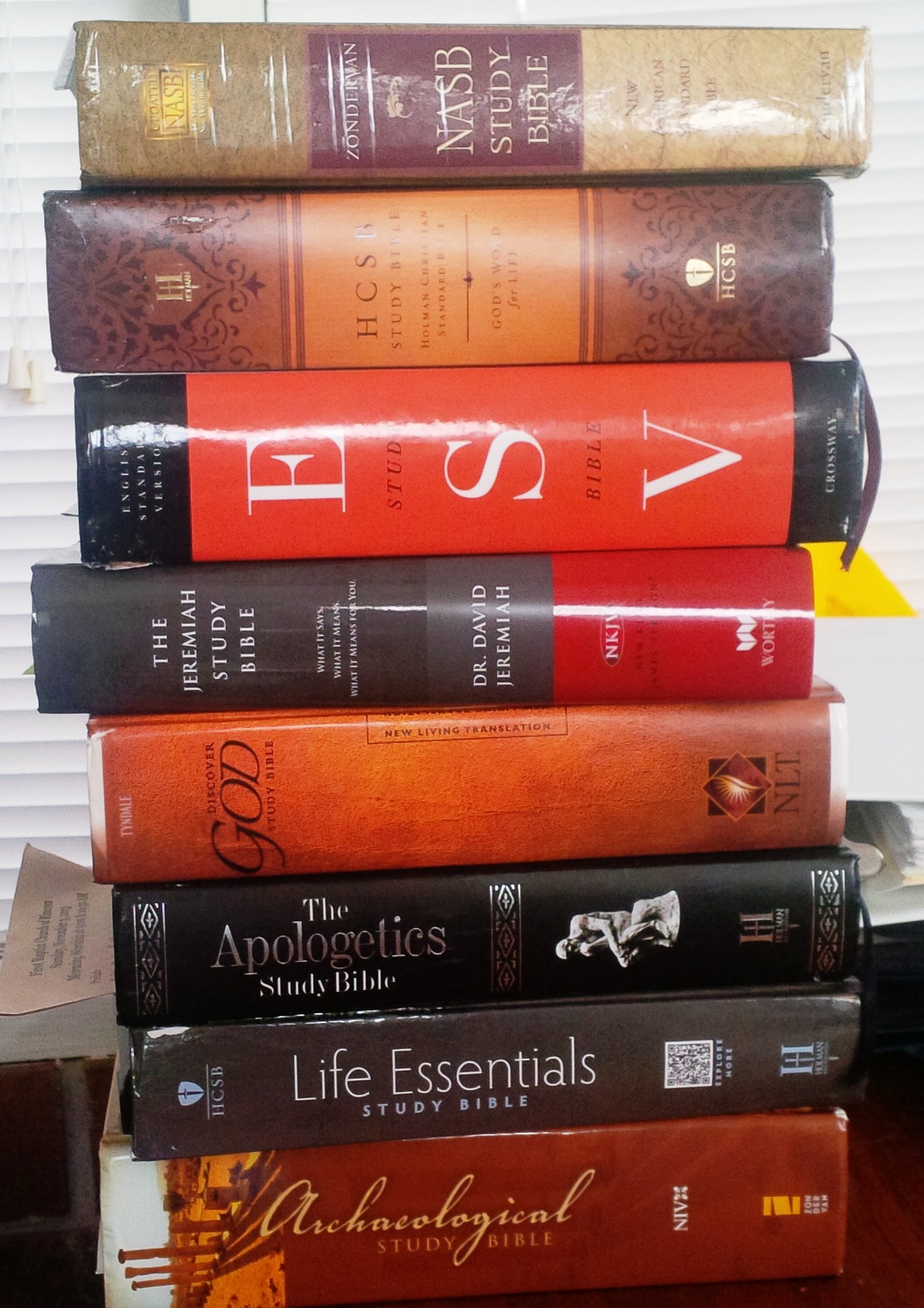 Copyright 2014 by Bob Rogers
When it comes to studying the Bible, not only are there many choices of translations, but also many choices of study Bibles. Here is an overview of some that I have found helpful.
There are several general study Bibles that are connected directly to a certain translation of the Bible. If a person cannot afford an entire set of commentaries, or wishes to have commentary on the whole Bible in one volume, these study Bibles are the best option. The NASB Study Bible (also available with the same notes as the NIV Study Bible), the HCSB Study Bible, the ESV Study Bible and the Jeremiah Study Bible (NKJV) are examples of this. Each of these study Bibles have extensive introductions to the books of the Bible, maps, and notes at the bottom of the page to explain the text in the particular translation used. The ESV Study Bible is the most scholarly and exhaustive of these study Bibles. The HCSB Study Bible is in a more popular style, and makes the best use of color, making it the easiest to read. The Jeremiah Study Bible has notes by popular Bible teacher, Dr. David Jeremiah.
Some study Bibles focus on a special purpose. The Archaeological Study Bible (NIV) includes notes and articles that explain the cultural and historical background of the Bible. The Life Essentials Study Bible (HCSB) and Life Application Bible (available in NLT, NIV, NKJV, NASB) focus on applying the truths of scripture to our lifestyle. The Life Essentials Study Bible makes use of QR code. Readers can scan the code with their mobile phone and watch a video of a Bible teacher explaining the passage in greater depth. The Discover God Study Bible (NLT) focuses on devotional and doctrinal truth. This is an excellent study Bible for a new believer. The Apologetics Study Bible (HCSB) includes notes and articles that defend the Christian faith against non-Christian religions and skeptics.
All of these study Bibles are excellent resources in shedding light on God’s word. I refer to many of them on a regular basis, depending on how I am studying a particular passage. But none of these aids can substitute for simply reading the text first yourself. I would recommend you read and read again the text and make your own notes on what you observe before you turn to these or any other study aids. After your own study, check your observations with those of the experts. That way, you will allow the Holy Spirit to speak directly to you through scripture, and to speak to you through those who have studied it before you.
(If you see a video ad below this post, please understand that I have no control over these ads, and that I do not necessarily endorse the product. If you see an inappropriate ad, feel free to contact me at brogers@fbcrincon.com.)
Finding Christ in our Christmas gifts
 Copyright 2013 by Bob Rogers
At Christmas, people all over the world exchange gifts. The Gallup Poll estimates that each American will personally spend about $740 this Christmas on Christmas gifts. (Source: http://www.gallup.com/poll/166226/consumers-holiday-spending-intentions-remain-modest.aspx). American Research Group estimates that each American spends $801. (Source: http://americanresearchgroup.com/holiday/)
Research says that on Black Friday 2013, Americans spent $12.3 billion in stores and nearly $2 billion online. Source: http://www.slideshare.net/WishpondTechnologiesLtd/black-friday-2013-results-1). Hundreds of billions of dollars more will be spent during the entire Christmas season.
Children look for Santa Claus to bring them gifts. According to a survey on Today.com, 67% of American families will give each of their children at four gifts or more for Christmas. So most American children get more gifts for Christmas than Jesus got on His own birthday! Many children are so excited about getting gifts that they forget that the holiday is to celebrate Jesus’ birth.
In America, exchanging gifts at Christmas has become gluttonous, excessive and wasteful. How did get so far away from the original idea? Let’s work our way backwards to where this all came from, and see if we can’t also get back to where we should be.
I. The tradition of gifts from Santa Claus
Santa Claus as we know him today originated here in America, particularly in New York.
The tradition of Santa Claus comes primarily from the poem by Clement C. Moore, a seminary professor in New York City. The poem was originally called, “A Visit from St. Nicholas,” but most of us know it by the first line, “’Twas the Night Before Christmas.” It was published in 1823 and had a great impact on the tradition of Santa Claus. It is from this poem that people get the idea of a jolly elf with a big belly coming on Christmas Eve with reindeer and bringing gifts for children. Yet even this poem never calls him Santa Claus, but instead it calls him St. Nicholas. New York, where Clement C. Moore lived, was first settled by the Dutch, who used the term Sinterklaas, to refer to St. Nicholas, and Sinterklaas came to be pronounced Santa Claus in English. But who was St. Nicholas?
Nicholas was a real person who was a Christian bishop in the 4th century. He was born in A.D. 270, and died on December 6, A.D. 343. Nicholas grew up in a wealthy home in Myra, part of modern-day Turkey. He became bishop of Myra and was known as a conservative, Bible-believing bishop, with a reputation for secret gift-giving and caring for children. One legend said that he often put coins in the shoes of people in need. The most famous legend about Nicholas was that a poor man had three daughters but could not afford a proper dowry for their wedding. This meant that they would remain unmarried and probably, in absence of any other possible employment, would have to become prostitutes. Hearing of the girls’ plight, Nicholas decided to help them, but being too modest to help the family in public (or to save them the humiliation of accepting charity), he went to the house under the cover of night and threw three purses (one for each daughter) filled with gold coins through the window opening into the house.
One version of the legend has him throwing one purse for three consecutive nights. Another has him throwing the purses over a period of three years, each time the night before one of the daughters comes of age. Invariably, the third time the father lies in wait, trying to discover the identity of their benefactor. In one version the father confronts the saint, only to have Saint Nicholas say it is not him he should thank, but God alone. In another version, Nicholas learns of the poor man’s plan and drops the third bag down the chimney instead; a variant holds that the daughter had washed her stockings that evening and hung them over the embers to dry, and that the bag of gold fell into the stocking. (Sources: http://en.wikipedia.org/wiki/Christmas#Gift_giving, http://en.wikipedia.org/wiki/Saint_Nicholas)
You can quickly see how these legends developed over the centuries into the legend of a character who brings gifts in secret, sometimes in stockings or down a chimney. He is known by many names in many countries, including Father Christmas, Père Noël in French, and Sinterklaas in Dutch.
Because the real St. Nicholas died on December 6, in many nations he is remembered on that day with the giving of gifts. But during the Protestant Reformation, many Protestants changed the gift-giver to the Christ child, which is Christkindl in German, and changed the date from December 6 to Christmas Eve. The German Christkindl got corrupted to Kris Kringle in English, and the Dutch Sinterklaas got corrupted to Santa Claus in English.
But we need to go further back than St. Nicolas to understand gift-giving at Christmas. Nicholas was a Christian bishop, and we need to go back to the Bible to see where he learned to give gifts.
II. The tradition of gifts from the wise men
Many traditions have grown up about the wise men who came to bring gifts to Jesus. The popular Christmas carol, “We Three Kings of Orient Are,” has led people to believe that there were three wise men, and that they were kings. Tradition has even given the three kings names: Melchior from Persia, Caspar from India, Balthasar from Arabia. (Source: http://en.wikipedia.org/wiki/Biblical_Magi)
How much of this is really in the Bible?
Matthew’s Gospel tells us that after Jesus was born in Bethlehem, that wise men came from the East, following a star to find the newborn Messiah, the king of the Jews. It does not say there were three of them, it only says they brought three gifts. There could have been twelve of them, for all we know.
The word translated “wise men” in Matthew 2:1 is magi. It is a Persian word that described priests of the Zoroastrian religion who foretold the future by studying the stars. The word magi was first used by Darius the Mede, who is considered from the people group known today as the Kurds. Kurds today still celebrate certain Zoroastrian practices, especially the Zoroastrian New Year that they call Newroz. Thus instead of kings from India, Persia and Arabia, the wise men were very likely Zoroastrian priests and astrologers from the Medes, or modern-day Kurds.
Now let’s look at Matthew 2:11. It says, “Entering the house, they saw the child with Mary His mother, and falling on their knees, they worshiped Him. Then they opened their treasures and presented Him with gifts: gold, frankincense, and myrrh.”
This happened many months after Jesus’ birth, so they now live in a house, not in a stable, and Jesus is a child, not a baby. Joseph is not mentioned, probably because he was away at work. But what is most important for us is to notice what the wise men did. If we will pay close attention to what they did, we will get our Christmas gift-giving back in balance. They did two things. First, they fell on their knees and worshiped Jesus. Second, they presented Him with treasures.
Notice that their first gift was their worship. There is no greater gift that you or I can give Jesus than to give him our worship. The poet Christina Rosetti wrote,
“What can I give Him? Poor as I am? If I were a shepherd, I would bring a lamb. If I were a Wise Man, I would do my part. Yet what can I give Him, Give Him my heart.”
This was the first gift of the wise men, the gift of their hearts. The apostle Paul writes about the Christians in Macedonia in 2 Corinthians 8, who gave offerings even though they were poor. Yet Paul says in 2 Corinthians 8:5 that they first gave themselves to the Lord, even before they gave their financial gifts.
Notice that their second gift was their treasures: gold, frankincense, and myrrh. There are many traditional symbols associated with these three gifts. Gold was considered one of the most precious medals in ancient times just as it is today. Job 28:15 talks about wisdom being so valuable that not even gold could be exchanged for it. King Solomon’s court was full of gold. Gold is often associated with Jesus as king. Frankincense is an incense that was used to burn before the Lord in the altar, according to Exodus 30:35-36. Thus frankincense is associated with prayer and worship. Myrrh is a valuable perfume. Myrrh was used as a beauty treatment, but John 19:39 says that the women used myrrh to anoint Jesus’ body for burial, and thus myrrh was associated with Jesus coming to die on the cross for our sins.
III. How to find Christ in our giving
So how do we find Christ in our Christmas gifts? Our journey backwards to the root of our traditions should give us some answers.
First, we should give ourselves to Christ in worship.
The wise men first gave of themselves in worship, and then gave their treasures to Christ. This should remind us that Christmas is about giving, not getting gifts. It is not about us receiving gifts, but about us giving to celebrate Christ. The most important gift of all is our worship to Christ. A Christian who is too busy exchanging presents at Christmas to give Jesus his presence in worship is guilty of idolatry! The wise men came to Jesus, and fell on their knees before Him. So should we.
Second, we should give Christ our treasures.
This should also remind us that our gifts should have a purpose. While there are many legends about the purpose of the gold, frankincense and myrrh, the reality is that soon after this, Joseph and Mary had to flee from the murderous intentions of King Herod, and the rich gifts from the wise men must have been very practical and useful to them in financing their trip. Genesis 37:25 mentions traders on a caravan of camels who were carrying perfumes and incense. The fact is that all three gifts were easy to transport, valuable and easy to sell on the open market. The gifts were not wasteful; they had a useful purpose.
If we truly treasure Jesus Christ, if we are truly grateful for Him coming to safe us, then we will want to give gifts to glorify Jesus Christ. This can include gifts to people in need, and gifts to share the gospel of Jesus Christ.
What would happen if just half of our church members would just give 10% of their spending to missions to share the gospel?
Last year, Southern Baptists gave $149.3 million to the international missions offering.
If just half of Southern Baptists gave just 10% of the average Christmas spending to missions, we would give $592 million dollars to missions. Instead, Southern Baptists only gave 25% of that amount.
Third, we should not teach our children to be greedy and materialistic. Many children think that Santa Claus has an unlimited supply to give them anything they want, which encourages greed and selfishness. Parents need to resist the culture’s materialism in the way they give gifts to their kids. As a mentioned in the beginning of this sermon, most American children get four or more gifts at Christmas, yet Jesus only received three. Many parents are saying that it’s time that they take a lesson from the wise men, and in honor of Jesus, they give their children three gifts. By giving your children three gifts, you remind them of Jesus’ three gifts. Some families do it this way: something they want, something they need and something to read. Others choose something they want, something they need, and something to wear. Other families give a “gold” present, and “frankincense” present, and a “myrrh” present. The “gold” present is something a child would want and treasure. The “frankincense” present is used in worship and spiritual life, such as a Bible, and the “myrrh” present is something for the body, like clothing or shoes. Many families allow a fourth present, as the child gets to pick a gift to give away to somebody else in need.(Source:http://t.co/ckwo8WQcvZ)
Fourth, we should exchange gifts to express our love.
As long as we honor Christ at Christmas, there is nothing wrong with exchanging gifts with our family and friends, as well. After all, giving and receiving gifts are an expression of love. Gary Chapman, in his bestseller, The Five Love Languages, says that people feel love in five major ways: words of affirmation, quality time, receiving gifts, acts of service, and physical touch. Although people have a primary love language, most people feel loved when they receive all five of those. Chapman points out that a gift does not have to be expensive to express love. It’s more important that the gift is thoughtful.
My sister, Nancy, is the best gift-giver I know. I have always noticed how thoughtful she is in selecting gifts for others. So I called her up and asked for her advice, and here is what she told me:
Nancy said, “I think about what that person would enjoy. It depends on who the person is. I ask, would it appeal to that person, not to me. So I ask myself, how would they react when they open this gift? Like a person who loves cats, I might think they would like a cat figurine, but then I think about how this person does not collect items and so even though they like cats, they don’t collect figurines. So I don’t just think about it just a minute. I give it some time and thought.
“When it comes to gift giving, the magic thing is not the dollar value. It’s showing the other person that you care about them and value them by thinking about what they would like. It’s about the receiver, the care and thought. One year when I had no money, I baked cookies and put them in plastic bags and put handwritten notes with the cookies, and it went over fine, because I tried to personalize it. A lot of times, a card you make yourself or a blank card that you write a note in, means even more.”
“What you will discover when you start putting time and thought into your gift-giving, is that gift-giving will become more enjoyable for you. You will look forward to seeing how the other person reacts and how they know that you showed that you care by selecting something just for them. After all, giving gifts is an expression of our love, and if we love someone, we will put some thought into what we give them.”
A young man wanted to get a special Christmas gift for his father, who lived far away. He looked for something unique that would show how much he valued his father. So he got an exotic parakeet. It could speak five different languages and it could sing “The Yellow Rose of Texas” standing on one leg.
He spent $10,000 on the bird and had it shipped this unusual bird to his father. On Christmas Day, he called his father. He couldn’t wait to hear what his Dad thought of his gift. He said, “Dad, did you get my gift?” His father said, “I certainly did, son.” The man said, “Well, Dad how did you like it?” His dad replied, “Oh, it was delicious!”
He said, “But Dad, that was a special bird that could speak five different languages and even sing while standing on one leg! I can’t believe you ate him!” His father replied, “If he could speak five different languages, I can’t believe he didn’t say something before I ate him!” (Adapted from Tony Evans’ Book of Illustrations, p. 117-118.)
God sent the greatest gift at all at Christmas when He sent His Son to save us. But many of us have missed the point, like the man who ate the parakeet. But before we criticize those who miss the point, let’s ask ourselves a question: “Why don’t we say something?” After all, how are they going to know about the real gift of Christmas if we don’t tell them?
If you see a video ad below this post, please understand that I have no control over these ads, and that I do not necessarily endorse the product.


 Bob Rogers