Blog Archives
Book review: “Out of Control”
 Ben Young & Samuel Adams’s book, Out of Control, has a very long subtitle: Finding Peace for the Physically Exhausted and Spiritually Strung Out. But the subtitle is accurate. They describe how our culture is out of control because rather than letting the greater efficiency afforded by technology such as cell phones and computers give us more time to rest, we have instead tried to cram even more activity into shorter time.
Young and Adams describe seven symptoms of an “out of control” lifestyle: out of shape (physical), out of sorts (emotional/mental), out of touch (relational), out of time, out of focus, out of balance and out of order (spiritual). Then they confront the lies that keep us out of control, particularly the idea of pleasing the world to be successful and the idea that getting rest is laziness.
The rest of the book takes a pleasantly surprising turn, as it is NOT another “how-to” book with seven easy steps. Instead, they dig into the spiritual disciplines of the Bible, and encourage the reader to practice a real “Sabbath” and take time to unplug completely from technology in order to practice the other spiritual disciplines of solitude and prayer.
This book influenced me to become more serious about unplugging from technology for a large portion of the day on my day off in order to spend more authentic time with God. It was a truly rewarding experience that I pray I will continue to explore for a long time to come.
ABC’s of Praying for Missionaries

When you ask missionaries what they need from us, more than anything else, they say, “Prayer.” So how can we pray for them? Here are seven scriptural prayers, arranged alphabetically:
Accepted by the believers
“Pray that I may be rescued from the unbelievers in Judea, that the gift I am bringing to Jerusalem may be acceptable to the saints,” Romans 15:31 (HCSB)
Language study can be difficult, but it’s vital to be accepted among the believers, and fit in. If the missionary isn’t accepted by the believers, he won’t be able to reach the unbelievers.
Unfortunately, believers aren’t perfect, and can have conflict in churches on the mission field, just as churches here can have conflict. So pray for unity between the missionaries and the local believers.
Bold in sharing the gospel
“Pray also for me, that the message may be given to me when I open my mouth to make known with boldness the mystery of the gospel. Pray that I might be bold enough in Him to speak as I should.” Ephesians 6:19-20 (HCSB)
Dr. Cal Guy was a missions professor who was asked to preach a revival. Members were concerned about one man, “Fine Old Mr. Crenshaw,” who was known to be a fine man, but saw no need for Christ. The pastor took Dr. Guy to meet him, and said, “Mr. Crenshaw, I’ve been telling Dr. Guy what a fine man you are.” Dr. Guy retorted, “I don’t believe it. If you’re a man as I’m a man, then you’re a rotten sinner, headed to hell.” After a long pause, Mr. Crenshaw smiled and said, “You’re right. Let’s talk.” And he accepted Christ.
Missionaries cannot be timid about sharing their faith. They need wisdom about when to be bold.
Clear in sharing the gospel
“…that I may make it clear, which is how I ought to speak.” Col 4:4 (ESV)
The gospel can often be misunderstood. Hindus want to add Jesus to their other gods, and need to hear that Jesus is the only way. Muslims often think that when we say Jesus is the “Son” of God, that we are talking about a literal, crude sexual relationship between God the Father and Mary. So pray that missionaries will make the message clear in the culture where they serve.
Delivered from unbelievers
“Pray that I may be rescued from the unbelievers in Judea, that the gift I am bringing to Jerusalem may be acceptable to the saints,” Romans 15:31 (HCSB)
Persecution is very real in many places around the world. Missionaries have been expelled from countries on trumped-up charges. Pray for them to be rescued.
Enter open doors
“At the same time, pray also for us that God may open a door to us for the message, to speak the mystery of the Messiah, for which I am in prison,” Colossians 4:3 (HCSB)
“After they arrived and gathered the church together, they reported everything God had done with them and that He had opened the door of faith to the Gentiles.” Acts 14:27 (HCSB)
Steven Gillum, IMB missionary in Curitiba, Brazil, prayed and prayed to discover an area of his city without a church, and then it was shown to him.
Missionaries are always looking for unreached areas. Pray those doors will open for them to go in.
Fruitful
“Now I want you to know, brothers, that I often planned to come to you (but was prevented until now ) in order that I might have a fruitful ministry among you, just as among the rest of the Gentiles.” Romans 1:13 (HCSB)
“You have already heard about this hope in the message of truth, the gospel 6 that has come to you. It is bearing fruit and growing all over the world,” Colossians 1:5-6 (HCSB)
William Carey labored in India for seven years without a single convert. One North American missionary befriended 60 families among an unreached people group, but has not yet seen one of them convert to faith. The work can be hard. Pray that they will be fruitful, as Carey was, when eventually God sent a revival. Today there are over a million Baptists in India who consider William Carey their spiritual forefather.
Good Health
“Dear friend, I pray that you may prosper in every way and be in good health physically just as you are spiritually.” 3 John 2 (HCSB)
Anytime you go to a different country, you may be exposed to different diseases. When I went on a short-term mission trip to Villa Berthet, Argentina, I noticed trees painted white halfway up, and certain markings on houses. When I asked what it meant, they said that it meant the “chagas” disease from an insect had infected those trees and houses.
In Africa and Asia, missionaries often have to confront malaria, dengue fever, yellow fever, typhoid fever, cholera, and hepatitis A, among other diseases. Pray for their health.
Missionaries serve in many different circumstances and different places around the world. Carlton Walker is a missionary reaching out to some of the 24 million senior adults in Japan. A retired man, Mr. S, takes Carlton around and introduces him to people, and he boldly shares his faith when people who have been Buddhist all of their lives. Pray for missionaries like Carlton Walker and others in the United States and around the world.
Why I am praying for President Obama
Copyright 2013 by Bob Rogers
Thursday, May 2, is the National Day of Prayer, a day when Christians gather to pray for the president and all of our nation’s leaders. However, many Christians express more anger than prayer for President Obama. The same was true when President Bush was in office. Just as much vitriol was poured out against him from the left as is now being poured out against President Obama from the right. Yet it is my duty to pray for my president daily.
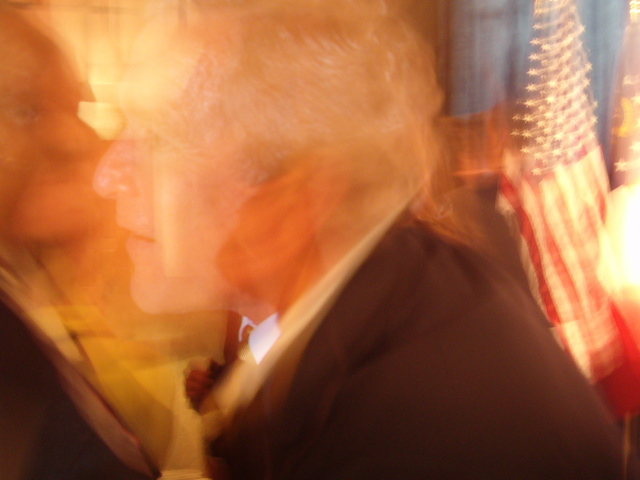
This fuzzy photo is a picture of President George W. Bush. On August 21, 2006, I led a public prayer for President George W. Bush at a campaign rally. After the president spoke, he went through the crowd shaking hands, and I grabbed my camera and took this picture in such a hurry that it came out so fuzzy.
As Mr. Bush greeted the crowd and shook my hand, I said, “I pray for you every day.” He looked me in the eye, and exclaimed, “Thanks, it’s working!” A priest who disliked President Bush’s policies later told me, “It must not be working.” Because he disagreed with the politician, he dismissed the prayer. How short-sighted! Scripture commands us to pray for our leaders. The apostle Paul said, “I urge that petitions, prayers, intercessions and thanksgivings be made for everyone, for kings and for all those who are in authority…” (1 Timothy 2:1-2, HCSB).
The Old Testament prophets modeled this kind of praying for us. Isaiah said that the Lord “wondered that there was no intercessor” (Isaiah 49:16), Jeremiah wept over the nation, and Ezekiel called for someone to “stand in the gap” (Ezekiel 22:30) on behalf of the nation.
So I must pray for President Obama, just as I prayed for President Bush.
After all, if first century Christians could pray for a Roman emperor who threw them to the lions, cannot we pray for an elected president with whom we may disagree? Notice that when Paul urged us to pray for political leaders, he also gave us a reason: “… so that we may lead a tranquil and quiet life in all godliness and dignity” (1 Timothy 2:2b). African-American pastor Tony Evans points out, “What many conservative Christians fail to realize … is that when our first black president, Barack Obama, is dishonored through caricatures, name-calling, or disrespectful talk by white Americans, it merely creates a greater chasm between the races.” (Tony Evans, Oneness Embraced, p. 52). Evans illustrates what the apostle Paul was talking about– angry words instead of words of prayer for President Obama create chaotic lives, not tranquil lives. One preacher pointed that that if we would pray for the president instead of complain about the president, maybe he would do better.
So I am praying for President Obama. Will you join me this Thursday and every day?
Recommended reading on The Lord’s Prayer
There are many wonderful books that have been written on the Lord’s Prayer, but there are two in particular that I have found inspiring.

Max Lucado’s book, The Great House of God: A Home for Your Heart, uses the creative analogy of a big mansion to compare to the Lord’s Prayer. He takes each part of the prayer and compares it to part of the great house. For example, the study is where we learn “thy will be done,” and the kitchen is where we pray “give us this day our daily bread.” Lucado draws a visual image of the prayer that helps the reader see it in fresh ways.

Albert Haase’s book, Living the Lord’s Prayer: The Way of the Disciple, is my favorite book on the Lord’s Prayer. He challenges the reader to live the prayer, not just say the prayer. He takes each part of the prayer and challenges us to put the principles into practice. He uses personal and deeply moving illustrations that encourages the reader to be different because of this prayer.
The Prayer Life of Jesus Christ, Part 3

Copyright 2013 by Bob Rogers
This is the third and final post in my series on the prayer life of Jesus. In the past two days we have taken a survey of the times and places Jesus prayed, and the actual words recorded in His prayers. Based on that, here are four lessons I have learned from Jesus’ prayer life:
1. The priority of prayer. He made prayer a high priority. Mark 1:35; Luke 5:16; 6:12-13; 11:1. If prayer was so important for Jesus, how much more necessary is it for us?
2. The privacy of prayer. He constantly prayed in private. Matthew 14:22-23; Mark 1:35; Luke 5:16; 9:18. Oh, how we need to get alone with God like Jesus did.
3. The pinnacle prayer principle. He loved to pray on mountains: Matthew 14:23; Mark 6:46; Luke 6:12; 9:28. However, the fact that He often withdrew to “deserted places” (Luke 5:16) shows that the important thing was to be alone in God’s creation. Your place in nature may be a lake, a small garden, or front porch, or backyard swing. Even if you live in a crowded city, you can find a balcony or quiet room to focus your thoughts on God. The point is that Jesus knew that He had to be in a place where His total attention was upon the Father.
4. The people prayer principle. The more people, the shorter the prayer, the fewer people, the longer the prayer. His public prayers were short. Luke 10:21; John 11:41-42; Matthew 27:46. He condemned long prayers for show in Mark 12:40. His longest recorded prayer, John 17, was with a small group, while His longest prayer of all was totally alone (Luke 6:12). Too often we reverse this and pray too long in public and don’t pray enough in private.
What lessons have you learned from Jesus’ prayers?
The Prayer Life of Jesus Christ, Part 2
 Copyright 2013 by Bob Rogers
Yesterday I began this study of Jesus’ prayer life. We looked at the times and places that He prayed, and today we will look at the actual words He prayed. After the previous study revealed how pervasive prayer was during His earthly life, it is striking to notice that there are relatively few prayers of Jesus for which we have the words recorded. In fact, I have only noticed ten. Of those ten, the first two are actually model prayers that He gave for us to pray, and most of the others are extremely short. The great exception is His “high priestly prayer” in John 17, which should indicate to us how important it is to study that prayer in particular.
Here is a list of the recorded prayers of Jesus:
The Words that He prayed:
1. The Model Prayer (usually called “The Lord’s Prayer”). Matthew 6:4-13; Luke 11:2-4.
2. The Model Confession. Jesus tells a parable and says the prayer of the tax collector is a worthy example of confession. Luke 18:13.
3. Praising God for His revelation. Matthew 11:25-26; Luke 10:21.
4. Thanking God in advance for answering prayer. John 11:41-42.
5. For God to glorify His name. John 12:27-28.
6. His High Priestly Prayer. John 17:1-26. Here Jesus prayed for Himself to be glorified (v. 1-5), for His disciples to be sanctified (v. 6-19), and for all believers to be unified (v. 20-26).
7. For God’s will. Matthew 26:36-44; Mark 14:36; Luke 22:40-46.
8. On the cross: forgiveness. Luke 23:34
9. On the cross: forsakenness. Matthew 27:46; Mark 15:34.
10. On the cross: finality. Luke 23:46.
(To Be Continued Tomorrow)
The Prayer Life of Jesus Christ, Part 1
Copyright 2013 by Bob Rogers

The disciples asked Jesus, “Lord, teach us to pray.” (Luke 11:1). The record of His prayers in the four Gospels teaches us many valuable lessons. We can learn from the times and places that He prayed, and from the words that He prayed. We can also see several patterns in His prayers and draw conclusions from them. Over the next few days, I will share several prayer lessons from Jesus’ prayer life.
First, notice the times and places that He prayed:
1. Early in the morning. Mark 1:35; Luke 4:42
2. At the end of a long day. Mark 6:30-31, 45-56; Mathew 14:22-23
3. All night before a major decision. Luke 6:12-13
4. Before meals (Feeding 5,000 and 4,000; Last Supper). Matthew 14:19; 15:36; 26:26-27; Mark 6:41; 8:6; 14:22-23; Luke 9:16, 22:17; John 6:11
5. In private. Matthew 14:23; Luke 5:15-16; 9:18. (See Matthew 6:6)
6. With a small group of disciples. John 18:1-2.
7. Often in deserted places. Luke 5:16
8. On a mountain. Matthew 14:23; Mark 6:46; Luke 6:12: 9:28
9. For a disciple to be strengthened. Luke 22:31-32
10. At His baptism. Luke 3:21-22
11. At His transfiguration. Luke 9:29
12. On the Mount of Olives in the Garden of Gethsemane. Matthew 26:36; Mark 14:32; Luke 22:39-40. John 18:1-2 says He went there often with His disciples.
(To Be Continued Tomorrow)
The Old Testament prayer of Jesus
Copyright 2013 by Bob Rogers
“Then the Angel of the LORD responded, ‘How long, LORD of Hosts, will You withhold mercy from Jerusalem and the cities of Judah that You have been angry with these 70 years?’ The LORD replied with kind and comforting words to the angel who was speaking with me.” – Zechariah 1:12-13, HCSB
I believe that the person called the Angel of the LORD in this passage is the pre-incarnate Son of God, and that this is a unique example of a prayer of Jesus in the Old Testament.
Notice that He is called “the LORD” in Zechariah 3:2, even though He is called the Angel of the LORD in verse 1 and 4 of that same chapter.
We also see that the Angel of the LORD appears to Abraham in Genesis 22:11-12 yet speaks as God, and appears to Jacob in Genesis 31:11 and wrestles with Jacob in Genesis 32:24-30. In the last passage, Jacob says He saw God face to face. In Daniel 3:24-25, a fourth person appeared in the fiery furnace with the three Hebrews, and one is described as looking “like a son of the gods.” All of this leads many Bible commentators to wonder if these are appearances of Jesus, the Son of God, in the Old Testament.
Another reason why I take Zechariah 1:12 as a prayer of Jesus is the unique wording of the prayer. While we read of angels praising God in Ezekiel 3:12, Luke 2:14, Revelation 15:3-4; 16:5-6, it is unusual for an angel to pray like this, making intercession. However, this prayer fits the prayer and personality of Jesus. Hebrews 7:25 says that Christ always lives to intercede for us, and Matthew 23:37 says that Jesus wept over Jerusalem. In this passage, the Angel of the LORD prays for God to show mercy and forgiveness to the exiles of Jerusalem after 70 years in Babylon.
Notice also how the LORD replies to the prayer of the Angel in Zechariah 1:13: “with kind and comforting words.”
Oh, that Christ might intercede for us, who are His followers, and He does! Oh, what joy to know that the Son prays for mercy for us and the Father replies to that prayer with comforting words!
How to pray in times of distress
 Copyright 2012 by Bob Rogers
Psalm 102 teaches us how to pray when we are in distress.
It was written by someone who suffered through the exile in Babylon, but it applies to anybody in suffering. Like the changing weather, this psalm expresses the psalmist’s changing mood. Open your Bible to the psalm and follow this prayer outline:
1) Clouds gather (v. 1-2). He first cries out to God. “Lord, hear my prayer…Do not hide Your face from me in my day of trouble…”
2) Gloom and darkness (v. 3-11). Next, he describes his suffering: heartache (v. 4), he can’t eat (v. 4), he loses weight (v. 5), he is lonely (v. 6). he can’t sleep (v. 7), he suffers abuse (v. 8), he weeps (v. 9), and he suffers because of his sin (v. 10). Thus he says, “My days are like a lengthening shadow.” (v. 11). But the clouds part and the sun shines in.
3) Sunshine (v. 12-22). A ray of future hope from the Lord shines in his heart, and he sees that he will see the ruins of Zion and rebuild Jerusalem, or at least the future generations will see it.
4) Clouds return (v. 23-24). But as he waits for the fulfillment of his future hope, the clouds of doubt return briefly. Can’t we all relate to that?
5) Eternal light (v. 25-28). Finally the psalm ends with a statement of faith in the eternal light of God, for even when the earth wears out like clothing, “You are the same, and Your years will never end.” (v. 27). This part of the psalm is quoted in Hebrews 1:10-12 as a prophecy of Jesus Christ. This reminds us that our ultimate light and hope for our distress comes when we trust in Jesus.
Post-election thoughts
I wrote the following blog on November 7, 2008, when President Obama was first elected. It seems appropriate today to republish:
However you voted in the recent election, let us remember that rulers change on earth, but God still reigns over all. Isaiah was probably worried about the future when King Uzziah died after reigning nearly all of Isaiah’s life, but we read in Isaiah 6:1 that “in the year that King Uzziah died, I saw the Lord…” He got a vision of God’s greatness, and forgot about the change in power on earth. R egarding our new president-elect and other newly elected leaders, 1 Timothy 2:1-2 commands us to pray for those in authority. Some people might object that they don’t agree with the politics of their leaders. I share that concern, particularly on the issues of protecting life and marriage. However, let us remember that in Paul’s day, their political leaders were throwing the Christians to the lions, and Paul still said we should pray for them. So should we.
How to Get Your Prayers Answered
 Are you satisfied with your prayer life? Many are not. Christianity Today magazine did an online poll, and out of 678 respondents, only 23 felt satisfied with the time they were spending in prayer. (Philip Yancey, Prayer: Does It Make Any Difference? p. 15).
Yet in the Gospels, Jesus Himself specifically tells us how to get our prayers answered. Listen to what He says…
I. Ask in Jesus’ name
“If you ask Me anything in My name, I will do it.” John 14:14, HCSB
Praying in Jesus’ name does not mean using Jesus’ name like a magic chant. It means coming to represent all that Jesus stands for. For example, if the president of the United States sends you as an ambassador to Mexico, then when you go to Mexico City, you are going in the name of the president. You represent his interests and the interests of the United States. You cannot just say anything. You must say what represents the president’s wishes, because you are speaking in his name.
Likewise, praying in Jesus’ name must come from knowing Jesus and all that Jesus represents. There is an interesting example of this is found in Acts 19. It says seven Jewish exorcists in Ephesus “attempted to pronounce the name of the Lord Jesus over those who had evil spirits, saying, ‘I command you by the Jesus that Paul preaches!’ But verse 15 says that the evil spirit answered them, “I know Jesus, and I recognize Paul—but who are you?” Then the spirit pounced on them, and the exorcists ran out of the house stripped naked and wounded! (Acts 19:13-16)
Why did this happen? Was the name of Jesus not effective? The very next verse after this story explains it. Acts 19:17 says, “This became know to everyone who lived in Ephesus… then fear fell on all of them, and the name of the Lord Jesus was magnified.” People recognized that it is a serious thing to pray in Jesus’ name, and it is not to be done lightly. To pray in Jesus’ name demands that we know Jesus and what He stands for.
George Mueller, the great prayer warrior who ran an orphanage in England, said, “Prayer is not overcoming God’s reluctance. It is laying hold of God’s willingness.” We must learn to pray in God’s will. We do that by praying in Jesus’ name.
II. Ask while remaining in Christ
“If you remain in Me and My words remain in you, ask whatever you want and it will be done for you.” John 15:7, HCSB
Tony Evans tells the story of two dogs who lived at the same house: a German shepherd and a poodle. They were arguing about which dog was the greatest. The German shepherd argued that he was bigger and stronger; the poodle argued that he was cuter.
The German shepherd proposed a contest: they would test their greatness by seeing who could get inside the house of the owner first. Poodle agreed. The German shepherd went first. With its strength, it went up on its hind legs, opened its mouth, and put it on the doorknob. He couldn’t turn the knob with his mouth, so he took his paws and began twisting. After about three minutes, he had twisted the door open. He was worn out, but he finally got the door open.
Next, the poodle took his turn. He went to the other door, got on his hind lets, and scratched. The owner came and opened the door. The poodle was inside the house and was in the lap of the owner, being petted, in less than 30 seconds.
What was the difference? The German shepherd was trying to get the door open by his own strength. The poodle was depending on his master to open it because he had a relationship with his master. (Tony Evans’ Book of Illustrations, p. 168-169)
Ole Hallesby, the great Norwegian writer on prayer, says, “Your helplessness is your best prayer.” (O. Hallesby, Prayer, p. 19). What he means is that when we come before God totally helpless and dependent on Him, is when our prayers have most impact, because it is prayer while remaining in Christ.
III. Ask in faith
“And if you believe, you will receive whatever you ask for in prayer.” Matthew 21:22, HCSB
Richard Foster is a Christian author and professor at Azusa Pacific University. During his second week at the school, one of his students, named Maria, fell out of a pickup truck and hit her head on the pavement. He rushed to the hospital and joined the students who gathered to pray, fervently calling on God to heal her. Then he went back to the campus, and while he was there, he joined some of the faculty who gathered to pray for Maria.
At the faculty prayer meeting, one prayed, “We place Maria into your hands; there is nothing else we can do.” Another prayed, “Lord, help Maria to get well, if it be thy will.” Dr. Foster agreed that we should seek God’s will, but this kind of praying sounded more like they did not believe Maria could be healed. Their prayers hindered his faith. So he left and went back to the hospital. By this time, her parents had arrived, and they joined the gathered students in praying, believing God was fully able to heal Maria. About 6:00 a.m., the parents decided to pray by picturing in their minds that Maria was waking up. At that very moment a student was in the ICU with Maria, and said Maria opened her eyes and smiled at her. Within a week she was released from the hospital and completely healed. Pray in faith! (Richard Foster, Prayer: Finding the Heart’s True Home, p. 212-214)
IV. Keep asking
“Keep asking, and it will be given to you. Keep searching, and you will find. Keep knocking, and the door will be opened to you. For everyone who asks receives, and the one who searches finds,and to the one who knocks, the door will be opened.” Matthew 7:7-8, HCSB
Mother Teresa said, “If you want to pray better, you must pray more.” (Philip Yancey, Prayer: Does It Make Any Difference? p. 161)
Christian pastor Youcef Nadarkhani was in jail in Iran for three years for his faith. During that time, millions of Christians learned to pray faithfully on his behalf. God decided to answer those prayers. But why didn’t God set him free sooner? God wants us to learn to keep on asking, because in continuing to ask, we learn to depend upon God.
For fifteen years, an Italian mother named Monica prayed for her son to come to Christ. Once, she prayed all night that God would stop him from going to Rome, because she knew how much trouble he would get into in the big city. Yet he slipped out of the house and went to Rome, anyway. Were her prayers unanswered?
Not at all! On that trip to Rome, her son had an experience with Jesus Christ, and became a believer. Reflecting back on it later, he said that God denied his mother once in order to grant her what she had prayed for always.
Oh, and by the way, her son’s name was Augustine. Augustine went on to become one of the greatest theologians in Christian history. (Philip Yancey, p. 241.)
So, my brothers and sisters: pray in Jesus’ name, pray while remaining in Christ, pray in faith, and keep on praying!
How to Pray Great Prayers
 Copyright 2012 by Bob Rogers
“Call to Me and I will answer you and tell you great and incomprehensible things you do not know.” — Jeremiah 33:3, HCSB
Some say God’s “phone number” is JER 33.3, referring to this great promise of Jeremiah 33:3 that God will give great answers to our prayers. The context of this promise is the great prayer of Jeremiah in 32:16-25. In that passage, we notice three characteristics of great prayer:
1) Pray to a great God.
Jeremiah speaks of God’s great character in verse 17: “Oh, Lord God! You Yourself made the heavens and earth by Your great power and with Your outstretched arm. Nothing is too difficult for you!” He speaks of God’s great covenant in verse 18: “You show faithful love to thousands…” He speaks of God’s great counsel in verse 19: “the One great in counsel and mighty in deed…”
2) Pray believing God still acts today.
Notice that in verse 20, Jeremiah not only remembers God’s signs and wonders in Egypt, but goes on to say that God continues to “do so to this very day.”
3) Pray believing God keeps His promises.
Jeremiah prayed in verse 24, pointing out that God was allowing the city of Jerusalem to be conquered just as He had promised would happen. God warned them that they would be punished, and they were, as Babylon laid siege to the walls of Jerusalem (see Jeremiah 32:2). But God also promised that after 70 years, He would punish Babylon and bring them home, so they had a future and a hope (Jeremiah 29:10-14). Jeremiah reasoned that if God kept His promise of punishment, He would also keep His promise of grace. Thus, believing they would come back one day, Jeremiah told the Lord in verse 25 that since God told him to buy property for the future in the land of Judah, he would buy it, even as they were about to be taken to Babylon in exile.
Can you pray believing God when all hope seems lost? If you can, you can pray a great prayer!
Notice what “great and incomprehensible things” God showed him in chapter 33. In Jeremiah 33:7 God promised a return from captivity, and in 33:15 God promised a Messiah: “In those days and at that time I will cause a Righteous Branch to sprout up for David…” God always does more than we can imagine.
So let us pray great prayers to our great God!
How to hear angel prayers

Copyright 2012 by Bob Rogers
“The Spirit then lifted me up, and I heard a great rumbling sound behind me– praise the glory of the LORD in His place!– with the sound of the living creatures’ wings brushing against each other…” – Ezekiel 3:12-13, HCSB
Ezekiel heard the prayers of angels. How did this happen? How can we experience such things?
1) Be in the Spirit. Ezekiel 3:12 says, “The Spirit then lifted me up.” John the Revelator also heard angels in Revelation 15:3 and 16:5, and he also was “in the Spirit on the Lord’s day” (Revelation 1:10). How can we be “in the Spirit”? First, we have to be believers in Jesus Christ. Only a believer can be in the Spirit: “But the unbeliever does not welcome what comes from God’s spirit, because it is foolishness to him; he is not able to understand it since it is evaluated spiritually” (1 Corinthians 2:14, HCSB). Second, the believer must be “filled with the Spirit” (Ephesians 5:18), which comes by filling our minds with the Word of God and filling our hearts with prayer.
2) Pay attention. Ezekiel 3:12 says, “I heard a rumbling sound.” He paid attention to what he was hearing. The shepherds on the hillside near Bethlehem paid attention when the angel of the Lord appeared to them (Luke 2:8-15). Interestingly, the shepherds heard of prayer of “Glory to God in the highest heaven” (Luke 2:13), just as Ezekiel heard “praise the glory of the LORD in His place” (Ezekiel 3:12). Too often we fail to hear because we fail to listen.
3) Be willing to obey. Ezekiel felt the bitterness of God’s anger at sin (Ezekiel 3:14), and he sat stunned for seven days (Ezekiel 3:15). It was only after he had that desire to obey that he received a word from the Lord in Ezekiel 3:16-17. Paul experienced what may have been angel prayers when he was caught up into paradise and “heard inexpressible words” (2 Corinthians 12:4). And just as Ezekiel, Paul was also willing to obey God when God would not remove the thorn from his flesh, but said His grace is sufficient. Pauls’ response was to accept God’s grace, “For when I am weak, then I am strong” (2 Corinthians 12:10).
And maybe, just maybe, when we are listening that closely to God, we might even hear the prayers of angels!
“Prayer” by Philip Yancey is honest and inspiring
 Philip Yancey did it again with his book on prayer. His book The Jesus I Never Knew is the best book I have read on Jesus. His book, What’s So Amazing About Grace? is the best book I have read about grace. His book, Prayer: Does it make any difference? (Zondervan, 2006) is the best book I have read on prayer. That is a strong statement for me to make, even as a person who loves the writings of Philip Yancey. I have read dozens of great books on prayer, including great books by people like Richard Foster, Ole Hallesby, Bill Hybels and Oswald Chambers.
What sets Yancey’s book apart is his brutal honesty about the struggles people have with prayer, balanced with inspiring stories of how prayer has changed people’s lives. Yancey is particularly self-effacing about his own struggles with prayer and his feelings of inadequacy in failing to pray. Yet by the end of the book, it is apparent that Yancey is much more of a prayer warrior than he admits at first.
The books’ 22 chapters are divided into five parts. Part One, “Keeping Company with God,” explores what prayer is. He points out that Jesus “virtually invented private prayer” (p. 63).
Part Two, “Unraveling the Mysteries,” discusses frustrations and questions that people have about the effectiveness of prayer. He gives a disarmingly profound answer to those who ask why we should bother to pray when some prayers seem unanswered: “Why pray? Because Jesus did” (p. 78). Later in the book he gives another simple but true answer: “Why pray? God likes to be asked” (p. 143).
Part Three, “The Language of Prayer,” discusses how to pray. He gives great practical advice on handling distractions to prayer, and reminds the reader that there is no right way to pray, because different styles of prayer fit different personalities. “Keep it simple, keep it honest, and keep it up” he advises (p. 191).
Part Four, “Prayer Dilemmas,” returns to questions people have about prayer, especially unanswered prayer. I would disagree slightly with his defintion of “unanswered prayer,” as he includes in that definition prayers that receive a “no” answer. Yancey’s approach to prayer for physical healing is balanced and insightful, as he reveals scientific research showing healing that cannot be explained, while recognizing the importance of using medicine and how God usually works through natural processes.
Part Five, “The Practice of Prayer,” provides motivation for faithful praying.
Yancey’s writing includes frequent illustrations from a variety of sources, from popular culture to literature to world history. Being a famous author and editor for Christianity Today magazine, Yancey has received many letters about prayer, and he shares this correspondence throughout the book. One unique quality about this book is that each chapter includes a couple of sidebars written by others, sharing personal experiences in prayer. For example, on p. 224-225 a prostitute whose prayer for deliverence resulted in her miraculous salvation. Although each sidebar story can be read alone, they relate to the chapters where they are inserted.
I disagree with Yancey in chapter 7, when he discusses Abraham’s prayer that “changed” God’s mind. Yancey does not notice that Genesis 18:33 says that it is God who ended the conversation with Abraham, not Abraham with God, so God did not change His mind.
Also, I believe that Yancey misinterprets Job 21:15 on p. 95. There he says that Job asks “What would we gain by praying to him?” However, the context of the chapter implies that Job quotes the wicked in this passage; Job does not say that he himself questions prayer.
It is remarkable that these were the only two places that I disagreed with Yancey, because he makes bold and strong statements throughout the book. I am sure many people will be offended or disagree with some things he said, just because he asserts so many strong opinions. But this is one of the values of the book: Yancey stimulates you to think deeply about prayer, and challenges your preconceived notions. Yet he does so while remaining fiercely loyal to the Bible’s teachings on prayer.
In summary, this book is destined to be a classic book on prayer, useful for group study or personal review and study over and over again.


 Bob Rogers