Blog Archives
How to pray for corrupt politicians

Article Copyright by Bob Rogers
Fiddler on the Roof is a film about changing culture and faith among Russian Jewish families in 1905. In one scene, the village Rabbi was asked if there was a blessing for the czar, who had persecuted the Jews. He replied, “The Lord bless and keep the czar– far away from us!”
We may chuckle at the story, but we still wonder how do we actually pray for bad leaders. We feel a tension between the Biblical command to pray for all those in authority (1 Timothy 2:1-4), and the fact that some of those in authority live ungodly lives and support unrighteous policies.
Cry out to God
Ezekiel cried out to the Lord in distress on behalf of the righteous remnant. “I fell facedown and cried out, ‘Oh, Lord GOD! Are You going to destroy the entire remnant of Israel when You pour out Your wrath on Jerusalem?” (Ezekiel 9:8; see also 11:13). There is nothing wrong with crying out to God about your heart-felt concern. Ezekiel did. But don’t stop there.
Pray for God to work through bad leaders
Habakkuk cried out to the Lord about evil rulers. In Habakkuk 1:2, the prophet described life under the wicked King Jehoiakim this way: “This is why the law is ineffective and justice never emerges. For the wicked restrict the righteous; therefore justice comes out perverted.” Sounds like a modern news report, doesn’t it? God’s first answer to this dilemma comes in the next verses, saying, “Look at the nations and observe– be utterly astounded! For something is taking place in your days that you will not believe when you hear about it” (Habakkuk 1:5). He goes on to describe how God would bring judgment on Jerusalem through the Babylonians.
God often uses nations and rulers for His purpose, even evil rulers. God can hit straight with a crooked stick anytime He wishes. He used King Cyrus of Persia (Isaiah 44:28-45:1) to bring the Jews home from captivity. Daniel 2:21 says, “He removes kings and establishes kings. He gives wisdom to the wise and knowledge to those who have understanding.” Acts 2:23 shows how God even used evil leaders in the crucifixion of Jesus Christ: “Though He was delivered up according to God’s determined plan and foreknowledge, you used lawless people to nail Him to a cross and kill Him.”
Therefore, we can pray for God to work through bad leaders. John F. Kennedy had many extramarital affairs, but God used his courage to stand against communist Russia in Cuba. Richard Nixon was corrupted by the Watergate scandal, yet God used him to open doors with China. We may pray for bad leaders by praying for good to overcome evil, despite their failures and sins.
Watch and pray
Returning to Habakkuk, we find two principles of prayer: expectancy, and faith. First is the principle of expectancy: the prophet finally resolved to be a “watchman” in prayer: “I will stand at my guard post and station myself on the lookout tower. I will watch to see what He will say to me and what I should reply about my complaint” (Habakkuk 2:1). Likewise, we are to watch what happens with rulers, and continually pray, expecting that God will do something. The second principle is faith. The Lord encouraged the prophet to keep watching, and waiting, and then God revealed one of the greatest doctrines of the Bible: “But the righteous one will live by his faith” (Habakkuk 2:4). This verse is quoted repeatedly in the New Testament, reminding us that our salvation comes by faith and trust in the Lord, and Him alone (Romans 1:17, Galatians 2:11 and Hebrews 10:38). As Jesus said, “Watch and pray” (Matthew 26:41; Luke 22:46).
Ask God what you can do
Contemporary Christian singer Matthew West sings about how he saw all kinds of suffering and injustice in the world which disgusted him. Then the singer cried out, “‘God, why don’t you do something?’ He said, ‘I did, I created you!'” (“Do Something” by Matthew West, from the album, Into the Light).
Isaiah gives a similar response to our prayers complaining about bad government. Isaiah prophesied that the Lord would answer their cries when He saw social injustice in the land (Isaiah 58:3-10). The people were fasting and praying for justice. In this passage, God responded to the prayer by calling on His people to put feet to their own prayers. “Isn’t the fast I choose: To break the chains of wickedness… Is it not to share your bread with the hungry, to bring the poor and homeless into your house, to clothe the naked when you see him, and not to ignore your own flesh and blood? Then your light will appear like the dawn… and the LORD’s glory will be your rear guard” (Isaiah 48:6-8). God hears our prayers for justice to overcome evil, and He nudges us to get personally involved in fighting injustice. Pray for bad leaders by deciding to do something good yourself! You can vote for pro-life candidates, but don’t stop there; volunteer at a crisis pregnancy center. You can vote for candidates who support the police and who fight for racial justice, but don’t stop there; show your kindness and speak up against mistreatment of the police and mistreatment of those of other races.
Conclusion
So what does all of this mean to us today? It means that no matter who occupies the White House, the State House or the courthouse, God is on His throne, and He is in control. It means that while we pray for and support godly leaders, we also pray for God to work His will through ungodly leaders. It means that we put our trust in the Lord, not in earthly leaders. It means that instead of just complaining about evil, we need to ask God what good we can do ourselves. Then we need to get up from our prayers, and do something good in the name of Jesus.
Prayer for Bad Politicians
O God, I cry out to You for my nation. You told us to pray for kings and all those in authority, but how do I pray for bad politicians? The wicked restrict the righteous, and justice comes out perverted. God, do something new! Lord, You remove kings and establish kings; You even used an unbelieving King, Cyrus of Persia, to rescue Your people from exile. Knowing this, Lord, I ask that you either remove bad leaders from their positions, or work through bad leaders to do good. Lord, I will watch and pray for You to work through our nation. I will keep my eye on our leaders to pray for them, but I will keep my faith in You, for my hope is in You, not in politicians. Lord, I ask that You to give me wisdom to vote my values, that You give me courage to volunteer my time and that You give me generosity to donate my money to those who are overcoming evil with good. In the Name of the Righteous Judge. Amen.
Guest post: “What a hospital chaplain learned about ICU waiting when his own father died”
Copyright 2016 by Brian Williamson

(NOTE: Brian Williamson is an experienced hospital chaplain, but recently he experienced the other side of ministry, spending many hours in the waiting room of the Intensive Care Unit –ICU– as his own father died. In this post, he shares his observations, in hopes that it can help those of us who visit the sick and their families, especially those in ICU.)
These are some notes I prepared from my experiences in the ICU waiting room as a family member when my father was dying. Since I work extensively in this area as a hospital chaplain, the new experience from a personal perspective has given me insights into how I can better minister to folks going through something like this. Since my observations are filled with my own feelings, they could be negatively or positively impacted by what I’m feeling and/or experiencing. I’ve offered them to my friend and co-worker, Bob Rogers to share with others. My hope is that they will be insightful and helpful to others. So, take them for what you think they’re worth.
1. ICU family members (yes, I was guilty!) are pivoting/hinging on every little idea of their loved one getting better. You want your loved one to “be” better, so if something is “a little better” (such as a lab result, an O2 sat, blood gas, etc.) then you accentuate that and project it to everything else. This may not be the case… (“He squeezed my hand, so I know he’s getting better!” “The kidneys are looking good.” Some nurses might say, “the numbers are a little better today,” or “We turned the O2 down to 60%, so that’s a little better…” {never mind the tea-colored urine, the 9 medicines in the IV bags, the ventilator set on “C-full control” and the doctor is just hoping that you won’t have to turn it back up, etc., etc.})
2. People in the waiting room—family members, staff, pastors, etc.—tell you what to believe and what to say; and you’re usually polite enough to not slap them when they do; or to argue with them, because you know they won’t understand.
3. There is no shortage of people who want to tell you what it’s like for them. They ask you what’s going on with your loved one, but then they interrupt you to tell you “their story.” When they finish, they usually have forgotten that they haven’t heard your story.
4. Very few people really want to hear your story or talk about your memories; or what’s important to you. Fallacious clichés such as, “I know how you feel” and “I know what that’s like” are the status quo. The reality is that people in the ICU waiting room have their own pain and struggles to deal with. You feel connected to them; but, when your story starts to “go south,” they distance from you as if what you’re experiencing is contagious. If you’re loved one begins to worsen, they leave you alone and whisper to other waiting room people about what’s happening with your patient.
5. Many preachers, ministers, etc., form circles with families that block traffic in the middle of the aisles, then pray loudly—and pray, and pray and pray. Most of them leave after the prayer, and then it’s very interesting what people talk about after the minister leaves.
6. When someone is on the ventilator they have to be sedated (usually). The sedation helps keep the person relaxed so the machine can be beneficial. BUT…what I didn’t know is that every 12 hrs, the sedation has to be turned off in order to “let the person wake up a little bit.” This test helps the hospital be aware of mental changes. During the time the sedation is off, the nurse assesses the patient’s ability to respond to instructions like “squeeze my fingers,” “blink your eyes,” “wiggle your toes,” etc. In other words, you awake every 12 hrs to a tube down your throat that makes you cough and gag, you become just awake enough to know you’re not able to breathe. This can be quite punishing to the patient.
7. Silence is golden. Nurses work hard at saying the right thing and “keeping you company,” which is very special and sometimes greatly appreciated; but, I think that being quiet while being with someone is usually more valuable as their loved one is dying. One of the best questions I heard a nurse ask was, “Would you like some privacy or would you like me to stay with you a little longer?” The worst question I heard was asked by a nurse as I sat in a chair in the pod outside my dad’s room, just after his death… “Uh, you’re the chaplain, right? Well, I was wondering, “How do you feel about monogamy in marriage?”
8. Always visiting during visiting hours may not be the best idea for clergy members. Families get precious few minutes every few hours that could end up being the last minutes they have with their loved one alive. Experiment with waiting room visits followed by in-room visits. I suggest taking someone for a walk around the building, to the canteen, to the coffee shop or somewhere outside. If they ask you to “go back” with them, then go. If not, don’t.
9. There’s lots of praying going on, even though you can’t hear it.
(This is Bob again. From reading Brian’s observations, five lessons come to mind for ministry to families in ICU waiting rooms: 1. Be quiet and really listen, 2. Don’t offer pat answers, 3. Keep vocal prayers soft and short, 4. Don’t be afraid of silence, and 5. Don’t abandon them when they hurt the most. What are your thoughts? Feel free to comment below.)
The right question to ask of Job

Copyright 2016 by Bob Rogers
“Should we accept only good from God and not adversity?” (Job 2:10, HCSB)
Last week, I met a man who wanted to give up on life. I asked him if he knew the story of Job, from the Bible. He said he had a Bible somewhere, but had never heard of Job. So I gave him the short version of the story: Job was a good man who worshiped God, but he lost everything. Bandits stole his property, a storm killed his children, and then his skin broke out in painful sores. His wife told him, “Curse God and die.” When I said this, my new friend raised his eyebrows, and wanted to know what happened next. I explained that Job refused to curse God. Then his three friends came to comfort him, but instead of comforting him, they tried to defend God. They said Job must have sinned, and that was why God was allowing him to suffer. Job objected, saying he didn’t deserve his suffering. In the end, God spoke to Job, and restored his fortunes.
The wrong question to ask of Job
Many people go to the book of Job looking for the answer to why people suffer. Unfortunately, the only answers they find are negative:
Job’s suffering was not because God was angry or punishing him. Bildad, one of Job’s friends, accused him of this. He implied that Job must have forgotten God, so God forgot him (Job 8:13). But Bildad was wrong! God specifically said in Job 1:8 and 2:3, “Have you considered My servant Job? No one else on earth is like him, a man of perfect integrity, who fears God and turns away from evil.”
Job’s suffering was not because Job sinned. Bildad said that Job’s children died because of their sin (8:3), and Zophar, another one of Job’s friends, accused Job himself of being so sinful that “God has chosen to overlook some of your sins” (11:6). But they were wrong! Job 2:10 says, “Throughout all of this Job did not sin in what he said.”
Job’s suffering was not answered by God, either. After the long debates between Job and his friends, the Lord Himself answered Job from the whirlwind in chapters 38-41. But if you read those chapters to find an answer to suffering, you will be disappointed. It’s not there. Instead, God turns the questions on those who have been asking questions. “Where were you when I established the earth? Tell Me, if you have understanding,” God asks (38:4). Then the Lord lists the amazing traits of His creation, and asks if Job can explain all of that. The point is blunt: We do not know all there is to know. Only God does. We cannot understand God. As the Lord proclaimed through the prophet Isaiah, “For as heaven is higher than earth, so My ways are higher than your ways, and My thoughts than your thoughts” (Isaiah 55:9).
So what is the answer to suffering? The Book of Job doesn’t answer that question. In fact, it’s the wrong question to ask.
The right question to ask of Job
The question to ask is not, Why is there suffering? The question to ask is, What do suffering people need to do? The Book of Job has hope-filled answers to this question.
First, hold on to faith. Despite his losses and sorrow, Job fell to the ground and worshiped, saying, “Naked I came from my mother’s womb, and naked I will leave this life. The Lord gives, and the Lord takes away. Praise the name of Yahweh” (1:21). Later, in the middle of his debates with his friends, Job says, “Even if He kills me, I will hope in Him.” This doesn’t fit with the so-called “prosperity gospel” that says if you just have faith, all will go well. No, this is a real-world faith, that holds on to God’s hand, even when it cannot see His plan.
Second, live in integrity. Satan, the old accuser before the Lord, said that Job would curse God if Job suffered. But Satan was wrong. This is one of the major points of the book. The word “integrity” is repeatedly used to describe Job. Notice the question Job’s wife asks: “Do you still retain your integrity? Curse God and die!” (2:9) But Job rejects her suggestion as foolish, saying, “Should we accept only good from God and not adversity?” (2:10) We read in James 2:2-4 to consider it joy when we face trials, because God uses it to produce maturity in us. It has been my observation as a hospital chaplain, that suffering generally reveals the attitude that is already in a person. I’ve seen people handle horrible physical problems with grace and peace, while others with lesser physical ailments complain and are bitter. We choose how we will respond. Job set a standard, choosing to live in integrity.
Third, hope in the Savior. One of the greatest cries of faith comes in the midst of the greatest pain, when Job says, “Even now my witness is in heaven, and my advocate is in the heights!… But I know my living Redeemer, and He will stand on the dust at last. Even after my skin has been destroyed, yet I will see God in my flesh” (16:19; 19:25-26). Long before Jesus Christ came, Job caught a vision of the Redeemer, who would die on the cross for our sins, and be our advocate before God the Father (Romans 8:34; 1 Timothy 2:5).
There is an fable about a poor man who had a valuable horse. People told him that he should sell his horse, so he wouldn’t be poor, but he refused. Then the horse ran away, and the people asked, “Why didn’t you sell it when you could? The man said, “Don’t say that. All you can say is the horse ran away.” Later, the horse returned, with 20 wild horses, and the man suddenly became the owner of 21 valuable horses. This time they said, “We were wrong! Now we know why the horse ran away; it was to bring you riches later.” The man said, “Don’t say that. All you can say is the horse returned with more horses.” Then the man’s son broke his leg, trying to tame one of the wild horses. The people said, “Why did you keep the wild horses? Now your son has a broken leg.” The man said, “Don’t say that. All you can say is my son broke his leg.” Then their country went to war against a larger, more powerful nation, and the army came to their town, forcing all of the young men to join the army, except for the son of the man with the wild horses. The people said, “Now we know why his leg was broken, to spare him from dying in the war.” Once again, the man said, “Don’t say that. We don’t know why. All we can say is my son did not have to go to war.”
Thus the question we need to ask is not why? but what? Not, Why do people suffer? but What do suffering people need to do? Even if we knew the answer to why, it would not help us do anything different. But the answer to the second question gives us hope and purpose that we can put into action. Because our Redeemer lives, we even after our skin is destroyed, we shall see God!
Book review: “Snoop: A Spiritual Memoir of a Vietnam Army Grunt”
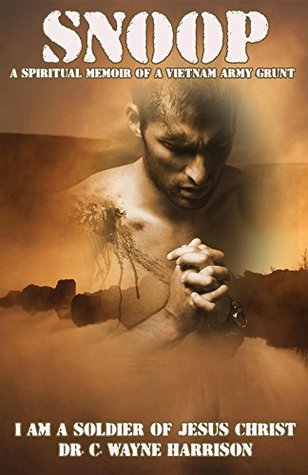
Snoop: A Spiritual Memoir of a Vietnam Army Grunt (Published by Parables, 2016), by C. Wayne Harrison, is a 98-page book that tells stories of war, grouped together for devotional reflection. That may sound like an unusual approach, but Harrison makes it work.
Harrison was a private in the U.S. Army, who fought in the jungles in the Vietnam War in 1969-1970. Today he is Baptist minister in Booneville, Mississippi. In ten short chapters, he recalls his desire to be a soldier and relates in vivid detail the horrors he experienced in the war. Although the stories tend to move chronologically from early in his life through his year in Vietnam, the chapters are more thematic in nature, with titles such as, “The Heart of a Soldier,” “The Hands of a Soldier,” “The Hardships of a Soldier,” etc. Each chapter opens with a passage from the Bible, then focuses on stories that relate to the theme of the chapter, followed by some discussion questions and a prayer.
The reader identifies with the young man, who is nicknamed “Snoop” because of his lapel pin of Snoopy, the dog who imagined he was a fighter pilot, in the “Peanuts” comic strip. Some descriptions of war in the book may be disturbing to young readers, and the stories certainly are sobering even to mature readers. I believe Harrison’s writing will connect well with soldiers who read the book, and would make an excellent resource for military chaplains or anybody, especially soldiers, who are willing to reflect on God’s purpose for their lives.
The book is well-written, using excellent images and descriptions, and is easy to read, although I noticed a typo on p. 64, where the word “scar” was spelled “scare.” There are black-and-white photos of Harrison as a young soldier in the back of the book. In interest of full disclosure, I received a complimentary copy of this book from the author, with no obligation to write a favorable review.
15 years after 9/11: The answer to “why?”

Article copyright 2016 by Bob Rogers
Fifteen years ago, on September 11, 2001, terrorists attacked America, flying hijacked airplanes into the World Trade Center in New York, the Pentagon and Washington, D.C. The evil intentions of hijackers on a third plane that day is unknown, because brave passengers resisted the hijackers and forced it to crash in Pennsylvania.
When tragedies like this happen, the inevitable question is, “Why?” Amazingly, Jesus Christ asked the same question as he was dying upon the cross, crying out, “My God, my God, why have you forsaken Me?” (Mark 15:34) It is in that very question of Jesus that we can find helpful answers.
He absorbed our evil by His love. When Adam and Eve sinned in the Garden of Eden, they unleashed a Pandora’s Box of evil that impacts us to this day. But upon the cross, Jesus absorbed that evil, by lovingly sacrificing Himself. The apostle Paul put it this way: “God made Him who had no sin to be sin for us” (2 Corinthians 5:21). Jesus Himself said, “Greater love has no one than this, that He lay down His life for His friends” (John 15:13).
He empowered us to overcome evil by faith. Jesus’ sacrifice inspires us to identify with Christ by faith, and moves us to action ourselves. Paul said, “I have been crucified with Christ and I no longer live, but Christ lives in me” (Galatians 2:20). Thus Paul says, “Do not be overcome by evil, but overcome evil with good” (Romans 12:21).
He heals the hurt of evil by giving hope. The greatest medicine for healing is not penicillin or aspirin– it’s hope. During World War II, psychologist Viktor Frankl studied the lives of people who survived Nazi concentration camps, and found the survivors were those who had hope. The Bible says, “For in hope we have been saved” (Romans 8:24); “This hope we have as an anchor for the soul” (Hebrews 6:19); “because of the hope laid up for you in heaven” (Colossians 1:5).
Louie Zamperini was an American aircraft gunman in World War II, whose plane crashed in the Pacific Ocean. He and his friends floated across the ocean for a month, losing half of their body weight and nearly going insane, only to be captured by the Japanese. Because Zamperini had been a famous Olympic runner, the Japanese treated him with particular cruelty, beating him mercilessly. His story was made famous in the 2014 movie, Unbroken. But Hollywood only hinted at the rest of the story. After his return from war, Louie Zamperini suffered so much post-traumatic stress that he fell into despair and addiction. Then a young preacher named Billy Graham held a revival in his home in Los Angeles. At the urging of his wife, Louie went. Graham stood and asked, “Why is God silent when good men suffer?” He reminded the audience that God sends us messages through creation and through Christ that He cares for us. Zamperini remembered seeing a swirl of light in the sky when he was floating across the Pacific, awed by God’s creation. He listened as Graham talked about the good news of Jesus’ sacrifice for our sin, and that day, Zamperini found hope in Christ. For the rest of his life, Louie Zamperini followed Christ. He founded a ranch to offer hope to troubled boys, and he even traveled to Japan to forgive his prison captain.
Louie Zamperini found the answer to “Why” in the loving sacrifice of Jesus Christ. So can you and I.
Twisted scripture: “by His stripes we are healed”
Copyright 2016 by Bob Rogers

(NOTE: This is the fifth blog post in a series on scriptures commonly misinterpreted.)
But He was wounded for our transgressions,
He was bruised for our iniquities;
The chastisement for our peace was upon Him,
And by His stripes we are healed. – Isaiah 53:5, NKJV
I often meet people praying for the sick who claim Isaiah 53:5 as a promise that God will heal any sickness if they pray for it in faith. Their logic is straightforward: the prophet said that the Messiah would be crucified for our sins, “and by His stripes we are healed.” Thus, they conclude, the verse is saying that Jesus’ cross has two effects: first, Christ paid for our sins, and second, He also heals our diseases, if we pray in faith. After all, they reason, didn’t Jesus say, “Your faith has made you well?” (Mark 5:34).
Is this really what Isaiah 53:5 is teaching? Does it teach a two-part effect of the cross: a healing from both sin and sickness? This interpretation fails to take into consideration the kind of Hebrew poetic writing used here, often called Hebrew parallelism. That is, the Hebrew poet frequently says the same thing twice in slightly different ways, for emphasis. We see this in many psalms, such as, “While I live I will praise the Lord; I will sing praises to my God while I have being” (Psalm 146:2). If this is Hebrew parallelism, then the second part means the same thing as the first part, and the first part says the Messiah was wounded for our transgressions, not our sickness. But what if this is not Hebrew parallelism?
Here is where we need to apply a very important but often neglected principle of Bible interpretation: scripture itself is the best interpreter of other scripture. So what does the rest of the Bible say on this subject?
The New Testament frequently discusses the effect of the cross of Jesus Christ. Romans 3:24-25 speaks of how Jesus’ blood justifies us from sin, redeems us from sin, and presents Jesus as a sacrifice for our sin. Ephesians 1:7 says His blood gives us forgiveness from our sin. Colossians 1:20-22 says Jesus made peace through the blood of His cross, in order to present you “holy and blameless” before God. Many other scriptures talk about how the cross of Christ offers salvation from sin, but nowhere does the New Testament say that the cross of Christ brings healing from sickness.
Is Isaiah 53:5 directly quoted anywhere else in the Bible? Yes, it is, in 1 Peter 2:24. Here it is:
“Who Himself bore our sins in His own body on the tree, that we, having died to sins, might live for righteousness—by whose stripes you were healed.”
If Isaiah 53:5 was intended to be a prophecy that Jesus’ cross would heal from sickness as well as sin, then when Peter quoted that very same verse, surely Peter would have mentioned the effect of the cross on sickness. Yet it is not there. Read the verse again. It says Jesus “bore our sins in His own body…” It continues, “that we, having died to sins, might live for righteousness.” After making reference to sin twice, Peter then quoted Isaiah 53:5: “by whose stripes you were healed.” There is no question what kind of healing Peter understood Isaiah to mean. He already said it twice: healing from our sins.
Remember this important principle: the best interpreter of scripture is other scripture, not a human preacher or teacher. Should we pray for the sick? Yes, we are commanded to do so (Matthew 10:8; James 5:14). Is God able to heal the sick? Yes, and He often chooses to do so, although not always (Acts 5:16; 2 Corinthians 12:7-10). However, does Isaiah 53:5 teach that the cross of Christ is a promise of physical healing for us to claim in faith? Based on the interpretation of scripture itself, we can only conclude that it is a promise for one type of healing– the greatest kind of all– from our sin.
Twisted scripture: “the truth shall make you free”
Copyright 2016 by Bob Rogers

(NOTE: This is the fourth blog post in a series on scriptures commonly misinterpreted.)
President James A. Garfield said, “The truth will set you free, but first it will make you miserable.” The president was making a humorous allusion to the famous words of Jesus in John 8:32.
Unfortunately, this Bible verse is often taken out of context John 8:32: “And you shall know the truth, and the truth shall make you free.” This verse is engraved on courthouse entrances, implying that if a wise court can grant freedom by finding truth. This verse is cited by educators to say that knowledge is freedom, and it is quoted by investigative reporters who believe that freedom can be found in digging up the truth. While all of these are worthy goals, these interpretations ignore the verse immediately before it. So let’s read it again, this time in context:
Then Jesus said to those Jews who believed Him, “If you abide in My word, you are My disciples indeed. And you shall know the truth, and the truth shall make you free.” (John 8:31-32, NKJV)
What a difference verse 31 makes! This verse gives us the audience to whom Jesus was speaking, and the conditions Jesus laid down to know truth and freedom. Notice what they are:
1. The audience. The audience who first heard these words were believers. Jesus “said to those Jews who believed Him…” Thus this promise is not intended for the general public. It is a promise for those who believe in Jesus Christ. Yet there is more.
2. The conditions. Jesus laid down two conditions to knowing truth and freedom. They link together like links in a chain. First, “If you abide in My word.” The first link is to continually study and obey the words of Christ. The second link results from the first: discipleship. He said, “you are My disciples indeed.” Note the word “indeed.” That is, if we study and obey Christ, then we are real disciples. The third link is in verse 32: “And you shall know the truth.” What is that truth? When Jesus was on trial before the Roman governor, He said, “Everyone who is of the truth listens to My voice” (John 18:37). The governor asked, “What is truth?” Jesus had already answered that question in John 14:6: “I am the way, the truth, and the life.” The fourth link results from the third, of knowing the truth: “And the truth shall make you free.” As we have seen, the truth is Jesus. No wonder Christ said of Himself a few sentences later, “Therefore if the Son makes you free, you shall be free indeed” (John 8:36).
So there you have it. If you believe in Jesus, then abide in Him. Study His word and obey it. If you do, you will be a real disciple. And if you are a real disciple, then you will really know the truth, for the truth is Jesus. And when you really know the truth in Jesus, you will truly be free.
Free from what? From from the power of death and the devil, from deception, and from deeds of sin. (See Hebrews 2:14, 1 John 2:11, 2 Corinthians 10:5, Galatians 5:13).
Engraved on the Statue of Liberty is a poem by Emma Lazarus that says, “Give me your tired, your poor, your huddled masses yearning to breathe free.” Millions of people have passed by the Statue of Liberty as they came into New York harbor, seeking freedom in America. But Jesus Christ has a better offer. He says to those who believe in Him, “If you abide in My word, you are My disciples indeed. And you shall know the truth, and the truth shall make you free.” Real freedom comes from real discipleship, following the real Savior.
Twisted scripture: I can do all things through Christ who strengthens me
Copyright by Bob Rogers

(NOTE: This is the third in a series of blog posts I am doing on some of the most commonly twisted and misinterpreted verses in the Bible.)
“I can do all things through Christ who strengthens me.” – Philippians 4:13, NKJV
Philippians 4:13 is one of the most beloved verses in the Bible. Sports teams emblazon it on their uniforms to inspire them to win games, and business people quote it to inspire their sales force. So what is the problem with that? A closer look at the verse shows that such interpretations violate the cardinal rule of Bible interpretation: context. So let’s put the verse back into its context and unpack it.
The apostle Paul was in jail when he wrote the letter to the Philippians. He stated in the letter that he could die there for the gospel (Philippians 1:12-13, 20-21). In the last chapter of the letter, Paul talked about his suffering in prison, and said, “…for I have learned to be content in whatever circumstances I am. I know both how to have a little, and I know how to have a lot. In any and all circumstances I have learned the secret of being content–whether well-fed or hungry whether in abundance or in need. I am able to do all things through Him who strengthens me” (Philippians 4:11-13, HCSB). From the context, it is obvious that Paul was not talking about winning games or setting sales records. In fact, he didn’t even ask to change his circumstances, to break out of jail. Instead, he was talking about contentment in the midst of his circumstances.
Taken out of context, people often stress the phrase “I am able to do all things,” as if this is a guarantee that we can climb the highest mountain and swim the deepest sea. But taken in the context of Paul’s contentment, despite his imprisonment, the whole verse makes sense. The emphasis of the verse is not about being able to do anything, but on being able to do all things (including handling bad things) through Christ. That is, whatever I face in the physical world, I can face it with with the spiritual strength that Christ gives me.
Understanding the context should not spoil the inspiring words of Philippians 4:13, nor even ban it from a theme for sports teams or business people. It can. It can inspire the team that has lost to get up and go again. It can inspire the business that has failed not to quit. Just remember that this verse is more about Christ than self, more about hope than hype, and more about rising from the bottom than about climbing to the top.
What makes a happy Father’s Day
Copyright 2016 by Bob Rogers

A man came home late from work, exhausted, and went to his son’s room to tell him goodnight. His son sat up in bed and asked, “Daddy, how much money do you make?” Irritated by such a question, he said, “Enough!” But the boy wasn’t satisfied and asked, “I mean how much do you make an hour?” He grumbled, “They pay me $25 an hour.” The boy then asked, “Can I borrow $10?” The father gruffly replied, “No! Now go to sleep!”
The following morning, the overworked dad apologized to his son and handed him a $10 bill. The little guy excitedly ran to his room, and soon returned with his piggy bank. He spilled all of his pennies, dimes and nickels on the breakfast table in front of his father. He said, “I’ve got $15 in my piggy bank.” Then he added the $10 bill to the pile and said, “Here’s $25, Daddy. Can I buy an hour of your time?”
This Father’s Day, let’s remember that our families want a relationship with us more than they want our money. And the greatest example is the relationship that Jesus, Son of God, has with God the Father. This is beautifully expressed by Jesus’ words in John 5:19-23. There we read that Jesus and the Father worked in perfect harmony, as Jesus said, “For whatever the Father does, the Son also does these things in the same way” (John 5:19). Too often, families are like a choir whose members are all are singing a different tune in a different key and rhythm. The result is a discordant chaos. The Father-Son relationship puts harmony to sheet music for the rest of us. Their relationship also proved its love by showing honor. Jesus said, “For the Father loves the Son and shows Him everything He is doing…So that all people will honor the Son just as they honor the Father…” (John 5:20, 23). Too often for us, the very mention of “family” causes a person to get a knot in his or her stomach, because of painful memories, hurtful words, and feelings of rejection. However, the Father-Son relationship is a picture of what love feels like. When Jesus was baptized, the Father proudly proclaimed, “This is My Beloved Son!” (Matthew 3:17). If God had a refrigerator, Jesus’ photos would be all over it.
Jesus said, “whatever the Father does, the Son does these things in the same way.” His way is a relationship path all of us should follow. That’s what makes for a happy Father’s Day!
Twisted scripture: “God doesn’t put on you more than you can handle”
Article copyright by Bob Rogers

(NOTE: This is the second in a series of blog posts I am doing on some of the most commonly twisted and misinterpreted verses in the Bible.)
As a hospital chaplain, I seek to guide patients to find the spiritual strength to handle their problems. After hearing their story, I sometimes ask, “How are you handling that?” Many people will reply, “Well, God doesn’t put on you more than you can handle.” Others will say, “The Bible says God doesn’t give us more than we can bear.” That sounds nice, but it’s not what the Bible says! People get this idea from a misreading of 1 Corinthians 10:13. Here is what the entire verse says [italics mine]:
“No temptation has overtake you except such as is common to man; but God is faithful, who will not allow you to be tempted beyond what you are able, but with the temptation will also make a way of escape, that you may be able to bear it.” – 1 Corinthians 10:13, NKJV
Many people seem to think that this verse says that God will not allow you to be tested beyond what you can bear. But read the verse again. Is that what it says? No! It says God will not allow you to be tempted beyond what you are able. Some people correctly argue that the Greek word can be translated “tested” or “tried,” instead of “tempted.” However, almost all translations prefer the word “tempted” in this verse. Why? Because of the context. A rule of thumb for Bible interpretation is to read the context. So when we read the whole chapter, we see that 1 Corinthians 10 is about temptation. The first part of the chapter gives a series of warnings against falling into disobedience through unbelief. Verse 12 warns, “So, whoever thinks he stands must be careful not to fall.” Fall into what? Temptation. And verse 14 says the solution to the temptation is to “flee.” So the context of 1 Corinthians 10:13 shows that it is about temptation.
But if 1 Corinthians 10:13 does not say God won’t put on us more than we can bear, do other verses teach this? Ironically, Paul says in 2 Corinthians 1:8 that “we were so utterly burdened beyond our strength that we despaired of life itself.” In other words, God put more on him than he could handle! But he goes on to say in the next verse, “But that was to make us rely not on ourselves but on God who raises the dead.” The scripture frequently says that when we cannot handle things, God can give us the strength we need (See 1 Samuel 30:6; Philippians 4:13). (Unfortunately, Philippians 4:13 is also misinterpreted, and we’ll discuss how in the next blog post.)
Here is the bottom line: God is not saying that we won’t face more than we can handle, but He is saying that He will give us the spiritual strength to handle whatever we face.
Twisted scripture: “Putting out the fleece”
Copyright 2016 by Bob Rogers

(NOTE: This is the first in a series of blog posts I will be doing on some of the most commonly twisted and misinterpreted scriptures in the Bible.)
In Judges 6:36-40, Gideon put fleece on dry ground, and asked God for a sign: to make the morning dew fall on the fleece of wool while leaving the ground around it dry, and then a second sign on the second morning, by leaving the fleece dry and covering the ground in dew. God granted Gideon’s request. From this story, we get the expression “putting out the fleece.” For many people, this has come to indicate the practice of asking God for a sign to show them God’s will. They may pray for God to show them a “sign” before making a major decision like getting married or taking a job. Sometimes, they even ask for a specific fulfillment, as putting out their fleece. For example, a person may pray, “God, if you want me to marry this man, have him notice the emerald ring on my right hand.” Or they may pray, “God, if you want me to take the job, then when I go for the interview, have the boss wear a blue tie.”
The problem is, that this is a twisting of scripture, and totally unbiblical. Here’s why:
1. Gideon didn’t just ask for a coincidence, he asked for a miraculous sign. For dew to fall only on the fleece with the ground left dry, and then dew to fall only on the ground with the fleece left dry, is not a natural occurrence, and cannot happen by accident. It required a supernatural intervention from God. So what Gideon asked for cannot be compared with the common idea of asking for an interesting coincidence to happen to guide someone to God’s will.
2. Gideon was not asking for God’s will. He already knew that it was God’s will to fight for their independence from the Midianites. He was looking for reassurance of God’s power and presence. He said, “If You will deliver Israel by my hand, as You said [italics mine], I will put a fleece of wool here…” (Judges 6:36-37)
3. Gideon’s “test” (Judges 6:39) was a violation of Deuteronomy 6:16, where God commanded the Israelites not to put the Lord to a test. Jesus himself interpreted this as a command not to test God with signs, and Jesus refused the temptation to do so (Matthew 4:7). Apparently, Gideon realized that he was treading on dangerous ground, since he asked God not to be angry at him for making the request (Judges 6:39). The fact that God granted Gideon’s request only shows that God is sometimes gracious with us, even in our foolishness.
4. Jesus refused to grant signs, implying we should trust in Biblical revelation instead of mystical experiences. In Matthew 12:38-39, the scribes and Pharisees said, “Teacher, we want to see a sign from You.” He replied, “An evil and adulterous generation demands a sign, but no sign will be given to it except the sign of the prophet Jonah.” He went on to talk about how Jonah was in the belly of the fish for three days and came out, and likewise Jesus Himself will be in the earth three days and come out. So Jesus was pointing them to the scripture and to the events of the gospel, and saying, “Put your trust in this.”
5. All of this points to a rule of thumb for Bible interpretation: Don’t get truth from a descriptive passage of scripture; get truth from prescriptive scripture passages. For example, the Bible often describes people having multiple wives, but 1 Timothy 3:12 prescribes only one wife for deacons in the church. Judges 6:36-40 is descriptive; it describes what happened. That does not necessarily imply that it endorses Gideon’s behavior. Deuteronomy 6:16 is prescriptive; it specifically condemns putting God to a test.
The power of a mother’s prayer


Copyright 2015 by Bob Rogers
Many people have had mothers who prayed for them. The great theologian, Augustine, attributed his Christian conversion to the prayers of his mother, Monnica. Evangelist Billy Graham said, “What a comfort it was for me to know that no matter where I was in the world, my mother was praying for me.”
A Jewish mother named Hannah was a model of motherly prayer. The Bible says in the Book of First Samuel, chapter one, that Hannah was distraught because she could not have a child, and went to the tabernacle of the Lord to pray. There she met the priest Eli, who told her, “Go in peace, and may the God of Israel grant the petition you’ve requested from Him” (1 Samuel 1:17). Later, she gave birth to her son, Samuel, the prophet who anointed the first two rulers of Israel, King Saul and King…
View original post 425 more words
In these strange political times, be a patriotic prayer warrior!
Christians are commanded in scripture (1Timothy 2:1-4) to pray for the president and all of our nation’s leaders. However, many conservative believers expressed more anger than prayer for President Obama, and many liberal people of faith are doing the same today for President Trump. The same was true when President Bush was in office. Yet it is my duty to pray for my president daily.
My friend and fellow hospital chaplain, Dick Allison, usually votes for Democrats. He tells me that during the Watergate scandal that plagued Republican President Richard Nixon, he would often complain about Nixon’s failures. He didn’t vote for Nixon, and he didn’t like him. One day he realized that he had failed to pray for Nixon. “Since that day, hardly a day has gone by that I have not prayed for the president, whoever it was,” says Chaplain Allison.

I have a fuzzy photo of President George W. Bush taken on August 21, 2006, when President Bush spoke in Savannah, Georgia. After speaking, he went through the crowd shaking hands, and I grabbed my camera and took this picture in such a hurry that it came out fuzzy. As Mr. Bush greeted the crowd and shook my hand, I said, “I pray for you every day.” He looked me in the eye, and exclaimed, “Thanks, it’s working!” A priest who disliked President Bush’s policies later told me, “It must not be working.” Because he disagreed with the politician, he dismissed the prayer. How short-sighted! Scripture commands us to pray for our leaders (1 Timothy 2:1-4), and the Old Testament prophets modeled this kind of praying for us. Isaiah said that the Lord “wondered that there was no intercessor” (Isaiah 49:16), Jeremiah wept over the nation, and Ezekiel called for someone to “stand in the gap” (Ezekiel 22:30) on behalf of the nation. Whatever our political persuasion, we can be patriotic prayer warriors. If the praying prophets of ancient Israel could pray for their nation, even when they had evil rulers, can we do less? Will we stand in the gap for America?
The difference in success and failure
Copyright 2016 by Bob Rogers
Above are photographs of fans of the pro football team, the New Orleans Saints. One is a photo of Saints fans in 1980, when the Saints were consistent losers. The fans wore bags over their heads and called the team the “Aints.” The other photo was taken in 2009, when the Saints won the Super Bowl, and fans chanted, “Who dat? Who dat? Who dat say dey gonna beat dem Saints?” What a difference between the thrill of victory and the agony of defeat!
Scripture gives us a powerful example of the difference in success and failure in the story of Joshua and the Israelites in the first and second battle of Ai. After their great victory over Jericho, when the walls came tumbling down, The Book of Joshua, chapter 7, tells the story of how they went up to the small city of Ai with only a small army of 3,000 men, and were soundly defeated. When Joshua cried out to the Lord in prayer, the Lord told him that the entire nation was suffering the consequences of the sin of one man, Achan, who had hid for himself some of the loot from Jericho which was supposed to be sacred to the Lord.
Joshua and all of the Israelites took drastic action, destroying Achan and his family, and then went up a second time to fight Ai. The Book of Joshua, chapter 8, tells how this time, they involved the whole Army, and devised a battle tactic that tricked the men of Ai into chasing a small Hebrew army. When the men of Ai abandoned the city to pursue the Israelites, a larger Hebrew army of 30,000 attacked the city, burned it down, and then both armies attacked the men of Ai from both sides, catching them in the middle with nowhere to run. It was a total victory– all of Ai was destroyed. Afterwards, Joshua took the people to Mt. Gerizim and Ebal and read to them to law of Moses and had them repeat the blessings and curses that Moses had told them to repeat.
For many years, my father, U.S. Army Chaplain Robert H. Rogers, preached a message on this passage called, “The Difference in Success and Failure.” Here are some important lessons that this story teaches us about the difference in spiritual success and spiritual failure:
HOW TO FAIL SPIRITUALLY
1. Belittle the task God gives you. In Joshua 7:3 they said, “Don’t send all the people… since the people of Ai are so few…”
2. Leave God’s work to a few people. In Joshua 7:3 they said, “but send about 2,000 or 3,000 men to attack Ai… don’t wear out all our people there.” The attitude of spiritual defeat says, “I don’t need to share the gospel or minister; that’s what we pray the preacher to do.”
3. Rest on past laurels. Victory at Jericho did not guarantee victory at Ai. Just because you have experienced spiritual victories in the past does not guarantee victory in the future. Celebrate the past, but don’t linger there.
4. Do no more than necessary. They were lazy, trying to get by with minimum effort to conquer Ai. Spiritual losers are apathetic like that, lacking passion for the word of God.
5. Ignore the slide into sin. This is very important. Notice the gradual slide into sin in four steps. Achan confessed in Joshua 7:21: “I saw,” “I coveted,” “took,” “concealed.” First he saw the gold and silver, then he desired it, then he took it, and after he took it, he hid it. This is exactly what I did in major sin in my past. I saw something, then I desired it, then I acted on that desire, and then I tried to hide my sin. People rarely plan ahead to get addicted to drugs or commit adultery and embezzle funds. Instead, they fall slowly into temptation. We cannot ignore those early warning signs against sin.
6. Ignore sin in your midst. This final caution is one that we Americans struggle with, because America is highly individualistic. We red in Joshua 7:1, “The Israelites… were unfaithful… Achan… took some of what was set apart, and the LORD’s anger burned against the Israelites.” How is it that God held all of Israel accountable for one man’s sin? This is the Biblical concept of corporate sin. Because we tolerate sin in our midst, and turn a blind eye, we are all complicit. Don’t you think somebody saw Achan hid the loot in his tent? If we fail to address sin in our own families, our own churches, and our own nation, we we fail spiritually.
HOW TO SUCCEED SPIRITUALLY
1. Become deeply concerned. When they were defeated by Ai, Joshua 7:6 tells us how Joshua responded: “Then Joshua tore his clothes and fell before the ark of the LORD…” We, too, must become deeply concerned about sin and spiritual apathy.
2. Depend upon prayer. Joshua 7:7 tells us that Joshua expressed his concern by prayer. He didn’t run out and get the latest book on “10 Easy Steps to Church Growth.” Instead, he knew it required the hard step of humble prayer. This is a lesson he had to learn again, as we read in Joshua 9:14 that he and the Israelites failed to inquire of God in prayer in the matter of Gibeon, and they were deceived. We must depend on daily prayer to succeed in the daily spiritual battle against sin.
3. Remove sin from your midst. Joshua 7:10-11, 24-26 tells the graphic details of how they discovered that Achan was guilty, and they stoned Achan and his family to death in the valley of Achor. The judgment seems harsh to the modern reader, but it is a reminder that sin cannot be taken lightly. Jesus warned that if the right eye causes you to sin, to gouge it out, and if the right hand causes you to sin, cut it off (Matthew 5:29-30). Yes, the wages of sin is death– that’s the harsh reality of sin. But the good news is that the free gift of God is eternal life through Jesus Christ (Romans 6:23).
4. Follow Godly leadership. After facing the sin, it says in Joshua 8:3, “So Joshua and the whole military force set out…” Joshua chose to be obedient to God, and the people chose to follow his godly leadership.
5. Enlist everyone for God’s work. The word “all” is repeated frequently in these two chapters. Joshua 7:25 says, “all Israel stoned them…” Joshua 8:3 says, “the whole military force set out to attack Ai.” Joshua 8:11 says,“All those who were with him went up…” At the first battle of Ai, they sent a small army of 3,000 against a city of 12,000 and were defeated. At the second battle, they went over 30,000 to ambush the city from behind, while an army of 5,000 attacked and withdrew, then attacked again in a well-planned tactic to entrap Ai. This required the involvement of all of the people. Families and churches that involve everybody in the spiritual battle will win every time.
6. Re-commit to God. Joshua 8:30-35 tells how they went to Mt. Gerizim and Mt. Ebal and renewed their covenant with the Lord, to obey His laws. If we wish to see a lifestyle of continual spiritual victories in our own lives, we too must continually return to God’s Word and pledge ourselves anew to faithful obedience. The end result for them was the conquest of the Promised Land. What will it be for you and me?
Thoughts on going to jail over same-sex marriage
Unless you have been living in a cave somewhere, you probably already know that Rowan County, Kentucky clerk Kim Davis has been sent to jail by a judge for refusing to issue any marriage license since the Supreme Court imposed same-sex marriage on all 50 states, causing an eruption of opinions on both sides of this issue.
On one side are those who would make her into a martyr for the faith. While I believe the judge could have been far less harsh (a gay couple in Kentucky who acted in civil disobedience in 2013 against the law were only fined one penny), we should remember that Mrs. Davis is not a private citizen; she is a government official who has sworn to uphold the law, and she could have resigned her position and advocated for change as a private citizen.
On the other side are those who mock her as hypocrite, especially since she has been divorced multiple times. This ignores the fact that Mrs. Davis only recently became a Christian in 2011, and her multiple divorces happened before she had a life-changing conversion to Christ. Now she openly acknowledges her sinful past, says that Jesus has changed her life, and she sincerely wants to obey Him now, no matter how hard that may be. That is not hypocrisy; that is honesty and courage.
Much more could be said about it, but Russell Moore has written by far the best blog that I have read on this subject. Please read this link to his blog before making any comments here.


 Bob Rogers