Category Archives: Apologetics
Why it is reasonable to believe that God exists, Part Two
 A few days ago I posted here an essay explaining why it is reasonable to believe in God. With today’s post, we will look at three more specific reasons to believe in God’s existence.
I. First reason: The First Cause. (Psalm 90:2)
Psalm 90:2 says, “Before the mountains were born, before You gave birth to the earth and the world, from eternity to eternity, You are God.” So God has always existed, but the universe has not always existed. The universe had a beginning, when God created it out of nothing.
But why should we believe this? We have clear evidence that the universe has not always existed. Instead, it began to exist. If it began to exist, what started it? What was the first cause? The answer is God!
Someone might ask, “How do we know the universe has not always existed? How do we know that it started sometime in the past?” We know this from logic, and science also confirms it.
Think about it. It is logically impossible for the past to go into infinity. It is impossible to count down from infinity to one. There is always an infinite distance to travel, so we never arrive. In the same way, if the past went on into infinity, we could never arrive at the present. But here we are! So there must have been a beginning. (Douglas Groothuis, Christian Apologetics, p. 219-223)
Science has also given us reason to believe in a first cause. In 1929, astronomer Edward Hubble discovered that a dozen galaxies near earth were moving away from us at high speeds. Scientists today agree that the universe is expanding, because it had a beginning, which they often call the “Big Bang.” Scientists don’t know what caused the big bang, they just know it happened. But as Christians, we know that caused the Big Bang. God spoke, and bang! It happened.
The Big Bang Theory is not the only scientific reason to believe in a first cause. There is also the second law of thermodynamics. This scientific law states that the energy in the universe is slowly but surely being used up. Like a fire that eventually burns out, all the energy in the universe is eventually going to disappear. Now here’s where it gets interesting. If the universe existed for eternity in the past, then it would have already used up all the energy by now. But here we are, with energy still available to use. So the universe is not eternal; it had a beginning in the past. What other way is there to explain this beginning, except that an all-powerful, supernatural person was the first cause? (Groothuis, p. 224-226)
The only answer atheists can have to this, is to argue that the universe was caused by nothing but a pure accidental explosion. Not only does it take more faith to believe the beautiful complexity of the universe had no cause, but such belief would also mean that everything in life is meaningless, and has no cause or reason. So would you prefer to believe that an all-powerful Creator spoke the word and brought the universe into being with a purpose, or would you prefer to believe that everything began from no cause, and life has no meaning? The choice is yours, but thank God we have a better choice than to live a meaningless life that began by nothing and has no purpose. Instead, it makes far more sense to believe that there was a First Cause, a supernatural Being, who brought the universe into existence, and that our lives do have purpose and meaning.
II. Second reason: Self-Consciousness. (Genesis 2:9; Romans 7:22)
Those who believe in Darwinian evolution, think that the human being is a mere biological collection of atoms that assembled by chance over a long period of time.
The Bible, on the other hand, says that God formed mankind from the earth, and we became a “living being.” (Genesis 2:9). Romans 7:22 talks about understanding something “in my inner self.” Whether or not you believe the Bible, we all know that we have an inner self, a self-consciousness. As the philosopher Rene Descartes said, “I think, therefore I am.” I have an awareness of my own self; I have something within myself that makes me to be me.
But where in the human body is my consciousness located? Where is my self-awareness? No scientist has located it. Nobody can tell you that in this part of the brain, or any other place on the human body, is the location of self-consciousness. Nobody can tell you where it is, yet we know we have it.
And if I am only a biological collection of chemicals, then how do we explain the human appreciation for beauty, music, poetry and art, and how do you explain love?
If you are an atheist, there is no explanation for it. But if you believe in God, the answer is simple: God put it there.
III. Third reason: Religious Experience (John 9:25)
The man born blind who was healed by Jesus could testify to a changed life, and nobody could dispute his experience. In John 9:25 we read, “He [the blind man] replied, ‘Whether he [Jesus] is a sinner or not, I don’t know. One thing I do know. I was blind but now I see!'”
In Isaiah 6:1-5, Isaiah had a face-to-face encounter with the Lord in the temple; in Acts 9:1-9, Saul met the Lord on the road to Damascus and had a life-changing conversion experience.
This series of blog posts was originally presented as a series of sermons at the church I was serving in near Savannah, Georgia. When I presented the message, a student at Armstrong Atlantic State University, came forward at the end of the early worship service to publicly profess her faith, and at the second morning service, she gave her testimony to the congregation. She told how she did not believe in the existence of God, but she began to seek God. She heard all of the same arguments for the existence of God that we have talked about last week and this week, but she was still undecided about whether she believed. Then she decided to go with the Baptist Collegiate Ministry at Armstrong Atlantic State University on a mission trip to Haiti. That week, she prayed, and said, “God, if you are there, will you reveal Yourself to me.” Later in the week, she was walking through a voodoo area of Haiti, where all of the statues had been destroyed by the earthquake, and she looked up and saw a statue of Jesus on the cross. Her friend had been encouraging her to have faith in God, and right then she looked up and saw the statue. She decided that if she turned away then, she would never believe. That experience finally brought her to belief in God and faith in Jesus Christ.
The religious experience of millions of people is a powerful evidence for God. People can deny the existence of God, but they cannot deny the fact that millions of people of every time, language and culture have believed in God and claimed to have an experience with God. When the white men first came to the New World, they found Native Americans who had never had contact with Western society, yet they believed in a Great Spirit.
Atheists sometimes claim that people who believe in God are ignorant, or even neurotic. But they have a more difficult time making this claim when confronted with the fact that so many great leaders like George Washington and Abraham Lincoln believed in God, great musicians like Ludwig von Beethoven and Johann Sebastian Bach believed in God, great artists like Leonardo da Vinci believed in God and great scientists like Werner Van Braun believed in God. My late uncle, Dr. R.A. Clinton, Jr., was a rocket scientist who worked alongside Van Braun in building a satellite at the space center in Huntsville, Alabama. My uncle later became the leading American expert on Russian missile technology. Yet brilliant as he was, Uncle R.A. was also a believer, who taught Sunday School at First Baptist Church of Huntsville for over 25 years.
Atheists often claim that much harm and cruelty has been done in the name of God. However, atheists must also face the fact that millions of people were massacred by atheist dictators like Joseph Stalin and Mao-tse Tung. Atheists are correct that people with distorted views of God have done great harm, whether they were misguided people who claimed to follow Christ, as in the Crusades, or the brutal terrorists of ISIS. This points to the fact that it is not enough to believe in the existence of God; one needs to know the personal God who has revealed Himself to us in Jesus Christ, and truly obey Him. True followers of Christ have fed millions of hungry and in the name of God millions of sick have been nursed to health. After Hurricane Katrina, there were no atheist relief organizations to help, but thousands of churches and Christian organizations came to help. The life-changing experience of the God of the Bible, Jesus Christ, is the greatest reason I know to believe in God. How about you? Do you believe?
Movie review: “God’s Not Dead”
 A lot of Christian films have poor acting and predictable scripts, so I was quite surprised at how good this movie was. Of course, it was predictable in defending the belief in God, but it presented that message in a way that was creative and hip. The film introduced a variety of characters but did not show how they all connect until later in the film, giving the subplots an unpredictability, even as the main plot was fairly much what the viewer expected. It targeted a young audience, as the protagonist and most of the primary actors were young adults who constantly used smart phones, computers, and visual media to communicate, and it all came to a conclusion during a Christian rock concert.
The acting was outstanding, both by the lead characters and the supporting roles. It was some of the best acting that I’ve seen in a Christian film. The dramatic tension made a very intellectual argument interesting, bringing it to a climax that was so strong that the theater audience where I was broke out into loud applause. Atheists will hate this film, but they cannot dismiss it as simple-minded or shallow. But what might infuriate atheists the most was that the movie showed that it is not only reasonable to be a believer, but it can even be cool to be a believer.
x
x
x
(If you see a video ad below this post, please understand that I have no control over these ads, and that I do not necessarily endorse the product.)
Book review: Many choices in study Bibles
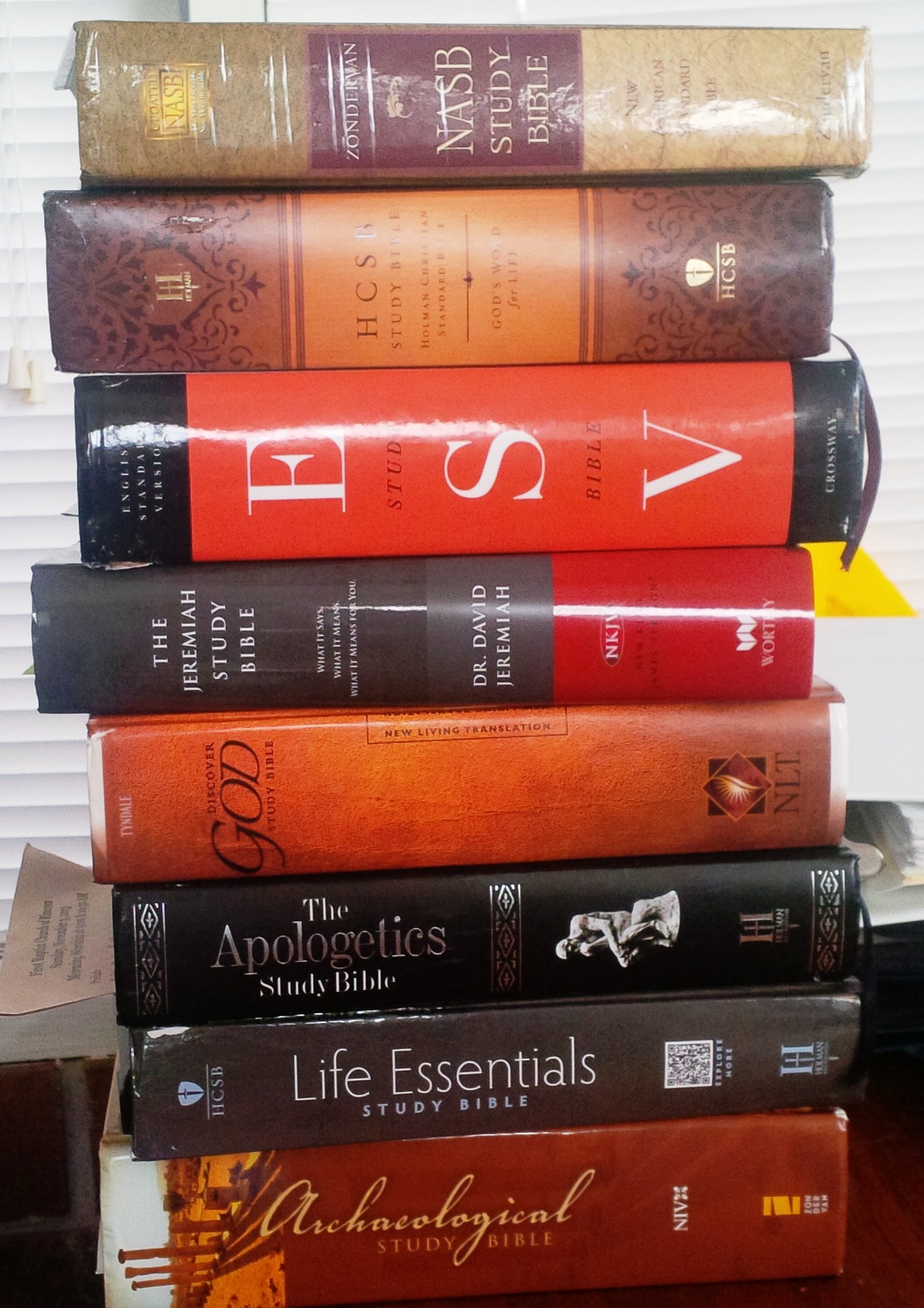 Copyright 2014 by Bob Rogers
When it comes to studying the Bible, not only are there many choices of translations, but also many choices of study Bibles. Here is an overview of some that I have found helpful.
There are several general study Bibles that are connected directly to a certain translation of the Bible. If a person cannot afford an entire set of commentaries, or wishes to have commentary on the whole Bible in one volume, these study Bibles are the best option. The NASB Study Bible (also available with the same notes as the NIV Study Bible), the HCSB Study Bible, the ESV Study Bible and the Jeremiah Study Bible (NKJV) are examples of this. Each of these study Bibles have extensive introductions to the books of the Bible, maps, and notes at the bottom of the page to explain the text in the particular translation used. The ESV Study Bible is the most scholarly and exhaustive of these study Bibles. The HCSB Study Bible is in a more popular style, and makes the best use of color, making it the easiest to read. The Jeremiah Study Bible has notes by popular Bible teacher, Dr. David Jeremiah.
Some study Bibles focus on a special purpose. The Archaeological Study Bible (NIV) includes notes and articles that explain the cultural and historical background of the Bible. The Life Essentials Study Bible (HCSB) and Life Application Bible (available in NLT, NIV, NKJV, NASB) focus on applying the truths of scripture to our lifestyle. The Life Essentials Study Bible makes use of QR code. Readers can scan the code with their mobile phone and watch a video of a Bible teacher explaining the passage in greater depth. The Discover God Study Bible (NLT) focuses on devotional and doctrinal truth. This is an excellent study Bible for a new believer. The Apologetics Study Bible (HCSB) includes notes and articles that defend the Christian faith against non-Christian religions and skeptics.
All of these study Bibles are excellent resources in shedding light on God’s word. I refer to many of them on a regular basis, depending on how I am studying a particular passage. But none of these aids can substitute for simply reading the text first yourself. I would recommend you read and read again the text and make your own notes on what you observe before you turn to these or any other study aids. After your own study, check your observations with those of the experts. That way, you will allow the Holy Spirit to speak directly to you through scripture, and to speak to you through those who have studied it before you.
(If you see a video ad below this post, please understand that I have no control over these ads, and that I do not necessarily endorse the product. If you see an inappropriate ad, feel free to contact me at brogers@fbcrincon.com.)
Warning signs of false religion
 Copyright 2013 by Bob Rogers
There are many religions; how can you tell which one is true and which is false? Some people say it doesn’t matter, because all religions have truth, but don’t tell that to the former followers of Jim Jones or David Koresh.
In 1978, Congressman Leo Ryan went to the South America to investigate a controversial cult based in San Francisco, named the People’s Temple, that had established a commune in Guyana. There were charges that Jim Jones, the founder of the People’s Temple, had defrauded members and was exerting total control over members by threats of violence. At the airport, Congressman Ryan and four others were shot to death, and then 913 members of the People=s Temple, including Jim Jones, committed mass suicide. (“Jones, Jim.” Encyclopedia Britannica 2005.)
In 1993, David Koresh, leader of a religious cult known as the Branch Davidians, stockpiled weapons with his 130 followers at a compound near Waco, Texas. Four federal agents were killed in a shootout with his followers, and for 51 days the government laid siege to the compound. Finally, they attacked the compound and 80 Branch Davidians, including David Koresh, died in a fire. (“Branch Davidians.” Encyclopedia Britannica 2005.)
Many other false religions are not as violent, but equally false. So how can a person tell which one is true and which is false? In the ancient Book of Deuteronomy, we find answers to this question.
I. Beware of False Words (Deuteronomy 18:14-22)
Deuteronomy gives us one of those tests in Deuteronomy 18:21-22.
Verses 21-22 specifically answer the question, “How can we know when a message has not been spoken by the Lord?” The answer is, “If what a prophet proclaims in the name of the Lord does not take place or come true, that is a message the Lord has not spoken.” So the first test of false religion is false words. If the religion makes false predictions, the religion is false.
I know of a false religious cult that has predicted the end of the world many times, evening naming the date. They failed this test.
Contrast them with Jesus, who is the true prophet. Deuteronomy 18:17-18 says the Lord will raise up a prophet.
In Luke 19:41-44, Jesus prophesied that Jerusalem would be destroyed, and in A.D. 70, it was destroyed exactly as He said. No wonder Acts 3:20-22 says the prophet Moses spoke of is Jesus!
Jesus Himself claimed to be the way, the truth, and the life. He speaks the truth; he IS the truth.
II. Beware of False Ways (Deuteronomy 18:9-13)
With the popularity of the Harry Potter novels, witchcraft has almost been sanitized today. And while I realize that the Harry Potter stories are just fantasy, we need to understand that real witchcraft is not taken lightly in the Bible. Beware against thinking that it is okay to delve into magic.
Back up a few verses in Deuteronomy and we find the second test of false religion. Deuteronomy 18:9 warns against the “detestable ways” of the nations in the land the Israelites are entering. Then it proceeds to describe every kind of witchcraft and occult practice you can imagine in verses 10-11.
It gives a specific list here of seven kinds of witchcraft:
1. Human sacrifice. Even today human sacrifice is sometime associated with the occult.
2. Divination and sorcery – using objects to foretell the future, such as psychics, tarot cards, and horoscopes.
3. Interprets omens – interpreting things like cloud or bird movements to reveal the future.
4. Witchcraft – rituals such as charms, spells, and potions
5. Cast spells
6. Medium and spiritist. (Leviticus 20:27 says a medium or spiritist must be put to death)
7. Consults spirits of the dead. Saul did this with the Witch of Endor (1 Samuel 28) and he was condemned.
Why is this so wrong? Isaiah 8:19 says that when people say let’s consult a spiritist or consult the death, shouldn’t a people consult their God? It is wrong because it is an attempt to get answers to life and foretell the future by consulting dead spirits and earth spirits, rather than depending upon the Holy Spirit of God who indwells the believer in Jesus Christ.
III. Beware of False Worship (Deuteronomy 13:1-5)
Remember that we saw in Deuteronomy 18 that false predictions were a warning sign of false religion? But in Deuteronomy 13, scripture informs us that some people might make true predictions and still be false prophets because of false worship. Listen to Deuteronomy 13:1-3: “If a prophet, or one who foretells by dreams, appears among you and announces to you a sign or wonder, and if the sign or wonder spokken of takes place, and the prophet says, ‘Let us follow other gods,’ (gods you have not known) ‘and let us worship them,’ you must not listen to the words of that prophet or dreamer. The LORD your God is testing you to find out whether you love him with all your heart and with all your soul.” So add to false words and false ways, a third test: false worship. Even if people in a religion do good deeds and say some good things, it is still false if their worship is false.
Many cult leaders started out well as members of Christian churches, but then they began to exert total control over their members, making themselves the “Messiah.” Many world religions teach good deeds, but they do not believe in the one true God of the Bible. They often worship other gods and have their own books that they claim are inspired by God.
Galatians 1:6-9 says that even if an angel should bring a different message, let him be accursed! 1 Corinthians 12:3 says that no one who is speaking by the spirit of God says, “Jesus be cursed,” and no one can say, “Jesus is Lord” except by the Holy Spirit. The ultimate test is, does this religion exalt Jesus Christ as Lord and Savior? If not, the religion practices false worship.
Jesus says, “I am the way, the truth and the life.” He IS truth. This is the true religion. Have you trusted in Christ, and Christ alone to save you?
NOTE: If a video ad appears below this post, I do not necessarily endorse the product.
Four great truths from the creation account in Genesis

Copyright 2013 by Bob Rogers.
Some people get so caught up debating how to fit different scientific views to the creation account in Genesis chapter one, that they miss the great theological truths in this chapter:
1) God created! Only God can create, and He does simply by speaking the Word, “Let there be…” and creation comes out of nothing (compare Hebrews 11:3).
2) God’s creation is good! Repeatedly, God saw what he created and “saw that it was good” (Genesis 1:4, 10, 12, 18, 21, 25, 31). When He created mankind, He said it was “very good.”
3) God’s creation is under His Lordship. God is the one in control. He speaks, and it comes to be. God alone is to be worshiped, not “Mother Earth” or the sun or moon, which is why God deliberately did not name the sun and moon (Genesis 1:16). Compare Romans 1:25.
4) God’s creation is under mankind’s trusteeship. Man was told to subdue and rule creation (Genesis 1:28), but also to “watch over it” (2:15). We have a responsibility to be good managers, for we don’t own it; God owns it all (compare Psalm 24:1).
NOTE: If a video ad appears below this post, I do not necessarily endorse the product.
Is God a psychotic mass-murderer? A reply to Bill Maher

Copyright 2013 by Bob Rogers
Recently, TV talk-show host Bill Maher said, “God in the Old Testament is a psychotic mass murderer.”
Is this true? Many people think so, because of passages in the Old Testament where God allows people to be destroyed, such as Noah and the flood, the plagues on Egypt, and the many wars that Israel fought with their enemies.
There are three things we need to understand, in order to understand the God in the Old Testament.
I. We need to understand what actually happened
Many people are disturbed by the command of God for the destruction of people and cities in the Old Testament, but they are unaware of the culture and history of the time and the Hebrew words used to describe what actually happened. When one takes a closer look at all this, a completely different picture comes to light.
In some cases, the Old Testament is merely reporting what people did, not saying that God commanded that it be done. For example, King Jehu destroyed all of the worshipers of Baal (2 Kings 10:18-27), but the prophet Hosea said that God would punish King Jehu for this act of brutality (Hosea 1:4). So don’t assume that just because the Bible reports acts of cruelty that it means God endorsed those actions.
But the conquest of Canaan was clearly commanded by God. So how do we justify that?
The Canaanites were not innocent. They defiled the land with detestable practices that included incest, pedophilia, bestiality and homosexuality. (Leviticus 18:24-25)
Deuteronomy 20:16-18 gives the invasion policy for when Joshua was to conquer the land of Canaan. God commanded their destruction (herem, devotion to the ban), because of their wickedness. However, when we study the events of conquest of Canaan more closely, we see that it was not the kind of genocide some have made it out to be.
The word translated “city” in Deuteronomy 20:16 and in Joshua is ‘ir, which can mean a walled fortress, like Jerusalem was when David attacked it in 2 Samuel 5:7, 9. We know from history that in ancient times, the ‘ir was like a walled fort. It was an agricultural society, in which the people lived on farms around the ‘ir, but the military stayed in the ‘ir, which was primarily a military citadel, not an urban city as we think of it today. So when the Book of Joshua says that they conquered city after city, they were actually destroying the walled cities, or forts, of the Canaanites. They were taking military targets.
So when Deuteronomy 20:16 says not to let any living thing survive among each “city,” or ‘ir, of the land, God was ordering a military conquest of an evil empire, not a genocide of an innocent people.
II. We need to understand God’s mercy
Notice how the Old Testament describes God’s mercy.
God waited 100 years in Noah’s day for the people to repent. (Genesis 5:32; 7:6)
God waited 400 years to judge Canaan because “the iniquity of the Amorites has not yet reached its full measure.” (Genesis 15:16)
God waited for generations for Israel to repent, sending them prophets to warn them. “But Yahweh, the God of their ancestors sent word against them by the hand of His messengers, sending them time and time again, for He had compassion on His people and on His dwelling place.” (2 Chronicles 36:15) It was only after they failed to repent that God allowed the Jews to be taken into exile in Babylon.
God takes no pleasure in the death of the wicked. (Ezekiel 33:11) God is patient, not wanting any to perish. (2 Peter 3:9)
Romans 2:4 turns the question on our own generation: “Or do you despise the riches of His kindness, restraint, and patience, not recognizing that God’s kindness is intended to lead you to repentance?”
III. We need to understand God’s justice
We just read 2 Chronicles 36:15, which said that God had compassion on His people “time and time again.” But the next verse, 2 Chronicles 36:16, says, “But they kept ridiculing God’s messengers, despising His words, and scoffing at his prophets, until the LORD’s wrath was so stirred up against His people that there was no remedy.”
The other thing we need to understand about God in the Old Testament is that while He is a God of mercy and grace, He is also a God of justice.
Leviticus 18:24-25 explains that God drove the Canaanites out of the land because they had defiled the land with their sinful lifestyles, and God said, “the land will vomit out its inhabitants.” God is a God of mercy, but eventually if we do not repent, His patience will run out, and His moral stomach will be turned against sin until He can hold it back no longer.
In Genesis 6:3, the LORD said, “My Spirit will not remain with mankind forever, because they are corrupt.” God is merciful, but when mankind continues to reject God’s mercy, God will judge.
As we have seen already, the punishment of the Canaanites was anticipated by God long before it happened, as God told Abraham in Genesis 15:16 that the sin of the Amorites had not reached its full measure. The implication was that when it did reach its full measure, it would then be too late. Throughout the Old and New Testament, we see this pattern: God is a God of grace and mercy who does not wish to punish. But if we continue in rebellion and refuse to repent, eventually God’s patience will run out, and He will execute His justice. We see this with Noah and the flood: God waited 100 years for them to repent, but when they refused, God sent the flood. God waited 400 years for the people in Canaan to repent, but when they refused, He sent Israel to conquer the land. God waited hundreds of years for Israel to repent, but when they refused to listen to the prophets, He allowed them to go into exile. The conquest of Canaan by Joshua and all of the other stories of punishment are not only history, they are also prophecy. It points to the final judgment that we all must face. Hebrews 9:27 says, “It is appointed for people to die once—and after this, judgment.” But God has also provided a way to escape Judgment Day, by sending Jesus as a personal sacrifice for our sins.
God is not a bloodthirsty bully at all. God is a blood-giving Savior, who gave the blood of His own Son Jesus on the cross that we might be saved from judgment and spend eternity with Him in Heaven. This is the God of the Bible, both Old and New Testament.
A collection of Christian thoughts on the Supreme Court ruling on same-sex marriage
 In June 2013, the U.S. Supreme Court struck down the Federal Defense of Marriage Act, allowing federal benefits for same-sex marriage partners in States that already have legalized same-sex marriage.
How should we respond to this? Here are a some brief thoughts of my own, and links to what other Christian bloggers are saying:
1) We must respond with Christ-like love. Ranting and raving on Facebook and Twitter and angry words to our friends and family will only confirm the unbeliever’s preconceived notion that Christians are judgmental and narrow-minded.
LifeWay researcher and Southern Baptist author Ed Stetzer calls for gracious, Christ-like responses in his blog: http://www.christianitytoday.com/edstetzer/2013/june/prop-8-doma-and-christian-response.html.
2) We must prepare to live in a non-Christian culture. Our parents lived in a generation where Judeo-Christian values were the norm. That is no longer the case. We will need to stand by Christian values that are at odds with our culture, and be prepared to graciously endure persecution, if needed, when submission to anti-Biblical standards are demanded of us. Do not conform to this world, but be transformed (Romans 12:1-2).
Sylvania, Georgia youth pastor Steve Dresen reminds us of how the early church responded in a culture that did not share our values: http://stevendresen.wordpress.com/2013/06/27/scotus-same-sex-marriage-and-the-churchs-identity
3) We must not give up. Don’t forget that the majority of States still do not allow same-sex “marriage.” In many nations around the world, such as Africa and Eastern Europe, homosexuality is still considered sinful by the overwhelming majority of people. Just as the prophets in the Old Testament boldy spoke truth to their culture, we too must proclaim the truth, rather than concede defeat. Last year I preached a sermon entitled, “What the Bible teaches about homosexuality may surprise you.” You can read it here: https://bobrogers.me/2012/07/09/what-the-bible-says-about-homosexuality-may-surprise-you/
Roman Catholic scholars make some good points about how the Supreme Court decision does not end the debate and that “gay marriage” is not inevitable. Here is the report from the Catholic News Agency: http://www.catholicnewsagency.com/news/gay-marriage-is-not-inevitable-analysts-say/.
4) We must remember that God is on His throne. God was still on His throne when Noah built the ark, when Moses fled from Pharaoh, when Jerusalem was destroyed by the Babylonians, and when Jesus died on the cross. The demise of God and godliness has been overstated many times before, and God always turns it around for good. Rather than despair, Christian, let us get on our needs and pray for a new movement of God that is totally dependent upon the power of God, not the power of politics.
Book Review: “Crime Scene Jerusalem: A Novel”
Copyright 2013 by Bob Rogers

Crime Scene Jerusalem: A Novel by Alton Gansky (published by David C. Cook, 2007) does a masterful job of pulling off a peculiar premise: Max Odom, a forensics expert, is taken back in time to investigate the crucifixion and resurrection of Jesus Christ. Gansky makes the story much more than believable– he makes it gut-wrenching. The forensics expert doesn’t want to be there, and expresses all of the sarcastic humor of a jaded American man. But when he comes face-to-face with the cross, and sees how Jesus’ death speaks to the pain in his own life, he… well, read the book yourself. You will not be able to put it down, and you’ll be changed by the experience. Gansky describes life and culture in first-century Jerusalem vividly, and Gansky keeps the reader guessing what hurt Max Odom experienced that must come to the surface as he witnesses the Passion of Christ. A fascinating read for the Easter season or any season.
What really matters

Copyright 2013 by Bob Rogers
Millions of people gather around their television sets to watch sports championship games. Some will be very happy after the game, and others will be very disappointed. But in the end, it really doesn’t matter.
Philippians 2:10-11 says that in the end, “At the name of Jesus every knee will bow… and every tongue should confess that Jesus Christ is Lord.”
In the end, it will not matter what team you follow, but it will matter whether or not you followed Jesus. In the end, it will not matter what nation you lived in, but it will matter whether you were you in the kingdom of God. In the end, it will not matter what terrorists you feared, but whether you feared God. In the end, it will not matter which church you attended, but whether you were part of the body of Christ.
In the end, it will not matter what your political affiliation was, but whether your affiliation was with Jesus. In the end, it will not matter where you worked, but whether you served Jesus. In the end, it will not matter what family or culture you were born in, but whether you were born again into the family of God. Because in the end, what will matter is not whether you got your name in the history books, but did you get your name in the Lamb’s Book of Life?
The Blind Men and the Elephant – Revisited
 (Adapted from “The Blind Men and the Elephant,” by John Godfrey Saxe. Last two stanzas Copyright by Bob Rogers.)
It was six men of Indostan,
To learning much inclined,
Who went to see the Elephant
(Though all of them were blind),
That each by observation
Might satisfy his mind.
The First approach’d the Elephant,
And happening to fall
Against his broad and sturdy side,
At once began to bawl:
“God bless me! but the Elephant
Is very like a wall!”
The Second, feeling of the tusk,
Cried, -“Ho! what have we here
So very round and smooth and sharp?
To me ’tis mighty clear,
This wonder of an Elephant
Is very like a spear!”
The Third approach’d the animal,
And happening to take
The squirming trunk within his hands,
Thus boldly up and spake:
“I see,” -quoth he- “the Elephant
Is very like a snake!”
The Fourth reached out an eager hand,
And felt about the knee:
“What most this wondrous beast is like
Is mighty plain,” -quoth he,-
“‘Tis clear enough the Elephant
Is very like a tree!”
The Fifth, who chanced to touch the ear,
Said- “E’en the blindest man
Can tell what this resembles most;
Deny the fact who can,
This marvel of an Elephant
Is very like a fan!”
The Sixth no sooner had begun
About the beast to grope,
Then, seizing on the swinging tail
That fell within his scope,
“I see,” -quoth he,- “the Elephant
Is very like a rope!”
And so these men of Indostan
Disputed loud and long,
Each in his own opinion
Exceeding stiff and strong,
Though each was partly in the right,
And all were in the wrong!
MORAL,
So, oft in theologic wars
The disputants, I ween,
Rail on in utter ignorance
Of what each other mean;
And prate about an Elephant
Not one of them has seen!
AND YET…
Doth this mean all religions
Are wrong in what they say?
Or doth it mean many faiths
See God in a different way?
And if we follow where He leads,
Then find the truth, we may!
The blind used hands to feel
A wall, a tree, a spear.
But let the blind open eyes
And see the truth and hear.
There’s One Great God over all
Who says to us, “Come near!”
Who is to blame for the theater shooting in Colorado?
 Copyright 2012 by Bob Rogers
The Dark Knight Rises is the name of the much-anticipated third Batman movie in the wildly popular films produced by Christopher Nolan. But it was a dark night in a different sense in a theater in Aurora, Colorado, where gunman James Holmes took to the stage himself and shot 70 people, killing at least 12.
When such horrific tragedies happen, we gasp, we hug our children, we lower our flags, we pray, and we ask, “Why?”
Soon a number of scapegoats will be brought forth to be sacrificed at the altar of our need to blame someone or something.
Some will blame a lack of gun control. They will say that if we had stricter gun control, this man could not have obtained so many weapons. However, mass shootings have occurred in other nations that have strict gun control.
Some will blame a lack of security, since the gunman carried so much artillery into the theater. Perhaps improvements in security can be made but the police and security guards cannot be everywhere.
Some will blame violence in the movies, saying that it desensitizes the viewer and can lead to copy-cat actions. Some news reports today say that the shooter was dressed as the Joker, lending some credence to this theory. However, millions of other people have seen the Batman films without having an urge to hurt anybody.
Others will blame the man’s upbringing, environment, how he may have been treated at the school where he dropped out, and so on.
But in playing the “blame game,” we often fail to look at the greatest reason for the actions of James Holmes and for each of us: the human heart.
Jeremiah 17:9 (ESV) says, “The heart is deceitful above all things, and desperately sick; who can understand it?” Jesus said that evil comes from within, out of the heart (Mark 7:21).
When the Gospel of John describes how Judas Iscariot got up from the Last Supper, left Jesus and the other disciples, and stepped outside to betray Christ, John adds this short sentence: “And it was night.” (John 13:30). John was speaking of the spiritual darkness of that moment. But after that dark night, a light arose, because this Jesus who died on the cross also arose from the dead to defeat evil and give us hope.
The greatest need that mankind has is not gun control, more police, controls over movies, or psychologists. Our greatest need is for a Savior who can change the heart. He alone can change our dark nights into bright mornings.
What the Bible Says about Homosexuality May Surprise You
 Copyright by Bob Rogers
Does the Bible encourage hatred toward homosexuals? Much of the problem people have with the Bible on this issue is not what the Bible says, but what people think it says. What the Bible says about homosexuality may surprise you.
I. Homosexuality is not the worst sin
While homosexuality is sin, the Bible does not say it is the worst sin. For some reason, many Christians and churches act as if the sin of homosexuality is the one sin that cannot be forgiven. But the Bible simply lists it along with many other sins. For example, 1 Corinthians 6:9-10 lists these sins: “No sexually immoral people, idolaters, adulterers, or anyone practicing homosexuality, no thieves, greedy people, drunkards, verbally abusive people, or swindlers will inherit God’s kingdom.”
Homosexuality is just one of many sins in this list, right alongside thieves, greedy people, drunkards and verbally abusive people, etc. If you cheat on your income taxes, you are just as much a sinner as a homosexual. If you have a drinking problem, you are just as much a sinner as a homosexual. If you yell and scream at your family all the time, you are just as much a sinner as a homosexual.
Don’t misunderstand me. I’m not denying that homosexuality is a sin. The Bible is very clear on that. From the sin of Sodom and Gomorrah in Genesis 19 to the law against sex with the same sex in Leviticus 18:22, to Jesus’ affirmation that sex is supposed to be between a man and a woman in Matthew 19:4-6, to Paul’s lengthy passage in Romans 1:24-27 about how unnatural it is for men to be with men and women with women, as well as 1 Corinthians 6:9 and 1 Timothy 1:10, it is clear that the Bible says homosexuality is a sin.
However, nowhere does the Bible say that homosexuality is the worst sin or the unpardonable sin.
If there is any sin that can be called the worst, it would be blasphemy against the Holy Spirit, which is a denial of the Spirit’s call to follow Christ, according to Mark 3:29-30.
II. Homosexual feelings are not sinful
Many people with homosexual attractions have felt excluded from the church, instead of helped by the church. But the Bible does not say homosexual feelings are sinful. Feelings are feelings. The sin is in how we act on those feelings. For example, Psalm 4:4 says, “Be angry and do not sin.” Ephesians 4:26 quotes this psalm, again saying, “Be angry and do not sin.” The sin is not the feeling of anger, the sin is what you do with the feeling. Likewise, if a person has homosexual urges and feelings, but decides to abstain from homosexual acts, he has not sinned.
Notice at the end of 1 Corinthians 6:9, it names the sin this way: “anyone practicing homosexuality.” It does not say “anyone with homosexual feelings.” The original Greek refers specifically to partners in the act of homosexual behavior.
This is a very important distinction that has often been overlooked in conservative, Bible-believing churches today. Missing this point has caused many people who struggle with homosexual attractions to assume that they cannot come to faith in Christ. If you are struggling with same-sex attractions right now, please hear me. You can come to Christ. All of us must come to Christ just as we are, and allow God to make us into what He wants us to be.
Conversion to Christ does not mean that homosexual urges will immediately vanish, any more than other immoral sexual urges will vanish when a heterosexual is converted, but it does mean that the homosexual, just like the heterosexual, is called to abstain from sexual relations that are not between a man and a woman married to one another.
III. Homosexuals can change!
Our culture constantly says that homosexuals are born that way. They say that the homosexual did not choose to be that way. They say that it is simply genetic. Is that really true? If all homosexuals were born that way, then shouldn’t nearly all identical twins have the same sexual orientation, since they have the same genetic makeup? Yet research shows that only about half of the time when homosexuals have an identical twin is that twin also homosexual (exodus-international.org/exodus_faqs.shtml).
First Corinthians 6:9-11 lists “practicing homosexuality” as one of the sins that do not inherit the kingdom of God. But the passage also says that homosexuals can change. Notice that verse 11 says, “And some of you used to be like this. But you were washed, you were sanctified, you were justified in the name of the Lord Jesus Christ and by the Spirit of our God.” Did you hear that? Paul said, “Some of you used to be like this.” But they had changed! Some of them used to be thieves, but they stopped stealing. Some of them used to be verbally abusive, but they quit yelling at their wives. And some of them used to engage in homosexual acts, but they stopped!
A female Christian counselor I know in Macon, Georgia, shared with me how she talked to a young lady recently who was struggling with same-sex attractions, and the counselor saw God completely and radically transform her. Asked how this happened, the counselor simply said, “by taking her by the hand and walking her to the Redeemer.”
A male Christian counselor I know in the Florida panhandle told me that he has counseled many homosexual men, and he begins by letting them know that he loves them, not in a sexual way, but just wants them to know that he loves them. He says many of them have never had an appropriate love shown to them by a father or another man. He helps them see that our Heavenly Father loves them, and can change them, and he often sees men break down and weep in his office, desiring a change.
If you would like help with same-sex attractions, visit the website of the Restored Hope Network: http://www.restoredhopenetwork.org/.
I knew a man who lost his job and lost his family because he was caught in a homosexual act. He was a believer in Jesus Christ, but he struggled with the gay lifestyle. We had a mutual friend who referred him to me, not so much for counseling as for accountability. He wanted to change, but he needed a healthy relationship with a male friend to encourage him in that direction. So we would meet for breakfast or lunch, and talk, and talk on the phone sometimes. It was hard for him, because he found that the people who accepted him the most were homosexuals, when he needed Christians to accept him and help him to change! Although it was hard, he managed to abstain from the gay lifestyle, got another job, and began to rebuild his life. When he got a better job that required him to move out of state, he brought me a plaque with a rope on it, and said, “Thanks for being there for me when I was at the end of my rope.”
If you are at the end of your rope, the Bible has good news for you. Hang on. Jesus is ready to help you when you are at the end of your rope, if you will trust your life to Him.
If you see a video ad below this post, please be aware that I have no control over what ads show up, and that I do not necessarily endorse the product.
Is your worldview from Hollywood or the Bible?
Copyright by Bob Rogers.
Is your worldview more in line with Hollywood or the Bible?
Let’s take four popular Hollywood movies as an example. Titanic, The Avengers, The Hunger Games, Inception. Do you have any idea if these movies have a Christian worldview? If you live by the view of life in these movies, will you build on a rock or just blow in the wind?
So how can we avoid being blown by the wind of popular opinion? How can we build a solid foundation for our lives?
Jesus said to build on the rock in the Sermon on the Mount (Matthew 7:24-27). He was referring to Himself and His teachings. Notice how this can give you a solid foundation for life.
There are four main components to a coherent worldview: what you believe about God, mankind, ethics and reality.

1) God. In the movie The Avengers, Black Widow tells Captain America that Thor and Loki are “basically gods.” Even so, Cap adds something else. “There’s only one God,” he tells her, “and I’m pretty sure He doesn’t dress like that.”
The Bible teaches God is the Creator. Genesis 1:1 says that in the beginning, God created. It also teaches that there is one God, but He is revealed in three persons: Father, Son and Holy Spirit. So when characters on Star Wars say “may the force be with you,” Christians know the true “force” is God.
But there are many religions that believe in God. The Christian belief about God provides the answer for the other three major components of a coherent worldview, and they all fit together, like pieces of a puzzle.

2) Mankind. In the movie The Hunger Games, Katniss understands that life has great value, and she is willing to sacrifice her own life to save others. The Bible says something good and something bad and something that is potentially great about mankind. The good thing is that we are made in the image of God. The bad thing is that we are all sinners. The great thing is that through faith in Jesus Christ, we can be forgiven of sin, and have eternal life. Why? Because Jesus made the ultimate sacrifice for us by paying for our sin through His death on the cross.
3) Ethics. In the movie Titanic, Jack is having a sexual romp with Rose and says, “This is crazy; it doesn’t make any sense,” She responds, “I know, that’s why I trust it.” That kind of thinking will sink you about as fast as the iceberg. It’s sinking thinking! A coherent worldview needs to have a foundation for ethics. Philosophers like Plato and Aristotle said to do the right thing and do the reasonable thing, but how can we know what that is? That is  why we need a standard to live by, and because we believe in God, we have that standard. The Bible says gives us the Ten Commandments and many other moral teachings, but it also gives us the power to live a godly life. Somebody might say that other religions like Islam also believe in God and have a holy book with a standard of living. That is true. But other religions do not have the same motivation for ethics that Christianity has. Other religions seek to motivate good ethics by guilt, but Christianity motivates by grace. Titus 2:11-12 says, “For the grace of God that brings salvation has appeared to all men. It (grace) teaches us to say “No” to ungodliness and worldly passions…” We have the motivation of grace, and we also have the power of the Holy Spirit, as every believer is indwelled by the Spirit, so as we live by the Spirit, we are able to live ethical lives (Romans 8:4), producing the fruit of the Spirit (Galatians 5:22-23).
4) Reality. In the movie Inception, characters living in a dream within a dream within a dream. They are not even sure what reality is, whether this world is real, and whether this life is worth living. The Bible teaches that this life is very real, and that the ultimate reality is found in eternal life in heaven through faith in Jesus Christ. The purpose of life is to know Christ and share Him with oth ers, that we may please God and experience the reward of eternal life in heaven.
Do you see how all of this fits together? If we believe in the God of the Bible, then all of the pieces of the puzzle fit together. God is the source of all truth. All of this truth is found in the Bible. A Christian who does not know his or her Bible is like a cowboy with no bullets in his gun. He may look good, but in battle, he’s useless.
If an entertainer on Dancing with the Stars says that God is in her shoes, will you know your Bible well enough to know that God is separate from us and beyond us? If you go to see a movie like Clint Eastwood’s Million Dollar Baby and see the hero killing the heroine so that she won’t have to live the rest of her life as an invalid, will you know your Bible well enough to know that all life is sacred and valued by God, and that it is wrong for us to take a human life just because that life is sick or handicapped?
First Peter 3:15 (HCSB) says, “Always be ready to give a defense to anyone who asks you for the reason for the hope that is in you.” The word translated “defense” is the Greek word apologia, from which we get apologetics, defending the faith.
So know what you believe, and be ready to defend it. Don’t let Hollywood do your thinking for you.
Does the Bible Demean Women?

In the United States of America, women have great freedoms and influence. Women are in influential positions all over our society; we even have women justices on the Supreme Court and a female elected as vice-president. It is often assumed in our culture that for women to have equal rights, they have the right to do anything a man does. So when they read the Bible, many people in our culture see the Bible as sexist, demeaning toward women. So let’s look at four passages often taken as demeaning toward women.
Before we view these passages, let me ask you a question. Are you opposed to women’s suffrage? My daughter, Melissa, is a school teacher, and she often asks this question and frequently gets a response of yes, that they are opposed to women’s suffrage. Then they find out that the term means a woman’s right to vote. So if you are opposed to women’s suffrage, that means you are opposed to a woman’s right to vote! But some people misunderstand the term, because “suffrage” sounds like “suffering.”
Now, if English-speaking Americans can misunderstand a term in our own language, don’t you think it is possible that English-speaking Americans today might misunderstand something written in Greek and Hebrew to a different time and culture in the Bible? So let’s take a fresh look at four major passages that are often described as demeaning to women.
Genesis 2:18 The Lord God said, “It is not good for the man to be alone. I will make a helper suitable for him.”
Eve was created as Adam’s “helper” (NIV “suitable for him,” HCSB “as his complement”). This has often been distorted as if it means the woman is the man’s servant to do whatever he commands, but the Hebrew word is translated well in the HCSB as “his complement.” That is, she completes him. He has a role, she has a role, and the marriage and family meets its full potential when the woman and man function together.
1 Corinthians 11:3: Now I want you to realize that the head of every man is Christ, and the head of the woman is man, and the head of Christ is God.
Man is the head of the woman. Greek word for head, kephale, when used metaphorically means “source, origin,” unlike the English word head which can also mean “chief, ruler.” So yes, it says that woman came out of the man and he leads her, but in the original Greek, the word “head” does not imply the domination that it does in our language. Remember, the man may be the head of the house, but the woman is the neck, and the head cannot turn without the neck!
Ephesians 5:22: Wives, submit to your husbands as to the Lord.
There is no verb in verse 22, and the verb is implied from verse 21, where we are first told to be in mutual submission to one another. Thus a wife’s submission only comes when the husband also has a humble and sacrificial attitude toward his wife. Notice as well that Ephesians 5:25 tells husbands to love their wives as Christ loved the church, and Christ died for the church. Rarely does a wife have a problem submitting to a husband who is willing to die for her.
1 Timothy 2:12: I do not permit a woman to teach or to have authority over a man; she must be silent.
The point here is that men lead the church. This is why we do not call a woman as pastor. However, this does not mean that women can never teach men, or else Priscilla would have been wrong to teach Apollos in Acts 18:26. Also there are references to women prophesying in both the Old and New Testaments,and these prophesies were sometimes directed toward men. For example, Deborah was a prophetess and judge over Israel who commanded the man Barak to take up arms against the oppression of his people (Judges 4:4-7). So the point is not that women can never speak God’s word in church and community, but that the leadership role of pastor in the church is reserved for men.
So as we study these verses, we see that while they do give a leadership role to men, they are not nearly as negative toward women as often portrayed. As we can see, these verses do not justify abuse of women at all. However, they do teach a distinctions and differences in the roles of men and women. In our culture today, we have been conditioned to think that if there is any difference in the role, there is a difference in their value. But that is not what the Bible teaches, at all.
Genesis 1:27: So God created man in his own image, in the image of God he created him; male and female he created them.
This verse teaches that men and women are created equally in the image of God.
Galatians 3:28: There is neither Jew nor Greek, slave nor free, male nor female, for you are all one in Christ Jesus.
This teaches that men and women are equal in Christ.
Sharon James, writing in The Apologetics Study Bible, uses the Trinity to illustrate how equality does not mean sameness and submission does not mean lesser worth. She points out that the three persons of the Trinity, Father, Son and Holy Spirit, are equally God, but have different roles. Likewise, men and women can have different roles and still be equal in value.
She also points out that Jesus, the Son of God, submits to God the Father. Likewise, wives who submit to their husbands are not worth less just because they are submissive.
Sharon James goes on to say that the different gender roles show how Eve was made as a complement to Adam: Masculine strength can be for protection and provision, while feminine sensitivity to relationships are useful for nurture and care.
The Bible does not put down women at all; it lifts them up! Historically, wherever Christianity has spread, the status of women has improved. Those countries where women are most exploited today are those with the least exposure to the gospel.
Easter Sunday, the day of surprise!

Copyright 2012 by Bob Rogers
Many people who doubt the truth of Jesus’ resurrection say something like this: “People in the first century were superstitious, simple-minded people, and they were much more likely to believe in a resurrection than modern people are today. So probably something else happened, and they just wanted so badly for Jesus to live that they convinced themselves, maybe even had a hallucination that Jesus was raised from the dead.” (Never mind that many different people testified to seeing Him alive, even 500 at once, and mass crowds do not have hallucinations.) But when we read the gospels, a totally different picture appears. The early disciples were just as surprised then as we would be now.
Mark could hardly have used more words to describe how surprised they were. Mark 16:5 says they were “alarmed.” The word means to be both amazed and alarmed. The angel calmed them by saying, “Don’t be alarmed… You are looking for Jesus the Nazarene, who was crucified. He has risen! He is not here.”
Mark 16:8 says, “Trembling and bewildered, the women went out and fled from the tomb. They said nothing to anyone, because they were afraid.”
“Alarmed.” “Bewildered.” “Afraid.” Mark is letting us know that they were totally surprised by the resurrection.
Celsus, a Greek philosopher who lived in the second century A.D., was hostile to Christianity and wrote books arguing against Christianity. Listen to what Celsus considered to be his strongest argument against the resurrection. He said that the written accounts of the resurrection are based on the testimony of women—and we all know that women are hysterical. Many of Celsus’s readers agreed. It was a major problem in ancient societies, because women were looked down upon; they didn’t give much credibility to a woman’s testimony.
Timothy Keller points out that if Mark was making up these stories, he would never have written that women were the first eyewitnesses. Yet we read in Mark 16:1 that it was Mary Magdalene, Mary the mother of James, and Salome who brought spices to anoint Jesus’ body. No men came, despite all that Jesus had said about rising on the third day. And even the women were not expecting a resurrection; they just wanted to give Him a proper Jewish burial. The only reason Mark would write this, that no men were there to first learn of the resurrection, is because that’s exactly what happened.
It completely surprised the first disciples. They never expected it. Yet it really happened.
And because it happened, world history is changed. Time is divided from B.C. to A.D. because of Jesus. Within five weeks, 10,000 Jews in Jerusalem were following Jesus, and within 300 years, the Roman empire came under the sway of Christianity.
Best of all, because of Jesus’ resurrection, we don’t have to escape reality, we can face reality! So many people try to escape their painful lives by diversions and entertainment. But Jesus’ resurrection changes all that. The sick man doesn’t have to transport himself into the imaginary world of a basketball star who slam dunks the ball; the sick man knows that in Christ, one day he will walk on streets of gold! The unloved woman does not have to escape into a world of romance novels; one day because of her faith in Christ she will be in a place where everybody loves and accepts her, and she will see the One who died to save her.
Surprise! Surprise! Easter is not a myth at all. It really happened, and because it happened, we can face reality.


 Bob Rogers