Blog Archives
As If Heaven Had Ordained It

“Not one word of all the good promises that the Lord had made to the house of Israel had failed; all came to pass.” – Joshua 21:45
When the Continental Congress gathered in Philadelphia in 1774 to unite against the British, they decided to open their proceedings in scripture and prayer. An Episcopalian minister named Jacob Duché was chosen. Before his prayer, rumors arrived that the British had attacked Boston. A frightened and receptive audience awaited as Duché read Psalms 35:1: “Contend, O LORD, with those who contend with me; fight against those who fight against me!” It was the assigned reading for the day in the Episcopal lectionary, but John Adams says members of the Continental Congress were stunned when they heard the words. Adams wrote, “It seemed as if Heaven had ordained that psalm to be read on that morning.” Have you had such an experience where the scripture seemed perfect for what you were going through at the time? I have several such scriptures marked in my Bible. Once when I was anxious about a situation at work, I read Psalm 34:4, “I sought the LORD, and he answered me and delivered me from all my fears.” That verse gave me sudden comfort. Eventually, everything worked out. Another verse that has helped me when facing a difficult decision is the promise of James 1:5, “If any of you lacks wisdom, let him ask God, who gives generously to all without reproach, and it will be given him.” Praying over that promise, God has given me direction time after time. Once when I was a hospital chaplain, I visited a patient writhing in pain, asking me to pray. As I was about to pray, two nurses entered and gave her tablets to take for pain, then left the room. Immediately I began to pray, and I sensed God telling me to quote Psalm 23, so I did. Even before I finished the psalm, she grew peaceful and still. I finished quoting the psalm, added a few more words asking God for healing, and then I looked up. The patient was resting. Her sister-in-law looked at me, eyes wide in amazement. I said, “That pain medicine hasn’t had time to work, has it?” The sister-in-law said, “No, but Psalm 23 did!” What scripture has given you guidance, comfort, or strength “as if Heaven had ordained” it?
Prayer
Lord, my heart is full of anxieties and desires, but your word is full of good promises and timely guidance. As I read scripture, show me how it applies to my life as if Heaven had ordained it for this day.
A prayer in the pandemic
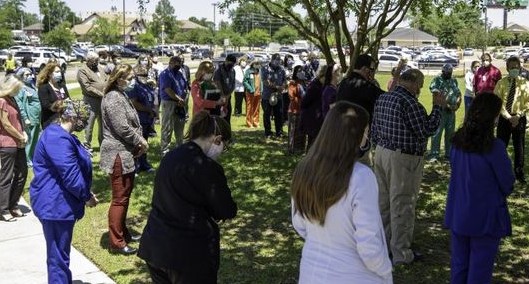
Copyright by Bob Rogers.
Oh, Lord, how we need Your presence in this pandemic.
For those who are sick, we ask for Your mercy and healing.
For those who are caring for the sick, we ask for Your compassion and strength.
For those who are afraid of the sickness, we ask for Your peace and protection.
For those who make policies about the sickness, we ask for Your wisdom and courage to do the right thing.
Heavenly Father, unite all of us, as Your children, by the bonds of Jesus Christ, our Savior and Lord.
Three thorns and roses in Romans 8:28

Article copyright by Bob Rogers.
We know that all things work together for the good of those who love God, who are called according to his purpose. – Romans 8:28, CSB
Romans 8:28 is one of the most beloved promises in the Bible. Most people focus on the words, “for the good.” Perhaps we should reflect more on the phrase, “work together,” because the verse is teaching that God can mix bad things in the life of a believer, and bring about good results, like roses on the end of a thorny stem. Let me suggest three kinds of thorns God brings from our lives that work together to grow roses: troubles, temptations and trespasses.
1) The thorn of troubles. God will allow troubles in our lives, to teach us to trust Him. When we have troubles, we are faced with our weakness. Yet, they work together for the good lesson of teaching us to depend on God’s sufficiency. As 2 Corinthians 1:9 says, this teaches us to “not trust in ourselvs but in God who raises the dead.”
2) The thorn of temptations. God will allow temptation in our lives, to teach us obedience. An athlete develops muscles and endurance by the pressure, weight and strain of exercise. Likewise, God allows us to be tempted, so that it works together for the good spiritual muscles that we develop as we grow stronger in obedience. (1 Corinthians 10:13)
3) The thorn of trespasses. By trespasses, I mean sin. God does not want us to sin, but when we sin, we must humble ourselves, repent, and ask Jesus for forgiveness. Scripture tells us to forgive, even as the Lord has forgiven us (Colossians 3:13). Those who have truly experienced the grace of forgiveness tend to be better at forgiving others. So trespasses– whether they be our own or the sins of others– work together to grow beautiful flowers of forgiveness in our lives.
Twisted scripture: I can do all things through Christ who strengthens me
Copyright by Bob Rogers

(NOTE: This is the third in a series of blog posts I am doing on some of the most commonly twisted and misinterpreted verses in the Bible.)
“I can do all things through Christ who strengthens me.” – Philippians 4:13, NKJV
Philippians 4:13 is one of the most beloved verses in the Bible. Sports teams emblazon it on their uniforms to inspire them to win games, and business people quote it to inspire their sales force. So what is the problem with that? A closer look at the verse shows that such interpretations violate the cardinal rule of Bible interpretation: context. So let’s put the verse back into its context and unpack it.
The apostle Paul was in jail when he wrote the letter to the Philippians. He stated in the letter that he could die there for the gospel (Philippians 1:12-13, 20-21). In the last chapter of the letter, Paul talked about his suffering in prison, and said, “…for I have learned to be content in whatever circumstances I am. I know both how to have a little, and I know how to have a lot. In any and all circumstances I have learned the secret of being content–whether well-fed or hungry whether in abundance or in need. I am able to do all things through Him who strengthens me” (Philippians 4:11-13, HCSB). From the context, it is obvious that Paul was not talking about winning games or setting sales records. In fact, he didn’t even ask to change his circumstances, to break out of jail. Instead, he was talking about contentment in the midst of his circumstances.
Taken out of context, people often stress the phrase “I am able to do all things,” as if this is a guarantee that we can climb the highest mountain and swim the deepest sea. But taken in the context of Paul’s contentment, despite his imprisonment, the whole verse makes sense. The emphasis of the verse is not about being able to do anything, but on being able to do all things (including handling bad things) through Christ. That is, whatever I face in the physical world, I can face it with with the spiritual strength that Christ gives me.
Understanding the context should not spoil the inspiring words of Philippians 4:13, nor even ban it from a theme for sports teams or business people. It can. It can inspire the team that has lost to get up and go again. It can inspire the business that has failed not to quit. Just remember that this verse is more about Christ than self, more about hope than hype, and more about rising from the bottom than about climbing to the top.
Twisted scripture: “God doesn’t put on you more than you can handle”
Article copyright by Bob Rogers

(NOTE: This is the second in a series of blog posts I am doing on some of the most commonly twisted and misinterpreted verses in the Bible.)
As a hospital chaplain, I seek to guide patients to find the spiritual strength to handle their problems. After hearing their story, I sometimes ask, “How are you handling that?” Many people will reply, “Well, God doesn’t put on you more than you can handle.” Others will say, “The Bible says God doesn’t give us more than we can bear.” That sounds nice, but it’s not what the Bible says! People get this idea from a misreading of 1 Corinthians 10:13. Here is what the entire verse says [italics mine]:
“No temptation has overtake you except such as is common to man; but God is faithful, who will not allow you to be tempted beyond what you are able, but with the temptation will also make a way of escape, that you may be able to bear it.” – 1 Corinthians 10:13, NKJV
Many people seem to think that this verse says that God will not allow you to be tested beyond what you can bear. But read the verse again. Is that what it says? No! It says God will not allow you to be tempted beyond what you are able. Some people correctly argue that the Greek word can be translated “tested” or “tried,” instead of “tempted.” However, almost all translations prefer the word “tempted” in this verse. Why? Because of the context. A rule of thumb for Bible interpretation is to read the context. So when we read the whole chapter, we see that 1 Corinthians 10 is about temptation. The first part of the chapter gives a series of warnings against falling into disobedience through unbelief. Verse 12 warns, “So, whoever thinks he stands must be careful not to fall.” Fall into what? Temptation. And verse 14 says the solution to the temptation is to “flee.” So the context of 1 Corinthians 10:13 shows that it is about temptation.
But if 1 Corinthians 10:13 does not say God won’t put on us more than we can bear, do other verses teach this? Ironically, Paul says in 2 Corinthians 1:8 that “we were so utterly burdened beyond our strength that we despaired of life itself.” In other words, God put more on him than he could handle! But he goes on to say in the next verse, “But that was to make us rely not on ourselves but on God who raises the dead.” The scripture frequently says that when we cannot handle things, God can give us the strength we need (See 1 Samuel 30:6; Philippians 4:13). (Unfortunately, Philippians 4:13 is also misinterpreted, and we’ll discuss how in the next blog post.)
Here is the bottom line: God is not saying that we won’t face more than we can handle, but He is saying that He will give us the spiritual strength to handle whatever we face.


 Bob Rogers