Blog Archives
The shotgun house on Desire Street
Copyright 2014 by Bob Rogers

Lillie Mae Lanier leaned on her wall
In her shotgun house on Desire Street.
Missing her husband, afraid of it all
In her shotgun house on Desire Street.
Her heart hurt, her head broke
Open the truth that she spoke
To her wall– as it wondered if it could stay still
When such painful emotions were written on the wall
In the shotgun house on Desire Street.
Katrina had come, Katrina had gone
To the shotgun house on Desire Street.
Waters had risen, families washed away
But Lillie Mae Lanier never wandered away
From the faith she had on Desire Street
Why? You may ask. Why lean on that wall
In your shotgun house on Desire Street?
Lillie Mae still leans day after day
In her shotgun house on Desire Street
For she knows the wall will never give way
And one day will take her heart far away
From her shotgun house on Desire Street.
When all that you have has melted away
And Monday’s food must last till Friday
You need a wall to lean on
You need a foundation to stand on
Lillie read the words written on her wall
That keeps her faith strong
That moves her along
She knows that one day He will take her away
And she’ll never again live on Desire Street.
For she’s a princess in hiding
And she’s waiting for her King
To smile on her heart on the day she departs
From her shotgun house on Desire Street.
x
x
x
(If you see a video ad below this post, please understand that I have no control over these ads, and that I do not necessarily endorse the product.)
Juggling Sunday
 Copyright by Bob Rogers
A hymnal in my left hand, a Bible in my right
Tossing a communion cup on a one-foot hop.
Cascading with a committee on Sunday night
Spinning a budget, now what will I drop?
A juice-stained Bible by my foot on the floor
Heart cut on the cup, fingers shut in the door
I thought diabolo was a juggler’s trick
But I ended up falling on the devil’s stick.
x
x
x
x
(If you see a video ad below this post, please understand that I have no control over these ads, and that I do not necessarily endorse the product.)
Finding Christ in our Christmas gifts
 Copyright 2013 by Bob Rogers
At Christmas, people all over the world exchange gifts. The Gallup Poll estimates that each American will personally spend about $740 this Christmas on Christmas gifts. (Source: http://www.gallup.com/poll/166226/consumers-holiday-spending-intentions-remain-modest.aspx). American Research Group estimates that each American spends $801. (Source: http://americanresearchgroup.com/holiday/)
Research says that on Black Friday 2013, Americans spent $12.3 billion in stores and nearly $2 billion online. Source: http://www.slideshare.net/WishpondTechnologiesLtd/black-friday-2013-results-1). Hundreds of billions of dollars more will be spent during the entire Christmas season.
Children look for Santa Claus to bring them gifts. According to a survey on Today.com, 67% of American families will give each of their children at four gifts or more for Christmas. So most American children get more gifts for Christmas than Jesus got on His own birthday! Many children are so excited about getting gifts that they forget that the holiday is to celebrate Jesus’ birth.
In America, exchanging gifts at Christmas has become gluttonous, excessive and wasteful. How did get so far away from the original idea? Let’s work our way backwards to where this all came from, and see if we can’t also get back to where we should be.
I. The tradition of gifts from Santa Claus
Santa Claus as we know him today originated here in America, particularly in New York.
The tradition of Santa Claus comes primarily from the poem by Clement C. Moore, a seminary professor in New York City. The poem was originally called, “A Visit from St. Nicholas,” but most of us know it by the first line, “’Twas the Night Before Christmas.” It was published in 1823 and had a great impact on the tradition of Santa Claus. It is from this poem that people get the idea of a jolly elf with a big belly coming on Christmas Eve with reindeer and bringing gifts for children. Yet even this poem never calls him Santa Claus, but instead it calls him St. Nicholas. New York, where Clement C. Moore lived, was first settled by the Dutch, who used the term Sinterklaas, to refer to St. Nicholas, and Sinterklaas came to be pronounced Santa Claus in English. But who was St. Nicholas?
Nicholas was a real person who was a Christian bishop in the 4th century. He was born in A.D. 270, and died on December 6, A.D. 343. Nicholas grew up in a wealthy home in Myra, part of modern-day Turkey. He became bishop of Myra and was known as a conservative, Bible-believing bishop, with a reputation for secret gift-giving and caring for children. One legend said that he often put coins in the shoes of people in need. The most famous legend about Nicholas was that a poor man had three daughters but could not afford a proper dowry for their wedding. This meant that they would remain unmarried and probably, in absence of any other possible employment, would have to become prostitutes. Hearing of the girls’ plight, Nicholas decided to help them, but being too modest to help the family in public (or to save them the humiliation of accepting charity), he went to the house under the cover of night and threw three purses (one for each daughter) filled with gold coins through the window opening into the house.
One version of the legend has him throwing one purse for three consecutive nights. Another has him throwing the purses over a period of three years, each time the night before one of the daughters comes of age. Invariably, the third time the father lies in wait, trying to discover the identity of their benefactor. In one version the father confronts the saint, only to have Saint Nicholas say it is not him he should thank, but God alone. In another version, Nicholas learns of the poor man’s plan and drops the third bag down the chimney instead; a variant holds that the daughter had washed her stockings that evening and hung them over the embers to dry, and that the bag of gold fell into the stocking. (Sources: http://en.wikipedia.org/wiki/Christmas#Gift_giving, http://en.wikipedia.org/wiki/Saint_Nicholas)
You can quickly see how these legends developed over the centuries into the legend of a character who brings gifts in secret, sometimes in stockings or down a chimney. He is known by many names in many countries, including Father Christmas, Père Noël in French, and Sinterklaas in Dutch.
Because the real St. Nicholas died on December 6, in many nations he is remembered on that day with the giving of gifts. But during the Protestant Reformation, many Protestants changed the gift-giver to the Christ child, which is Christkindl in German, and changed the date from December 6 to Christmas Eve. The German Christkindl got corrupted to Kris Kringle in English, and the Dutch Sinterklaas got corrupted to Santa Claus in English.
But we need to go further back than St. Nicolas to understand gift-giving at Christmas. Nicholas was a Christian bishop, and we need to go back to the Bible to see where he learned to give gifts.
II. The tradition of gifts from the wise men
Many traditions have grown up about the wise men who came to bring gifts to Jesus. The popular Christmas carol, “We Three Kings of Orient Are,” has led people to believe that there were three wise men, and that they were kings. Tradition has even given the three kings names: Melchior from Persia, Caspar from India, Balthasar from Arabia. (Source: http://en.wikipedia.org/wiki/Biblical_Magi)
How much of this is really in the Bible?
Matthew’s Gospel tells us that after Jesus was born in Bethlehem, that wise men came from the East, following a star to find the newborn Messiah, the king of the Jews. It does not say there were three of them, it only says they brought three gifts. There could have been twelve of them, for all we know.
The word translated “wise men” in Matthew 2:1 is magi. It is a Persian word that described priests of the Zoroastrian religion who foretold the future by studying the stars. The word magi was first used by Darius the Mede, who is considered from the people group known today as the Kurds. Kurds today still celebrate certain Zoroastrian practices, especially the Zoroastrian New Year that they call Newroz. Thus instead of kings from India, Persia and Arabia, the wise men were very likely Zoroastrian priests and astrologers from the Medes, or modern-day Kurds.
Now let’s look at Matthew 2:11. It says, “Entering the house, they saw the child with Mary His mother, and falling on their knees, they worshiped Him. Then they opened their treasures and presented Him with gifts: gold, frankincense, and myrrh.”
This happened many months after Jesus’ birth, so they now live in a house, not in a stable, and Jesus is a child, not a baby. Joseph is not mentioned, probably because he was away at work. But what is most important for us is to notice what the wise men did. If we will pay close attention to what they did, we will get our Christmas gift-giving back in balance. They did two things. First, they fell on their knees and worshiped Jesus. Second, they presented Him with treasures.
Notice that their first gift was their worship. There is no greater gift that you or I can give Jesus than to give him our worship. The poet Christina Rosetti wrote,
“What can I give Him? Poor as I am? If I were a shepherd, I would bring a lamb. If I were a Wise Man, I would do my part. Yet what can I give Him, Give Him my heart.”
This was the first gift of the wise men, the gift of their hearts. The apostle Paul writes about the Christians in Macedonia in 2 Corinthians 8, who gave offerings even though they were poor. Yet Paul says in 2 Corinthians 8:5 that they first gave themselves to the Lord, even before they gave their financial gifts.
Notice that their second gift was their treasures: gold, frankincense, and myrrh. There are many traditional symbols associated with these three gifts. Gold was considered one of the most precious medals in ancient times just as it is today. Job 28:15 talks about wisdom being so valuable that not even gold could be exchanged for it. King Solomon’s court was full of gold. Gold is often associated with Jesus as king. Frankincense is an incense that was used to burn before the Lord in the altar, according to Exodus 30:35-36. Thus frankincense is associated with prayer and worship. Myrrh is a valuable perfume. Myrrh was used as a beauty treatment, but John 19:39 says that the women used myrrh to anoint Jesus’ body for burial, and thus myrrh was associated with Jesus coming to die on the cross for our sins.
III. How to find Christ in our giving
So how do we find Christ in our Christmas gifts? Our journey backwards to the root of our traditions should give us some answers.
First, we should give ourselves to Christ in worship.
The wise men first gave of themselves in worship, and then gave their treasures to Christ. This should remind us that Christmas is about giving, not getting gifts. It is not about us receiving gifts, but about us giving to celebrate Christ. The most important gift of all is our worship to Christ. A Christian who is too busy exchanging presents at Christmas to give Jesus his presence in worship is guilty of idolatry! The wise men came to Jesus, and fell on their knees before Him. So should we.
Second, we should give Christ our treasures.
This should also remind us that our gifts should have a purpose. While there are many legends about the purpose of the gold, frankincense and myrrh, the reality is that soon after this, Joseph and Mary had to flee from the murderous intentions of King Herod, and the rich gifts from the wise men must have been very practical and useful to them in financing their trip. Genesis 37:25 mentions traders on a caravan of camels who were carrying perfumes and incense. The fact is that all three gifts were easy to transport, valuable and easy to sell on the open market. The gifts were not wasteful; they had a useful purpose.
If we truly treasure Jesus Christ, if we are truly grateful for Him coming to safe us, then we will want to give gifts to glorify Jesus Christ. This can include gifts to people in need, and gifts to share the gospel of Jesus Christ.
What would happen if just half of our church members would just give 10% of their spending to missions to share the gospel?
Last year, Southern Baptists gave $149.3 million to the international missions offering.
If just half of Southern Baptists gave just 10% of the average Christmas spending to missions, we would give $592 million dollars to missions. Instead, Southern Baptists only gave 25% of that amount.
Third, we should not teach our children to be greedy and materialistic. Many children think that Santa Claus has an unlimited supply to give them anything they want, which encourages greed and selfishness. Parents need to resist the culture’s materialism in the way they give gifts to their kids. As a mentioned in the beginning of this sermon, most American children get four or more gifts at Christmas, yet Jesus only received three. Many parents are saying that it’s time that they take a lesson from the wise men, and in honor of Jesus, they give their children three gifts. By giving your children three gifts, you remind them of Jesus’ three gifts. Some families do it this way: something they want, something they need and something to read. Others choose something they want, something they need, and something to wear. Other families give a “gold” present, and “frankincense” present, and a “myrrh” present. The “gold” present is something a child would want and treasure. The “frankincense” present is used in worship and spiritual life, such as a Bible, and the “myrrh” present is something for the body, like clothing or shoes. Many families allow a fourth present, as the child gets to pick a gift to give away to somebody else in need.(Source:http://t.co/ckwo8WQcvZ)
Fourth, we should exchange gifts to express our love.
As long as we honor Christ at Christmas, there is nothing wrong with exchanging gifts with our family and friends, as well. After all, giving and receiving gifts are an expression of love. Gary Chapman, in his bestseller, The Five Love Languages, says that people feel love in five major ways: words of affirmation, quality time, receiving gifts, acts of service, and physical touch. Although people have a primary love language, most people feel loved when they receive all five of those. Chapman points out that a gift does not have to be expensive to express love. It’s more important that the gift is thoughtful.
My sister, Nancy, is the best gift-giver I know. I have always noticed how thoughtful she is in selecting gifts for others. So I called her up and asked for her advice, and here is what she told me:
Nancy said, “I think about what that person would enjoy. It depends on who the person is. I ask, would it appeal to that person, not to me. So I ask myself, how would they react when they open this gift? Like a person who loves cats, I might think they would like a cat figurine, but then I think about how this person does not collect items and so even though they like cats, they don’t collect figurines. So I don’t just think about it just a minute. I give it some time and thought.
“When it comes to gift giving, the magic thing is not the dollar value. It’s showing the other person that you care about them and value them by thinking about what they would like. It’s about the receiver, the care and thought. One year when I had no money, I baked cookies and put them in plastic bags and put handwritten notes with the cookies, and it went over fine, because I tried to personalize it. A lot of times, a card you make yourself or a blank card that you write a note in, means even more.”
“What you will discover when you start putting time and thought into your gift-giving, is that gift-giving will become more enjoyable for you. You will look forward to seeing how the other person reacts and how they know that you showed that you care by selecting something just for them. After all, giving gifts is an expression of our love, and if we love someone, we will put some thought into what we give them.”
A young man wanted to get a special Christmas gift for his father, who lived far away. He looked for something unique that would show how much he valued his father. So he got an exotic parakeet. It could speak five different languages and it could sing “The Yellow Rose of Texas” standing on one leg.
He spent $10,000 on the bird and had it shipped this unusual bird to his father. On Christmas Day, he called his father. He couldn’t wait to hear what his Dad thought of his gift. He said, “Dad, did you get my gift?” His father said, “I certainly did, son.” The man said, “Well, Dad how did you like it?” His dad replied, “Oh, it was delicious!”
He said, “But Dad, that was a special bird that could speak five different languages and even sing while standing on one leg! I can’t believe you ate him!” His father replied, “If he could speak five different languages, I can’t believe he didn’t say something before I ate him!” (Adapted from Tony Evans’ Book of Illustrations, p. 117-118.)
God sent the greatest gift at all at Christmas when He sent His Son to save us. But many of us have missed the point, like the man who ate the parakeet. But before we criticize those who miss the point, let’s ask ourselves a question: “Why don’t we say something?” After all, how are they going to know about the real gift of Christmas if we don’t tell them?
If you see a video ad below this post, please understand that I have no control over these ads, and that I do not necessarily endorse the product.
Finding Christ in our Christmas songs
 Copyright 2013 by Bob Rogers
What is the most popular Christmas song in America? Billboard magazine’s list of the top ten Christmas songs of 2012 is probably our best source. This is not based on opinion, but is based on airplay on the radio, sales, and online streaming. Here is the list (Source: http://wgna.com/the-most-popular-christmas-songs-of-2012/):
10. Last Christmas- Wham!
9. Christmas Eve (Sarajevo 12/24)- Trans-Siberian Orchestra
8. It’s The Most Wonderful Time Of The Year- Andy Williams
7. White Christmas- Bing Crosby
6. Jingle Bell Rock- Bobby Helms
5. A Holly Jolly Christmas- Burl Ives
4. Feliz Navidad- Jose Feliciano
3. The Christmas Song (Chestnuts)- Nat King Cole
2. Rockin’ Around The Christmas Tree- Brenda Lee
1. All I Want For Christmas Is You- Mariah Carey
Did you notice who is completely missing from the top ten? Jesus! Christ is not only not in the top 10 songs, he’s not even mentioned in the rest of the top 20.
In a world that sings about Christmas without Christ, God is calling the church of Jesus Christ back to the tradition of Christmas carols.
I. The history of Christmas carols
While many Americans sing about Santa, chestnuts and a white Christmas, Christians all over the world have sung about the birth of Jesus Christ for centuries. As early as the fourth century, Ambrose, the archbishop of Milan, wrote a hymn for Christmas to teach that God truly became a man, in response to heretics who denied Jesus’ incarnation.
Singing Christmas carols was popularized by St. Francis of Assisi during the Middle Ages in Europe, and was also encouraged by the Protestant Reformers, such as Martin Luther. As early as the 15th century, groups of singers would go from house to house in England and sing Christmas carols. Christmas carols in English first appear in a 1426 work of John Awdlay, chaplain from Shropshire, who lists twenty five “caroles of Cristemas”, probably sung by groups of “wassailers,” who went from house to house and enjoyed “wassail,” ale, or apple cider, and other desserts given to them at each home. Thus we get the line, “here we go a wassailing among the leaves so green,” and since the homes often fed the carolers, we also get the line, “bring out the figgy pudding, we won’t go until we get some.” It was only later that carols begun to be sung in church, and to be specifically associated with Christmas.
Two of the oldest Christmas carols still sung today are “O Come, all ye faithful,” which was originally written in the 13th century, and “Good Christian Men, Rejoice” which was first composed in the 14th century.
Perhaps the three most popular Christmas carols in English are “Joy to the World,” “Hark! The Herald Angels Sing” and “Silent Night.” The first two were sung in the American colonies even before the United States was a nation, but the third one came from Austria.
“Joy to the World” was written by Isaac Watts in 1719. It is based on Psalm 98, and its tune comes from one of the songs in Handel’s Messiah. Originally this song was intended to refer to Jesus’ Second Coming, but it has come to be associated mostly with His first coming at Christmas.
“Hark the Herald Angels Sing” was written by the great Methodist founder Charles Wesley in 1739, and the words were revised by the great evangelist of the Great Awakening, George Whitefield. A hundred years later, the classical composer Felix Mendelssohn composed the tune that is popular today when people sing “Hark the Herald Angels Sing.”
“Silent Night” was originally written in German and first sung on Christmas Eve, 1818, at St. Nicholas Church in the village of Oberndorf, near Salzburg, Austria. The organist, Franz Gruber, discovered that the organ wasn’t working at the church. The priest, Joseph Mohr, had composed the words in German to “Silent Night” two years before. So he shared it with Gruber, who composed the tune to be sung by guitar. When Karl Mauracher came to repair the organ, he heard the story of how the song was composed in an emergency and sung without the organ, and Mauracher spread the song everywhere that he went. The song came to America by German-speaking congregations. Originally the words were “Stille Nacht, Heilige Nacht.” The English words we sing today were translated by John Freeman Young. “Silent Night” has been translated into 140 languages. (Sources: Wikipedia and Companion to Baptist Hymnal by William Reynolds.)
I wish we had time to talk about many other popular Christmas carols like “O Holy Night,” including some newer songs like “Mary Did You Know?” Many families bake a birthday cake and sing “Happy Birthday” to Jesus on Christmas morning, which is a wonderful way to teach the true meaning of Christmas to children. Which brings us back to the original story itself, because the first Christmas carols are found in the Bible itself.
II. The songs of the first Christmas
Really, singing Christmas carols goes all the way back to the first Christmas, because Luke’s Gospel records four different songs as he gives the Christmas story. Let’s look at the lessons we get from these original Christmas carols.
A Mary’s song says that Christ came to love the forgotten (Luke 1:46-55)
When Mary was told that she would be the mother of the Messiah, she broke out into a song of praise, found in Luke 1:46-55. It is often called “The Magnificat” because she began, “My soul magnifies the Lord…”
The song emphasizes how God has remembered the forgotten and lifts up the lowly. In verse 48-49 she sings with amazement that God chose her, a simple girl from Nazareth: “He has looked with favor on the humble condition of His slave. Surely, from now on all generations will call me blessed.” And notice what she sings in verse 52: “He has toppled the mighty from their thrones and exalted the lowly.”
Mary’s song reminds us that in Christ, God remembers the forgotten. Mary was a poor girl, and Jesus was born in a feeding trough. The song should remind us to stop and give a donation to the Salvation Army when we go shopping, to help Toys for Tots, and share with Operation Christmas Child and Backpacks for Appalachia. The Christmas child shoe boxes and backpacks are a wonderful way to share Jesus with the poor at Christmas.
B. Zechariah’s song says that Christ came to save us (Luke 1:67-79)
Not only was Jesus’ birth a miracle, but the birth of John the Baptist, who was the forerunner of Christ, was also a miracle, because his parents were way too old to be having children. Yet an angel appeared to Zechariah to tell him that his wife Elizabeth would have a child in her old age. When John the Baptist was born to them, Zechariah broke out into a song of praise. It is found in Luke 1:67-79.
Zechariah’s song emphasizes that Christ came to save us. Luke 1:68-69 says, “Praise the Lord, the God of Israel, because He has visited and provided redemption for His people. He has raised up a horn of salvation for us in the house of David.” In the Bible, a horn was a symbol of strength. The Messiah was to come from the family line of King David. So Zechariah was singing about the same thing his son would prophesy when John the Baptist saw Jesus, and John proclaimed, “Here is the Lamb of God who takes away the sin of the world!” (John 1:29).
Zechariah’s song reminds us that Christ came to save us from sin.
C. The angel’s song says that Christ came to give us peace (Luke 2:13-14)
When the angel announced the birth of Jesus to the shepherds, he was suddenly surrounded by a great angel choir that sang the best-known of the songs that first Christmas. We read it in Luke 2:13-14. It is called “Gloria in Excelsis Deo” because it begins with the words, “Glory to God in the highest.”
The angel’s song spoke about Christ, the Prince of Peace, coming to bring us peace. Most of us know this song from the King James Version, which says, “Glory to God in the highest, and on earth peace, Good will towards men.” Many of us react to that like the poet Henry Wadsworth Longfellow, who wrote the words to “I Heard the Bells on Christmas Day” during the Civil War. He wrote,
And in despair I bowed my head:
“There is no peace on earth,” I said,
“For hate is strong and mocks the song
Of peace on earth, good will to men.”
The good news is that the most reliable ancient manuscripts do not say what the KJV says. That is why the HCSB translates it, “peace on earth to people He favors!” You see, Jesus’ coming is not a general guarantee that everybody will have peace. The more accurate translation does not say peace to all men, but peace to people He favors. That is, peace is available to those who receive God’s grace, or favor, through faith in Christ. As Romans 5:1 says, “Therefore, since we have been declared righteous by faith, we have peace with God through our Lord Jesus Christ.” On Christmas Eve, 1914, during World War I, the British, French and German armies laid down their arms and visited with one another in peace, and they all sang “Silent Night” in their own languages, as they all knew the song. The message about the Prince of Peace made all the difference, even in the midst of war.
Have you found the peace of Christ? The angel’s song reminds us that Christ came to give us peace, a peace we receive by faith in Him.
D. Simeon’s song says that to keep Christmas with us, we must share it (Luke 2:29-32)
There is one more Christmas song in Luke’s Gospel. Officially, it was after Christmas, since it happened a few days later. A lot of people get the post-Christmas blues after Christmas is over. They get kind of sad, taking down the Christmas tree and putting away the decorations. And we rarely sing Christmas carols after Christmas Day. But Simeon did.
A few days after Jesus was born, Mary and Joseph took Jesus to Jerusalem to dedicate Him to the Lord in the temple. There they met a prophet named Simeon, who had been waiting all of his life for the Messiah to come and save His people. Luke 2:26 says it had been revealed to him by the Holy Spirit that he would not die before he saw the Messiah. When he saw Jesus with Mary and Joseph, Simeon took Him in his arms and sang the fourth Christmas carol. In that song, Simeon reminded us that to keep Christmas with us, we must share it. We read the song in Luke 2:29-32.
Simeon sang, “For my eyes have seen Your salvation. You have prepared it in the presence of all peoples—a light for revelation to the Gentiles and glory to Your people Israel.”
Simeon knew that the salvation that is offered in Jesus Christ was prepared for “all peoples,” both Gentiles and Jews, and he wanted everybody to know that the baby Jesus that he was holding in his arms was the Savior.
Simeon’s song reminds us, to keep Christmas all year long, keep on sharing the good news.
Christmas carols that celebrate Jesus may not be in the top 20, but people still recognize the songs and enjoy hearing them this season of the year, which is all the more reason for us to play carols in our homes and cars and places we work. It’s a simple way to share the good news.
And how we need to renew the tradition of going Christmas caroling! I have a suspicion that if Zechariah and Simeon and Mary were with us today, they would be going door-to-door caroling, with some shepherds right behind them and angels overhead.
Years ago, a small group of carolers went door-to-door in a wealthy neighborhood of Beverly Hills, California. They rang a doorbell, and the man of the house answered, all in a hurry. He said, “Look, I appreciate the sentiment, but I really don’t have time for this. The house is a mess and we’re trying to get out the door to go shopping. Come by some other day.” As he shut the door, Bing Crosby and his family said, “Okay,” and left.
God sent His Son at Christmas. Don’t be so busy you miss the song.
If you see a video ad below this past, please be aware that I have no control over these ads, and that I do not necessarily endorse the product.
Finding Christ in Our Christmas Lights
 Copyright 2013 by Bob Rogers
Houses all over my neighborhood are covered with outdoor Christmas lights, but what does it have to do with the birth of Jesus Christ? Let’s go back and look at where we got the tradition of Christmas lights.
I. Origins of Christmas lights
For centuries, Christmas lights meant lighting candles.
The tradition of putting up Christmas lights began with putting candles on Christmas trees. Christmas trees originated in Germany by the 16th century, from several different traditions. Some Germans actually burned an evergreen tree in the town square and danced around it. There is a popular legend that Martin Luther, the German Protestant reformer, began the tradition of putting candles on Christmas trees. The legend says that one crisp Christmas Eve, about the year 1500, he was walking through snow-covered woods and was struck by the beauty of a group of small evergreens. Their branches, dusted with snow, shimmered in the moonlight. When he got home, he set up a little fir tree indoors so he could share this story with his children. He decorated it with candles, which he lighted in honor of Christ’s birth. (Accessed on the Internet on December 5, 2013 at: http://www.christmas-tree.com/where.html).
Whether or not this is true, we know that the Advent wreath was invented in 1839 by Johann Henrich Wichern, a Protestant pastor who worked with the urban poor in Germany. The children would ask every day if Christmas had arrived, so Wichern built a ring with evergreen and candles to candles to light the 24 days in December before Christmas, and large candles to mark the Sundays. Later this was simplified to four candles for the four Sundays, and a Christ candle in the middle for Christmas Eve or Christmas Day. The custom of lighting an Advent candle did not spread to America until a century later, in the 1930s. (Accessed on the Internet December 4, 2013 at: http://en.wikipedia.org/wiki/Advent_wreath).
II. Modern Christmas light traditions
On December 22, 1882, Edward H. Johnson, vice president of the Edison Electric Light Company, displayed his Christmas tree with 80 red, white and blue electric lights bulbs the size of walnuts, at his home on Fifth Avenue in New York City. This was the first time a Christmas tree had been illuminated with electric lights, but the idea spread quickly. Three years later, the White House Christmas tree was covered with electric lights. By the early 19th century, it became popular to put lights on buildings, not just on Christmas trees. In the 1960s, with the construction of so many subdivisions in American communities, it became the custom in American neighborhoods for many families to cover their houses with lights. This custom has spread around the world, and is particularly popular in Japan. (Accessed on the Internet on December 4, 2013 at: http://en.wikipedia.org./wiki/Christmas_lights).
As I mentioned at the beginning of this message, Christmas lights cover waterfronts, caverns, skyscrapers and shopping centers today. Some even use synchronized timers to have their lights flash to music.
Yet while many American homes are covered with Christmas lights, many of the families who live inside never go to church. Christmas lights are popular in Japan, but a very few Japanese are Christians. So what do Christmas lights have to do with Jesus Christ and His birth? Actually, it has everything to do with Christmas!
III. The light of Christ
The Bible uses light as a symbol for Christ in both the Old Testament and New Testament.
In Numbers 24:17, the prophet Balaam said, “A star will come from Jacob, and a scepter will arise from Israel.”
The prophet Isaiah said, “Arise, shine, for your light has come, and the glory of the LORD shines over you… Nations will come to your light, and kings to the brightness of your radiance…Caravans of camels will cover your land… They will carry gold and frankincense and proclaim the praises of the LORD.” (Isaiah 60:1, 3, 6).
The Gospel of Matthew shows how these prophecies pointed to the coming of Jesus as the Messiah: “After Jesus was born in Bethlehem in Judea in the days of King Herod, wise men from the east arrived unexpected in Jerusalem, saying, ‘Where is He who has been born King of the Jews? For we saw His star in the east and have come to worship Him.’” (Matthew 2:1-2)
Perhaps the eastern star-gazers had been studying the Hebrews scriptures. Perhaps they read Balaam’s prophecy in Numbers 24:17 that a star would come in Israel. We don’t know what star they saw. Astronomers say that there was a convergence of Mars, Jupiter and Saturn in 7-6 B.C., and a Comet in 5 B.C. Since our calendars are off a few years, we now know that Jesus was born about 4-6 years earlier than 1 A.D., so it is possible that they saw one of these astronomical events. Yet God could well have produced a supernatural light. According to Matthew 2:9, the star moved and then stopped moving. “After hearing the king, they went on their way. And there it was—the star they had seen in the east! It led them until it came and stopped over the place where the child was.”
Perhaps the wise men read Isaiah’s prophecy that nations would come to his light and caravans of camels would bring gold and frankincense to praise the Lord. For look at what it says in Matthew 2:11, “Entering the house, they saw the child with Mary His mother, and falling on their knees, they worshiped Him. Then they opened their treasures and presented Him with gifts: gold, frankincense, and myrrh.”
Matthew’s gospel shows us how Jesus fulfilled the prophecy and is represented by the light. John’s gospel makes the application to you and me. John 1:4-5 says, “Life was in Him, and that life was the light of men. That light shines in the darkness, yet the darkness did not overcome it.”
Let’s take a closer look at this, because every line in these two verses is expanded on later in the Gospel of John.
John 1:4a says, “Life was in Him.” John 5:26 says, “For just as the Father has life in Himself, so also He has granted to the Son to have life in Himself.” Jesus, the Messiah, has something powerful within Himself: life. He is able to give abundant life and eternal life to His followers.
John 1:4b says, “and that life was the light of men.” John 1:5a continues, “That light shines in the darkness.” We read in John 8:12, “Then Jesus spoke to them again: ‘I am the light of the world. Anyone who follows Me will never walk in darkness but will have the light of life.” Do you see how John 8:12 explains John 1:4-5? If you want to have real, abundant, eternal life, you need to come out of the darkness of sin and this evil world, and come to the light of Jesus Christ.
Now look at John 1:5b: “yet the darkness did not overcome it.” The Message says, “the darkness couldn’t put it out.” The NLT translates, “the darkness can never extinguish it.” In John 12:35 we read, “Jesus answered, ‘The light will be with you only a little longer. Walk while you have the light so that darkness doesn’t overtake you.’” The word translated “overtake” in John 12:35 is the same Greek word translated “overcome” in John 1:5.
So what does this all mean? It means that there is a great spiritual battle between the forces of darkness and the forces of light. Jesus warns that darkness can overtake you. You and I can be consumed with evil and sin and defeated. But Jesus is the light of the world. And if we come to His light, the darkness can never put it out. In Matthew 5:14, Jesus said, “You are the light of the world.” Jesus calls us to shine His light to a dark world that does not know Him.
Let me tell you the tale of two sons. It is a true tale. Both families have given me permission to tell their stories.
Mitch and Amy Ambrose are members of First Baptist Church of Rincon, Georgia. Their son, Joshua, was two years old when he got sick, but he loved Christmas lights. He had several surgeries that next year. When he was almost three years old, he was going to have to go to the hospital for brain surgery. It was the middle of November. He asked if they were going to have a Christmas tree with lights on it. They said yes, and Amy they put the tree up in the middle of November, and put lights on it the day before they went to the hospital, so he got to see the lights. The morning after the brain surgery, he had a seizure and lost consciousness, which left him totally physically disabled. He couldn’t respond to his family at all, so the doctors labeled him as blind. But when he was about eight years old, he was lying on his play mat on the floor, and the Christmas tree was up with the lights on. When Mitch and Amy came home from Wednesday night church, Josh had crawled up under the tree, trying to get closer to the light, unknown to the caregiver. To this day, Josh still loves to come to church and see the Christmas lights.
Nick and Brenda Revette are my brother-in-law and sister-in-law, and are members of First Baptist Church, Lake, Mississippi. Their son, our nephew Brian, was two and a half years old, about the same age as Josh, also right before Christmas. Brian was struck with spinal meningitis, and almost died. He survived, but was left blind. He wanted to see the Christmas tree, but he couldn’t see it that year, because he was blind. He was afraid of the dark. He would say, “dark is bad.” But people continued to pray for Brian, just as people prayed for Josh. A few months after Christmas, Brian remarked that he saw a horse on the TV, and they realized that his eyesight was coming back. The next year, Brian got to see the light on the Christmas tree again.
Both of these young men, Josh Ambrose and Brian Revette, were in their 20s when I first wrote this blog post. Josh still cannot speak. Brian could see, but tragically, in 2018 Brian died after having one of his seizures. Yet the thing Josh and Brian had in common is that they have both wanted to see the Christmas lights, and they both did. Josh saw the lights right before his stroke. Brian saw the lights after he recovered from his stroke. Jesus said in Revelation 22:16, “I am the Bright and Morning Star.” And because a star stood over Bethlehem, and because Jesus came as the light of the world, one day both of these young men will see Jesus face to face in the brilliance of all His glory in heaven.
Yet there remain billions of people who have yet to see the true light of Christmas.
It is interesting that almost every nation celebrates Christmas, even nations that are not Christian. The Japanese, for example, love the lights and music of Christmas. Post-modern Europe, which is largely post-Christian and has forgotten Christ, still loves to celebrate Christmas.
The 6.8 billion people in the world are ethnically grouped into 11,626 people groups. Of these people groups, some 3,352 people groups have no one who is spreading the gospel among them. No churches, no missionaries, no gospel.
The nations are waiting. The light has dawned at Bethlehem. As we put up our Christmas lights, let’s make sure that we share the light of Christ with the nations. Their eternal destiny depends on it.
When I asked Brian’s mother, my sister-in-law Brenda, to share how she feels about Christmas lights, she said, “God was not in the dark. God was in the light. God sent us His light, the light of the world that first Christmas. God’s miracles are great. When you look at the Christmas lights, remember the true light!”
Finding Christ in the Christmas tree

Article copyright by Bob Rogers
All over the world, people are putting up Christmas trees this time of the year.
In southern California in 2013, a 90-foot Christmas tree was erected at the Fashion Island shopping center in Newport Beach, covered with strobe lights and Disney-themed music for the thousands of shoppers. (Emily Foxhall, “90-foot Christmas tree arrives at Newport Beach’s Fashion Island,” Los Angeles Times, November 8, 2013.)
All over the world, people are putting up Christmas trees for the holiday. But what does this have to do with the birth of Jesus? Is it just a pagan practice, or can we find Christ in the Christmas tree?
I. The origins of the Christmas tree
Where did the tradition of the Christmas tree come from?
There are many different stories, since ancient peoples have made use of trees and even worshipped them. One of my favorite stories is of St. Boniface, the missionary to the Germans in the 8th century. Boniface told them about Jesus Christ, but they worshipped a great oak tree. So Boniface boldly went to the oak with an axe and began to chop it down. They were ready to kill him, when a great wind came and blew the tree down. After that, the Germans converted to Christianity in large numbers.
Some legends tell that St. Boniface later decorated a fir tree to represent Jesus instead of their pagan gods. It is uncertain whether this is true.
During the Middle Ages, there was a popular medieval play in western Germany about Adam and Eve and a “paradise tree,” which was a fir tree hung with apples, that represented the Garden of Eden. Germans set up paradise trees in their homes on December 24, the feast day of Adam and Eve. They hung wafers on it, representing the bread of Christ in the Lord’s Supper, and then later they hang cookies, and often put candles, symbols of Christ as the light. (“Christmas tree.” Encyclopaedia Britannica. Encyclopeaedia Britannica Ultimate Reference Suite. Chicago: Encylopaedia Britannica, 2012.)
Meanwhile, in the 15th and 16th century in Latvia, Estonia and northern Germany, there was a tradition of bringing an evergreen tree to the town square on Chritmas Eve, dancing around it, and letting it burn. Eventually people in Germany began to light a tree on Christmas Eve with candles. Lutheran tradition says that the Protestant reformer Martin Luther helped popularize the lighting of an evergreen tree at Christmas all over Germany.
II. Modern Christmas tree traditions
German settlers brought the Christmas tree to North America as early as the 17th century.
Prince Albert of Germany, the husband of Queen Victoria of England, introduced the Christmas tree into England in the early 19th century. By the 19th century, Christmas trees were popular all over the world. In Victorian England, trees were decorated with toys and small gifts, candles and candy. Blown-glass ornaments became popular in the 1870s. By 1890, strings of electric tree lights became popular to hang on trees. In the 1960s, artificial Christmas trees made out of aluminum became popular, but these were soon replaced by artificial trees that look realistic.
Many families still enjoy going together to get their own real Christmas tree. John and Pam Carper’s family have a tradition for the past five or six years, of traveling to a North Carolina Christmas tree farm, to cut a Fraser fir to bring back to Georgia for Christmas. James & Kerri Gilyard also have a tradition of getting a real tree, which they do right after Thanksgiving. Their tradition is to put on the lights first, then the ornaments, with the memorable and breakable ones up higher. Last of all, they put an angel on top.
Many families will choose a special ornament for each member of the family. We have an ornament for each child on the year that they were born. Kevin & Sharon Kendall choose a special ornament each year for each child in the family. They enjoy looking at the ornaments to see what dates they got each ornament.
That brings us back to our question. As nice as these traditions are, what if anything does a Christmas tree have to do with the birth of Jesus? Let’s open our Bibles and see.
III. God’s Christmas tree
- Israel was symbolized by a tree (Isaiah 5; Ezekiel 17; Daniel 4:10-12)
In ancient Israel, a tree symbolized God’s people Israel. Isaiah 5 gives a parable of a vineyard that was planted but failed to produce good fruit, and so it is torn down. Isaiah says, “For the vineyard of the Lord of Hosts is the house of Israel, and the men of Judah, the plant He delighted in.” (Isaiah 5:7, HCSB).
Ezekiel 17 gives another parable comparing Israel to a tree, saying God will plant a sprig on a mountain. “I will plant it on Israel’s high mountain so that it may bear branches, produce fruit, and become a majestic cedar… Then all the trees of the field will know that I am Yahweh.”
Thus Psalm 1:3 speaks of the righteous man as like a tree planted by water, and in Matthew 3:10, John the Baptists says every tree that doesn’t produce is cut down.
Daniel 4 tells how God used a vision of a tree to warn King Nebuchadnezzar of Babylon to beware of his pride. He told about a tree that reached to the sky, but it was cut down, and Daniel said, “That tree is you, the king.” (Daniel 4:22).
So a tree often symbolized Israel, although it could also symbolize the life of others.
- Christ is symbolized by a tree of life (Isaiah 11:1-10) and a tree of death (1 Peter 2:24)
So if we stay with the symbolism of life in a tree, notice what we read in the prophecy of Isaiah 11: “Then a shoot will grow from the stump of Jesse, and a branch from his roots will bear fruit… On that day the root of Jesse will stand as a banner for the peoples. The nations will seek Him, and His resting place will be glorious.” (Isaiah 11:1, 10, HCSB).
Jesse was the name of the father of King David, so this passage is referring to the Messiah who would be a descendant of David. Notice the description of the Messiah in verses 2 and following:
“The Spirit of the Lord will rest on Him—
A Spirit of wisdom and understanding,
A Spirit of counsel and strength,
A Spirit of knowledge and the fear of the Lord…”
From the beginning to the end of the Bible, we read of a tree of life. In the Garden of Eden, Genesis 2:9 speaks of a tree of life, and in Revelation 22:2 we read that in heaven, “The tree of life was on both sides of the river, bearing 12 kinds of fruit, producing its fruit every month. The leaves of the tree are for the healing of the nations…”
Jesus is symbolized by this tree of life, for Christ gives us life. And how? Because he is also represented by a tree of death by his death on the cross!
Crucifixion was so horrible it was illegal to crucify a Roman citizen, and Jews saw it as a curse. Deuteronomy 21:23 says that anybody executed on a tree is cursed, and Galatians 3:13 repeats this. So when Jesus was nailed to the cross, which of course was made from a tree, the Jews thought He was cursed.
Yet look what we read in 1 Peter 2:24: “He Himself bore our sins in His body on the tree, so that, having died to sins, we might live for righteousness, for you have been healed by His wounds.”
Thus the tree of life became the tree of death so that by faith in Christ, we could enjoy life.
The best Christmas gift was not under a tree, but hung upon a tree, the tree of Calvary.
In 1957, Frances Kipps Spencer at Ascension Lutheran Church in Danville, Virginia, came up with the idea of the Chrismon tree. She wanted a way to display a Christmas tree in her church that had Christian symbols, instead of gaudy, bright lights. So she covered the tree with monogrammed letters, and other Christian symbols, such as the cross, fish, crown, etc. Today, many churches display a “Chrismon tree,” which is a Christmas tree that only has Christian symbols on it.
Why don’t we have our own traditions to see and show Christ in the Christmas tree? Put an angel or a star on the top. Display a manger scene under the tree. Put a nail on a ribbon, and hang it on the tree to remember the tree upon which Jesus was nailed. Make a Chrismon tree full of Christian symbols. When your family, friends and neighbors see your tree, you can share the meaning of the symbols.
But there is something even more important than what we do with our Christmas trees. That is what we do with our lives. Let us show Christ in a Christmas tree traditions, but even more, let us show Christ in the way we carry the cross of Christ in our daily lives.
If you see a video ad below this post, please understand that I have no control over these ads, and that I do not necessarily endorse the product.
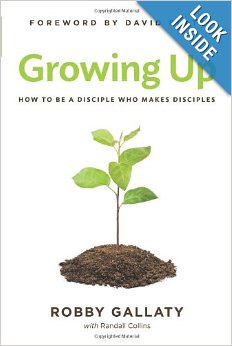
Book review on discipleship: “Growing Up”
 Copyright 2013 by Bob Rogers
Robby Gallaty’s life was radically changed from drug-dealer to the pastor of a growing church. He credits the transformation not only to his conversion experience, but also to the process of personal discipleship he enjoyed under David Platt and others. His book, Growing Up: How to Be a Disciple Who Makes Disciples, shares his passion for discipleship that he is living out as pastor of Brainerd Baptist Church in Chattanooga, Tennessee.
Gallaty gives a strong Biblical argument for the need for discipleship. The focal point of his book is the suggestion that instead of depending on Sunday School classes to do discipleship, churches should have small, closed discipleship groups with a leader and 3 or 4 other people of the same gender. He uses the name “D-group” for such discipleship groups. He prefers such small groups over discipleship by one-on-one mentors, saying one-on-one mentoring is harder to reproduce and may turn into a counseling relationship instead of a discipleship process. While he gives good reasons for the D-group, he seems to overstate the case that his is the best way. After all, Gallaty himself was mentored one-on-one by David Platt, while Jim Putnam’s book, Real-Life Discipleship, describes some effective discipleship with small groups that are larger than the size that Gallaty suggests.
Nevertheless, Growing Up is a useful resource for church leaders wishing to get serious about discipleship. The book is filled with practical advice about growing in one’s prayer life, Bible study, evangelism, and discipling others. Gallaty is fond of acronyms. The last six chapters of his book form the acronymn for the discipleship process: “CLOSER” which stands for Communicate, Learn, Obey, Store, Evangelize and Renew. He suggests the “HEAR” method of Bible study: Highlight, Explain, Apply and Respond. He says the D-group needs “FAT” belivers: Faithful, Available and Teachable.
While I would argue that D-groups are not the only way to do it, the fact remains that Gallaty is actually leading his church to do something, rather than just talk about it. I would highly recommend Growing Up as a resource that church leaders can use to implement true discipleship in their churches. It is “REAL” (Realistic, Easy to Read, Applicable, and Life-changing).
In the interest of full disclosure, let me state that I received a free copy of this book for review, but I was under no obligation to write a positive review.
If you see a video ad below this post, please understand that I have no control over the content in these ads, and I do not necessarily endorse the product.
Pilgrims and Pigs at Thanksgiving
 Cal & Rose Samra tell how Thanksgiving Day was approaching, and a family received a Thanksgiving card with a painting of a Pilgrim family on their way to church.
Grandma showed the card to her small grandchildren, saying, “The Pilgrim children like to go to church with their mothers and fathers.”
“Oh yeah?” her grandson shot back, “if they really like to go, then why is their dad carrying that rifle?”
Which raises a question this Thanksgiving: do you really like to worship God and give Him thanks?
John Walker from Post, Texas, tells about a Christian farmer who visited a city and went to eat at a fine restaurant. When he received his food, he bowed his head and quietly gave thanks to God. Some rowdy teenagers at the next table sneered and said, “Hey farmer, does everybody do that where you live?”
The old farmer looked at the young man and calmly said, “No, son, the pigs don’t.”
Don’t be a pig this Thanksgiving. Be willing to give thanks to your Creator for all His gifts to you. Do it gladly, without somebody having to hold a rifle to your head.
If you see a video ad below this post, please understand that I have no control over these ads, and that I do not necessarily endorse the product.
Is burial preferable to cremation?

Article copyright by Bob Rogers
With the increased popularity of cremation instead of burial, people often ask me if the Bible forbids cremation. The Bible does not prohibit cremation, but it does seem to show a preference for burial.
In defense of cremation, the apostle Paul speaks positively about death by fire in 1 Corinthians 13:3 with the phrase, “if I give my body to be burned…” While Paul was referring to martyrdom, not cremation, the apostle certainly did not think death by burning would prevent him from being in heaven. God can reassemble the molecules of your body at the resurrection, whether they are burned to ashes or decay to ashes.
I have done funerals for people who chose cremation. It certainly is a less expensive option.
Nevertheless, the Bible shows a preference for burial. In the Old Testament, passages such as Genesis 50 show great concern for the proper burial of the remains of Jacob and Joseph. In the New Testament, the Christian belief in resurrection is vividly shown as Lazarus and Jesus were buried and bodily raised from a grave. In Romans 6:4, baptism is depicted as a burial and resurrection: “We were therefore buried with Him through baptism…” Mark Coppenger says, “I would hate to think what sort of ceremony cremation would suggest.”
So while cremation is not prohibited and may be understandable for financial reasons, burial has a stronger basis in the Bible and is a clearer testimony to our faith.
If you see a video ad below this post, please understand that I have no control over these ads, and that I do not necessarily endorse the product.
The Voice translation and The Compass Study Bible
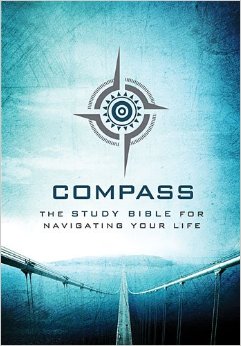
Compass: The Study Bible for Navigating Your Life, is a study Bible edition of The Voice translation, a new translation released in 2012.
I received an advance copy of The Compass Bible to review. It will not be released until February 2014, but The Voice translation itself is available in other editions now.
First, let me discuss the translation itself. Second, I will comment on the distinctions in this study edition.
The Voice translation takes a unique approach in Bible translation, which makes it difficult to classify this as a translation or a paraphrase. Perhaps it’s best to say that it is a translation that is amplified with paraphrase. That is, the text has a fairly accurate translation, but then it inserts additional words into the text in italics for clarity and explanation. For example, Romans 10:9 is translated and amplified like this: “So if you believe deep in your heart that God raised Jesus from the pit of death and if you voice your allegiance by confessing the truth that ‘Jesus is Lord,’ then you will be saved!” Here’s another example that includes even more amplification, Psalm 23:5: “You spread out a table before me, provisions in the midst of attack from my enemies; You care for all my needs, anointing my head with soothing, fragrant oil, filling my cup again and again with Your grace.” In both of these verses, the text without italics is an accurate translation, but the text added in italics amplifies and explains the meaning of the verse. The advantage of this over other paraphrases is that the reader knows which part is translation, and which part is commentary.
But there is more. On nearly every page, there is bracketed, bold text, giving background explanation of the history, culture and meaning of words and events in the passage.
As its name implies, The Voice is written to be heard. It appears in screenplay format, whenever there is dialogue, giving the name of the speaker in bold, followed by a colon. For instance, in Luke 1:60-61, the text is laid out like this:
Elizabeth (disagreeing): No, We will name him John.
Her Relatives (protesting): That name is found nowhere in your family.
The translation pays close attention to alliteration and other devices of sound, such as Genesis 1:16: “the Divine needled night with the stars.” Or another example, when the angels rejoice over Jesus’ birth in Luke 2:14: “To the highest heights of the universe, glory to God! And on earth, peace among all people who bring pleasure to God!”
All of these features make The Voice a Bible that is well-suited to be heard, whether read aloud or heard in the reader’s mind.
The Compass Bible is an edition of The Voice translation that adds some appropriate Bible-reading aids, primarily in the back, which include a 40-day reading retreat plan with suggestions for meditation and prayer, a 365-day reading plan through the whole Bible, an index of notes by topic, and maps. Other than a few Bible-reading aids, there is no difference between the text in the Compass Bible and other editions of The Voice translation, as they all include the topical notes in the text. The Compass Bible is printed on a less expensive paper, and retails for less than the regular edition.
Taken together, the Compass edition of The Voice translation should make the Bible come alive to people who are not familiar with the Bible, and it should bring new insights to those who are familiar with the Bible.
In the interest of full disclosure, let me state that I received a free copy of the Compass Bible for review, without any obligation to give a favorable review, and I did not receive any other compensation for writing this review.
If you see a video ad below this post, I do not necessarily endorse the product.
Blessing the food; ways to say “grace” before meals

Copyright by Bob Rogers
In the Lord’s Prayer, Jesus taught us to pray, “Give us this day our daily bread.” (Matthew 6:11)
Jesus also blessed the food and gave thanks for it when He fed the 5,000, and when He instituted the Lord’s Supper. Thus Christians all over the world make it their regular practice to pray a prayer of blessing and thanks before their meals. But scripture does not record the words Jesus prayed, which is probably a good thing, as it has allowed Christians to develop many different prayers. Here is a collection of prayers I have found from various sources. Of course, it is best to pray from the heart, and avoid getting in a rut. But perhaps by sharing these prayers, it will prompt you to pray some fresh thoughts as you thank God for His blessings each time you eat. Here are the prayers. Where I know the source, I list it in parentheses:
GENERIC PRAYERS
“Thank you, Lord, for the food we are about to receive, and for the nourishment to our bodies. For Christ’s sake, Amen.”
“Humble our hearts, Oh Lord, and make us thankful for these and all our blessings. In Christ name Amen.” (Shared by Brenda Holloway and Darren Thomas)
“Lord, bless this food to our nourishment, and us to Your service. In Jesus’ name, Amen.” (Traditional prayer I heard in my family.)
“Bless us, O Lord, and these Thy gifts which we are about to receive, through Thy bounty through Christ our Lord we pray. Amen.” (Traditional Roman Catholic prayer.)
“Christ God, bless the food and drink of Thy servants, for Thou art holy, always, now and ever, and to the ages. Amen.” (Traditional Eastern Orthodox prayer.)
CHILDREN’S PRAYERS
“God is great, God is good. Let us thank Him for our food. By His hands, we are fed. Give us, Lord, our daily bread. Amen.” (Traditional children’s rhyme.)
“ABCDEFG Thank you, God, for feeding me.”
To the tune of Superman Theme: “Thank you God for giving us food. Thank you God for giving us food. [Both hands pointed up.] For daily bread, that we are fed. [One hand moves to the hip on ‘daily bread’ and then alternate with other hand on ‘we are fed.’] Thank you God [hands up], for giving us food” [hands move to the hips and voice deepens.](Shared by Joseph & Beth Copeck)
“Thank You for the food we eat, yum yum! Thank You for the friends we meet, ho ho! Thank You for the birds that sing, a-ling a-ling! Thank You, Lord, for everything, Amen!” (Robin Anker Peterson of Perth, Scotland, sang this happily to his young children.)
To the tune of Frere Jacques (“Brother John”): “God our Father, God our Father, We thank you, We thank you, For our many blessings, For our many blessings, A-men, A-men.”
WITTY, PITHY PRAYERS
“Good food, good meat, good Lord, let’s eat. Amen.”
“Lord, bless this bunch as they munch their lunch.”
“Grace in the kitchen, Grace in the hall, please O God, don’t let them get it all.” (Shared by Buddy Wasson)
“Lazarus rose, Moses led, Noah built, Jesus fed. Amen.” (Debbie T. Alsup)
PRAYERS MENTIONING FAMILY AND FRIENDS
“Heavenly Father, bless this food, and bless our friends and family who’ve come to dine with us today. Amen.”
“God, we give you thanks for the delicious food on our table, for the loved ones gathered around, and for you, who make it all possible. We are humbly grateful. Amen.” (Norman Vincent Peale, A Prayer for Every Need)
“Dear Lord, we’ve gathered to share good times, good conversation, good friends, and good food, which we thank you for all. Amen.”
“Bless the food before us, the family beside us, and the love between us.” (Shared by Lynda Easterling Stinson)
PRAYERS REMEMBERING THOSE IN NEED
“Give us grateful hearts, O Father, for all thy mercies, and make us mindful of the needs of others; through Jesus Christ our Lord. Amen.” (1928 Book of Common Prayer)
“For food in a world where many are in hunger; For faith in a world where many walk in fear; For friends in a world where many walk alone; We give you thanks, O Lord. Amen.” (Huron Hunger Fund, Anglican Church of Canada)
“Oh Lord, make us grateful for this food that we are about to receive, as we remember those who do not have enough to eat. Amen.”
PRAYERS MENTIONING THOSE WHO PREPARED THE FOOD
“Thank you, Lord for this food, and bless the hands that prepared it. In Jesus’ Name, Amen.” (Traditional prayer I heard in my family.)
“God, many hands made this meal possible. Farmers grew it. Truckers drove it. Grocers sold it. We prepared it. Bless all those hands, and help us always remember our dependence on you. Amen.” (Norman Vincent Peale, A Prayer for Every Need)
“You are mighty Lord, and all providing. We thank you for this food we have been given for nourishment and delight. We ask a special blessing to those who prepared this meal with love and care tonight. Amen.”
PRAYERS IN OTHER LANGUAGES
Read more at http://www.beliefnet.com/Health/2002/07/Bless-This-Food.aspx#MqG6G842Slf51mw8.99
Read more at http://www.beliefnet.com/Health/2002/07/Bless-This-Food.aspx#MqG6G842Slf51mw8.99
“Some hae meat and cannae eat. Some nae meat but want it. We hae meat and we can eat and sae the Lord be thankit.” (Some have meat and cannot eat. Some no meat but want it. We have meat and we can eat and so the Lord be thanked.) (Scottish blessing.)
“Alles das wir haben (All that we have), Alles ist gegaben (All of it is a gift), Es kommt, O Gott, von dir (It comes, O God, from you), Wir danken dir dafuer. (We thank you for it.)” (German blessing.)
“Cristo, pan de vida (Christ, bread of life) Ven y bendice esta comida. Amen. (Come and bless this food.)” (Spanish blessing.)
My mom tells the story that when I was a little boy, a family member asked me to say the prayer at a large family gathering. I gave thanks for everything on the table and everything else in sight, and as my prayer went on and on, my mom tried to bring me to an end by interrupting with an “Amen.” I looked up and said, “But I’m not finished praying yet.” I suppose there are two lessons in that story. On the one hand, we need to keep our public prayers short and sweet. But on the other hand, we should never be finished praying from the heart. As scripture says, “Pray without ceasing” (1 Thessalonians 5:17, KJV).
CLICK BELOW TO READ SOME OF MY OTHER BLOG POSTS ON PRAYER:
In this weird political year, be a patriotic prayer warrior
How to pray for corrupt politicians
ABC’s of praying for missionaries
The Prayer Life of Jesus Christ, Part 1: Times and Places He Prayed
The Prayer Life of Jesus Christ, Part 2: Words that He Prayed
The Prayer Life of Jesus Christ, Part 3: Lessons Learned
NOTE: If you see a video ad below this post, please be aware that I have no control over which ads appear, and I do not necessarily endorse the product.
Warning signs of false religion
 Copyright 2013 by Bob Rogers
There are many religions; how can you tell which one is true and which is false? Some people say it doesn’t matter, because all religions have truth, but don’t tell that to the former followers of Jim Jones or David Koresh.
In 1978, Congressman Leo Ryan went to the South America to investigate a controversial cult based in San Francisco, named the People’s Temple, that had established a commune in Guyana. There were charges that Jim Jones, the founder of the People’s Temple, had defrauded members and was exerting total control over members by threats of violence. At the airport, Congressman Ryan and four others were shot to death, and then 913 members of the People=s Temple, including Jim Jones, committed mass suicide. (“Jones, Jim.” Encyclopedia Britannica 2005.)
In 1993, David Koresh, leader of a religious cult known as the Branch Davidians, stockpiled weapons with his 130 followers at a compound near Waco, Texas. Four federal agents were killed in a shootout with his followers, and for 51 days the government laid siege to the compound. Finally, they attacked the compound and 80 Branch Davidians, including David Koresh, died in a fire. (“Branch Davidians.” Encyclopedia Britannica 2005.)
Many other false religions are not as violent, but equally false. So how can a person tell which one is true and which is false? In the ancient Book of Deuteronomy, we find answers to this question.
I. Beware of False Words (Deuteronomy 18:14-22)
Deuteronomy gives us one of those tests in Deuteronomy 18:21-22.
Verses 21-22 specifically answer the question, “How can we know when a message has not been spoken by the Lord?” The answer is, “If what a prophet proclaims in the name of the Lord does not take place or come true, that is a message the Lord has not spoken.” So the first test of false religion is false words. If the religion makes false predictions, the religion is false.
I know of a false religious cult that has predicted the end of the world many times, evening naming the date. They failed this test.
Contrast them with Jesus, who is the true prophet. Deuteronomy 18:17-18 says the Lord will raise up a prophet.
In Luke 19:41-44, Jesus prophesied that Jerusalem would be destroyed, and in A.D. 70, it was destroyed exactly as He said. No wonder Acts 3:20-22 says the prophet Moses spoke of is Jesus!
Jesus Himself claimed to be the way, the truth, and the life. He speaks the truth; he IS the truth.
II. Beware of False Ways (Deuteronomy 18:9-13)
With the popularity of the Harry Potter novels, witchcraft has almost been sanitized today. And while I realize that the Harry Potter stories are just fantasy, we need to understand that real witchcraft is not taken lightly in the Bible. Beware against thinking that it is okay to delve into magic.
Back up a few verses in Deuteronomy and we find the second test of false religion. Deuteronomy 18:9 warns against the “detestable ways” of the nations in the land the Israelites are entering. Then it proceeds to describe every kind of witchcraft and occult practice you can imagine in verses 10-11.
It gives a specific list here of seven kinds of witchcraft:
1. Human sacrifice. Even today human sacrifice is sometime associated with the occult.
2. Divination and sorcery – using objects to foretell the future, such as psychics, tarot cards, and horoscopes.
3. Interprets omens – interpreting things like cloud or bird movements to reveal the future.
4. Witchcraft – rituals such as charms, spells, and potions
5. Cast spells
6. Medium and spiritist. (Leviticus 20:27 says a medium or spiritist must be put to death)
7. Consults spirits of the dead. Saul did this with the Witch of Endor (1 Samuel 28) and he was condemned.
Why is this so wrong? Isaiah 8:19 says that when people say let’s consult a spiritist or consult the death, shouldn’t a people consult their God? It is wrong because it is an attempt to get answers to life and foretell the future by consulting dead spirits and earth spirits, rather than depending upon the Holy Spirit of God who indwells the believer in Jesus Christ.
III. Beware of False Worship (Deuteronomy 13:1-5)
Remember that we saw in Deuteronomy 18 that false predictions were a warning sign of false religion? But in Deuteronomy 13, scripture informs us that some people might make true predictions and still be false prophets because of false worship. Listen to Deuteronomy 13:1-3: “If a prophet, or one who foretells by dreams, appears among you and announces to you a sign or wonder, and if the sign or wonder spokken of takes place, and the prophet says, ‘Let us follow other gods,’ (gods you have not known) ‘and let us worship them,’ you must not listen to the words of that prophet or dreamer. The LORD your God is testing you to find out whether you love him with all your heart and with all your soul.” So add to false words and false ways, a third test: false worship. Even if people in a religion do good deeds and say some good things, it is still false if their worship is false.
Many cult leaders started out well as members of Christian churches, but then they began to exert total control over their members, making themselves the “Messiah.” Many world religions teach good deeds, but they do not believe in the one true God of the Bible. They often worship other gods and have their own books that they claim are inspired by God.
Galatians 1:6-9 says that even if an angel should bring a different message, let him be accursed! 1 Corinthians 12:3 says that no one who is speaking by the spirit of God says, “Jesus be cursed,” and no one can say, “Jesus is Lord” except by the Holy Spirit. The ultimate test is, does this religion exalt Jesus Christ as Lord and Savior? If not, the religion practices false worship.
Jesus says, “I am the way, the truth and the life.” He IS truth. This is the true religion. Have you trusted in Christ, and Christ alone to save you?
NOTE: If a video ad appears below this post, I do not necessarily endorse the product.
Four great truths from the creation account in Genesis

Copyright 2013 by Bob Rogers.
Some people get so caught up debating how to fit different scientific views to the creation account in Genesis chapter one, that they miss the great theological truths in this chapter:
1) God created! Only God can create, and He does simply by speaking the Word, “Let there be…” and creation comes out of nothing (compare Hebrews 11:3).
2) God’s creation is good! Repeatedly, God saw what he created and “saw that it was good” (Genesis 1:4, 10, 12, 18, 21, 25, 31). When He created mankind, He said it was “very good.”
3) God’s creation is under His Lordship. God is the one in control. He speaks, and it comes to be. God alone is to be worshiped, not “Mother Earth” or the sun or moon, which is why God deliberately did not name the sun and moon (Genesis 1:16). Compare Romans 1:25.
4) God’s creation is under mankind’s trusteeship. Man was told to subdue and rule creation (Genesis 1:28), but also to “watch over it” (2:15). We have a responsibility to be good managers, for we don’t own it; God owns it all (compare Psalm 24:1).
NOTE: If a video ad appears below this post, I do not necessarily endorse the product.
Book review: “Deep Mentoring”
 Deep Mentoring: Guiding Others on Their Leadership Journey, by Randy D. Reese and Robert Loane is a guidebook for Christian leaders on why and how we should mentor future leaders. Deep Mentoring is a deep book. It is not an easy read, but it is well worth reading. The book is scholarly, yet practical; academic, yet full of pithy quotes and illustrations.
Reese and Sloane divide their work into three parts. Part One is entitled, “Noticing God’s Already-Present Action.” In this section, the authors show how we need to slow down enough to pay attention to people and their needs. Part Two is, “Learning from Those Who Have Come Before Us.” This section takes the reader through the stages of life. They give a powerful explanation of how important it is to know a person’s background to really understand him or her. Then they show how our roles change from young adults who are actors to middle adults who are actors who influence others, and how we should finish well as influencers. Part Three, “Guiding the Formation of Others,” shows the techniques that Jesus used to influence others, and then lays out a plan for the reader to do the same. Each chapter of the book includes specific exercises for the reader to apply to his or her mentoring relationship. Four appendices at the end of the book give practical tools that the reader can come back to and use again and again through the mentoring process.
I bought this book because I have a desire to lead my church in greater discipleship of believers through mentoring. After reading the book, I have an even greater desire for mentoring, and many new tools for the journey.
NOTE; If you see a video ad below this post, I do not necessarily endorse the product.
How do you pray when you are desperate for help?

Copyright 2013 by Bob Rogers
How do you pray when you are desperate for help?
Matthew 9:27 says, “As Jesus went on from there, two blind men followed Him, shouting, ‘Have mercy on us, Son of David!”
Notice three things about their prayer:
1) They refused to give up. They followed Him, shouting! Luke 18:1 reminds us to always pray and not give up.
2) They made a simple plea. They just said, “Have mercy on us.” Your prayer does not have to be complex or eloquent.
3) They recognized Jesus’ authority to heal. By calling Him “Son of David,” they were confessing that He was the Messiah, who was to be a descendant of David. In verse 28, when Jesus asked them if they believed He could heal them, they said, “Yes, Lord.” The miracle of healing the blind never happened in the Old Testament, but Isaiah 35:5 prophesied the blind would be healed by the Messiah. In our times of desperate need, do we believe Jesus has the ability to do in our lives what nobody ever did before?


 Bob Rogers