Blog Archives
Book review: “Redeemed by Fire: The Rise of Popular Christianity in China”
 Most Christians who are interested in missions are aware that Christianity has grown dramatically in modern China, despite persecution by the Communist government. But the story of how Christianity grew and what it looks like today in China remains a mystery to most Western Christians. Lian Xi, a native of China who is now professor of history at Hanover College, lifted that mystery for Western readers in 2010 with his carefully researched book published by Yale University Press, Redeemed by Fire: The Rise of Popular Christianity in Modern China.
Xi briefly surveys the presence of Christianity in China in ancient times, and then focuses most of the book on Christianity in China in the 19th and 20th centuries. China was forced to sign treaties with Western nations that included official toleration of Christianity after 1858. For the next century, over 23,000 missionaries poured into China from the West, half of them Americans. While this mission effort did contribute to over 623,000 members in mission churches by 1949, it also led to a deep resentment against Christians by most Chinese, who saw it as a religion of foreigners that was forced upon them. This resentment erupted into violence at times, such as the Boxer Rebellion. Xi stresses that Protestant Christianity was able to become truly indigenous under Communist rule, and no longer was seen as a foreign religion. The Communist government unwittingly allowed this to happen, by settting up the officially recognized and state-controlled Three-Self Church. Most Christians rejected the Three-Self Church as guilty of ungodly compromise with the state, and turned instead to a variety of underground church movements.
Xi then follows the stories of several influential indigenous movements among Protestant Christians, including the True Jesus Church, the Bethel Band, the Jesus Family, and the Little Flock, with charismatic leaders like John Sung, Wang Mingdao, and Watchman Nee. Most of these churches held to a fundamentalist faith, a charismatic leader, pre-millennial hope, and a revivalistic, if not Pentecostal, fervor. Some half million Christians died under Communist persecution, but by 2000 there were 15 million Protestants and 5 million Catholics in the official registered churches, and an additional 30 million Protestants and several million Catholics in underground churches.
Westerners tend to idealize the faith of Chinese Christians, but Xi points out that the lack of theological training and isolation from any accountability in underground churches occasionally led to doctrinal heresies and mixtures of Chinese folk religion with Christianity, as well as opening the door to leaders who were dictatorial and sometimes immoral. Despite these shortcomings among the underground churches, Xi credits them with having a powerful appeal by offering hope to the powerless under Communist oppression. Despite the phenomenal growth of Christianity in China, it is still a minority faith in China, and expected to remain a religion of the common people, not a majority faith or a faith of those in influence or power in China.
I found Xi’s research to be thorough and highly informative, but it came across as somewhat aloof and skeptical of genuine faith. He tends to explain away the faith of Chinese Christians in terms of sociological factors. He includes stories of the moral failings of Chinese Christian leaders, but he reports very few of the stories of commitment, martyrdom and persecution suffered by Chinese Christians. Nevertheless, Xi’s research is likely to become a standard resource for any historian or missiologist wishing to understand Christianity in modern China.
X
X
X
(If you see a video ad below this post, please understand that I have no control over these ads, and that I do not necessarily endorse the product.)
Movie review: “God’s Not Dead”
 A lot of Christian films have poor acting and predictable scripts, so I was quite surprised at how good this movie was. Of course, it was predictable in defending the belief in God, but it presented that message in a way that was creative and hip. The film introduced a variety of characters but did not show how they all connect until later in the film, giving the subplots an unpredictability, even as the main plot was fairly much what the viewer expected. It targeted a young audience, as the protagonist and most of the primary actors were young adults who constantly used smart phones, computers, and visual media to communicate, and it all came to a conclusion during a Christian rock concert.
The acting was outstanding, both by the lead characters and the supporting roles. It was some of the best acting that I’ve seen in a Christian film. The dramatic tension made a very intellectual argument interesting, bringing it to a climax that was so strong that the theater audience where I was broke out into loud applause. Atheists will hate this film, but they cannot dismiss it as simple-minded or shallow. But what might infuriate atheists the most was that the movie showed that it is not only reasonable to be a believer, but it can even be cool to be a believer.
x
x
x
(If you see a video ad below this post, please understand that I have no control over these ads, and that I do not necessarily endorse the product.)
Finding Christ in the Christmas tree

Article copyright by Bob Rogers
All over the world, people are putting up Christmas trees this time of the year.
In southern California in 2013, a 90-foot Christmas tree was erected at the Fashion Island shopping center in Newport Beach, covered with strobe lights and Disney-themed music for the thousands of shoppers. (Emily Foxhall, “90-foot Christmas tree arrives at Newport Beach’s Fashion Island,” Los Angeles Times, November 8, 2013.)
All over the world, people are putting up Christmas trees for the holiday. But what does this have to do with the birth of Jesus? Is it just a pagan practice, or can we find Christ in the Christmas tree?
I. The origins of the Christmas tree
Where did the tradition of the Christmas tree come from?
There are many different stories, since ancient peoples have made use of trees and even worshipped them. One of my favorite stories is of St. Boniface, the missionary to the Germans in the 8th century. Boniface told them about Jesus Christ, but they worshipped a great oak tree. So Boniface boldly went to the oak with an axe and began to chop it down. They were ready to kill him, when a great wind came and blew the tree down. After that, the Germans converted to Christianity in large numbers.
Some legends tell that St. Boniface later decorated a fir tree to represent Jesus instead of their pagan gods. It is uncertain whether this is true.
During the Middle Ages, there was a popular medieval play in western Germany about Adam and Eve and a “paradise tree,” which was a fir tree hung with apples, that represented the Garden of Eden. Germans set up paradise trees in their homes on December 24, the feast day of Adam and Eve. They hung wafers on it, representing the bread of Christ in the Lord’s Supper, and then later they hang cookies, and often put candles, symbols of Christ as the light. (“Christmas tree.” Encyclopaedia Britannica. Encyclopeaedia Britannica Ultimate Reference Suite. Chicago: Encylopaedia Britannica, 2012.)
Meanwhile, in the 15th and 16th century in Latvia, Estonia and northern Germany, there was a tradition of bringing an evergreen tree to the town square on Chritmas Eve, dancing around it, and letting it burn. Eventually people in Germany began to light a tree on Christmas Eve with candles. Lutheran tradition says that the Protestant reformer Martin Luther helped popularize the lighting of an evergreen tree at Christmas all over Germany.
II. Modern Christmas tree traditions
German settlers brought the Christmas tree to North America as early as the 17th century.
Prince Albert of Germany, the husband of Queen Victoria of England, introduced the Christmas tree into England in the early 19th century. By the 19th century, Christmas trees were popular all over the world. In Victorian England, trees were decorated with toys and small gifts, candles and candy. Blown-glass ornaments became popular in the 1870s. By 1890, strings of electric tree lights became popular to hang on trees. In the 1960s, artificial Christmas trees made out of aluminum became popular, but these were soon replaced by artificial trees that look realistic.
Many families still enjoy going together to get their own real Christmas tree. John and Pam Carper’s family have a tradition for the past five or six years, of traveling to a North Carolina Christmas tree farm, to cut a Fraser fir to bring back to Georgia for Christmas. James & Kerri Gilyard also have a tradition of getting a real tree, which they do right after Thanksgiving. Their tradition is to put on the lights first, then the ornaments, with the memorable and breakable ones up higher. Last of all, they put an angel on top.
Many families will choose a special ornament for each member of the family. We have an ornament for each child on the year that they were born. Kevin & Sharon Kendall choose a special ornament each year for each child in the family. They enjoy looking at the ornaments to see what dates they got each ornament.
That brings us back to our question. As nice as these traditions are, what if anything does a Christmas tree have to do with the birth of Jesus? Let’s open our Bibles and see.
III. God’s Christmas tree
- Israel was symbolized by a tree (Isaiah 5; Ezekiel 17; Daniel 4:10-12)
In ancient Israel, a tree symbolized God’s people Israel. Isaiah 5 gives a parable of a vineyard that was planted but failed to produce good fruit, and so it is torn down. Isaiah says, “For the vineyard of the Lord of Hosts is the house of Israel, and the men of Judah, the plant He delighted in.” (Isaiah 5:7, HCSB).
Ezekiel 17 gives another parable comparing Israel to a tree, saying God will plant a sprig on a mountain. “I will plant it on Israel’s high mountain so that it may bear branches, produce fruit, and become a majestic cedar… Then all the trees of the field will know that I am Yahweh.”
Thus Psalm 1:3 speaks of the righteous man as like a tree planted by water, and in Matthew 3:10, John the Baptists says every tree that doesn’t produce is cut down.
Daniel 4 tells how God used a vision of a tree to warn King Nebuchadnezzar of Babylon to beware of his pride. He told about a tree that reached to the sky, but it was cut down, and Daniel said, “That tree is you, the king.” (Daniel 4:22).
So a tree often symbolized Israel, although it could also symbolize the life of others.
- Christ is symbolized by a tree of life (Isaiah 11:1-10) and a tree of death (1 Peter 2:24)
So if we stay with the symbolism of life in a tree, notice what we read in the prophecy of Isaiah 11: “Then a shoot will grow from the stump of Jesse, and a branch from his roots will bear fruit… On that day the root of Jesse will stand as a banner for the peoples. The nations will seek Him, and His resting place will be glorious.” (Isaiah 11:1, 10, HCSB).
Jesse was the name of the father of King David, so this passage is referring to the Messiah who would be a descendant of David. Notice the description of the Messiah in verses 2 and following:
“The Spirit of the Lord will rest on Him—
A Spirit of wisdom and understanding,
A Spirit of counsel and strength,
A Spirit of knowledge and the fear of the Lord…”
From the beginning to the end of the Bible, we read of a tree of life. In the Garden of Eden, Genesis 2:9 speaks of a tree of life, and in Revelation 22:2 we read that in heaven, “The tree of life was on both sides of the river, bearing 12 kinds of fruit, producing its fruit every month. The leaves of the tree are for the healing of the nations…”
Jesus is symbolized by this tree of life, for Christ gives us life. And how? Because he is also represented by a tree of death by his death on the cross!
Crucifixion was so horrible it was illegal to crucify a Roman citizen, and Jews saw it as a curse. Deuteronomy 21:23 says that anybody executed on a tree is cursed, and Galatians 3:13 repeats this. So when Jesus was nailed to the cross, which of course was made from a tree, the Jews thought He was cursed.
Yet look what we read in 1 Peter 2:24: “He Himself bore our sins in His body on the tree, so that, having died to sins, we might live for righteousness, for you have been healed by His wounds.”
Thus the tree of life became the tree of death so that by faith in Christ, we could enjoy life.
The best Christmas gift was not under a tree, but hung upon a tree, the tree of Calvary.
In 1957, Frances Kipps Spencer at Ascension Lutheran Church in Danville, Virginia, came up with the idea of the Chrismon tree. She wanted a way to display a Christmas tree in her church that had Christian symbols, instead of gaudy, bright lights. So she covered the tree with monogrammed letters, and other Christian symbols, such as the cross, fish, crown, etc. Today, many churches display a “Chrismon tree,” which is a Christmas tree that only has Christian symbols on it.
Why don’t we have our own traditions to see and show Christ in the Christmas tree? Put an angel or a star on the top. Display a manger scene under the tree. Put a nail on a ribbon, and hang it on the tree to remember the tree upon which Jesus was nailed. Make a Chrismon tree full of Christian symbols. When your family, friends and neighbors see your tree, you can share the meaning of the symbols.
But there is something even more important than what we do with our Christmas trees. That is what we do with our lives. Let us show Christ in a Christmas tree traditions, but even more, let us show Christ in the way we carry the cross of Christ in our daily lives.
If you see a video ad below this post, please understand that I have no control over these ads, and that I do not necessarily endorse the product.
Book Review: “I Am a Church Member”
 If you are looking for a resource for your church’s new member class, this is a book you will want to read.
Thom Rainer, CEO of LifeWay Christian Resources, has written I Am a Church Member: Discovering the Attitude that Makes the Difference. It is a short book that can easily be read in one sitting, but it has the potential of making a big impact in local churches.
The book opens with a story about two members of the same church with completely opposite attitudes about church. Then he zooms in on the Biblical attitude members should have in six short chapters, based on Rainer’s extensive research in attitudes among church members. These chapters teach members to be active, bring unity, avoid the tendency to insist on personal preferences, pray for leaders, lead their own families to be involved, and to treasure church membership as a gift. The main point of the book is that church membership is not like a country-club membership with perks and privileges.
There are some churches that reject the term “membership,” saying it is an unbiblical modern term. Rainer disagrees, pointing out that 1 Corinthians 12:27-28 speaks of the “individual members” of the church. Rather than reject the term, Rainer seeks to give a Biblical definition of the term “membership.” He emphasizes that Biblical church membership is a treasured gift, just as our salvation is a gift, and thus we should serve in our churches gladly, not begrudgingly.
One of the strengths of this little book is that each chapter includes a pledge of loyalty for members to make. This requires the reader to respond to the challenge of the book. Each chapter also includes discussion questions, making this book an outstanding resource for small group or one-on-one study for church members, both new and old.
Book review: “Multiply” by Francis Chan
 Francis Chan, author of the influential books Crazy Love and Erasing Hell, has written Multiply: Disciples Making Disciples for the purpose of multiplying disciples in the church.
The book has some excellent material; however, I was disappointed in the book, because it was not what I expected. I downloaded the book and read it on my Kindle, deceived by the title into thinking it was about how to make disciples. While the introduction and first three chapters (about 40 pages) discuss how to use the book for discipleship, that’s about it. The rest of the book is an overview of the teachings of the Bible.
Don’t misunderstand me. The overview of the Bible is excellent. It’s well-written, and has good support material with questions for discussion and videos available to watch online. If you are a mature Christian, you will find very little new information here, but it is a good, solid summary of what the Bible teaches. If a person goes through this material with a new believer, that person will be very well-founded in a biblical worldview.
The bottom line: if you are looking for material for an in-depth teaching of the basics of Christianity for a small group or one-on-one, this is a great book. But if you are looking for a book on how to organize your church for the purpose of multiplying disciples, you will probably find more help elsewhere, such as Real-Life Discipleship by Jim Putman.
Recommended reading on The Lord’s Prayer
There are many wonderful books that have been written on the Lord’s Prayer, but there are two in particular that I have found inspiring.

Max Lucado’s book, The Great House of God: A Home for Your Heart, uses the creative analogy of a big mansion to compare to the Lord’s Prayer. He takes each part of the prayer and compares it to part of the great house. For example, the study is where we learn “thy will be done,” and the kitchen is where we pray “give us this day our daily bread.” Lucado draws a visual image of the prayer that helps the reader see it in fresh ways.

Albert Haase’s book, Living the Lord’s Prayer: The Way of the Disciple, is my favorite book on the Lord’s Prayer. He challenges the reader to live the prayer, not just say the prayer. He takes each part of the prayer and challenges us to put the principles into practice. He uses personal and deeply moving illustrations that encourages the reader to be different because of this prayer.
The Prayer Life of Jesus Christ, Part 3

Copyright 2013 by Bob Rogers
This is the third and final post in my series on the prayer life of Jesus. In the past two days we have taken a survey of the times and places Jesus prayed, and the actual words recorded in His prayers. Based on that, here are four lessons I have learned from Jesus’ prayer life:
1. The priority of prayer. He made prayer a high priority. Mark 1:35; Luke 5:16; 6:12-13; 11:1. If prayer was so important for Jesus, how much more necessary is it for us?
2. The privacy of prayer. He constantly prayed in private. Matthew 14:22-23; Mark 1:35; Luke 5:16; 9:18. Oh, how we need to get alone with God like Jesus did.
3. The pinnacle prayer principle. He loved to pray on mountains: Matthew 14:23; Mark 6:46; Luke 6:12; 9:28. However, the fact that He often withdrew to “deserted places” (Luke 5:16) shows that the important thing was to be alone in God’s creation. Your place in nature may be a lake, a small garden, or front porch, or backyard swing. Even if you live in a crowded city, you can find a balcony or quiet room to focus your thoughts on God. The point is that Jesus knew that He had to be in a place where His total attention was upon the Father.
4. The people prayer principle. The more people, the shorter the prayer, the fewer people, the longer the prayer. His public prayers were short. Luke 10:21; John 11:41-42; Matthew 27:46. He condemned long prayers for show in Mark 12:40. His longest recorded prayer, John 17, was with a small group, while His longest prayer of all was totally alone (Luke 6:12). Too often we reverse this and pray too long in public and don’t pray enough in private.
What lessons have you learned from Jesus’ prayers?
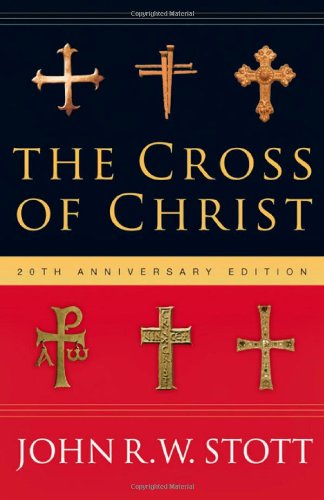
Book review: The Cross of Christ by John R. W. Stott
Copyright 2013 by Bob Rogers
John R. W. Stott, who was pastor of All Soul’s Anglican Church in London before passing away in 2011, was one of the most respected evangelical writers in Great Britain. I thoroughly enjoyed his classic book, The Cross of Christ (InterVarsity Press, 1986, 2006). I found it to be the best book I have ever read about the Cross. I’m not surprised that it received the 1988 Evangelical Christian Publishers Association Gold Medallion Award.
Stott wrote as an evangelical pastor and scholar. While he thought deeply, he wrote with clarity and frequent illustrations. In fact, I used his book as the basis for a series of sermons on the cross.
Stott’s book begins by making a passionate argument for the centrality of the cross to the Christian gospel. Then he explores the reasons for the crucifixion, and while describing many “images” of atonement, he zeros in on Christ as a substitutionary sacrifice to satisfy both the holiness and love of God. His discussion in chapter seven of propitiation, redemption, justification and reconciliation is perhaps the best chapter of the book. The book concludes with chapters on what it means to live as followers of the One who died on the cross, with excellent explanations of service, overcoming evil, and understanding suffering.
Stott has read widely on the subject and he graciously comments on opposing views from liberal scholars and Roman Catholic scholars. He takes other views seriously, but he is faithful to an orthodox evangelical interpretation of scripture. I found it interesting that he disagrees with the popular view of Jesus’ death as a “ransom” paid to the devil in a strictly literal sense. His discussion on the distinctions between Protestant and Roman Catholic views of justification is particularly insightful. Stott rejects the doctrine that God does not suffer, maintaining in chapter 13 that it is precisely because God did suffer on the cross that we are able to bear our suffering.
Many parts of the book read as if they were sermons. This is not surprising, since Stott was a pastor. Yet it comes together as a systematic theology of the cross. His conclusion makes an excellent sermon on how central the cross is to Paul’s Letter to the Galatians.
This is a book that I will read again and again in the years to come.
Guest blog: Thoughts on President Obama’s re-election
 (In the guest blog below, Bobby Braswell reminds Christians of some important truths we need to hear, regarding the re-election of President Obama. Rev. Braswell is the associational missionary of Middle Baptist Association in Sylvania, Georgia, where he ministers to pastors and churches in Screven County, Jenkins County and northern Effingham County. Bobby his wife Frankie (pictured with him here) live in Guyton, Georgia. They have two children: Emma, 22, and J.B., 20. You can read his blog at www.brotherbobbysblog.blogspot.com.)
Watching the returns and waiting to see who will become the next president is about as compelling as TV viewing gets. It’s no secret that millions of Christians went to bed with sour stomachs last night. Many, though I am sure not all, who would identify themselves as social conservatives and followers of Jesus were outspoken in our hopes that the incumbent president would have a new career beginning in January. Since that didn’t happen, what are some appropriate responses to a second term for Barrack Obama?
Pray for the president – 1 Timothy 2:1-2 (NKJV) 1 Therefore I exhort first of all that supplications, prayers, intercessions, and giving of thanks be made for all men, 2 for kings and all who are in authority, that we may lead a quiet and peaceable life in all godliness and reverence.
Preach the Gospel – A concern I have had for some time is that a lot of Christians behave as though getting the “right person” elected is THE ANSWER for America. Hello! It’s not! It never was! God changes people from the inside out. He changes the heart. I am not aware of anything that the government can do that can bring spiritual regeneration to people. Only the Gospel of Jesus Christ can do that (Titus 3:5). People who have experienced the grace of God through Jesus Christ can be a powerful force for transforming North American culture by radical obediennce to the Great Commission (Matthew 28:18-20). That is really the only way that God has ordained to change societies. I want upright legislators and leaders, but if the Gospel is not the focal point of the energy of Christians we will share the largest part of the blame for the disintegration of North American culture (Matthew 5:13-16).
See People through God’s Eyes – I think a less angry, less shrill, less paranoid perspective of our fellow human being would be extraordinarily helpful. It is easy to have a hateful attitude toward people who don’t share our worldview and our faith, but where in Scripture are we given permission to think and act that way? And what is the good in that? The truth about me is that I was a wreck of a person before God’s grace found me, and I still struggle and fail and have absolutely no right to look at anyone else’s failures as being more scandalous or wretched than mine. We are all in the same messed up situation–that is not to minimize sin, or to deny it’s severity–just to say that I don’t belong to God by my right but by His mercy!
Share hope – I woke up today, November 7, 2012 with hope, because God is Great and greatly to be praised (Psalm 48:1)! I woke up determined to have my life count for a great purpose because God is a great God! I woke up today convinced that America’s greatness has more to do with the faithfulness of me and all the other Christians I know and churches they are part of and our obedience to God and commitment to the truth of Gospel than what transpired in the presidential election.
Two interesting maps of the USA
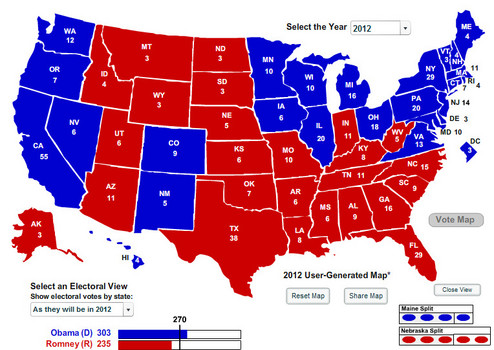 Here are two maps of the USA. The first compares the states that voted for Obama (blue) and Romney (red) in the 2012 presidential election. The second shows states that are very religious (dark green), average (green) and below average in religiosity (light green).

It is interesting that 100% of the “above average” religious states went for Romney, and 14 out of 16 “below average” religious states went for Obama. Exit polls show that people who go to church regularly supported Romney by large margins, and people who never go to church supported Obama by large margins.
Religion was not the only factor in the election, as there were many “average” religious states that went for Romney and two “below average” states (Wyoming and Alaska) that went for Romney. This is because there are two kinds of conservatives: social conservatives and fiscal conservatives. Wyoming and Alaska are definitely independent-minded, fiscally conservative states. But the map does indicate that despite all the focus on the economy in this election, the differences between the candidates on the social issues that religious people care about, especially abortion and traditional marriage, made a huge difference in how people voted.
Be a Christian “muslim”
Copyright 2012 by Bob Rogers
 Often on our television screens when we see pictures of Muslims bowing in submission to Allah. In fact, whenever a Muslim comes into a mosque, he bows with his forehead to the floor to represent his total submission to his God.
There is good reason for this. The Arabic word islam means “submission,” and the word muslim means “one who submits.” I am aware that President Bush and others said that islam means “peace,” but they were incorrect. Look it up in any reference work, and you will see that the word salam means peace, but islam means “submission,” and muslim means “one who submits.”
Now here is my point. We who are followers of Jesus Christ do not think of ourselves as Muslims at all. We do not worship the same God. We believe that Jesus Christ is God in the flesh, and they do not.
But Muslims can remind us of at least one thing in our own faith that too many of us have forgotten. The New Testament book of James calls upon believers to come before God in humility, and he says this in James 4:7-8a: “Therefore, submit to God. But resist the Devil, and he will flee from you. Draw near to God, and He will draw near to you.”
Muslims call themselves by that name because they submit to Allah. Unfortunately, many followers of Christ have neglected the command of scripture for us to submit to the God and Father of our Lord Jesus Christ. In a sense, you could say that we need to be “Christian muslims;” that is, believers in Jesus who are willing to do more than just say that they believe in Jesus—they are willing to surrender their lives completely to Jesus.
James explains submission in three basic ways: 1) standing up to the adversary (v. 7 “resist the Devil”), 2) cleaning up our actions (v. 8 “cleanse your hands, and purify your hearts”), and 3) straightening up our attitudes (v. 9 “your laughter must change to mourning”– apparently a reference to laughing at sin).
Pastor Nadarkhani is an inspiring example of a Christian “muslim.” This Christian pastor in Iran was arrested and spent three years in jail for his Christian faith, on trumped-up charges of blasphemy against Islam. Despite threats of execution, he refused to recant his faith in Jesus Christ, and after three years, he was released from prison, thanks to the fervent prayers of millions of Christians and international pressure on Iran.
Few Christians will be asked to submit to Christ in such a dramatic way, but most of us must make hard choices to do what is right, not what is convenient.
It’s hard to be a Christian muslim and totally surrender to God. It’s hard to stand up to the adversary, clean up our actions, and straighten up our attitudes.
Yet God gives us a great promise if we do. Read it in James 4:10: “Humble yourselves before the Lord, and He will exalt you.”
After all, God is not asking us to do anything that He hasn’t already done in His Son Jesus Christ. As Philippians 2:8-10 says, “He humbled Himself by becoming obedient to the point of death—even to death on a cross. For this reason God highly exalted Him and gave Him the name that is above every name, so that at the name of Jesus every knee will bow.”
Timothy Keller says, “If you go to Jesus, he may ask of you far more than you originally planned to give, but he can give to you infinitely more than you dared ask or think.” (Timothy Keller, King’s Cross, p. 63.)
That is the paradox of submission. The paradox is that if we will bow before God, we can stand up to anything and anybody else. When we submit to God, the Devil can’t beat us and the world can’t defeat us. So how about it, believer? Will you surrender your life totally to God’s will?
Does Democracy Depend on Biblical Values?
 (Copyright 2012 by Bob Rogers)
Can democracy flourish just as well in any society, no matter what the religious and cultural values, or does democracy depend on Biblical values to flourish and prosper?
Daniel Webster said, “Whatever makes men good Christians, makes them good citizens.”
Psalm 33:12 (HCSB) says, “Happy is the nation whose God is Yahweh—the people He has chosen to be His own possession!”
We sing “God Bless America,” but then we tell people to choose your god: Buddha, Allah, Ahura Mazda, Krishna, Yahweh, take your pick.
That simply will not work! Look at the verse again. Notice that it says in the Holman Christian Standard Bible (HCSB), “Happy is the nation whose God is Yahweh.” Most Bible translations say “the LORD.” Whenever you see “LORD” in all capital letters, it means that the Hebrew word used is the actual name of God given to Moses at the burning bush: “I am,” which in Hebrew is Yahweh.
A nation whose God is not Yahweh, a nation that rejects the God of the Bible and Biblical values, rarely has a stable democracy. There are a few exceptions, such as Turkey, India, Japan, and Indonesia. But all over the world, we have seen that nation after nation that has put the Lord out of government is having a hard time putting democracy in. All across Asia, the Middle East, and northern Africa, which have been dominated by communism and non-Christian world religions, we see most governments are dominated by dictators instead of democracy. In Iraq and Afghanistan, sectarian conflict is threatening democracy. In the Middle East, the “Arab Spring” of new democracies appears to be turning into a “Muslim Winter.”
Just as a life without Jesus will always fail, a government without Yahweh is often frail. But a nation that has the God of the Bible as its foundation has put into place the value system needed to support a successful democracy.
The Declaration of Independence contains four references to God: as Lawmaker (“the laws of nature and nature’s God”); as Creator (“endowed by their Creator with certain unalienable rights”); as Supreme Judge (“the Supreme Judge of the world for our intentions”); and as Protector (“the protection of Divine Providence”).
In 1787, the Constitutional Congress was arguing over the writing of the Constitution of the United States, and they were getting nowhere. Finally, Ben Franklin rose and said,
“In the beginning of the contest with Great Britain, when we were sensible of danger, we had daily prayers in this room for divine protection. Our prayers were heard, and they were graciously answered . . . Have we now forgotten this powerful friend? Or do we no longer need his assistance?
I have lived a long time, and the longer I live, the more convincing proofs I see of this truth: that God governs the affairs of man. And if a sparrow cannot fall to the ground without his notice, is it probable that an empire can rise without his aid?”
When George Washington took the oath of office as our first president in 1789, he asked that the Bible be opened, and he placed his hand on it to took the oath. Then he added to the oath the words, “So help me God,” and bent forward and kissed the Bible before him.
John Adams, our second president, said, “Our Constitution was made for a moral and religious people. It is wholly inadequate to the government of any other.”
Thomas Jefferson, our third president, said, “God who gave us life gave us liberty. Can the liberties of a nation be secure when we have removed a conviction that these liberties are the gift of God?” These words are engraved in the Jefferson Memorial in Washington, D.C.
History has shown that democracies have done well in nations founded on Biblical values. Democracy flourishes in Europe, which has a Christian heritage, in Israel, where the values of the Old Testament are the basis of their government, and in North America, most of Latin America, Australia, and most of central and southern Africa that are dominated by Christianity. In South Africa, where the white minority gave up rule to the black majority, Bishop Desmond Tutu led them through a peaceful transition of power. Miraculously, bloodshed was avoided, unlike the conflict we see today in Iraq, a struggling democracy that does not have worship of the God of the Bible as its foundation. The key was that as Christians, South Africans were able to forgive.
Why is it that democracies tend to flourish where the culture is dominated by Biblical values?
Philippians 3:20 says that “our citizenship is in heaven.” Yet it is interesting that citizens of the heavenly kingdom make better citizens of earthly kingdoms.
Christians know they have a responsibility to contribute to their government. Jesus said, “Therefore give back to Caesar the things that are Caesar’s, and to God the things that are God’s.” (Matthew 22:21).
“And for this reason you pay taxes, since the authorities are God’s public servants… Pay your obligations to everyone: taxes to those you owe taxes, tolls to those you owe tolls, respect to those you owe respect, and honor to those you owe honor.” (Romans 13:6-7)
Christians know that they have a responsibility to make a positive difference in their world.
Jesus said, “You are the salt of the earth… You are the light of the world… In the same way, let your light shine before men, so that they may see your good works and give glory to your Father in heaven.” (Matthew 5:13-16)
Christians know that they are to pray for their nation’s leaders. Paul says 1 Timothy 2:1-2 to pray for kings and all those in authority, and in Paul’s day, a pagan Roman was the emperor.
But because our highest citizenship is in heaven and not on earth, Christians also know that times may come when they have to stand up to godless and corrupt earthly rulers for the greater good of the nation.
Moses stood before Pharaoh, king of Egypt, and demanded that Pharaoh give up his Hebrew slaves.
The prophet Nathan confronted King David to his face when he murdered Uriah and committed adultery with Bathsheba.
The prophet Elijah confronted King Ahab and condemned Queen Jezebel for worshipping false gods.
John the Baptist told the ruler, Herod Antipas, that he was wrong to divorce his wife, and for his boldness, John the Baptist lost his head.
It may not always be easy, but it is always best for a democracy if that nation is founded on faith in Yahweh, the God of the Bible, the Father of our Lord Jesus Christ. If we wander away from that faith, we put in peril our earthly livelihood and our eternal home.
As John F. Kennedy said, “This country cannot afford to be materially rich and spiritually poor.”
No wonder Daniel Webster said, “Whatever makes good Christians makes them good citizens.”
As Psalm 33:12 says, “Happy is the nation whose God is Yahweh.”
Should Christians celebrate the death of Osama bin Laden?
 On this one-year anniversary of the death of Osama bin Laden, what is the appropriate reaction for Christians? Is it wrong for us to celebrate a man’s death, even an evil man?
It is a difficult issue, because as Christians it is not ours to avenge, but to leave it to the Lord. However, most Christians agree that there is such a thing as a “just” war when a greater evil is prevented. A good example is World War II and the ultimate death of Adolf Hitler.
There was a great German pastor in World War II named Dietrich Bonhoeffer who opposed Hitler. Bonhoeffer even participated in a plot to assassinate Hitler, and he was a Christian pastor! Why would he do that? Because Bonhoeffer knew that it would stop a greater evil.In the Old Testament, Moses was sent to Pharaoh and told to demand justice for the Hebrew slaves. God even sent a “death angel” as a final plague upon the Egyptians to set the people free. When the Hebrews fled across the Red Sea and Pharaoh chased them, God allowed the Egyptians to drown in the sea, and Exodus 15 records the song of rejoicing that Moses sang at their defeat. That is why Proverbs 11:10 says that when the wicked perish, there are shouts of joy.
How do we reconcile this with Jesus’ words in the Sermon on the Mount about turning the other cheek and loving our enemies? I think we need to make a distinction between personal offenses and social justice. While it is a virtue to overlook a personal insult, it is not a virtue to overlook a tyrant who is oppressing a people. The former act would be consider an act of grace; the latter would be considered a gross negligence of justice.
I cannot judge the hearts of those who shouted and jumped for joy at the news of Osama bin Laden’s death. I’m sure for many, it was a hateful rejoicing at a man’s death. However, for others, it may have been more of a celebration of justice being done, as we find in some of the psalms, such as Psalm 69:19-25. This psalm is quoted by Paul in Romans 11:9-11, and is applied to the death of Judas Iscariot by the early church in Acts 1:20. You will notice in Psalm 69 that the psalmist does not ask for an opportunity to personally harm his enemy, but he asks God to bring about justice, which is actually the same thing we read in Romans 12:19, where we are told to “leave room for God’s wrath.” Thus as a Christian, I do not rejoice that a man is dead, but I do rejoice that God executed His justice to end an evil terrorist who will never be able to blow up another building or murder any more defenseless people.
Tattoo or not tattoo?
 With permission to share, below is a question about tattoos from some college students, followed by my reply.
Hey Brother Bob! I wanted to get your opinion. We were discussing whether or not it is a sin to get a tattoo. One of the verses brought up was about keeping your body holy and the thought process was that any permanent markings (piercing of any kind, tattoos, etc) was making the temple unholy. Another thought process put on the table was that tattoos were ok except memorial tattoos because that is specifically what Leviticus said the pagans did to mourn their dead and we shouldn’t do that. Another thought was even Christian tattoos (i.e. crosses, Jesus fishes, etc) weren’t cool because its too much like trying to be like the world. The other thought was that as long as it was easily coverable (so as not to offend and turn off the lost), you didn’t do it because everyone else was or it became an obsession and it was something you really thought about and talked to God about, it was ok. Lastly, the thought that it was just like picking out clothes, not that big of a deal and no need to even consult Scripture… I just wanted to ask you how Scripture spoke to this issue…
My reply:
On the subject of tattoos, I would basically agree with the second view, that “memorial tattoos” violate Leviticus 19:28: “‘Do not cut your bodies for the dead or put tattoo marks on yourselves. I am the LORD.”
We have to be careful about projecting our cultural viewpoint on this issue, and make sure that we are following scripture, not tradition. The views that permanent markings make the temple of your body unholy, or that it is too much like trying to be like the world, are viewpoints that make an assumption that all tattoos are unholy and worldly. What evidence is there that all tattoos are unholy and worldly, other than tradition and personal preference? Similarly, some would point to Leviticus 19:28 and say the Bible says not to put tattoo marks on yourselves, but if you read the context, it is referring to tattoo markings as a memorial to the dead in pagan practice, just as you mentioned in your email. If someone insisted on a blanket ban on all tattoos based on Leviticus 19:28, to be consistent he would also have to ban all haircuts based on the previous verse, which says “do not cut off the hair at the sides of your head…” Without looking at the background, one might assume this forbids haircuts, but from Leviticus 21:5, 1 Kings 18:28 we can determine that this was a pagan practice, and the concern was to avoid a pagan practice.
Most people would agree that haircuts are permitted, but if there was a haircut commonly done to worship some false god, then we should avoid that. For example, Christians in Thailand would want to avoid getting haircuts that look like Buddhist monks.
If you apply this same logic to Leviticus 19:28, then you would have to say that the Bible is not necesssarily banning all tattoos, but it is warning against pagan tattoos. Deuteronomy 14:1-2 and Jeremiah 48:37 also refer to cutting of the body as common in pagan religion, so it would appear that this was the problem with tattoos in Leviticus 19:28. So basically, I would agree with the second viewpoint in your email.
Two other points to consider about tattoos:
1) Tattoos should be done by a professional, to avoid health risks. (Remember, the body is the temple of the Holy Spirit.)
2) Tattoos should not be placed on private body parts (breast, buttocks, etc.) by a person of the opposite sex, as this is immodest and sexually provocative contact between the sexes.
3) Remember that scripture teaches us not to do something which would cause your brother or sister in Christ to stumble (see Romans 14, especially verse 21.) That’s why, in my personal opinion, tattoos that can be covered by normal clothing are preferable. In a follow-up email with the student, I discovered that this subject came up because of a desire to put a tattoo on the foot with the words “Send Me” as a reminder to go where God would send, based on Romans 10:15. Certainly a tattoo like this that reminds a person of his or her calling and is covered and does not call attention to oneself cannot be said to be unholy. In fact, its very holy, indeed!
Doing church New York style

Copyright 2012 by Bob Rogers
Years ago when I lived in Mississippi, I visited the Empire State Building in New York City, and I heard a Southern accent from some young ladies. They asked me and my wife, “Are y’all from the South?” We said, “Yes, we’re from Mississippi,” and they said, “Well, we’re from Georgia, and it sounds so good to hear somebody from the South.”Actually, they didn’t say “Georgia,” they said “JAW-ja.” (And I didn’t say, “Mississippi,” I said “Miss-IP-y.”)
I was thinking, how would I feel if I was from New York and came to church down South? There are some great churches in New York; in fact, the Brooklyn Tabernacle is one of the greatest churches in America. But New Yorkers and Southerners have a different culture altogether. I wonder how we could make them feel at home? My sister lived in Manhattan for years, and now lives in Brooklyn. She says a “New York minute” actually lasts 19 seconds. I believe her. So read this rapidly, and maybe you’ll get some ideas for doing church “New York style.”
1. Everybody would have to line up outside the church, and when the doors opened, they would have to rush in as fast as they could and get a seat or find something to hold on to, because the ushers would shut the doors behind them in 10 seconds. Then the pastor would announce in garbled English, “The J-train is leaving the station now. Do not block the entrances!”
2. There would be different seating for Yankees and Mets fans, with armed uniformed policemen separating them.
3. Each member of the congregation would be given a headset so he or she could listen to the sermon in traditional or contemporary English, Spanish, Romanian, Korean, Vietnamese, Italian, Mandarin or Cantonese Chinese, Swahili or Yiddish. This would allow them to understand the service without having to actually talk to anybody else.
4. If somebody tried to sit in your pew, you would block his way and say, “Don’t play with me, man.”
5. The pastor would begin his sermon with, “Yo! Youse guys! I’m TALKIN’ to you!”
Our New York friends then could visit JAW-ja or Miss-IP-y or Luzy-anna and feel right at home. After all, didn’t the apostle Paul say, “I have become all things to all people, so that I may by all means save some”? (1 Corinthians 9:22, HCSB).


 Bob Rogers