Category Archives: Books
Book review: “Redeemed by Fire: The Rise of Popular Christianity in China”
 Most Christians who are interested in missions are aware that Christianity has grown dramatically in modern China, despite persecution by the Communist government. But the story of how Christianity grew and what it looks like today in China remains a mystery to most Western Christians. Lian Xi, a native of China who is now professor of history at Hanover College, lifted that mystery for Western readers in 2010 with his carefully researched book published by Yale University Press, Redeemed by Fire: The Rise of Popular Christianity in Modern China.
Xi briefly surveys the presence of Christianity in China in ancient times, and then focuses most of the book on Christianity in China in the 19th and 20th centuries. China was forced to sign treaties with Western nations that included official toleration of Christianity after 1858. For the next century, over 23,000 missionaries poured into China from the West, half of them Americans. While this mission effort did contribute to over 623,000 members in mission churches by 1949, it also led to a deep resentment against Christians by most Chinese, who saw it as a religion of foreigners that was forced upon them. This resentment erupted into violence at times, such as the Boxer Rebellion. Xi stresses that Protestant Christianity was able to become truly indigenous under Communist rule, and no longer was seen as a foreign religion. The Communist government unwittingly allowed this to happen, by settting up the officially recognized and state-controlled Three-Self Church. Most Christians rejected the Three-Self Church as guilty of ungodly compromise with the state, and turned instead to a variety of underground church movements.
Xi then follows the stories of several influential indigenous movements among Protestant Christians, including the True Jesus Church, the Bethel Band, the Jesus Family, and the Little Flock, with charismatic leaders like John Sung, Wang Mingdao, and Watchman Nee. Most of these churches held to a fundamentalist faith, a charismatic leader, pre-millennial hope, and a revivalistic, if not Pentecostal, fervor. Some half million Christians died under Communist persecution, but by 2000 there were 15 million Protestants and 5 million Catholics in the official registered churches, and an additional 30 million Protestants and several million Catholics in underground churches.
Westerners tend to idealize the faith of Chinese Christians, but Xi points out that the lack of theological training and isolation from any accountability in underground churches occasionally led to doctrinal heresies and mixtures of Chinese folk religion with Christianity, as well as opening the door to leaders who were dictatorial and sometimes immoral. Despite these shortcomings among the underground churches, Xi credits them with having a powerful appeal by offering hope to the powerless under Communist oppression. Despite the phenomenal growth of Christianity in China, it is still a minority faith in China, and expected to remain a religion of the common people, not a majority faith or a faith of those in influence or power in China.
I found Xi’s research to be thorough and highly informative, but it came across as somewhat aloof and skeptical of genuine faith. He tends to explain away the faith of Chinese Christians in terms of sociological factors. He includes stories of the moral failings of Chinese Christian leaders, but he reports very few of the stories of commitment, martyrdom and persecution suffered by Chinese Christians. Nevertheless, Xi’s research is likely to become a standard resource for any historian or missiologist wishing to understand Christianity in modern China.
X
X
X
(If you see a video ad below this post, please understand that I have no control over these ads, and that I do not necessarily endorse the product.)
Book review: Many choices in study Bibles
 Copyright 2014 by Bob Rogers
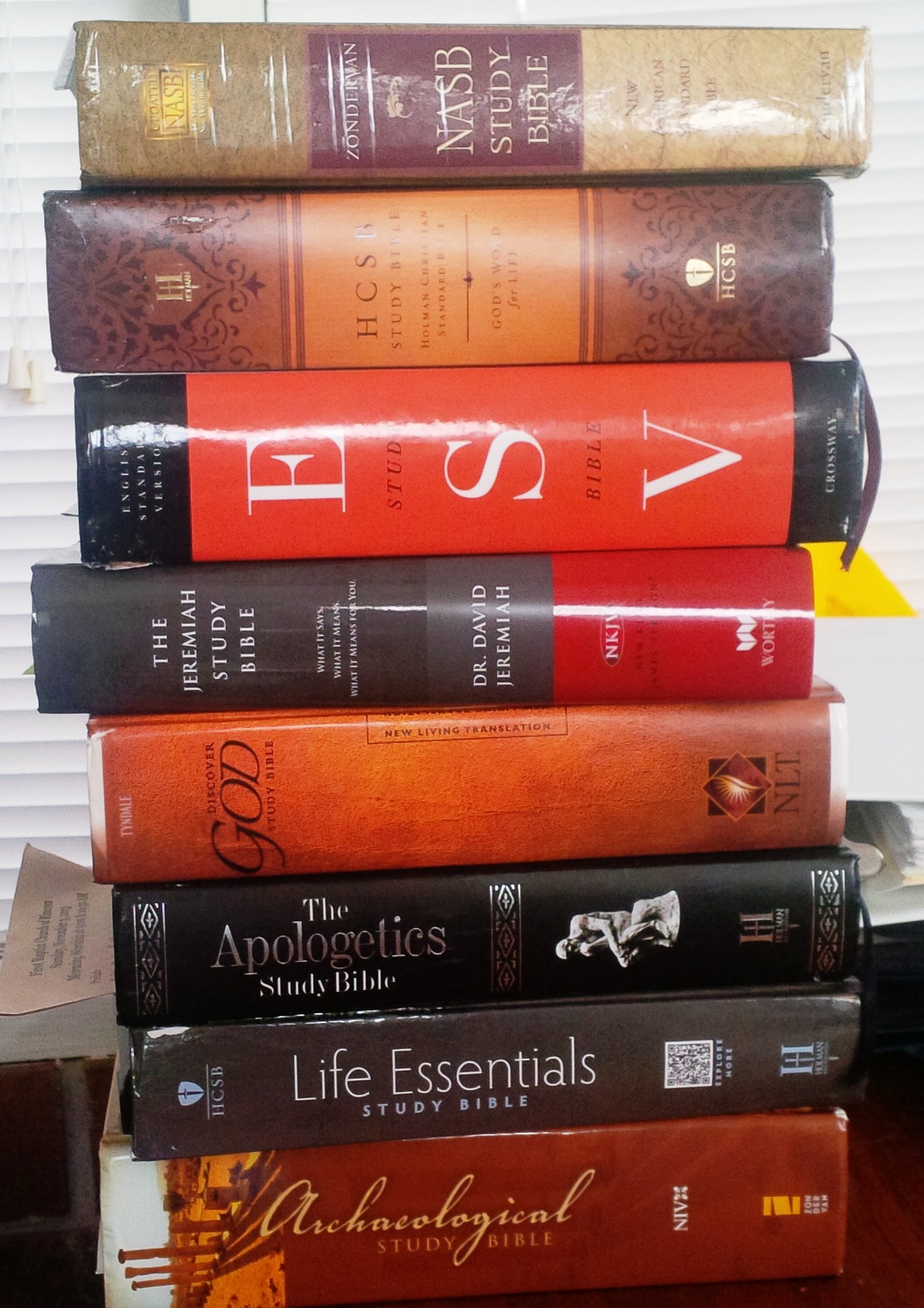
When it comes to studying the Bible, not only are there many choices of translations, but also many choices of study Bibles. Here is an overview of some that I have found helpful.
There are several general study Bibles that are connected directly to a certain translation of the Bible. If a person cannot afford an entire set of commentaries, or wishes to have commentary on the whole Bible in one volume, these study Bibles are the best option. The NASB Study Bible (also available with the same notes as the NIV Study Bible), the HCSB Study Bible, the ESV Study Bible and the Jeremiah Study Bible (NKJV) are examples of this. Each of these study Bibles have extensive introductions to the books of the Bible, maps, and notes at the bottom of the page to explain the text in the particular translation used. The ESV Study Bible is the most scholarly and exhaustive of these study Bibles. The HCSB Study Bible is in a more popular style, and makes the best use of color, making it the easiest to read. The Jeremiah Study Bible has notes by popular Bible teacher, Dr. David Jeremiah.
Some study Bibles focus on a special purpose. The Archaeological Study Bible (NIV) includes notes and articles that explain the cultural and historical background of the Bible. The Life Essentials Study Bible (HCSB) and Life Application Bible (available in NLT, NIV, NKJV, NASB) focus on applying the truths of scripture to our lifestyle. The Life Essentials Study Bible makes use of QR code. Readers can scan the code with their mobile phone and watch a video of a Bible teacher explaining the passage in greater depth. The Discover God Study Bible (NLT) focuses on devotional and doctrinal truth. This is an excellent study Bible for a new believer. The Apologetics Study Bible (HCSB) includes notes and articles that defend the Christian faith against non-Christian religions and skeptics.
All of these study Bibles are excellent resources in shedding light on God’s word. I refer to many of them on a regular basis, depending on how I am studying a particular passage. But none of these aids can substitute for simply reading the text first yourself. I would recommend you read and read again the text and make your own notes on what you observe before you turn to these or any other study aids. After your own study, check your observations with those of the experts. That way, you will allow the Holy Spirit to speak directly to you through scripture, and to speak to you through those who have studied it before you.
(If you see a video ad below this post, please understand that I have no control over these ads, and that I do not necessarily endorse the product. If you see an inappropriate ad, feel free to contact me at brogers@fbcrincon.com.)
Book review on discipleship: “Growing Up”
 Copyright 2013 by Bob Rogers
Robby Gallaty’s life was radically changed from drug-dealer to the pastor of a growing church. He credits the transformation not only to his conversion experience, but also to the process of personal discipleship he enjoyed under David Platt and others. His book, Growing Up: How to Be a Disciple Who Makes Disciples, shares his passion for discipleship that he is living out as pastor of Brainerd Baptist Church in Chattanooga, Tennessee.
Gallaty gives a strong Biblical argument for the need for discipleship. The focal point of his book is the suggestion that instead of depending on Sunday School classes to do discipleship, churches should have small, closed discipleship groups with a leader and 3 or 4 other people of the same gender. He uses the name “D-group” for such discipleship groups. He prefers such small groups over discipleship by one-on-one mentors, saying one-on-one mentoring is harder to reproduce and may turn into a counseling relationship instead of a discipleship process. While he gives good reasons for the D-group, he seems to overstate the case that his is the best way. After all, Gallaty himself was mentored one-on-one by David Platt, while Jim Putnam’s book, Real-Life Discipleship, describes some effective discipleship with small groups that are larger than the size that Gallaty suggests.
Nevertheless, Growing Up is a useful resource for church leaders wishing to get serious about discipleship. The book is filled with practical advice about growing in one’s prayer life, Bible study, evangelism, and discipling others. Gallaty is fond of acronyms. The last six chapters of his book form the acronymn for the discipleship process: “CLOSER” which stands for Communicate, Learn, Obey, Store, Evangelize and Renew. He suggests the “HEAR” method of Bible study: Highlight, Explain, Apply and Respond. He says the D-group needs “FAT” belivers: Faithful, Available and Teachable.
While I would argue that D-groups are not the only way to do it, the fact remains that Gallaty is actually leading his church to do something, rather than just talk about it. I would highly recommend Growing Up as a resource that church leaders can use to implement true discipleship in their churches. It is “REAL” (Realistic, Easy to Read, Applicable, and Life-changing).
In the interest of full disclosure, let me state that I received a free copy of this book for review, but I was under no obligation to write a positive review.
If you see a video ad below this post, please understand that I have no control over the content in these ads, and I do not necessarily endorse the product.
Book review: “When Will I Stop Hurting? Dealing with a Recent Death”
 Copyright 2013 by Bob Rogers
When Will I Stop Hurting? Dealing with a Recent Death by June Cerza Kolf is one of the most helpful, compassionate books I have read to comfort someone who is grieving. As a pastor, I have given several resources to people to help them with the grieving process. A church member who had lost her mother told me that this book was even more helpful to her than what I had given her, so I had to read it myself. Now I see why. Kolf writes as someone who not only understands the grief process, but has experienced it herself. She has a wonderful balance of encouragement and specific, practical advice. It is a resource that a grieving person will want to keep nearby to refer to again and again, and share with others.
The book is divided into three chapters: The Wound, The Flood, and the Rainbow. The first chapter, “The Wound,” explains the hurt and feelings of grief. Grieving readers will find themselves saying, “Yep, that’s me.” Yet they will find it comforting to see how what they are experiencing is normal, and they are not going crazy.
The second chapter, “The Flood,” explains the stages of grief and gives practical advice about making decisions and taking care of oneself through that process.
The third chapter, “The Rainbow,” is an inspiring and practical explanation of how one let’s go of grief and moves on in life.
There is an appendix that gives nearly 20 exercises with a “To Do” list to handle guilt, crying, loss of sleep, remembering your loved one, etc.
However, as good as this book is, I feel that Kolf could have strengthened the book with comforting scripture. She does mention two Bible verses, and talks about God throughout the book. On page 41, she gently recommends “a divine friend who loves me no matter what…This friend, Jesus, is available to everyone through prayer.” Since she chose to mention her faith, she could have strengthened this by citing scripture such as Jesus’ words about being with us and preparing a place in heaven (John 14:1-6), Paul’s words about finding comfort in God by comforting others (2 Corinthians 1:6), or Kind David’s beloved Shepherd’s Psalm, Psalm 23. I have seen people physically relax upon hearing the Twenty-third Psalm. Scriptures such as these could make this wonderful, helpful book even more “hope-ful” to the grieving reader.
If you see a video ad below this post, I do not necessarily endorse the product.
The Voice translation and The Compass Study Bible
Compass: The Study Bible for Navigating Your Life, is a study Bible edition of The Voice translation, a new translation released in 2012.
I received an advance copy of The Compass Bible to review. It will not be released until February 2014, but The Voice translation itself is available in other editions now.
First, let me discuss the translation itself. Second, I will comment on the distinctions in this study edition.
The Voice translation takes a unique approach in Bible translation, which makes it difficult to classify this as a translation or a paraphrase. Perhaps it’s best to say that it is a translation that is amplified with paraphrase. That is, the text has a fairly accurate translation, but then it inserts additional words into the text in italics for clarity and explanation. For example, Romans 10:9 is translated and amplified like this: “So if you believe deep in your heart that God raised Jesus from the pit of death and if you voice your allegiance by confessing the truth that ‘Jesus is Lord,’ then you will be saved!” Here’s another example that includes even more amplification, Psalm 23:5: “You spread out a table before me, provisions in the midst of attack from my enemies; You care for all my needs, anointing my head with soothing, fragrant oil, filling my cup again and again with Your grace.” In both of these verses, the text without italics is an accurate translation, but the text added in italics amplifies and explains the meaning of the verse. The advantage of this over other paraphrases is that the reader knows which part is translation, and which part is commentary.
But there is more. On nearly every page, there is bracketed, bold text, giving background explanation of the history, culture and meaning of words and events in the passage.
As its name implies, The Voice is written to be heard. It appears in screenplay format, whenever there is dialogue, giving the name of the speaker in bold, followed by a colon. For instance, in Luke 1:60-61, the text is laid out like this:
Elizabeth (disagreeing): No, We will name him John.
Her Relatives (protesting): That name is found nowhere in your family.
The translation pays close attention to alliteration and other devices of sound, such as Genesis 1:16: “the Divine needled night with the stars.” Or another example, when the angels rejoice over Jesus’ birth in Luke 2:14: “To the highest heights of the universe, glory to God! And on earth, peace among all people who bring pleasure to God!”
All of these features make The Voice a Bible that is well-suited to be heard, whether read aloud or heard in the reader’s mind.
The Compass Bible is an edition of The Voice translation that adds some appropriate Bible-reading aids, primarily in the back, which include a 40-day reading retreat plan with suggestions for meditation and prayer, a 365-day reading plan through the whole Bible, an index of notes by topic, and maps. Other than a few Bible-reading aids, there is no difference between the text in the Compass Bible and other editions of The Voice translation, as they all include the topical notes in the text. The Compass Bible is printed on a less expensive paper, and retails for less than the regular edition.
Taken together, the Compass edition of The Voice translation should make the Bible come alive to people who are not familiar with the Bible, and it should bring new insights to those who are familiar with the Bible.
In the interest of full disclosure, let me state that I received a free copy of the Compass Bible for review, without any obligation to give a favorable review, and I did not receive any other compensation for writing this review.
If you see a video ad below this post, I do not necessarily endorse the product.
Book review: “Deep Mentoring”
 Deep Mentoring: Guiding Others on Their Leadership Journey, by Randy D. Reese and Robert Loane is a guidebook for Christian leaders on why and how we should mentor future leaders. Deep Mentoring is a deep book. It is not an easy read, but it is well worth reading. The book is scholarly, yet practical; academic, yet full of pithy quotes and illustrations.
Reese and Sloane divide their work into three parts. Part One is entitled, “Noticing God’s Already-Present Action.” In this section, the authors show how we need to slow down enough to pay attention to people and their needs. Part Two is, “Learning from Those Who Have Come Before Us.” This section takes the reader through the stages of life. They give a powerful explanation of how important it is to know a person’s background to really understand him or her. Then they show how our roles change from young adults who are actors to middle adults who are actors who influence others, and how we should finish well as influencers. Part Three, “Guiding the Formation of Others,” shows the techniques that Jesus used to influence others, and then lays out a plan for the reader to do the same. Each chapter of the book includes specific exercises for the reader to apply to his or her mentoring relationship. Four appendices at the end of the book give practical tools that the reader can come back to and use again and again through the mentoring process.
I bought this book because I have a desire to lead my church in greater discipleship of believers through mentoring. After reading the book, I have an even greater desire for mentoring, and many new tools for the journey.
NOTE; If you see a video ad below this post, I do not necessarily endorse the product.
Book review: “Out of Control”
 Ben Young & Samuel Adams’s book, Out of Control, has a very long subtitle: Finding Peace for the Physically Exhausted and Spiritually Strung Out. But the subtitle is accurate. They describe how our culture is out of control because rather than letting the greater efficiency afforded by technology such as cell phones and computers give us more time to rest, we have instead tried to cram even more activity into shorter time.
Young and Adams describe seven symptoms of an “out of control” lifestyle: out of shape (physical), out of sorts (emotional/mental), out of touch (relational), out of time, out of focus, out of balance and out of order (spiritual). Then they confront the lies that keep us out of control, particularly the idea of pleasing the world to be successful and the idea that getting rest is laziness.
The rest of the book takes a pleasantly surprising turn, as it is NOT another “how-to” book with seven easy steps. Instead, they dig into the spiritual disciplines of the Bible, and encourage the reader to practice a real “Sabbath” and take time to unplug completely from technology in order to practice the other spiritual disciplines of solitude and prayer.
This book influenced me to become more serious about unplugging from technology for a large portion of the day on my day off in order to spend more authentic time with God. It was a truly rewarding experience that I pray I will continue to explore for a long time to come.
Guest blog: OUT OF THIS WORLD! Part Three: Books and audiovisuals on near death experiences and the afterlife.
Copyright 2013 by Joyce C. Rogers
 (For the past two days on this blog, my mother, Joyce Rogers, has shared her insights from scripture and other resources on the subject of what happens when we die. Today she lists the books, articles and audiovisuals she read on the subject, with a brief comment about each.)
ANNOTATED BIBLIOGRAPHY
Alcorn, Randy. Heaven. Tyndale House Publishers, Inc. Randy is considered a leading authority on Heaven. He answers some tough questions as he invites you to picture Heaven as the Scripture does. This is a very scholarly book. One needs more than an afternoon to read it!
Alexander, Eben, Proof of Heaven: A Neurosurgeon’s Journey into the Afterlife. Simon and Schuster Paperbacks. Dr. Alexander spent seven days in a coma and experienced a heavenly reality of love and beauty. His experiences changed his scientific mind to one of profound belief in God, spirituality and love. An excellent book.
Black, Dale. Flight to heaven; A Plane Crash: A Lone Survivor: A Journey to Heaven and Back. Published by Bethany House Publishers. Captain Black pursued his dream of flying planes, even after being severely injured in a plane crash. His trip to Heaven is beautifully detailed. The story is a fascinating read.
Burpo, Todd and Sonja Burpo. Heaven Changes Everything. Published by Thomas Nelson, Inc. This is a sequel to the very popular book, Heaven is for Real, the story of little Colton Burpo’s unforgettable trip to Heaven. This family’s lives were changed. The Burpos show how believing in Heaven helps one survive hardships here on earth, including the death of a loved one, particularly the loss of a child. A sweet and down to earth book.
Burpo, Todd with Lynn Vincent. Heaven is for Real: A little boy’s astounding story of His Trip to Heaven and Back. Thomas Nelson Publishing. A four year old child, he sat on Jesus’ lap, said angels took him from his hospital bed and other wonderful things. Colton spoke with disarming innocence. A delightful and convincing book. Colton and his parents were interviewed on the “Today” show, showing the public interest in this story.
Garlow, James and Keith Wall. Encountering Heaven and the Afterlife: True Stories From People Who Have Glimpsed the World Beyond. People who have had near death experiences (NDEs) bring back word descriptions of the pathway to Heaven or the descent into the darkness of Hell. Those who go to Heaven lose their fear and report amazing feelings of love, warmth and acceptance. Those who go to Hell are horrified and so thankful they get to come back.
.
Graham, Billy. Death and the Life After. Word Publishing. Billy Graham talks about how the culture relates to death, the death of children, living wills, euthanasia, hospice care, the grief process, and preparation for death. He explores the practical side of death. Dr. Graham helps the reader find peace and comfort for those grieving or pre- paring a will or planning a funeral.
Graham, Billy. Nearing Home: Life, Faith and Finishing Well. Thomas Nelson Publishing. At 93, Dr. Graham said that old age was a surprise. He advises one not to retire from life. Many older people have heard and obeyed God’s call. He says leave a legacy of faithfulness. We are meant for Heaven, our final home. Heaven is glorious because it is the dwelling place of God.
Graham, Billy. The Heaven Answer Book. Thomas Nelson Publishing. This short little question and answer book gives straight biblical answers about heaven in typical Billy Graham style. He answers such questions as “Does Heaven really exist?” and “What is a resurrected body?” Dr. Graham is evangelistic in his approach to these questions and answers.
Harris, Trudy. Glimpses of Heaven: True Stories. Published by Revell. A hospice nurse relates stories of those leaving the world in his/her own unique way.
Harrie, Trudy. More Glimpses of Heaven: Inspiring True Stories of Hope and Peace at The End of Life’s Journey. Published by Revell. More stories of the beauty and pain of life’s end as observed by hospice nurse, Trudy Harris.
Lotz, Anne Graham. Heaven, My Father’s House. W. Publishing Group. Billy Graham’s daughter writes about our heavenly home compared to our earthly home. She says, “The invitation to my Father’s house is extended to all, but you have to RSVP.” This is an inspiring little book.
Malz, Betty, My Glimpse of Eternity. Published by Chosen. Betty was “officially” Pronounced dead for 28 minutes before waking to report seeing and hearing angels and understanding several different languages at once. Catherine Marshall said, “Upon occasion God breaks into human life to give us a glimpse of what lies ahead.
Betty Malz’s remarkable experience is a resounding ‘Yes, there is life after death.’”
Neal, Mary C. MD. To Heaven and Back: A Doctor’s Extraordinary Account of Her Death, Heaven, angels, and Life Again. Waterbrook Press. Dr. Neal, a spine specialist, had a kayak accident and drowned. Her friends worked hard to revive her and finally did. In her “in-between “ state, she experienced a joyous welcome celebration in Heaven. Very readable and interesting.
Piper, Don with Cecil Murphy. 90 Minutes in Heaven: A True Story of Death and Life. Published by Revell. A popular book involving a car accident, being pronounced dead and waking up to sing with a minister praying and singing over him. After a long, grueling recovery, Don was persuaded to tell his story.
Prince, Dennis and Nolene. Nine Days in Heaven: A True Story. Charisma House Publishing. Nine Days in Heaven relates the vision of 25 year old Marietta Davis more than 150 years ago, in 1848. Her story is re-written in modern English. She was shown the heavenly nursery where infants are cared for and taught redemption’s story. Each section is supported by Scripture. Beautifully done. Especially helpful for those grieving for a lost child. Not to be confused with 90 Minutes in Heaven by Don Piper.
Rogers, Joyce C. “After This, Then What?” Family Bible Study, Life Ventures Learner Guide. Summer, 2005, p.116-161. LifeWay Sunday School unit. Speaks of salva-tion here and now and throughout eternity, Jesus’ return, and the special place God has prepared for His own.
Sigmund, Richard. My Time in Heaven: A True Story of Dying…And Coming Back. Whitaker House Publishing. Following a traffic accident, Richard found himself in a thick, cloudy veil. He could hear sirens and the words, “He’s dead.” He could hear singing and laughter on the other side. Led along a path by angels, he saw a book containing his name. He claims to have seen mansions belonging to loved ones and many other wonders. The book has testimonies, select scriptures and an index.
Springer, Rebecca. Within Heaven’s Gates. Published by Whitaker House. After feeling alone in her illness far from home and family, Rebecca has a vision of life in Heaven. She describes with unspeakable joy life in Heaven where she has her own mansion and visits with loved ones. A vision, not an NDE.
Stone, Perry. Secrets from Beyond the Grave: The Amazing mysteries of Eternity, Paradise, and the Land of Lost Souls. Published by Charisma House. Detailed studies of questions related to death and the afterlife. The author asserts that Heaven and Hell are real places. Details he relates include: people in Heaven or Hell have all 5 senses; are not limited to time or space or travel hindrances; and have conversations not with words but with thoughts.
Wiese, Bill. 23 Minutes in Hell; One man’s story about what he saw, heard, and felt in That place of torment. Published by Charisma House. Bill Wiese said that he saw the searing flames of hell and was terrorized. He said, “My sincere hope is that this book is the closest you will ever come to experiencing hell for yourself.” A question he answers is “Can ‘Good’ people go to hell? There is an 18-page scripture index.
ANNOTATED BIBLIOGRAPHY Of AUDIO VISUALS
Besteman, Marvin with Lorille Craker, read by Maurice England. “My Journey to Heaven.: What I Saw and How It Changed My Life.” Baker Publishing House, Christianaudio, 2012.. Marvin Besteman shares the true story of his experience of Heaven in detail. He speaks of angels accompanying him to the gate, his conversation with St. Peter, and his joy when he recognized friends and family members who had touched his life. Very interesting story. Running time 4.7 hours. CD.
Malarky, Kevin. “The Boy Who Came Back from Heaven,” Tyndale Entertainment Production in Association with Franklin Films. Based on book by Kevin Malarky. Six year old Alex Malarky suffered a terrible car accident which left him in a coma for 2 months. He awoke to share an incredible story of angels, Jesus and his trip to Heaven. He was left paralyzed, but we see how God is still using him today. This is an amazing and convincing story. Running time 50 minutes. DVD.
_______. “The Final Frontier.” Produced by Eternal Productions. Revived patients encounter some form of extension of consciousness beyond clinical death. They encounter some form of reality: Heaven or Hell. These are not hallucinations, but a highly structured and organized phenomenon. More and more scientific evidence tells us that life after death exists. Where we are going is a matter of choice. We must think about our own lives. This DVD makes one think. Running time 53 minutes.
_______. “The Lazarus Phenomenon: A Glimpse of Eternity.” Eternal Productions. Lan McCormack was stung by jelly fish off the coast of an island in the Pacific and was unable to get help. His experiences changed his life. On the other side of the world, a pastor died and 48 hours later revived. He was shown his death certificate. He also had experiences beyond the veil. Well worth watching. Running time 100 minutes..
Jeremiah, David Dr. “Revealing the Mysteries of Heaven.” Turning Point Television. Shadow Mountain Community Church, San Diego, California.. Sermons on Heaven. Dr. Jeremiah preaches a 3 month series of sermons on Heaven. Each sermon covers A different aspect of Heaven. Topics such as “Won’t Heaven be Boring?” and “What About the Children?” are covered. He says “Worship in Heaven is not about us – its about Him. Its not about here – its about there. Its not about now – its about then. Its not about one – its about many.” Wonderful resource. Each sermon about 30 to 40 minutes. DVD.
Copyright 2013 by Joyce C. Rogers
FREE BOOK GIVEAWAY- Discipling New Church Members
 I am giving away a free copy of Thom Rainer’s book, I Am a Church Member, this week on my blog. Here’s what you need to do to win:
1. Follow my blog. If you are not already following, click on the link at the right and sign up.
2. Leave a comment below telling me what your church does, or what you wish it would do, to disciple new members. You must leave me an email address in the comment, so that I can contact the winner.
I will select a winner based on the comments (the person must also be a follower of my blog), and I will announce the winner on Friday afternoon. LifeWay will mail the book directly to you. (By the way, the winner must live in the United States or Canada.)
Free book giveaway
I WILL BE GIVING AWAY A FREE BOOK NEXT WEEK TO SOMEBODY WHO VISITS MY BLOG.
WATCH FOR DETAILS ON MONDAY!
Book Review: “I Am a Church Member”
If you are looking for a resource for your church’s new member class, this is a book you will want to read.
Thom Rainer, CEO of LifeWay Christian Resources, has written I Am a Church Member: Discovering the Attitude that Makes the Difference. It is a short book that can easily be read in one sitting, but it has the potential of making a big impact in local churches.
The book opens with a story about two members of the same church with completely opposite attitudes about church. Then he zooms in on the Biblical attitude members should have in six short chapters, based on Rainer’s extensive research in attitudes among church members. These chapters teach members to be active, bring unity, avoid the tendency to insist on personal preferences, pray for leaders, lead their own families to be involved, and to treasure church membership as a gift. The main point of the book is that church membership is not like a country-club membership with perks and privileges.
There are some churches that reject the term “membership,” saying it is an unbiblical modern term. Rainer disagrees, pointing out that 1 Corinthians 12:27-28 speaks of the “individual members” of the church. Rather than reject the term, Rainer seeks to give a Biblical definition of the term “membership.” He emphasizes that Biblical church membership is a treasured gift, just as our salvation is a gift, and thus we should serve in our churches gladly, not begrudgingly.
One of the strengths of this little book is that each chapter includes a pledge of loyalty for members to make. This requires the reader to respond to the challenge of the book. Each chapter also includes discussion questions, making this book an outstanding resource for small group or one-on-one study for church members, both new and old.
Book review: “The Founding Fathers and the Place of Religon in America”
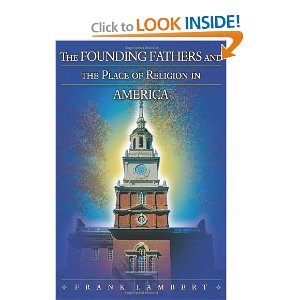
Frank Lambert, professor of history at Purdue University, does an excellent job of surveying this complex topic over a 200-year period. He does so thoroughly, yet concisely, in only 296 pages. While making generalizations at times, he often illustrates his points with quotations from original sources of the time period.
He begins by criticizing extremists on both sides of the issue, and proceeds to present a balanced approach. However, as I will explain at the end of this review, he shows his bias at the end.
Lambert’s thesis is this: America WAS first settled by people who wanted to make it a Christian nation, whether Puritans in New England, Anglicans in Virginia, or Quakers and others in Pennsylvania. These early founders had a vision of making America “a city on a hill,” a model Christian commonwealth. However, two major influences led the founding fathers to establish a government that separated church and state. These two influences were the Enlightenment and the Great Awakening. Men like Thomas Jefferson and Thomas Paine, who were influenced by the Enlightenment, felt that men should be free to use their own reason in matters of religion. The Baptists and others who benefitted from the rapid growth of “free” churches in the Great Awakening were persecuted by established churches and wished to have no established church, so they joined with men like Jefferson in calling for separation of church and state.
Lambert shows that there was great division over these issues, and gives interesting anecdotes and quotations from both sides. He quotes frequently from religious leaders on both sides of the issue. However, near the end of the book he spends much more time quoting Republicans like Thomas Jefferson and James Madison, and gives little space to Federalists like George Washington and John Adams. At one point, on page 161, Lambert implies that John Adams was a deist, even though biographies of Adams have shown him to be a devout Christian with a Puritan heritage.
Lambert shows his view in his conclusion, as he criticizes accomodationists such as Judge William Rehnquist and “religious right” preachers like Pat Robertson.
While Lambert gives both sides of the argument, he clearly leads the reader to his own separationist interpretation. Because the book is so full of useful information, I highly recommend it as a textbook on the subject, but let the reader understand that Lambert has his own bias, too.
Book review: “Multiply” by Francis Chan
 Francis Chan, author of the influential books Crazy Love and Erasing Hell, has written Multiply: Disciples Making Disciples for the purpose of multiplying disciples in the church.
The book has some excellent material; however, I was disappointed in the book, because it was not what I expected. I downloaded the book and read it on my Kindle, deceived by the title into thinking it was about how to make disciples. While the introduction and first three chapters (about 40 pages) discuss how to use the book for discipleship, that’s about it. The rest of the book is an overview of the teachings of the Bible.
Don’t misunderstand me. The overview of the Bible is excellent. It’s well-written, and has good support material with questions for discussion and videos available to watch online. If you are a mature Christian, you will find very little new information here, but it is a good, solid summary of what the Bible teaches. If a person goes through this material with a new believer, that person will be very well-founded in a biblical worldview.
The bottom line: if you are looking for material for an in-depth teaching of the basics of Christianity for a small group or one-on-one, this is a great book. But if you are looking for a book on how to organize your church for the purpose of multiplying disciples, you will probably find more help elsewhere, such as Real-Life Discipleship by Jim Putman.
10 Biblical steps to getting out of debt
 Back at the beginning of “The Great Recession” in early 2009, our church went through a study on how to get out of debt, using the teaching materials of Crown Financial Ministry. Here is a summary of 10 wise and Bible-based principles for getting out of debt:
1. Pray for God’s provision (see 2 Kings 4:1-7 for an example).
2. Start giving regularly (Malachi 3:8-10).
3. Don’t go further into debt. Stop charging with credit cards!
4. Establish a written spending plan by writing down every penny that you spend for a month, and then developing a spending plan that is realistic and living within your means.
5. Open a savings account and contribute faithfully to it until you have $1,000 in savings for emergencies. (This prevents further debt because you can use your savings for unexpected expenses.)
6. List everything you own and see if you can sell unnecessary assets to eliminate debt (Proverbs 27:23).
7. Make a list of everything you owe.
8. Establish a debt repayment schedule. Pay off the smallest debts with the highest interest first. When that debt is paid, apply that payment amount to the next second debt, and so on. See Crown Financial Ministries for free calculators and tools that can help at www.crown.org/Tools/Calculators.
9. Consider earning additional income.
10. Consider a radical change in your lifestyle (Romans 12:1-2).
Recommended reading on The Lord’s Prayer
There are many wonderful books that have been written on the Lord’s Prayer, but there are two in particular that I have found inspiring.

Max Lucado’s book, The Great House of God: A Home for Your Heart, uses the creative analogy of a big mansion to compare to the Lord’s Prayer. He takes each part of the prayer and compares it to part of the great house. For example, the study is where we learn “thy will be done,” and the kitchen is where we pray “give us this day our daily bread.” Lucado draws a visual image of the prayer that helps the reader see it in fresh ways.

Albert Haase’s book, Living the Lord’s Prayer: The Way of the Disciple, is my favorite book on the Lord’s Prayer. He challenges the reader to live the prayer, not just say the prayer. He takes each part of the prayer and challenges us to put the principles into practice. He uses personal and deeply moving illustrations that encourages the reader to be different because of this prayer.


 Bob Rogers