Author Archives: Bob Rogers
Church football– the other Sunday sport

Many NFL fans are not aware that there is another form of football played on Sunday. It’s called “church football.”
This game is often played by “bench warmers” who do not sing, pray, work or do anything much in the church but sit. They like to put the “backfield in motion” by making a trip back and forth to the restroom or water fountain. During “halftime,” when the music has ended and the sermon has not yet begun, they like to play “staying in the pocket,” keeping their money to themselves as the offering plate is passed.
Church footballers allow their children to run a “draw play” with the bulletin during the service. When the “two-minute warning” sounds and the sermon is almost over, they will try a “quarterback sneak,” leaving quietly during the invitation.
The preacher often tries to catch bench warmers in a “trap play” by calling on them to pray while they’re doing a quarterback sneak out the door. Church footballers often try to avoid the trap play with the “end run,” getting out of church quick, without speaking to the preacher or any other members. Then there is a “blitz” to the local restaurants. Many will also exercise the “halfback option,” as 50% of the congregation will not return to the evening service, especially on Super Bowl Sunday.
But then there is another breed of church football players. They are real winners who refuse to punt when the devil has them down on fourth and long. They choose to get into the game, block for their pastor, and tackle thorny problems. The preacher likes to put these people on the first string. When “sudden death” comes, they are the ones best prepared for the “overtime,” because they have committed the Head Coach’s playbook to memory and trusted Him to be right. They really believe they will win, no matter how big the opponent is, and because of their faith, they experience the thrill of victory, not the agony of defeat.
Which kind of church football player are you?
Does the Bible say ghosts are real?
 Copyright by Bob Rogers.
I received the following question from a man named Jason:
[My wife] came home telling me that somehow at work they got in the conversation about ghosts and whether Christians believe they are real or not. Can you help me with this? And can you provide me with specific scripture?
Here’s my answer:
The King James Version translates “Holy Spirit” as “Holy Ghost,” because in the English language four hundred years ago, the words “ghost” and “spirit” meant the same thing. However, today, we associate the word “ghost” with a shadowy image of a dead person coming back to haunt people, whereas the Bible is referring to the unseen living person of God when scripture calls Him the “Holy Spirit.”
Regarding the modern idea of ghosts, we read in I Samuel 28 that King Saul consults a medium and asks her to bring up the spirit of the dead prophet Samuel to speak to him, and she does! But the Bible strongly condemns mediums and witchcraft (see Leviticus 19:31). In fact, the first part of 1 Samuel 28 mentions that King Saul had banished the mediums and spiritists from Israel, but then violated his own law to try to bring back the ghost of Samuel. So yes, it is real, but the practice of spiritism is satanic and should be avoided. (I’m not saying that the spirit of Samuel was a demonic spirit; but that the practice of spiritism is a demonic practice. Even the spirit of Samuel, when brought up, scolded Saul for summoning his spirit from the dead.) Delving in ghosts leads people into dangerous territory. Instead, we should be consulting God’s word, not spirits of the dead. Isaiah 8:19 warns, “When they say to you, ‘Consult the spirits of the dead’… shouldn’t a people consult their God?” After all, the Holy Ghost is the Lord of hosts!
How to deal with disputable matters in church
 Copyright by Bob Rogers
Two churches were located a few blocks from each other in the same small community. The leadership of the two churches felt it would be wise to merge into one larger, stronger congregation, and so plans were set in motion. But it never happened. Why? They could not agree on the wording of the Lord’s Prayer. One group preferred “forgive us our trespasses” while the other wanted “forgive us our debts.” A newspaper article reporting the failed merger noted that one group went back to its “trespasses” while the other returned to its “debts” (Kenneth Boa and William Kruidenier, Holman New Testament Commentary: Romans, p. 417-418.)
Unfortunately, churches and church members often divide over many minor matters.
In Romans 14:1 (NIV84), Paul says, “Accept him whose faith is weak, without passing judgment on disputable matters.”
There are all kinds of disputable matters that come up in churches today. Church members debate over the translation of the Bible. Church members debate over whether to use organ and piano or use guitars and drums in worship. Church members debate over how much of the budget should go to missions, whether to tithe the gross or the net, and what Sunday School literature to use. Church members debate about whether it is proper for a Christian to have a tattoo or whether to wear dress clothes or casual clothes to church. Some churches debate over whether or not it is proper for a man to wear short sleeves and a woman to wear makeup. Some even debate over the color of the carpet.
So how do we handle it when disputable matters come up in the church?
Romans 14:4 asks, “Who are you to judge someone else’s servant?” The point Paul is making is that the Lord Jesus is the Master, not you or me, so don’t get critical over sideline issues.
How do we define a disputable matter?
This raises a question, however. How do we define what is a disputable matter? After all, most people would agree that whether I preach from the King James Version or some other translation of the Bible is a disputable matter, but for some people, it’s not even open for debate. How can we know? Here are some guidelines:
1) What does the Bible teach on the subject?
First, what does the Bible teach on the subject? Take the example of drinking alcohol. Some Christians drink alcohol, while others feel you cannot be a true Christian and drink alcohol. So what does the Bible teach? The Bible says in some passages that wine was consumed by good people (Melchizedek brought out wine and bread to Abraham in Genesis 14:18; Jesus turned water into wine in John 2:1-11), but it also says that drunkenness is sinful and foolish (Proverbs 20:1; 23:20, Isaiah 5:11). So according to the Bible, drinking alcohol is not a sin, but getting drunk is a sin. So the first principle is to ask what the Bible teaches on the subject.
Of course, there are some areas where sincere Christians have honest differences of opinion about what the Bible teaches on a subject. For example, I believe that the Bible teaches that Jesus’ Second Coming is premillenial. However, I used to believe it was amillenial, and I finally changed my mind after continual study. The reason for differences of opinion is that a person can take scripture and make arguments for both sides, based on scripture. And if two Bible-believing Christians can back up their viewpoints from scripture, then they should respect their differences of opinion.
2) Is the dispute over a practice or a principle?
There is a second guideline that can help us, however. Paul says later in this chapter, in Romans 14:17, “For the kingdom of God is not a matter of eating and drinking, but of righteousness, peace and joy in the Holy Spirit.” Notice that he is making a distinction between practices and principles. “Eating and drinking” are practices. “Righteousness, peace and joy in the Holy Spirit” are principles. Worshiping the Lord is a principle; playing the organ or playing the guitar are practices. We should stand on our principles but be flexible in our practices.
Keeping your dark secret from your pastor
 Copyright 2013 by Bob Rogers
Many pastors have come to learn some deep, dark secrets of members that we must take to our graves. But thanks to HIPAA, one of the secrets we used to find out about has been hidden. I’m talking about the real first names of church members.
You see, hospitals list patients by the name that is on their insurance, not by the name their family and friends call them. In the old days, the preacher could look at the list of patients at the information desk, and find out, for example, that John Smith was actually Orville J. Smith. Of course, John didn’t like to use the name “Orville” and would beg the preacher to keep it a secret. Going to visit “Bubba”? No problem, you could just ask for his last name and find him. But then along came HIPAA.
HIPAA, which stands for the Health Insurance Portability and Accountability Act of 1996, is a law that protects the privacy of hospital patients and wreaks havoc on the hospital visitation ministry of pastors. Under HIPAA, patients have the right to refuse the release of any information to anybody, including their own pastors. And under HIPAA, anybody inquiring about a patient must give the correct name of the patient– even if the patient doesn’t go by that name.
So now when the preacher goes to the hospital and asks for John Smith, the lady at the information desk looks down at “Orville J. Smith” on her computer screen, and then looks up at the preacher with a smirk and says, “I’m sorry, we don’t have anybody by that name.” The preacher can beg and plead and promise to do a wedding for her family for free, but she will just say, “Have you ever heard of HIPAA? I can’t release that information unless you can give me the correct name.”
I must admit, we preachers had it coming. After all, for years we have abused that privileged information, barging into the hospital room and loudly asking, “How are you feeling Orville?” as John (a.k.a. Orville) hides under his sheets in embarrassment. But no more. Now, only God and your doctor have to know your real first name. That is, unless Orville wants his pastor to come pray before his next knee surgery.
The Old Testament prayer of Jesus

Copyright 2013 by Bob Rogers
“Then the Angel of the LORD responded, ‘How long, LORD of Hosts, will You withhold mercy from Jerusalem and the cities of Judah that You have been angry with these 70 years?’ The LORD replied with kind and comforting words to the angel who was speaking with me.” – Zechariah 1:12-13, HCSB
I believe that the person called the Angel of the LORD in this passage is the pre-incarnate Son of God, and that this is a unique example of a prayer of Jesus in the Old Testament.
Notice that He is called “the LORD” in Zechariah 3:2, even though He is called the Angel of the LORD in verse 1 and 4 of that same chapter.
We also see that the Angel of the LORD appears to Abraham in Genesis 22:11-12 yet speaks as God, and appears to Jacob in Genesis 31:11 and wrestles with Jacob in Genesis 32:24-30. In the last passage, Jacob says He saw God face to face. In Daniel 3:24-25, a fourth person appeared in the fiery furnace with the three Hebrews, and one is described as looking “like a son of the gods.” All of this leads many Bible commentators to wonder if these are appearances of Jesus, the Son of God, in the Old Testament.
Another reason why I take Zechariah 1:12 as a prayer of Jesus is the unique wording of the prayer. While we read of angels praising God in Ezekiel 3:12, Luke 2:14, Revelation 15:3-4; 16:5-6, it is unusual for an angel to pray like this, making intercession. However, this prayer fits the prayer and personality of Jesus. Hebrews 7:25 says that Christ always lives to intercede for us, and Matthew 23:37 says that Jesus wept over Jerusalem. In this passage, the Angel of the LORD prays for God to show mercy and forgiveness to the exiles of Jerusalem after 70 years in Babylon.
Notice also how the LORD replies to the prayer of the Angel in Zechariah 1:13: “with kind and comforting words.”
Oh, that Christ might intercede for us, who are His followers, and He does! Oh, what joy to know that the Son prays for mercy for us and the Father replies to that prayer with comforting words!
What really matters

Copyright 2013 by Bob Rogers
Millions of people gather around their television sets to watch sports championship games. Some will be very happy after the game, and others will be very disappointed. But in the end, it really doesn’t matter.
Philippians 2:10-11 says that in the end, “At the name of Jesus every knee will bow… and every tongue should confess that Jesus Christ is Lord.”
In the end, it will not matter what team you follow, but it will matter whether or not you followed Jesus. In the end, it will not matter what nation you lived in, but it will matter whether you were you in the kingdom of God. In the end, it will not matter what terrorists you feared, but whether you feared God. In the end, it will not matter which church you attended, but whether you were part of the body of Christ.
In the end, it will not matter what your political affiliation was, but whether your affiliation was with Jesus. In the end, it will not matter where you worked, but whether you served Jesus. In the end, it will not matter what family or culture you were born in, but whether you were born again into the family of God. Because in the end, what will matter is not whether you got your name in the history books, but did you get your name in the Lamb’s Book of Life?
The cycling pastor eats humble pie
 Five years ago I started riding a mountain bike a few miles in the morning to work out at the YMCA. I figured with gasoline at $4.00 a gallon, I could pay for the bicycle in gas saved and be exercising while riding. Soon I was addicted to cycling, and started riding longer distances on Saturdays for fun. When I got up to nearly 20 miles, serious cyclists told me I should upgrade to a road bike, and I was blessed to receive one on permanent loan from a friend. Soon I was riding 30 and 40 miles on the weekends on the road bike, which is a lot easier and more fun to ride, with its light weight and narrow tires.
Then my brother, who lives in Louisiana, got into cycling. We decided that we would ride the 41-mile Longleaf Trace (near our parent’s home in Hattiesburg, Mississippi) over the Christmas holidays. Since I had been cycling a lot longer than Todd, I was sharing my expertise with him and comparing notes on Facebook and in phone calls. Soon he was riding 40 miles each weekend. I got up to 52 miles on my longest ride.
A couple of months before the ride, it dawned on me that my brother was going that distance on a mountain bike, while I was riding a road bike. I decided to be fair to him, I should also ride the slower, heavier mountain bike, and I started training again on my mountain bike. I had never been farther than 22 miles on a mountain bike. A couple of weeks before our ride, I got up to 35 miles on my mountain bike, and I thought I was going to die.
I should have seen what was coming, but my pride got in the way. On December 31, our Dad dropped us off in Prentiss at the beginning of the Longleaf Trace, with our mountain bikes. (That’s a picture of the two of us on this page, with Todd on the left, and me on the right.)
The idea was to ride in each other’s draft, taking turns leading one another. I led the first seven miles, with Todd right behind me in my draft. It was largely uphill, and then we took a break. I felt fine, but Todd said my pace seemed slow. He led the next 12 miles. Forget about staying in his draft, after about 5 miles, it was killing me to keep up with him. I had to make a decision: was I going to be in pain trying to keep up his pace, or just enjoy the ride? I decided to enjoy the ride and soon he was half a football field ahead of me, constantly looking back. After the next stop, I was feeling humiliated. I had to put the bicycle in a low gear to handle the slightest uphill slopes, while Todd started meandering on the path, over to the left and then to the right, just to slow himself down and keep from going over the horizon out of my view. Then he started telling me that he needed to reset his music on his mp3 player, and told me to go on ahead and he would catch up. Soon he was flying past me. I felt like the little engine that could, but I wasn’t so sure that I could. The last 10 miles were pure pain and determination. I think I saw a turtle pass me. After five hours and 41 miles on the trail, I finally crossed the line, muttering that I HATE mountain bikes. My brother was circling around the parking lot waiting for me, saying he could go another 5 miles. But I couldn’t be mad at him, because he was trying to be nice about it the whole time, thanking me for riding with him and saying how much fun we had. That evening he went out to a movie. I took ibuprofen and rubbed my sore thighs and knees at home.
The experience reminds me of the way we often see ourselves spiritually. We think we are really good people. We compare ourselves with others, and we look pretty good. But the Bible says, “All have sinned and fall short of the glory of God.” (Romans 3:23) When we compare ourselves with God, He runs circles around us, and leaves us in the dust. It’s an humbling realization, but an important lesson for us to learn.
That long ride on mountain bikes with my brother taught me that I’m not nearly as great a cyclist as I think I am, and also encouraged me to keep on training. Getting a glimpse of God’s glory should teach us a similar lesson: we aren’t nearly as holy and good as we think we are, but we have a loving God who is waiting on us up ahead, accepting us for who we are encouraging us to do better.
However, there is also a difference. My brother can do nothing to help me, except give encouragement. My God can give me power to do what I cannot do myself. “I can do all things through Christ who strengthens me.” (Philippians 4:13)
I’m looking forward to the ride with God in 2013.
UPDATE: When I got back to Georgia, I noticed that my rear tire was lose and rubbing against the rim, so I took it to my bike repairman. He said the bearings were shot, and he said, “I don’t know how you even finished 41 miles with a wheel in that bad shape.” Soooooo…. maybe, just maybe, I wasn’t in as bad a shape as I thought! Looks like I need to challenge Todd to another ride on the Longleaf Trace!
Guest blog: “Remembering your loved ones at Christmas”
 Below are some suggestions from Ed Ike, licensed professional counselor who does counseling for First Baptist Church, Rincon, Georgia. To contact Ed for counseling, you may call him at 912-658-2767.
The grief process is always very difficult and especially so during the holidays. Even the smallest memories will bring about a flood of painful thoughts and feelings. Sometimes we don’t know what to do or how to deal with these thoughts or the empty place on Christmas Day. Here are a few helpful suggestions:
Wrap a favorite keepsake or framed picture of your loved one, and give it as a gift to another grieving family member.
Create a special ornament with the name of your loved one and hang it on your Christmas tree.
Decorate a candle and light it at meal time in memory of your loved one.
Make a donation to a favorite charity in the person’s honor. Create a scholarship to keep the memory of the loved one alive and announce it at a holiday gathering of family and friends.
Purchase a Christmas book, perhaps a favorite of your loved one, and donate it to your local library or school. Ask the librarian to place a label in the front cover in memory of your loved one.
Bring your loved one’s favorite food to share at Christmas dinner. Mention their name in the blessing over the food.
Encourage grieving children to draw pictures and create gifts inspired by their memories of the one who died, to give to other family members.
Decorate and hang a cut-out star in your home, write on the star your hopes and dreams for the future. Thinking about tomorrow is part of the healing.
Once you have remembered your loved one, make sure you remember yourself. Take care of your needs. Be gentle. Do what you can and no more and no less.
How to pray in times of distress
 Copyright 2012 by Bob Rogers
Psalm 102 teaches us how to pray when we are in distress.
It was written by someone who suffered through the exile in Babylon, but it applies to anybody in suffering. Like the changing weather, this psalm expresses the psalmist’s changing mood. Open your Bible to the psalm and follow this prayer outline:
1) Clouds gather (v. 1-2). He first cries out to God. “Lord, hear my prayer…Do not hide Your face from me in my day of trouble…”
2) Gloom and darkness (v. 3-11). Next, he describes his suffering: heartache (v. 4), he can’t eat (v. 4), he loses weight (v. 5), he is lonely (v. 6). he can’t sleep (v. 7), he suffers abuse (v. 8), he weeps (v. 9), and he suffers because of his sin (v. 10). Thus he says, “My days are like a lengthening shadow.” (v. 11). But the clouds part and the sun shines in.
3) Sunshine (v. 12-22). A ray of future hope from the Lord shines in his heart, and he sees that he will see the ruins of Zion and rebuild Jerusalem, or at least the future generations will see it.
4) Clouds return (v. 23-24). But as he waits for the fulfillment of his future hope, the clouds of doubt return briefly. Can’t we all relate to that?
5) Eternal light (v. 25-28). Finally the psalm ends with a statement of faith in the eternal light of God, for even when the earth wears out like clothing, “You are the same, and Your years will never end.” (v. 27). This part of the psalm is quoted in Hebrews 1:10-12 as a prophecy of Jesus Christ. This reminds us that our ultimate light and hope for our distress comes when we trust in Jesus.
Some simple gift suggestions for Christmas
Copyright 2012 by Bob Rogers
 A lady didn’t have time to purchase gifts for her circle of friends, so she rushed to the store and bought a box of pretty Christmas cards, and mailed them without even reading the message inside. When she finally had time to relax on New Year’s, she picked up one of the unused cards and to her horror she read the message she had sent: “This Christmas card is just to say, a little gift is on the way!”
In all of our rushing around this Christmas season, let’s not forget the little gift, the baby Jesus, whom God sent to become the big gift for our eternal life. And let’s ask ourselves what gifts we are giving this Christmas. May I suggest a few?
The gift of time. Spend time doing things that matter– with your family, in worship, and in personal reflection.
The gift of love. Look people in the eye, give them a hug, truly listen to what they are saying. Show them they are important to you.
The gift of the gospel. Share the real meaning of Christmas with your Christmas decorations, using a nativity scene, a lighted cross, and so on. Ask a friend or co-worker, “What does Christmas mean to you?” and after they answer, tell them what it means to you.
The gift of money. Yes, money, but not like you may think. After all, it’s not your birthday or my birthday, it’s Jesus’ birthday. So why not spend at least as much money in honor of Jesus as we do on our own family members? Share generously with the missions offering to spread the gospel to those who have never heard. Share generously with people in need. And don’t forget your tithes to your own church, to continue the ministries that focus on the real reason for the season.
The gift of song. Christmas is a time for singing and rejoicing! Surround yourself with Christmas carols, and share it with everybody you meet. Go Christmas caroling in your neighborhood and share fresh-baked cookies with an invitation to our Christmas Eve service. This is one time of the year when the whole world likes to hear songs about Jesus, so spread the joy! Like the wise men who gave gold, frankincense and myrrh, what gifts can you and I bring Jesus?
The preacher who had too much fried chicken

As Thanksgiving comes and goes, most of us will feast on turkey, ham and many other wonderful foods. But you can get too much of a good thing– even fried chicken.
Fried chicken is so popular at church meals in the South, that some people call it “gospel bird.” But Dan Spencer from Thomasville, Georgia, tells about a preacher who had too much gospel bird. I don’t know if this story is true or not, but it makes a good point.
This particular minister was preaching a week-long series of revival sermons. Each day, he was invited to eat at the home of a different member of the congregation. And every day, they served the same thing– fried chicken. Most preachers like fried chicken, but not this man, which only made matters worse. Finally, he came to the last meal of the week, and when he sat down to eat, he looked and saw in front of him the same dish: fried chicken. The lady of the house asked the visiting preacher to ask God’s blessing on the meal, and this is what he prayed:
“Lord, I have it hot
and I’ve had it cold
I’ve had it young
and I’ve had it old
I’ve had it tender
and I’ve had it tough.
And thank you, Lord,
I’ve had enough!”
Sometimes we feel like that in life. Sometimes we just get to the point that we’ve had enough. We wonder if we can take any more of the troubles that life dishes out to us, such as financial problems, health problems and family problems. Sometimes we feel overwhelmed, even if it’s a good thing, we can get overloaded with work and busyness.
Thanksgiving is a wonderful time for us to stop and remember that in Jesus Christ, we can find peace when we’ve had enough. As Christ said, “I have told you these things so that in Me you may have peace. You will have suffering in this world. Be courageous! I have conquered the world” (John 16:33, HCSB).
So pass the chicken. I think I can take one more bite.
Guest blog: Thoughts on President Obama’s re-election
 (In the guest blog below, Bobby Braswell reminds Christians of some important truths we need to hear, regarding the re-election of President Obama. Rev. Braswell is the associational missionary of Middle Baptist Association in Sylvania, Georgia, where he ministers to pastors and churches in Screven County, Jenkins County and northern Effingham County. Bobby his wife Frankie (pictured with him here) live in Guyton, Georgia. They have two children: Emma, 22, and J.B., 20. You can read his blog at www.brotherbobbysblog.blogspot.com.)
Watching the returns and waiting to see who will become the next president is about as compelling as TV viewing gets. It’s no secret that millions of Christians went to bed with sour stomachs last night. Many, though I am sure not all, who would identify themselves as social conservatives and followers of Jesus were outspoken in our hopes that the incumbent president would have a new career beginning in January. Since that didn’t happen, what are some appropriate responses to a second term for Barrack Obama?
Pray for the president – 1 Timothy 2:1-2 (NKJV) 1 Therefore I exhort first of all that supplications, prayers, intercessions, and giving of thanks be made for all men, 2 for kings and all who are in authority, that we may lead a quiet and peaceable life in all godliness and reverence.
Preach the Gospel – A concern I have had for some time is that a lot of Christians behave as though getting the “right person” elected is THE ANSWER for America. Hello! It’s not! It never was! God changes people from the inside out. He changes the heart. I am not aware of anything that the government can do that can bring spiritual regeneration to people. Only the Gospel of Jesus Christ can do that (Titus 3:5). People who have experienced the grace of God through Jesus Christ can be a powerful force for transforming North American culture by radical obediennce to the Great Commission (Matthew 28:18-20). That is really the only way that God has ordained to change societies. I want upright legislators and leaders, but if the Gospel is not the focal point of the energy of Christians we will share the largest part of the blame for the disintegration of North American culture (Matthew 5:13-16).
See People through God’s Eyes – I think a less angry, less shrill, less paranoid perspective of our fellow human being would be extraordinarily helpful. It is easy to have a hateful attitude toward people who don’t share our worldview and our faith, but where in Scripture are we given permission to think and act that way? And what is the good in that? The truth about me is that I was a wreck of a person before God’s grace found me, and I still struggle and fail and have absolutely no right to look at anyone else’s failures as being more scandalous or wretched than mine. We are all in the same messed up situation–that is not to minimize sin, or to deny it’s severity–just to say that I don’t belong to God by my right but by His mercy!
Share hope – I woke up today, November 7, 2012 with hope, because God is Great and greatly to be praised (Psalm 48:1)! I woke up determined to have my life count for a great purpose because God is a great God! I woke up today convinced that America’s greatness has more to do with the faithfulness of me and all the other Christians I know and churches they are part of and our obedience to God and commitment to the truth of Gospel than what transpired in the presidential election.
Two interesting maps of the USA
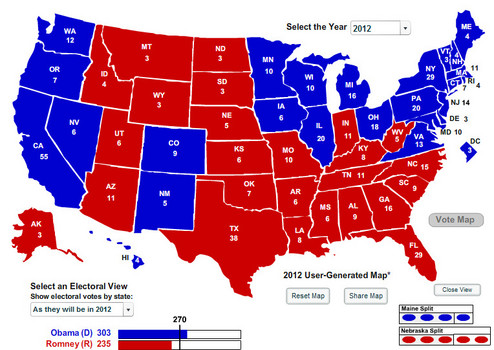 Here are two maps of the USA. The first compares the states that voted for Obama (blue) and Romney (red) in the 2012 presidential election. The second shows states that are very religious (dark green), average (green) and below average in religiosity (light green).

It is interesting that 100% of the “above average” religious states went for Romney, and 14 out of 16 “below average” religious states went for Obama. Exit polls show that people who go to church regularly supported Romney by large margins, and people who never go to church supported Obama by large margins.
Religion was not the only factor in the election, as there were many “average” religious states that went for Romney and two “below average” states (Wyoming and Alaska) that went for Romney. This is because there are two kinds of conservatives: social conservatives and fiscal conservatives. Wyoming and Alaska are definitely independent-minded, fiscally conservative states. But the map does indicate that despite all the focus on the economy in this election, the differences between the candidates on the social issues that religious people care about, especially abortion and traditional marriage, made a huge difference in how people voted.
Post-election thoughts
I wrote the following blog on November 7, 2008, when President Obama was first elected. It seems appropriate today to republish:
However you voted in the recent election, let us remember that rulers change on earth, but God still reigns over all. Isaiah was probably worried about the future when King Uzziah died after reigning nearly all of Isaiah’s life, but we read in Isaiah 6:1 that “in the year that King Uzziah died, I saw the Lord…” He got a vision of God’s greatness, and forgot about the change in power on earth. R egarding our new president-elect and other newly elected leaders, 1 Timothy 2:1-2 commands us to pray for those in authority. Some people might object that they don’t agree with the politics of their leaders. I share that concern, particularly on the issues of protecting life and marriage. However, let us remember that in Paul’s day, their political leaders were throwing the Christians to the lions, and Paul still said we should pray for them. So should we.
Book review of Mother Teresa: A Simple Path
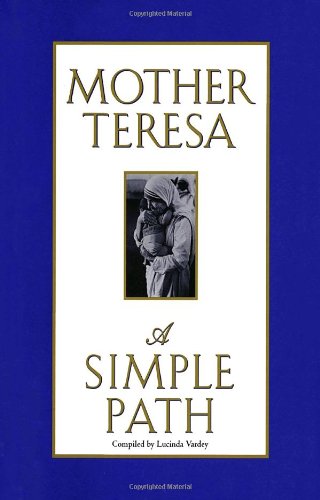 I was asked to read Mother Teresa: A Simple Path, to see if it should be placed in our church library. I am recommending that we do put it in the library because of its positive elements and for the Christian reader to be informed about her historical work, but with a statement of caution in the flyleaf. Why is that?
Mother Teresa is well known for her work with “the poorest of the poor” in Calcutta, India and around the world, for which she received the Nobel Peace Prize in 1979. This book is a collection of thoughts by Mother Teresa and her followers on her philosophy of life and ministry. This path is summed up on page 1 of the book this way: “The fruit of silence is prayer, the fruit of prayer is faith, the fruit of faith is love, the fruit of love is service, and the fruit of service is peace.”
The book is inspiring in its devotion to love the poor by loving Jesus Christ through the poor. There are many inspiring testimonies from volunteers, prayers, and simple statements that show how she kept her focus on her mission. She had a wonderful appreciation for the value of every human life, including the unborn. On p. 55 she asks why people worry about children being killed in wars but do not oppose mothers killing their own children.
I hesitate to say anything critical about Mother Teresa, because she has done far more for the needy in the name of Jesus than I have. However, I must point out that while she was a devoted follower of Christ, she encouraged people to follow whatever religion they were in, rather than convert to Christianity. For example, on p. 31 she says, “I’ve always said we should help a Hindu become a better Hindu, a Muslim become a better Muslim, a Catholic become a better Catholic.” This same philosophy is found throughout her book:
“I have never found a problem with people from different religions praying together. What I have found is that people are just hungry for God, and be they Christian or Muslim we invite them to pray with us…”
“God is not separate from the Church as He is everywhere and in everything and we are all His children– Hindu, Muslim, or Christian…”
“Anyone is capable of going to Heaven…” In this passage, she does not clarify that going to Heaven is by faith in Christ.
(Mother Teresa, A Simple Path, p. 31-32, 59, 73.)
Mother Teresa says that she is saved through Jesus, but she believed that Muslims and Hindus can be saved through Jesus, while remaining Muslims and Hindus.
This contradicts the words of Jesus, who said He was the only way to the Father (John 14:6), and the words of the apostle Paul, who said that there is salvation in no other name than the name of Jesus (Acts 4:12). We should not be surprised that Mother Teresa takes this viewpoint, as Roman Catholic theology generally teaches that the cross of Jesus Christ saves people who follow their own consciences and own religions, even if they never declare faith in Christ. (See statement by Pope John Paul II in Pontifical Council for Interreligious Dialogue – Congregation for the Evangelization of Peoples, Instruction Dialogue and Proclamation, 19 May 1991, n. 29; L’Osservatore Romano English edition, 1 July 1991, p. III; and Catechism #841.)
Mother Teresa’s work is truly inspiring and deserving of recognition. However, her teaching about salvation sadly follows the typical Roman Catholic viewpoint of salvation, a viewpoint that falls short of the teachings of the Bible. Let us be inspired by Mother Teresa’s devotion, but cautious of her as a theologian.


 Bob Rogers