Blog Archives
Book Review: “The Shack”

The Shack is a motion picture being released on March 3, 2017. It has a Christian message, yet some Christians are calling the movie heresy. What’s going on?
The movie is based on the bestseller of the same name by William Paul Young. (This is a review of the book. You can read my review of the movie by clicking here.) It is a deeply emotional story about why God allows suffering. The main character, Mack, gets a note from God, asking him to return to the shack where his young daughter had been murdered. Mack goes, and finds answers to his questions and doubts about God’s goodness. Sounds inspiring, doesn’t it? Then why the controversy?
Negative elements in the book
Many people are bothered by the portrayal of the Trinity in the book. God the Father appears as a black woman who goes by the name “Papa,” Jesus appears as a Middle Eastern man, and the Holy Spirit appears as an Asian woman named Sarayu (Sanskrit for “wind”) whom you can see through. Although they appear as three persons, they are shown as completely one, as they answer Mack in unison from time to time, and whenever he has a conversation with one of them, they always continue the conversations he had with the others. “Papa” reminds Mack that God is spirit, and since Mack had a poor relationship with his own father, he chose to reveal himself to Mack as a woman to get around his resistance. In fact, (spoiler warning: don’t read this next statement if you don’t want to know too much about the novel’s plot…) at the end of the book, after Mack is reconciled to his own father, “Papa” appears to Mack as a man.
Some people will be put off by a few uses of profanity in the book in the dialogue. There is one use of S.O.B., and a few other milder profanities spoken mostly in passages where the speaker is angry.
The most troubling part of the book occurs on page 182. Jesus is talking to Mack, and he says, “Those who love me come from every system that exists. They were Buddhists or Mormons, Baptists or Muslims, Democrats, Republicans and many who don’t vote or are not part of any Sunday morning or religious institutions…” At this point, Jesus appears to be teaching universalism, that everybody will be saved. It appears that Jesus is saying that He has taken people from any background and transformed them. Notice the next words that William Young has “Jesus” speak:
“…I have followers who were murderers and many who were self-righteous. Some were bankers and bookies, Americans and Iraqis, Jews and Palestinians. I have no desire to make them Christian, but I do want to join them in their transformation into sons and daughters of my Papa, into my brothers and sisters, into my Beloved.”
“‘Does that mean,’ asked Mack, ‘that all roads will lead to you?’
‘Not at all,’ smiled Jesus as he reached for the door handle to the shop. ‘Most roads don’t lead anywhere. What it does mean is that I will travel any road to find you.'”
Perhaps this is universalism, or perhaps it means that Jesus is the only way, but He will do what it takes to reach us. The only thing that is clear is that it is left unclear.
Positive elements in the book
The book does a beautiful job of showing that following Jesus is more a matter of relationship than religion. It illustrates how suffering cannot be understood because we cannot understand all of God’s purposes, thus we simply must trust God.
(Spoiler warning: skip this paragraph if you don’t want to know too much of the plot…) Perhaps the most powerful part of the book is when Mack is asked to “play God” and decide which three of his children will go to hell and which two will go to heaven. Mack’s reaction to this awful choice helps him see how God works through suffering.
There are several good quotations in the book:
“Grace doesn’t depend on suffering to exist, but where there is suffering you will find grace in many facets and colors.” (p. 185)
God says, “I am a verb. I am that I am. I will be who I will be. I am a verb! I am alive, dynamic, ever active, and moving. I am a being verb.” (p. 204)
God says, “Forgiveness is about forgetting, Mack. It is about letting go of another person’s throat.” (p. 224)
Conclusion
This is a review of The Shack, the book. The movie has several differences, so see my follow-up review of the actual film by clicking here. The movie has no profanity, and has fewer implications of universal salvation, as some of the above conversations that imply universalism are not in the film. Also, the depiction of God the Father as a woman is explained earlier and more clearly in the film.
Whatever your opinion about the depiction of the Trinity and other controversial elements in the book, it is an inspiring message of how God works through suffering that reminds us how we ultimately find hope not in the shack, but in the cross.
Book review: A novel of women surviving ISIS

“Today is Nazo Heydo’s wedding. The day she will set herself on fire.”
Thus begins What Comes with the Dust: Goes with the Wind, Gharbi Mustafa’s gripping novel about women who survive the abuses of the Islamic State.
I have read Gharbi Mustafa’s first novel, When Mountains Weep, which is the story of a Kurdish boy coming of age when Iraqi dictator Saddam Hussein tried to exterminate the Kurds. I knew Mustafa was as excellent novelist, so I was looking forward to this second novel about the suffering of Yazidi Kurds under ISIS. I was totally blown away by this new book. Mustafa’s first book was very good; this book is great.
What Comes with the Dust: Goes with the Wind is a long title, which comes from the Yazidi religious legends that are explained in the book. It is a story about two Yazidi women, Nazo and Soz, and their struggle to survive. Nazo must escape slavery from ISIS to reach her forbidden lover. Soz is a female soldier who fights ISIS but also struggles with a secret love. Their fates are intertwined in a heart-wrenching story taken directly from the events we see on the daily news.
In 2014, the world watched in horror as Kurdish helicopters dropped relief supplies and tried to rescue thousands of Yazidis on Shingal Mountain in Iraqi Kurdistan, trapped there by ISIS. Since then, the United Nations has recognized the Yazidis re the targets of genocide by the Islamic State.
Who are these Yazidis? Why are the Kurds so eager to rescue them? Why is ISIS so eager to destroy them? This novel answers these questions, even though it is a work of fiction. In story form, the novel unravels the mysteries of the Middle East to western readers. Along the way, Mustafa shows us the mysterious religion and culture of the Yazidis, and contrasts these peaceful people with the fanatical cruelty of ISIS. Rich in culture and characters, and jarring in its account of jihadist brutality, it is a story that keeps the reader turning the pages to the end. I simply could not put it down until I finished.
Gharbi Mustafa is uniquely qualified to write this story. A Kurd himself, Mustafa is professor of English at the University of Dohuk in the Kurdish region of northern Iraq. He has personally interviewed Yazidi women who escaped ISIS, and knows the culture like few writers in the English language. As a novelist, he writes in a way that is at once deeply moving and enlightening. It is well worth the two hours and 200 pages.
Four great children’s Christmas books
Parents and grandparents often look for great books to share with their children at Christmas. Here is what I consider to be four of the best children’s Christmas books. One is sentimental, some are humorous, and one will help a child deal with suffering.

One of my favorites is Alabaster’s Song: Christmas through the Eyes of an Angel by Max Lucado. It tells the story of a boy who believes he hears the angel on the Christmas tree singing. Then miraculously, the gap-toothed angel appears by the boy’s bedside, a boy like him, and tells him what it was like to sing to baby Jesus. Children of all ages will enjoy this book, but parents, watch out, because you may get a lump in your own throat at the way the story ends.

In my list of favorite children’s Christmas books, I have to include the classic book that I loved when I was a child, How the Grinch Stole Christmas, by Dr. Seuss. This beloved book has been made into a popular cartoon TV show, that includes the song, “You’re a Mean One, Mr. Grinch.” In recent years, a live-action movie was also made, but I still prefer the cartoon that follows the book word-for-word. It is hard to improve on the whimsical rhyme of Dr. Seuss.
Most readers already know the story, of how the Grinch couldn’t stand the noise that all the “Who’s down in Whoville” made on Christmas morning. So he decided to steal all of their toys on Christmas Eve. What he never anticipated was that they would still sing on Christmas morning without any presents at all. I love the climactic lines:
“It came without ribbons! It came without tags!/ It came without packages, boxes or bags!”/ And he puzzled three hours, till his puzzler was sore. / Then the Grinch thought of something he hadn’t before!/ “Maybe Christmas,” he thought, “doesn’t come from a store./ Maybe Christmas… perhaps… means a little bit more!”
The changed heart of the Grinch has put the word “Grinch” next to “Scrooge” in the Christmas vocabulary of the English language. Every child deserves a chance to hear a parent or grandparent read it to him or her directly from the book, and follow it with a heartfelt discussion about the real meaning of Christmas.
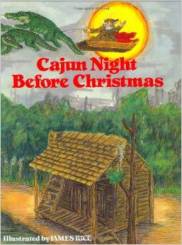
My third selection is Cajun Night Before Christmas, by “Trosclair,” edited by Howard Jacobs. This is a regional favorite in Louisiana, but I have read it to children in Georgia who loved it.
Imagine the famous poem, “Twas the Night Before Christmas,” told in the dialect of south Louisiana, with St. Nicholas gliding across the bayou, with “eight alligator a pullin’ a skiff.” Of course, the alligators have French names:
“Ha, Gaston! Ha, Tiboy! Ha, Pierre an’ Alcee’! Gee, Ninette! Gee, Suzette! Celeste an Renee’!”
I have read this story aloud to my family and to children in public schools over the years, and it always produces loud laughter, even among those who aren’t familiar with the Cajun culture. There have been many imitations of this book, such as the Cowboy Night Before Christmas and the Redneck Night Before Christmas. But none have surpassed the originality and pure fun of Cajun Night Before Christmas.
My final selection is All Is Well: A Story for Christmas, by Frank Peretti. Peretti is the best-selling author of the Christian thriller This Present Darkness, but he is also the author of one of the most touching Christmas books for children that I have ever read.
All Is Well is different from other children’s Christmas books for several reasons. It is on the reading level of an older child, perhaps about fifth grade. It is on the emotional level of a single mom who is struggling to make ends meet at Christmas. The story takes place in July, not during the Christmas season. Yet is most certainly a Christmas story, especially for those who going through tough times during the holidays.
If you are looking for a cute Christmas book for your child, this is not your book. But if you need encouragement to make it through Christmas, this may be the best book you could read, especially to a child who doesn’t understand why God is allows suffering and hard times.
Book review: “Snoop: A Spiritual Memoir of a Vietnam Army Grunt”

Snoop: A Spiritual Memoir of a Vietnam Army Grunt (Published by Parables, 2016), by C. Wayne Harrison, is a 98-page book that tells stories of war, grouped together for devotional reflection. That may sound like an unusual approach, but Harrison makes it work.
Harrison was a private in the U.S. Army, who fought in the jungles in the Vietnam War in 1969-1970. Today he is Baptist minister in Booneville, Mississippi. In ten short chapters, he recalls his desire to be a soldier and relates in vivid detail the horrors he experienced in the war. Although the stories tend to move chronologically from early in his life through his year in Vietnam, the chapters are more thematic in nature, with titles such as, “The Heart of a Soldier,” “The Hands of a Soldier,” “The Hardships of a Soldier,” etc. Each chapter opens with a passage from the Bible, then focuses on stories that relate to the theme of the chapter, followed by some discussion questions and a prayer.
The reader identifies with the young man, who is nicknamed “Snoop” because of his lapel pin of Snoopy, the dog who imagined he was a fighter pilot, in the “Peanuts” comic strip. Some descriptions of war in the book may be disturbing to young readers, and the stories certainly are sobering even to mature readers. I believe Harrison’s writing will connect well with soldiers who read the book, and would make an excellent resource for military chaplains or anybody, especially soldiers, who are willing to reflect on God’s purpose for their lives.
The book is well-written, using excellent images and descriptions, and is easy to read, although I noticed a typo on p. 64, where the word “scar” was spelled “scare.” There are black-and-white photos of Harrison as a young soldier in the back of the book. In interest of full disclosure, I received a complimentary copy of this book from the author, with no obligation to write a favorable review.
Book review: “Mark Twain: A Life” by Ron Powers
 I just finished reading Mark Twain: A Life, by Pulitzer-prize winning biographer, Ron Powers (Free Press, 2006). This is an in-depth biography of the famous writer and humorist Samuel Clemens, better known by his pen name, Mark Twain. At times, it seems too detailed, as it covers more than I wanted to know. Nevertheless, Powers does an excellent job of helping the reader understand the complexities of the man, and he also helps the reader understand American culture during the 19th century, as the two are so closely intertwined. This is a biography, not a literary critique, so Powers does not put heavy emphasis on analyzing Twain’s writing, although he does give a balanced discussion of how literary critics have judged his works, with special attention to his greatest work, Huckleberry Finn.
Some new things that I learned about Twain:
*he traveled extensively as a young adult and for the rest of his life
*he had a lost love that he never forgot
*he had a fierce temper
*he believed in God, but was turned off by the hypocrisy he saw in church, causing him to struggle in his faith
*he was a sucker for bad investments, but famously paid off his debts
*he had friendships with famous Americans, such as Henry Ward Beecher, William Dean Howells, Helen Keller, Ralph Waldo Emerson, and Ulysses S. Grant
*he almost fought a battle against Ulysses S. Grant, but later became a close friend of Grant, and published Grant’s autobiography
*during his latter years, he turned to political satire
*the context of some of his famous one-liners
Speaking of one-liners, I must mention a few of my favorites from the book:
“Preachers are always pleasant company when they are off duty.”
“I worked in a bookstore, but didn’t like it because the customers bothered me so much I could not read with any comfort.”
“He would rather decline two drinks than one German verb.”
“The new hobbies in the election year 1876 are politics and pornography. But I repeat myself.”
“Do you know why Balaam’s ass spoke Hebrew? Because he was a he-brayist.”
“When I was a boy everybody was poor but didn’t know it; and everybody was comfortable and did know it.”
“You can’t pray a lie– I found that out.” (quote of Huckleberry Finn)
“The report of my death was an exaggeration.”
If you love Mark Twain and American history, and you don’t mind reading a long book, you will enjoy this biography. If you don’t want to wade through 736 pages to learn about Twain’s life, or if you are more interested in a literary analysis of his writings than the story of his life, you may want to read a different biography.
Movie review: “Unbroken”

I loved Laura Hillenbrand’s bestselling book, Unbroken, about the amazing life of Louie Zamperini, so I was excited to hear that a movie version was being made. However, I was concerned when I heard reports that director Angelina Jolie had cut out the story of Zamperini’s Christian conversion.
The life of Louie Zamperini was made up of three inspiring stories of redemption: athlete, war hero, and Christian servant. Any one of these stories would make an great book or movie. The first story is how he was changed from a troubled boy into an Olympic runner through the inspiration of his big brother. The second story is how he survived air battles with the Japanese, a crash and 45 days afloat in the Pacific Ocean, and horrible torture in a Japanese P.O.W. camp through his personal determination. The third story is how he was saved from alcoholism, post-war trauma, a broken marriage, and bitterness toward the Japanese when he accepted Jesus Christ as his Lord and Savior at the Los Angeles evangelistic crusade in 1949 that made Billy Graham a world-famous preacher. The book tells all three of these stories; the movie tells the first two.
When I went to see the movie, I knew the conversion story would not be told, so I went with low expectations. I was pleasantly surprised to see that the movie did include the same foreshadowing of his spiritual conversion that is found in the book: the Christian message he heard growing up in an Italian Catholic home with a praying mother, and the promise he made to God when adrift in the ocean that if God would save him, he would serve Him the rest of his life. The movie ends with his homecoming after the war, but the text on the screen briefly tells the viewer that Zamperini “made good” on his promise to serve God, and that he returned to Japan to forgive his captors.
So the story of Zamperini’s faith is not omitted from the movie, but it is greatly abbreviated. The movie itself is very well done. The acting, filming, musical score and drama is top-notch and faithful to the story found in the first two parts of the book. If you have read the book, you will still enjoy the movie. If you have not read the book, I encourage you to see the movie and then read Laura Hillenbrand’s book to get “the rest of the story.”
Favorite children’s Christmas books: “All Is Well” by Frank E. Peretti
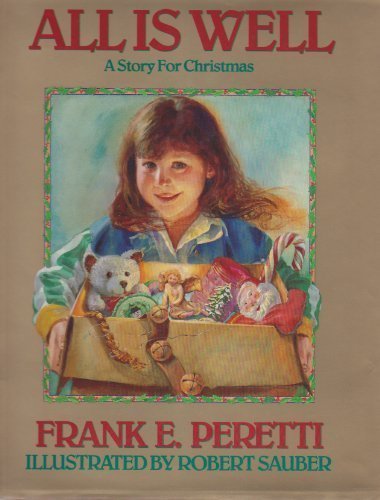 Frank Peretti is the best-selling author of the Christian thriller This Present Darkness, but he is also the author of one of the most touching Christmas books for children that I have ever read.
All Is Well: A Story for Christmas is different from other children’s Christmas books for several reasons. It is on the reading level of an older child, perhaps about fifth grade. It is on the emotional level of a single mom who is struggling to make ends meet at Christmas. The story takes place in July, not during the Christmas season. Yet is most certainly a Christmas story, especially for those who going through tough times during the holidays.
If you are looking for a cute Christmas book for your child, this is not your book. But if you need encouragement to make it through Christmas, this may be the best book you could read, especially to a child who doesn’t understand why God is allows suffering and hard times.
Favorite children’s Christmas books: “How the Grinch Stole Christmas”
 In my list of favorite children’s Christmas books, I have to include the classic book that I loved when I was a child, How the Grinch Stole Christmas, by Dr. Seuss. This beloved book has been made into a popular cartoon TV show, that includes the song, “You’re a Mean One, Mr. Grinch.” In recent years, a live-action movie was also made, but I still prefer the cartoon that follows the book word-for-word. It is hard to improve on the whimsical rhyme of Dr. Seuss.
Most readers already know the story, of how the Grinch couldn’t stand the noise that all the “Who’s down in Whoville” made on Christmas morning. So he decided to steal all of their toys on Christmas Eve. What he never anticipated was that they would still sing on Christmas morning without any presents at all. I love the climactic lines:
“It came without ribbons! It came without tags!/ It came without packages, boxes or bags!”/ And he puzzled three hours, till his puzzler was sore. / Then the Grinch thought of something he hadn’t before!/ “Maybe Christmas,” he thought, “doesn’t come from a store./ Maybe Christmas… perhaps… means a little bit more!”
The changed heart of the Grinch has put the word “Grinch” next to “Scrooge” in the Christmas vocabulary of the English language. Every child deserves a chance to hear a parent or grandparent read it to him or her directly from the book, and follow it with a heartfelt discussion about the real meaning of Christmas.
Favorite children’s Christmas books: “Cajun Night Before Christmas”
 Continuing my series of reviews of favorite children’s Christmas books, today’s selection is Cajun Night Before Christmas, by “Trosclair,” edited by Howard Jacobs.
Imagine the famous poem, “Twas the Night Before Christmas,” told in the dialect of south Louisiana, with St. Nicholas gliding across the bayou, with “eight alligator a pullin’ a skiff.” Of course, the alligators have French names:
“Ha, Gaston! Ha, Tiboy! Ha, Pierre an’ Alcee’! Gee, Ninette! Gee, Suzette! Celeste an Renee’!”
I have read this story aloud to my family and to children in public schools over the years, and it always produces loud laughter, even among those who aren’t familiar with the Cajun culture. There have been many imitations of this book, such as the Cowboy Night Before Christmas and the Redneck Night Before Christmas. But none have surpassed the originality and pure fun of Cajun Night Before Christmas.
The book is available in many book stores and at amazon.com here.
Favorite children’s Christmas books: “Alabaster’s Song” by Max Lucado
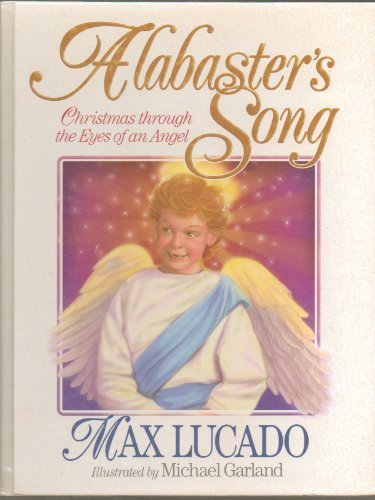 Parents often look for great books to share with their children at Christmas. For the next few days, I will share what I consider to be four of the best children’s Christmas books.
One of my favorites is Alabaster’s Song: Christmas through the Eyes of an Angel by Max Lucado. It tells the story of a boy who believes he hears the angel on the Christmas tree singing. Then miraculously, the gap-toothed angel appears by the boy’s bedside, a boy like him, and tells him what it was like to sing to baby Jesus. Children of all ages will enjoy this book, but parents, watch out, because you may get a lump in your own throat at the way the story ends.
The book can be found in many Christian book stores, and on Amazon.com here.
Book review: “Dead Lawyers Tell No Tales”
 If you like John Grisham, you will probably like Randy Singer. I have read many of Singer’s legal suspense novels, and I found his plot twists to be consistently good, often better than Grisham. Singer is a Christian writer who avoids profanity and has a Christian worldview to his books. As a Christian myself, I really like that. But if you are not a Christian, don’t let that put you off, especially in Dead Lawyers Tell No Tales. Although his previous novels are not “preachy,” this novel is even less so. Singer simply weaves a captivating story of redemption. Landon Reed, a former SEC football quarterback who went to jail for taking a bribe to throw a game, wants to redeem himself by becoming a lawyer and helping others. He is an imperfect man who nearly falls again, and then gets caught up in a law firm where somebody is slowly killing every lawyer at the firm.
From beginning to end the plot kept my interest. Each short chapter seemed to end with something that made me want to read the next chapter and learn how the plot would resolve. Singer is a lawyer himself, and is able to describe complicated legal situations with clarity and detail. But what made this story engrossing in the first half was the theme of forgiveness and a second chance. In the second half, the plot accelerated and I couldn’t put down the book until I finished. This is probably Randy Singer’s best book to date.
X
X
X
(If you see an ad below this post, please understand that I have no control over these ads, and that I do not necessarily endorse the product.)
Book review: Joe McKeever, “101 Cartoons”
 Recently, I had the pleasure of enjoying some pancakes with Joe McKeever. When he noticed that the waitress was friendly, he immediately pulled out a pad and pencil, asked her to stand still and smile, and in a few moments he had drawn a wonderful cartoon of her likeness. She was so excited, another waiter came to ask about it, and he gladly drew another one. Everywhere he goes, Joe draws pictures of people. You might say that he’s the quickest draw in the West.
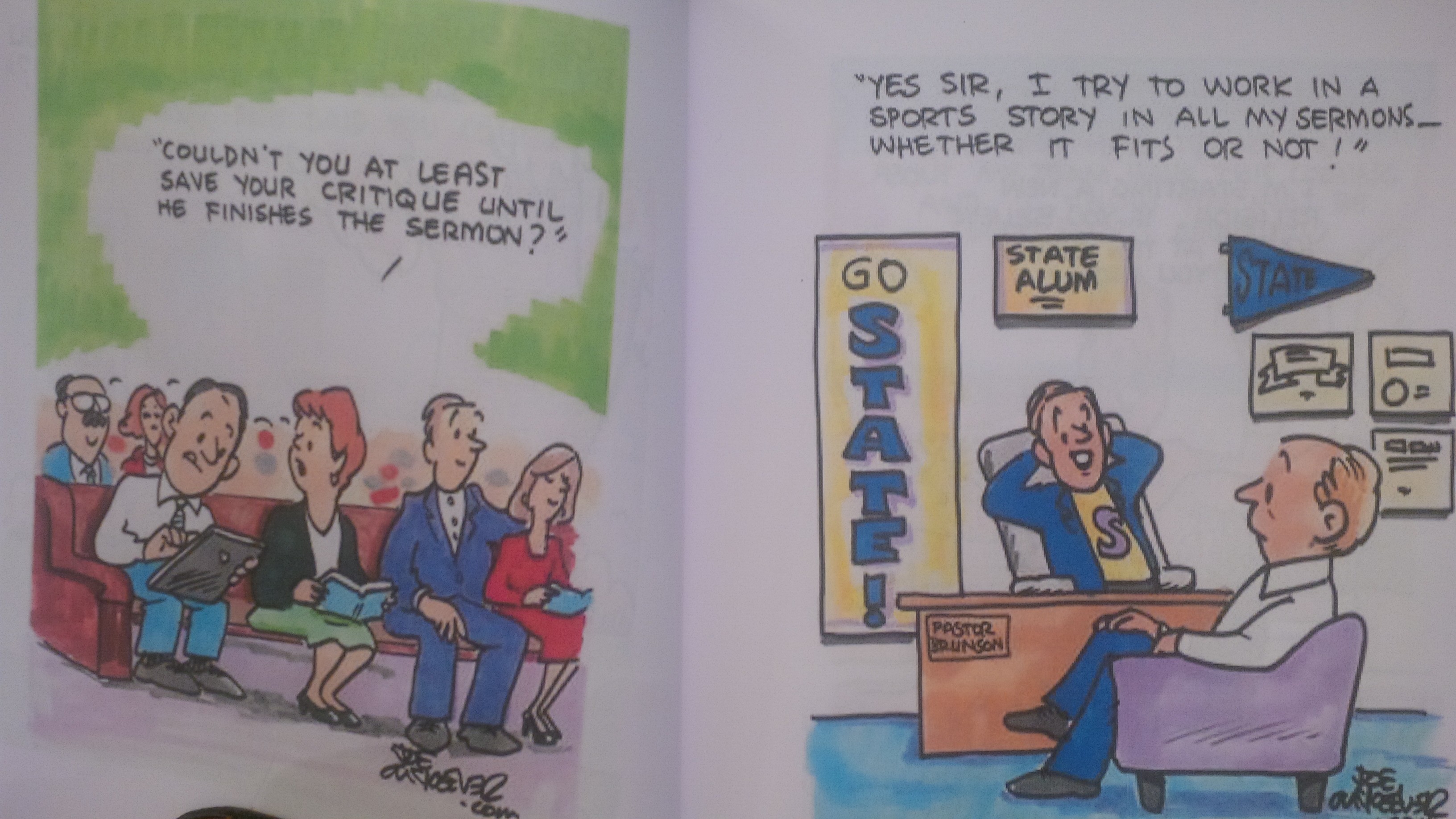
McKeever’s cartoons were published for years in Pulpit Helps and are still a regular feature in various Baptist newspapers through Baptist Press. Now McKeever has published a great collection of some recent favorites, entitled 101 Cartoons. Each cartoon is a full page, and nearly all are in full color. Most of the cartoons poke fun at religious subjects, as is illustrated by the photo at the bottom of this review. Others, like the cover photo above, poke fun at life in general.
McKeever has a corny sense of humor, which I like. He pokes fun at pastors, deacons, pastor search committees, hypocrites in church, seeker-sensitive churches, Calvinism, fickle church members, Facebook, smart phones, politicians, TV, the lottery, sports, health and exercise, among other things. Some of the cartoons make a serious point, such as the one that shows a man in a wheelchair in front of a church with inaccessible steps, who says, “I’ll bet this is a real pretty church on the inside.”
The print is large and easy to read, and as you can see from the photos, they are very colorful. It makes a great coffee table book for enjoyable conversation with family and visitors.
101 Cartoons is available from Amazon.com or you may purchase it directly from the author and he will inscribe a personal greeting and cartoon inside the front cover for you. Send a check for $15 for one or $27 for two, to Joe McKeever, P. O. Box 855, Kenner, LA 70063. In the interest of full disclosure, Brother Joe gave me a complimentary copy of his book along with the pancakes; however, he did not ask me to write this review– I was glad to do that myself!
 X
X
X
X
X
X
X
(If you see a video ad below this post, please understand that I have no control over these ads, and that I do not necessarily endorse the product.)
Book review: Max Lucado, “Outlive Your Life”
 I have read about 20 books by Max Lucado. I love his gift for telling a story and turning a phrase. However, after reading so many of his works, I began to feel that if I’ve read one of his books, I’ve read them all. So when I got a copy of Outlive Your Life: You Were Made to Make a Difference, I let it sit on my bookshelf for over three years.
Recently, some circumstances in my own life drew me again to the title. I’d like for my life to make more of a difference, so I decided to see what Max had to say. I was deeply moved– to take action.
This book uses the familiar writing style of Lucado that has made him one of the bestselling Christian authors of modern times: vivid storytelling with a surprise ending, and clever, poetic phraseology. For example, he described the apostle Peter’s reaction to the vision to eat unclean food by saying, “Peter was pondering the pigs in the blanket when he heard a knock at the door” (p. 146). He also follows a Biblical theme, as he does in most of his books. This one focuses on stories in the Acts of the Apostles to encourage Christian readers to make a difference in their world, the way the early disciples did.
What really stands out in this book, however, is how boldly Lucado calls on Christians to be involved in social action. Again and again, he urges Christians to help the poor, care for orphans, feed the hungry, etc. He is very specific in examples of how to do that, more so than any other book of his that I have read to date. He does so without abandoning the gospel message. In fact, chapter four, “Don’t Forget the Bread,” stresses that if we help the needy and don’t share the gospel, we are like he was when his wife sent him to buy bread at the grocery store and he came home with everything else and forgot the main thing: the bread.
Each of Lucado’s books include a discussion guide at the end, but this book has a “Discussion and Action Guide” (emphasis mine). America’s most inspirational author intends not only to inspire, but to move the reader to action. For this reader, he succeeded.
X
X
X
X
(If you see a video ad below this post, please understand that I have no control over these ads, and that I do not necessarily endorse the product.)
Book review: “Lord, Show Me Your Glory”
 I was attending a writer’s conference, and a publisher who was speaking to us said that books often sell well because of marketing and famous authors, not because of the quality of the books. Someone asked the publisher to name a book that did not sell well but was such a quality book that he was glad it was published. The publisher said, “Yes, the book is Lord, Show Me Your Glory by Ethel Herr.”
The book was out of print, so I ordered it from amazon.com. I’m glad that I did.
I spent the year of 2008 going through this devotional. A wonderful journey it was. The book is divided into 52 chapters to be used as 52 weeks of devotions. But each “Week” actually has two or three qualities of God to study, so it really amounts to about two or three devotionals for each week. For example, Week Four is a devotional on God is Carpenter, Potter, and a Working God, Week Twelve is on God as Living Bread and Manna, and Week Twenty is on Discipliner, Teacher/Master and Rabbi. You get the idea.
Herr has a very descriptive writing style. For example, in Week Eleven she describes God’s omniscience by saying, “grace without God’s omniscience would be as elusive as a hollow wind whistling through the broken window panes of an empty church” (p. 72). She also has keen insights into the character of God. In Week Eighteen, she says this about God’s as Resurrection and the Life: “So, when He chooses to let our dreams die so He can give us a resurrection rather than a healing, we sometimes feel abandoned” (p. 114). Each section lists scripture readings for further meditation on that particular quality of God. I found that looking up those scriptures was almost as enriching as the text of her book.
The experience of going through this book will help you understand the character of God in a powerful way. If you are looking for a practical devotional that is all about you and how you live your Christian life, this is not it. But if you are looking for a devotional that will make you forget yourself and will leave you in awe of our wondrous God, bowing before Him in worship, then find a used copy of this rare gem of a book online and order it.
X
X
X
(If you see a video ad below this post, please be aware that I have no control over these ads, and that I do not necessarily endorse the product.)
Book review on discipleship: “Growing Up”
 Copyright 2013 by Bob Rogers
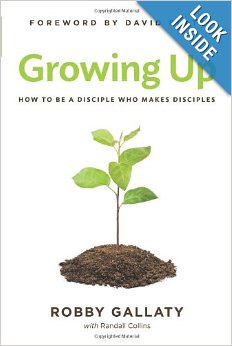
Robby Gallaty’s life was radically changed from drug-dealer to the pastor of a growing church. He credits the transformation not only to his conversion experience, but also to the process of personal discipleship he enjoyed under David Platt and others. His book, Growing Up: How to Be a Disciple Who Makes Disciples, shares his passion for discipleship that he is living out as pastor of Brainerd Baptist Church in Chattanooga, Tennessee.
Gallaty gives a strong Biblical argument for the need for discipleship. The focal point of his book is the suggestion that instead of depending on Sunday School classes to do discipleship, churches should have small, closed discipleship groups with a leader and 3 or 4 other people of the same gender. He uses the name “D-group” for such discipleship groups. He prefers such small groups over discipleship by one-on-one mentors, saying one-on-one mentoring is harder to reproduce and may turn into a counseling relationship instead of a discipleship process. While he gives good reasons for the D-group, he seems to overstate the case that his is the best way. After all, Gallaty himself was mentored one-on-one by David Platt, while Jim Putnam’s book, Real-Life Discipleship, describes some effective discipleship with small groups that are larger than the size that Gallaty suggests.
Nevertheless, Growing Up is a useful resource for church leaders wishing to get serious about discipleship. The book is filled with practical advice about growing in one’s prayer life, Bible study, evangelism, and discipling others. Gallaty is fond of acronyms. The last six chapters of his book form the acronymn for the discipleship process: “CLOSER” which stands for Communicate, Learn, Obey, Store, Evangelize and Renew. He suggests the “HEAR” method of Bible study: Highlight, Explain, Apply and Respond. He says the D-group needs “FAT” belivers: Faithful, Available and Teachable.
While I would argue that D-groups are not the only way to do it, the fact remains that Gallaty is actually leading his church to do something, rather than just talk about it. I would highly recommend Growing Up as a resource that church leaders can use to implement true discipleship in their churches. It is “REAL” (Realistic, Easy to Read, Applicable, and Life-changing).
In the interest of full disclosure, let me state that I received a free copy of this book for review, but I was under no obligation to write a positive review.
If you see a video ad below this post, please understand that I have no control over the content in these ads, and I do not necessarily endorse the product.


 Bob Rogers