Category Archives: history
The Mississippi Baptist story begins in South Carolina

Copyright by Robert C. Rogers and the Mississippi Baptist Convention Board.
The story of Mississippi Baptists begins in South Carolina. The Baptists of South Carolina furnished the first Baptist migrants to Mississippi and thus are of special importance in the history of Mississippi Baptists. Historians record that Rev. Richard Curtis, Jr. was 25 years old when he traveled with his parents and a group of fellow Baptists, who migrated from the Pee Dee River Valley of South Carolina in 1780 to settle on Cole’s Creek, about 20 miles north of Natchez, which at the time was controlled by Spain as part of West Florida. The precise location in South Carolina where these Baptists came from is unclear. One theory seeks to connect Richard Curtis and Mississippi Baptists to the historic Welsh Neck Baptist Church in Society Hill, in what is now in Darlington County, South Carolina. However, the church minutes of Welsh Neck Baptist Church from the time period are available for examination, and they never mention any of the Baptists who first settled in Mississippi. It seems more likely that they came from the region of Florence, South Carolina. There Richard Curtis, Sr., father of Richard Curtis, Jr., lived on Lake Swamp of Lynches Creek, near modern Florence, South Carolina, in 1766. In addition, Richard Curtis, Jr. was ordained by Benjamin Mosely when he fled back to South Carolina in the 1790s; Mosely was pastor of Ebenezer Baptist Church in Florence, South Carolina from 1784-1794.
The Revolutionary War period was one of great disturbance throughout South Carolina. There was a large group of Tories who were fanatical in support of England, but there was an equally powerful and more numerous citizenry who were American patriots. The conflict of these two groups stifled the economic development of South Carolina and brought fear and frustration into many parts of the colony. Over a hundred battles between American patriots and the British were fought in South Carolina alone. In 1774, Richard Curtis, Sr., and two of his sons, Benjamin and William Curtis, and his step-son, John Jones, enlisted with the American forces of Francis Marion, nicknamed the “Swamp Fox.” The records reveal that they served in three campaigns against the British, and then they were mustered out in 1779. In 1779 conditions had become almost unbearable, especially when British forces occupied Charleston. From this center, the British began a campaign to bring all of the colony under their control. The British were eventually overcome by General Nathanael Greene and his forces, but the turmoil and distress created by the war were undoubtedly a factor in encouraging some South Carolinians to seek a more peaceful place to live.
The Curtis family decided to establish their new homes along the Mississippi River near Natchez, in what was then called West Florida. After the French and Indian War in 1763, the British took Florida from Spain, and Englishmen from the colonies had begun to settle there. The stories of productive farmlands that were free to all settlers and the peace they would have from the turmoil of the fratricidal strife in South Carolina must have made the prospects of beginning again very enticing. In 1779, Spain took advantage of the British distraction with the American Revolution, and Spain conquered the Natchez district from the British and added it to West Florida. Despite this, the emigrants did not anticipate any difficulty from this source. As we shall see, they were wrong.
Dr. Rogers is writing a new history of Mississippi Baptists.
Announcement: I will be revising and updating A History of Mississippi Baptists

I am pleased to announce that on November 3, 2021, I signed a contract with the Mississippi Baptist Convention to revise and update A History of Mississippi Baptists by Richard Aubrey McLemore. The book was published by the convention, which holds the copyright, in 1971.
I expect the project to take a few years, as I will be doing a thorough revision of the original work, checking it for accuracy and rewriting in a more narrative style. After the revision is done, I will add two more chapters to update the last 50 years. You can read the full news story about the book here.
Follow his blog for stories that I learn and share along the way!
Book review: “Politics and Piety: Baptist Social Reform in America, 1770-1860”

Menikoff, Aaron. Politics and Piety: Baptist Social Reform in America, 1770-1860. Eugene, Oregon: Pickwick Publicaitons, 2014.
Aaron Menikoff fills in important gaps in Baptist history with this well-researched study of Baptist involvement in social reform between the American Revolution and Civil War. He is well-prepared to write on the subject, with a Ph.D. from Southern Baptist Theological Seminary, and experience as a legislative assistant to U.S. Senator Mark Hatfield, a Baptist.
This book debunks the common idea that Baptists in the 19th century were only concerned about personal salvation, and neglected social issues. He first examines the overall attitude of Baptists toward salvation, morality, politics, and church and state, with particular emphasis on how Baptists held in tension the idea that church and state should be separate, yet a nation needed to be virtuous to survive. In other words, the Baptist understanding of separation of church and meant the government had no right establishing a particular religion, but this did not mean a separation between church and society– far from it.
Next, Menikoff examines how this Baptist attitude played itself out in five major issues of the time: political parties, slavery, the Sabbath Mail Controversy, poverty, and the temperance movement. He shows the majority Baptist approach to each issue, while also revealing how different Baptists took different sides on each of these issues. ]
On political parties, Baptists usually avoided endorsing candidates or parties, yet spoke out on political issues, and some were more directly involved as candidates and supporting parties.
On slavery, Menikoff shows the complexity and diversity of Baptist views, including the colonization movement to resettle slaves in Africa. While Northern Baptists generally joined the abolitionist movement and southern Baptists opposed it, he shows how there were southern Baptists opposed to slavery in the south as late as the 1830s, and Baptist leaders like Richard Furman called upon slaveholders not to neglect the spiritual needs of their slaves.
The Sabbath Mail Controvesy is largely forgotten today, but at the time there was great religious opposition to the delivery of mail on Sunday, including most Baptists. He tells the fascinating story of how a Baptist Senator, Richard Johnson, gave the Congressional report supporting the delivery of mail every day, calling his fellow Baptists hypocrites for trying to unite church and state over the issue.
On poverty, the author shows how Baptists were active in relief efforts for the poor, although they often blamed the poor for getting themselves into their situation and focused on targeted giving of the “deserving poor.”
The temperance movement to abstain from alcohol was the most popular Baptist cause, as all Baptists saw alcohol abuse as a major social problem. However, Menikoff shows that Baptists also had different opinions over the temperance issue, especially defending the liberty of conscience for individual Baptists who drank moderately, and those Baptists who opposed to political efforts at prohibition on the grounds that it mixed church and state.
This book gave me a new perspective on several issues, especially the fascinating Sabbath Mail Controversy as well as how complex and diverse Baptist opinions were on slavery in the south. Menikoff’s research is carefully documented, with hundreds of footnotes and an exhaustive bibliography, leaving a rich resource for further study on the subjects covered. It is not light reading, but for those interested in Baptist history, it is rewarding, indeed.
Four 19th century biographies of Southern slavery
Recently, I’ve read four 19th century biographies and autobiographies of men and women who escaped slavery in the South. If you want to read about what slavery was really like in that time, these classic books will let you hear the stories in the words of those who experienced it.

Sarah Hopkins Bradford, Harriet, the Moses of Her People.
This biography, written by a white friend of Harriet Tubman gives a firsthand account of the amazing life of an amazing woman who bravely made so many trips to the South to rescue over 300 of her people along the “Underground Railroad.” The author is somewhat patronizing toward African-Americans, yet beautifully portrays the unwavering Christian faith that sustained Harriet through it all, and the events surrounding her that some call “supernatural.” Her story has recently been made into the film, Harriet.

Solomon Northrup, 12 Years a Slave.
The most dramatic story I have read of someone escaping slavery is that of Solomon Northrup, a free black man who was kidnapped in New York, and sold into slavery in Louisiana, where he suffered until his dramatic rescue. Northrup himself vividly describes his experiences, which shows the cruelty of slavery in the Deep South. The events surrounding his rescue will have you on the edge of your seat. No wonder this was made into an Academy Award Winning film!

Harriet Ann Jacobs, Incidents in the Life of a Slave Girl Written by Herself.
This account of a female former slave, using the name Linda Brent, shares graphic details of brutality and especially sexual abuse by white owners. There is a constant tension between Linda and her owner, Dr. Flint, whose affections she continually rejects. Although a true story published at the outbreak of the Civil War, it reads like a novel, and I read it quickly. It gives so many insights into slave life in the South, and even discrimination against blacks in the North.

Josiah Henson, The Life of Josiah Henson, Formerly a Slave.
This true story was the basis for Uncle Tom’s Cabin. I downloaded it and read it in one day. Henson was an industrious man with great leadership and organizational skills. The storyline moves quickly and is so emotional, that it overcomes the 19th century formal writing style. I highly recommend this short read to get a feel for the heartless institution of slavery in the South.
The memories behind the painting: growing up in the 1940s in rural Mississippi

(My mother, Joyce Clinton Rogers, was born on July 1, 1935. If you who follow her paintings on Instagram @mymothersart or on Facebook, you know that she is still actively painting, but the most treasured of all her paintings is the one of her grandfather in front of his home in Epley, Mississippi. Below she shares her personal memories of her grandparents, and what life was like growing up in the 1940s in rural Missississippi. It will help you understand why this painting is so special.)
by Joyce Clinton Rogers
When I was a little girl in the 1940s, my parents took me to spend a week in the summer with my Clinton grandparents who lived on a farm in Epley, Mississippi (located between Sumrall and Hattiesburg). I may have gone several summers– I’m not sure. I may have forgotten.
There wasn’t much a young girl could do but explore, so I did. A short walk away past the cemetery was a small bridge over a creek. It was fun to swing my feet into the cool creek water and see what critters were in the water.
My granddaddy was a farmer and a well-digger. Our whole family, my three sisters and three brothers, loved to play around the well. We had running water and electricity and a real bathroom at the teacher’s home at Oak Grove where we lived– but not my grandparents. My grandparents had an outdoor toilet and a Sears & Roebuck Catalogue for toilet paper. (I’m not kidding!) They had a tub used for washing clothes, vegetables, and for getting a bath, and goodness knows what else.
The story is told that granddaddy got baths by waiting ’til dark, stripping and pouring buckets of well water over his head, then drying off naturally by swinging in the swing on the front porch. One night, my Aunt Carol was entertaining a boyfriend on the front porch, and granddaddy’s arrival caused quite a stir!
I remember the house well. Our family visited every Sunday afternoon for years. I did a painting of the ole house, which hangs in back of my favorite chair where we live now. The farmhouse had no electricity and was heated by fireplaces and the kitchen by a stove. The stove had a door that opened and you put firewood inside. There were two fireplaces, one in each bedroom on each side of the house. When we went to visit in the wintertime, we sat on the edge of one of the two beds in the rooms to the right. If others came in, we just slid over. Grandma sat in her chair on the left of the fireplace, and granddaddy sat on the right.
On holidays, occasionally we might eat at the farmhouse. If that was the case, we came early so mama could help with the cooking. And oh, what a great feast we would have! We’d have fried chicken, lots of vegetables from their garden both fresh and “canned” (stored in jars), biscuits and cornbread, casseroles and desserts. As the oldest granddaughter, I got some jobs. Grandma made buttermilk and butter by placing milk in a jar, and I shook the jar until buttermilk and butter formed and separated from the other milk. My arms would get so tired!
I remember well hearing granddaddy say the blessing. He was loud! After he finished, he said, “Now you see what’s here…” I can’t remember what else he said (to finish that phrase). If any family remember, I wish you’d tell me how he finished that statement.
Speaking of being loud and praying, I had an interesting experience on one of my summer visits. I was on the swing on the front porch while granddaddy’s young pastor visited with him. I heard granddaddy praying loudly. I realized that the pastor didn’t come to pray for granddaddy, but for granddaddy to pray for him. Or maybe both ways.
Grandma always wore a long simple dress down to her ankles, an apron and her hair in a bun on top of her head. On Sunday, she wore a white apron. Granddaddy wore overalls and clean ones on Sunday.
Grandma swept the yard with a broom. She didn’t want grass growing in her yard. There was a rooster in the back yard who chased me. I was deathly afraid of him.
There was a long back porch where vegetables might be stacked or the washtub might be the bathing place for the more genteel. On the end of the porch near the kitchen was a shelf where a bucket of water with a dipper and a washpan stood. This is where you got a drink of water and/or washed your hands. Yes, we all drank from the same dipper.
Granddaddy never owned a car. He used his plowhorse, Dolly, to pull the family wagon to go to Sumrall for supplies and to church on Sunday. You can see him with Dolly in my painting.

Known in the community as “Uncle Charlie” and “Aunt Marthy,” this is how things were in rural Epley in the 1940s, 1950s and into the 1960s. Both are buried in the little Clinton Family Cemetery with their parents, their grandparents and some of their nine children and grandchildren, including one of my brothers, Donald Clinton. Also buried there are my parents, Rankin Anderson Clinton, Sr. and Lucy Rutledge Clinton, and Gwen Clinton, the first wife of my brother Sam.

Tearing down statues– where does it end?
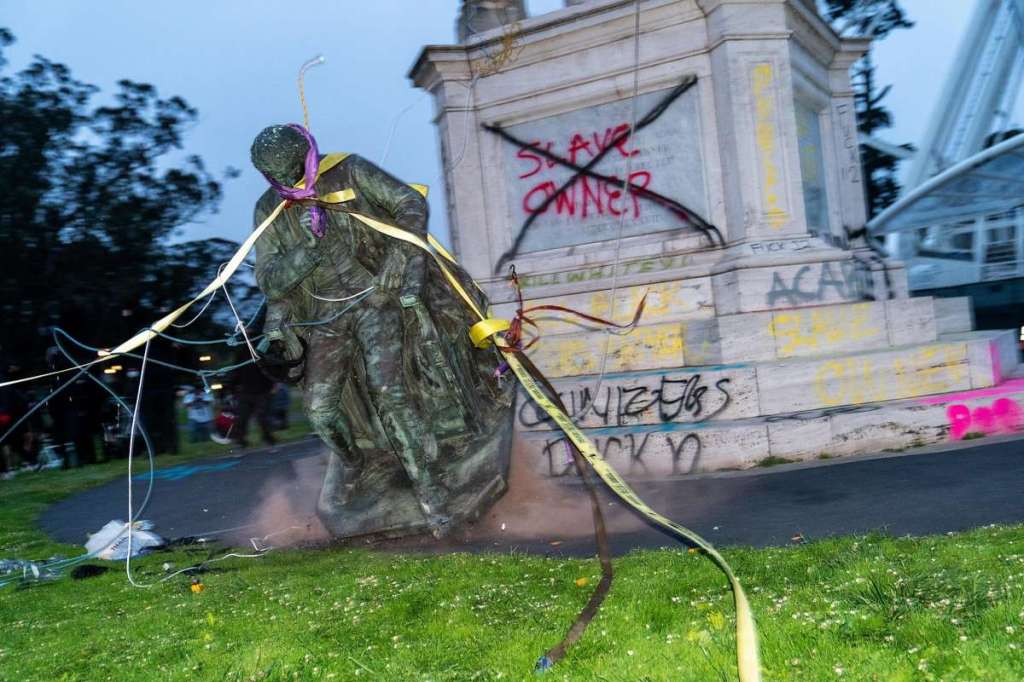
Protesters in San Francisco have pulled down a bust of Ulysses Grant, the former U.S. president and Union general who defeated the Confederates, because Grant married into a slave-owning family. They also pulled down other statues, including that of Francis Scott Key (pictured above), who wrote the U.S. national anthem, “The Star Spangled Banner,” since Key owned slaves.
I readily agree that slavery was and is reprehensible, and the Confederates were traitors to the Union. I also agree that statues of many such historical people need to be removed to museums, not glorified front and center in our parks and courthouses. But where does this sort of thing end? What person, past or present, is without character flaws?
I wonder if these same protesters would be willing to tear down a statue of Charles Darwin, since he was a racist who said Africans were less evolved than white people? I wonder if these same protesters would be willing to deface a statue of John F. Kennedy, since he was reportedly an adulterer?
Interestingly, some of those people of the past, if they were here today, would likely be shocked by the immoral practices of some of these modern protesters, some who may cohabitate outside of marriage or may have killed babies through abortion– but at least they didn’t own slaves, so they judge themselves righteous. How blind these self-righteous anarchists are, seeing the sins of the past but ignoring the sins of the present.
These modern moralists do not see how similar their vandalism is to ISIS fighters who tore down ancient statues in the Middle East because they were “pagan.” These revolutionaries do not see how their onrush to destroy any and every injustice in the name of the people is similar to another revolution– the French revolution, a time when the revolutionaries were soon devouring each other for not being radical enough. Today’s radicals could read about it in their history books, but it seems they have torn out most of the pages.
Book review: The Burdens of Disease: Epidemics and Human Response in Western History

J. N. Hays. The Burdens of Disease: Epidemics and Human Response in Western History. Rutgers, 2003.
During the coronavirus epidemic of 2020, I decided to pull this book off my shelf and read it. I’m glad I did, since it approaches the history of epidemics and disease in Western civilization from a historical and social perspective, explaining how society reacted to such epidemics as the Black Death, leprosy, typhus, cholera, tuberculosis, smallpox, polio, the flu epidemic of 1918, and AIDS. Hays traces the history of how physicians, governments, religion and common people responded to these epidemics. In particular, he gives a history of the development of modern medical science.
Although the book was written long before the international crisis of COVID-19, many lessons in his book will be of interest to readers today. He sees epidemic as a social issue, not just a medical issue, because it affects all of society.
Religious views toward disease have often been a factor. During the bubonic plague (Black Death) of the late Middle Ages, people often thought God was punishing them, and groups of “flagellants” even drew their own blood to atone for sins, assuming the role of Jesus’ sacrifice. Diseases like syphilis and AIDS were especially associated with sexual sin, but also tuberculosis (formerly called “consumption”) and polio were associated with the immorality in filthy slums, until the presence of these diseases among the rich and famous reframed attitudes. Hays tends to be negative toward religious faith, saying the scientific revolution “undercut traditional Christian orthodoxy” (p. 88), although he does not explain how, and later admits that the devout Christian scientist, Isaac Newton, appealed to “the very first Cause, which certainly is not mechanical” (p. 99). On the other hand, Hays also points out the limitations of science, holding in the mirror of irony the bold claims of scientists in 1872 that “men will master the forces of Nature” (p. 213) and in 1955 a news writer’s claim that “man one day may be armed with vaccine shields against every infectious ill that besets him” (p. 240).
Hays shows how disease was used and abused by the powerful, particularly governments, sometimes to protect, and sometimes to control. Italian city-states often quarantined people during the bubonic plague in an attempt to stop the spread of disease, much to the chagrin of businessmen and churches not allowed to meet or trade. Governments cleaned up slums, installed sanitary running water and garbage collection, and required vaccinations, all with a view to better health. However, democracies that valued personal freedoms struggled with this approach, as cities like Hamburg, Germany about 1900 were reluctant to impose vaccinations against the liberties of its people, until the city saw evidence of its effectiveness. City officials in San Francisco denied the existence of plague in Chinatown in 1900, calling it a “scare” and made it a felony to tell the news (p. 183). Governments fighting in World War I suppressed the news stories of the flu epidemic of 1918-19, so as not to divert attention from the war effort, thus it was nicknamed “Spanish flu” because Spain, a non-combatant in the war, reported on it freely. The darkest story of disease was the use of eugenics and euthanasia by Nazi Germany, which considered Jews “diseased” and also exterminated “the tubercular, the homeless, those unwilling or unable to work, and criminals of many sorts” (p. 287). Perhaps the most sinister destruction was the elimination of most of the Native American population by diseases that were brought by Europeans to the New World.
Socially, Hays discusses how social isolation protected people from epidemics in the Middle Ages, when people rarely travelled outside their own villages, and the Black Death only occured after cities arose in Europe and trade developed from nation to nation. He notes that major advances in transportation such as steamships and railroads provided opportunities for plagues to spread rapidly as travel from continent to continent was reduced to days, not giving viruses time to die before they spread to new victims.
Social changes also occurred for the better to prevent disease, as it became socially accepted to take baths, wash hands frequently, drink pastuerized milk, and it became socially unacceptable to spit or sneeze in public, or smoke tobacco in public. One wonders what social changes may occur after our current epidemic, but that is likely the subject of another book.
Book review: “A History of the Modern Middle East”
A
A History of the Modern Middle East by William L. Cleveland and Martin Bunton, 6th ed., (Westview Press, 2016).
This history does as the title promises, focusing more on the modern period of the Middle East, especially from the Ottoman Empire through 2015. The book covers the rise of ISIS but was written before the downfall of ISIS. It includes the Arab Spring of 2011, which Cleveland prefers to call the “Arab Uprisings.” It includes balanced discussions of areas from Turkey to Iran to the Arabian Peninsula to Egypt. It does not include neighboring countries such as the Sudan, North Africa or Afghanistan in the discussion, except where events there affect the Middle East proper, such as the Egyptian war in Sudan, the harboring of Osama bin Laden by the Taliban in Afghanistan, and the Arab uprisings that began in Tunisia and led to the downfall of Libya’s dictator, too.
The book gives much attention to the Arab-Israeli conflict, which is appropriate, as well as thorough coverage of the Kurdish problem of being a people without a homeland.
Perhaps due to his focus on the modern period, Cleveland passes over the Crusades with barely a mention, which I found peculiar, since modern Arabs like Osama bin Laden referred to Christians as the “Crusaders.”
While Cleveland strives to present a balanced report of both the positive and negative traits of each people and each personality, he appears to have certain biases. He clearly is sympathetic to the plight of the Palestinians verses the Jews, and is favorable to the Muslim worldview (for example, he blames Islam’s low view of women on the influences of the cultures neighboring the Arabs, and refers to the Muslim Brotherhood as “moderate”). Nevertheless, he does a good job of explaining the various sectarian and ethnic groups, such as the Sunni and Shi’a, and minority groups like Arab Christians, Assyrians, Yazidis, Druze, Alawites, etc.
Three strategies for victory, learned from Roman history

Copyright by Bob Rogers, Th.D.
The Romans were a powerful people for over a thousand years. However, it was a slow process for Rome to become a powerful nation. They won a 70-year off and on battle against the walled Etruscan city of Veii, only ten miles to the north, finally capturing it in 396 B.C. Here are three lessons for battle that they learned, that would make them a victorious military power for centuries. Many of these lessons are useful today:
Lesson 1: Learn from defeat.
The Gallic Sack of Rome about 387 B.C. shocked them, when wild warriors from Gaul swept down from the Po Valley, burned and looted the city. After paying the Gallic army to leave, they copied the walls of Veii, and built a wall around Rome.
They fought three wars with the Samnites, who inhabited the Apennines Mountains in central Italy, and lost major battles to them because the phalanx didn’t work well in the mountains, but they learned how to fight different ways in the mountains.
What defeats have you suffered in life? How can you learn from them?
Lesson 2: Divide and conquer.
Although strategically located, the Romans were not the largest or most powerful people in Italy in their early years. But Romans were well organized and united, able to slowly “divide and conquer” the rest of Italy, mainly because the other people groups were not united. For example, the Etruscan cities were totally independent of one another, so the other cities didn’t help Veii, allowing Rome to capture them. They often played one group against another, as when they made a peace treaty with Carthage and allowed them to oppose the Greeks in Sicily, then after Rome defeated the Greeks, Rome turned against Carthage.
This strategy is manipulative and unethical when done with allies and friends. However, the “divide and conquer” strategy has its usefulness with opponents and enemies. If you have multiple opponents or problems, instead of taking all of them on, which ones could you defeat first, and then move on to the next? What ways can you let them work against each other?
Lesson 3: Make your enemies your friends.
When they defeated the Latins, Rome made them their allies, eventually merging with them. They later did the same with other groups in Italy that they conquered, including Etruscans and Samnites and Gauls. As each became an ally, Rome became stronger and stronger. At last, they were strong enough to take on the Greek colonies in the south of Italy, and slowly they united all of Italy.
This strategy is much more ethical, and has many benefits. What common ground can you find with opponents, turning them into allies and friends?
(Dr. Rogers is an adjunct history professor for The Baptist College of Florida, where he has taught Roman History numerous times.)
Where do we get the tradition of Christmas trees?

Article copyright by Bob Rogers.
All over the world, people are putting up Christmas trees for the holiday. But what does this have to do with the birth of Jesus? Is it just a pagan practice, or can we find Christ in the Christmas tree?
Where did the tradition of the Christmas tree come from?
There are many different stories, since ancient peoples have made use of trees and even worshiped them. One of my favorite stories is of St. Boniface, the missionary to the Germans in the 8th century. Boniface told them about Jesus Christ, but they worshiped a great oak tree. So Boniface boldly went to the oak with an ax and began to chop it down. They were ready to kill him, when a great wind came and blew the tree down. After that, the Germans converted to Christianity in large numbers.
Some legends tell that St. Boniface later decorated a fir tree to represent Jesus instead of their pagan gods. It is uncertain whether this is true.
During the Middle Ages, there was a popular medieval play in western Germany about Adam and Eve and a “paradise tree,” which was a fir tree hung with apples, that represented the Garden of Eden. Germans set up paradise trees in their homes on December 24, the feast day of Adam and Eve. They hung wafers on it, representing the bread of Christ in the Lord’s Supper, and then later they hang cookies, and often put candles, symbols of Christ as the light.
Meanwhile, in the 15th and 16th century in Latvia, Estonia and northern Germany, there was a tradition of bringing an evergreen tree to the town square on Christmas Eve, dancing around it, and letting it burn. Eventually people in Germany began to light a tree on Christmas Eve with candles. Lutheran tradition says that the Protestant reformer Martin Luther helped popularize the lighting of an evergreen tree at Christmas all over Germany.
The stories behind three of the most popular Christmas carols

Article copyright by Bob Rogers.
Perhaps the three most popular Christmas carols in English are “Joy to the World,” “Hark! The Herald Angels Sing” and “Silent Night.” The first two were sung in the American colonies even before the United States was a nation, but the third one came from Austria.
“Joy to the World” was written by Isaac Watts in 1719. It is based on Psalm 98, and its tune comes from one of the songs in Handel’s Messiah. Originally this song was intended to refer to Jesus’ Second Coming, but it has come to be associated mostly with His first coming at Christmas.
“Hark the Herald Angels Sing” was written by the great Methodist founder Charles Wesley in 1739, and the words were revised by the great evangelist of the Great Awakening, George Whitefield. A hundred years later, the classical composer Felix Mendelssohn composed the tune that is popular today when people sing “Hark the Herald Angels Sing.”
“Silent Night” was originally written in German and first sung on Christmas Eve, 1818, at St. Nicholas Church in the village of Oberndorf, near Salzburg, Austria. The organist, Franz Gruber, discovered that the organ wasn’t working at the church. The priest, Joseph Mohr, had composed the words in German to “Silent Night” two years before. So he shared it with Gruber, who composed the tune to be sung by guitar. When Karl Mauracher came to repair the organ, he heard the story of how the song was composed in an emergency and sung without the organ, and Mauracher spread the song everywhere that he went. The song came to America by German-speaking congregations. Originally the words were “Stille Nacht, Heilige Nacht.” The English words we sing today were translated by John Freeman Young. “Silent Night” has been translated into 140 languages.
While these songs are popular today, the first Christmas carols can be found in the Bible itself. More about that tomorrow…
The origins of Christmas carols

Article copyright by Bob Rogers.
While many Americans sing about Santa, chestnuts and a white Christmas, Christians all over the world have sung about the birth of Jesus Christ for centuries. As early as the fourth century, Ambrose, the archbishop of Milan, wrote a hymn for Christmas to teach that God truly became a man, in response to heretics who denied Jesus’ incarnation.
Singing Christmas carols was popularized by St. Francis of Assisi during the Middle Ages in Europe, and was also encouraged by the Protestant Reformers, such as Martin Luther. As early as the 15th century, groups of singers would go from house to house in England and sing Christmas carols. Christmas carols in English first appear in a 1426 work of John Awdlay, chaplain from Shropshire, who lists twenty five “caroles of Cristemas”, probably sung by groups of “wassailers,” who went from house to house and enjoyed “wassail,” ale, or apple cider, and other desserts given to them at each home. Thus we get the line, “here we go a wassailing among the leaves so green,” and since the homes often fed the carolers, we also get the line, “bring out the figgy pudding, we won’t go until we get some.” It was only later that carols begun to be sung in church, and to be specifically associated with Christmas.
Two of the oldest Christmas carols still sung today are “O Come, all ye faithful,” which was originally written in the 13th century, and “Good Christian Men, Rejoice” which was first composed in the 14th century.
Perhaps the three most popular Christmas carols in English are “Joy to the World,” “Hark! The Herald Angels Sing” and “Silent Night.” The first two were sung in the American colonies even before the United States was a nation, but the third one came from Austria. More about them tomorrow…
The Christian roots of Santa Claus

Article copyright by Bob Rogers.
Many American children look forward to Christmas gifts from Santa Claus, but few people know the Christian roots of the legend of Santa.
Clement C. Moore’s poem
The American traditions of Santa Claus comes primarily from the poem by Clement C. Moore, a seminary professor in New York City. The poem was originally called, “A Visit from St. Nicholas,” but most of us know it by the first line, “’Twas the Night Before Christmas.” It was published in 1823 and had a great impact on the tradition of Santa Claus. It is from this poem that people get the idea of a jolly elf with a big belly coming on Christmas Eve with reindeer and bringing gifts for children. Yet even this poem never calls him Santa Claus, but instead it calls him St. Nicholas.
St. Nicholas
Nicholas was a real person who was a Christian bishop in the 4th century. He was born in A.D. 270, and died on December 6, A.D. 343. Nicholas grew up in a wealthy home in Myra, part of modern-day Turkey. He became bishop of Myra and was known as an orthodox, Bible-believing bishop, with a reputation for secret gift-giving and caring for children. One legend said that he often put coins in the shoes of people in need. The most famous legend about Nicholas was that a poor man had three daughters but could not afford a proper dowry for their wedding. This meant that they would remain unmarried and probably, in absence of any other possible employment, would have to become prostitutes. Hearing of the girls’ plight, Nicholas decided to help them, but being too modest to help the family in public (or to save them the humiliation of accepting charity), he went to the house under the cover of night and threw three purses (one for each daughter) filled with gold coins through the window opening into the house.
One version of the legend has him throwing one purse for three consecutive nights. Another has him throwing the purses over a period of three years, each time the night before one of the daughters comes of age. Invariably, the third time the father lies in wait, trying to discover the identity of their benefactor. In one version the father confronts the saint, only to have Saint Nicholas say it is not him he should thank, but God alone. In another version, Nicholas learns of the poor man’s plan and drops the third bag down the chimney instead; a variant holds that the daughter had washed her stockings that evening and hung them over the embers to dry, and that the bag of gold fell into the stocking.
The legends develop
You can quickly see how these legends developed over the centuries into the legend of a character who brings gifts in secret, sometimes in stockings or down a chimney. He is known by many names in many countries, including Father Christmas, Père Noël in French, and Sinterklaas in Dutch.
Because the real St. Nicholas died on December 6, in many nations he is remembered on that day with the giving of gifts. But during the Protestant Reformation, many Protestants changed the gift-giver to the Christ child, which is Christkindl in German, and changed the date from December 6 to Christmas Eve. The German Christkindl was corrupted to Kris Kringle in English, and in New York, the home of poet Clement C. Moore, the Dutch Sinterklaas was corrupted to Santa Claus in English.
The history of Christmas lights

Copyright by Bob Rogers.
Ever since the star of Bethlehem led the wise men to baby Jesus, Christmas has been associated with lights. For centuries, Christmas lights meant lighting candles.
Lights on trees
The tradition of putting up Christmas lights began with putting candles on Christmas trees. Christmas trees originated in Germany by the 16th century, from several different traditions. Some Germans actually burned an evergreen tree in the town square and danced around it. There is a popular legend that Martin Luther, the German Protestant reformer, began the tradition of putting candles on Christmas trees. The legend says that one crisp Christmas Eve, about the year 1500, he was walking through snow-covered woods and was struck by the beauty of a group of small evergreens. Their branches, dusted with snow, shimmered in the moonlight. When he got home, he set up a little fir tree indoors so he could share this story with his children. He decorated it with candles, which he lighted in honor of Christ’s birth.
Advent wreaths
Whether or not this is true, we know that the Advent wreath was invented in 1839 by Johann Henrich Wichern, a Protestant pastor who worked with the urban poor in Germany. The children would ask every day if Christmas had arrived, so Wichern built a ring with evergreen and candles to candles to light the 24 days in December before Christmas, and large candles to mark the Sundays. Later this was simplified to four candles for the four Sundays, and a Christ candle in the middle for Christmas Eve or Christmas Day. The custom of lighting an Advent candle did not spread to America until a century later, in the 1930s.
Origin of electric Christmas lights
On December 22, 1882, Edward H. Johnson, vice president of the Edison Electric Light Company, displayed his Christmas tree with 80 red, white and blue electric lights bulbs the size of walnuts, at his home on Fifth Avenue in New York City. This was the first time a Christmas tree had been illuminated with electric lights, but the idea spread quickly. Three years later, the White House Christmas tree was covered with electric lights. By the early 19th century, it became popular to put lights on buildings, not just on Christmas trees. In the 1960s, with the construction of so many subdivisions in American communities, it became the custom in American neighborhoods for many families to cover their houses with lights. This custom has spread around the world, and is particularly popular in Japan.
Today, Christmas lights cover waterfronts, caverns, skyscrapers and shopping centers. Some even use synchronized timers to have their lights flash to music. May each light remind us of a star long ago that led to Jesus, the Light of the world!
Four key pieces to the Middle East puzzle

Copyright by Bob Rogers.
After the terrorist attacks of September 11, 2001, country singer Alan Jackson wrote a hit song, asking, “Where were you when the world stopped turnin’ that September day?” One line in that song expressed how little most Americans understand the Middle East:
“I’m just a singer of simple songs
I’m not a real political man
I watch CNN, but I’m not sure I can tell you
The diff’rence in Iraq and Iran.”
So how does one piece together the puzzle of the Middle East? There are four important pieces to the puzzle that are key. Fit these four pieces in place, and you will get a good picture of why there is conflict in the Middle East:
1. Muslims are not all alike. Most Americans assume that all Muslims are the same. In fact, there are two major branches of Islam: Sunni and Shiite. They have different doctrines, and a long history of bitter conflict. On the Shiite side is Iran, southern Iraq, rebels in Yemen, Hezbollah in Lebanon, Hamas in Gaza, and Bashar al-Assad, dictator of Syria. On the Sunni side is most of the rest of the Muslim world, including northern and western Iraq, the government in Yemen, the Islamic State (ISIS), the majority of Syria, and such large nations as Saudi Arabia, Egypt and Turkey. Now take a look at the map above. See the two geographical giants, Saudi Arabia and Iran? Saudi Arabia is Sunni, and Iran is Shi’a, and the two nations are in constant struggle against one another. See Iraq between them? As Iran seeks to extend it’s influence, Saudi Arabia opposes Iran, and places like Iraq and Yemen are the battleground.
2. Middle Easterners are not all Arabs. Most Americans assume all Middle Easterners are either Arabs or Jews. In fact, there are three other major ethnic groups in the Middle East that speak different languages and have different cultures: Turks, Kurds and Persians. Jews dominate Israel, and most of the southern part of the Middle East is Arab, including Egypt and Saudi Arabia, but as one goes north, there are other ethnicities. Turks are the majority in Turkey, but some 20% of Turkey are Kurds, and Kurds are concentrated in southeastern Turkey. Kurds have a semi-autonomous self-rule in northern Iraq, and Kurds in northern Syria have dominated that region as they defeated ISIS during Syria’s Civil War. Iran is primarily Persian, but has Kurds in its western region. There are also ethnic groups in the Middle East like the Coptic Christians of Egypt, Druze in Lebanon, Assyrian Christians in Iraq, and Yazidis in Iraq (who speak the Kurdish language but have their own religion that blends Islam with Christianity and Zoroastrianism. ISIS considers the Yazidis to be demon-worshipers.).
3. Many of their national boundaries were forced on the Middle East. Before World War I, the Ottoman Empire ruled a vast area that included what is now Turkey, Iraq, Lebanon, Syria, Jordan, Israel, and Saudi Arabia (even Egypt was subject to the Ottoman Empire). The Ottomans sided with Germany in WWI, and lost everything but Turkey after the war. Europeans, who didn’t understand the region, drew new national boundaries to create many of the nations we now have in that region, most notably splitting up the region inhabited by 25 million Kurds into parts of Iran, Turkey, Iraq and Syria. Thus the Kurds have been a mistreated minority in their own homeland. What is more, the Europeans created a new nation called Iraq, out of three former Ottoman provinces that had no natural commonality, with Kurds in the north, Sunni Arabs in the middle, and Shi’a Arabs in the south. No wonder Iraq is in constant conflict.
4. There are two sides to the story in the Israeli-Palestinian conflict. Before World War I, the population of the Ottoman province of Palestine was about 90% Arab, although Jews were always there. The Ottoman Empire turned over Palestine to British rule after WWI, and the British encouraged Jews to return to their ancient homeland. Jews immigrated there in such massive numbers, buying up the best land, that by World War II, the Jews were nearly equal in number to Arabs. Palestinians deeply resented this, which they saw as an invasion of their homeland. After the Nazi holocaust of World War II, many more Jews fled to Palestine. Britain tried to divide the nation between the Palestinian Arabs and the Jews. Israel agreed to the two states solution, but the Arabs refused, only wanting the eradication of the Jews. This led to war, which the Jews won, establishing the state of Israel in 1948. Feeling disenfranchised, Palestinians have resorted to riots and terrorism ever since then. Israel has consistently won wars with the Arabs, and has often made peace with Arab neighbors by returning land in exchange for peace, especially with Egypt. However, Arabs living in Gaza (the “Palestinians”) and West Bank, have refused to make peace.
This is only a simplified summary of the Middle East. There are many other pieces to the puzzle, and other complicating factors. But if you understand these four key pieces above, you will have a much clearer picture of the Middle East puzzle.
(Dr. Bob Rogers has a Th.D. in Church History, and has taught History of the Middle East at The Baptist University of Florida.)


 Bob Rogers