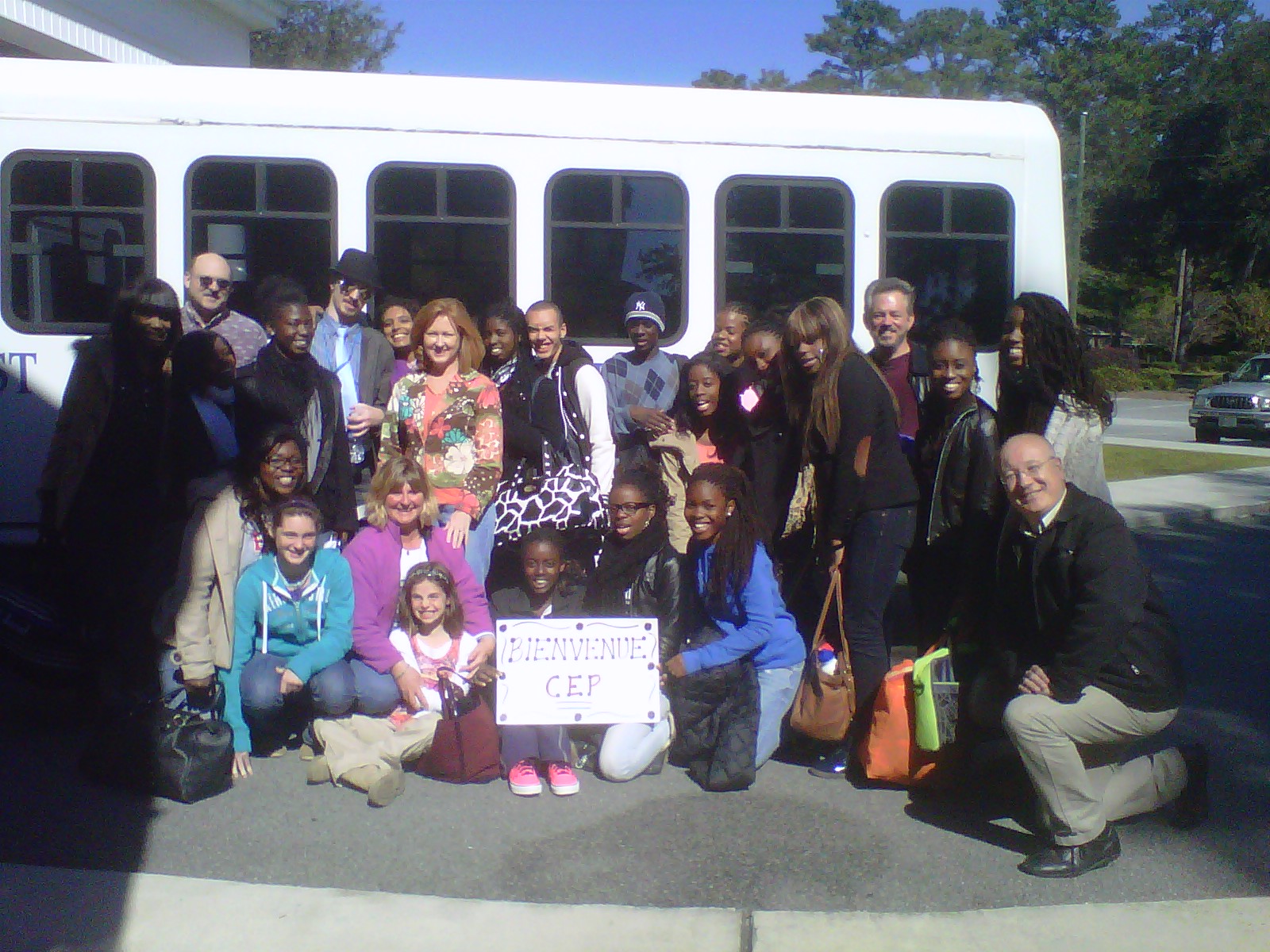
The youth group from Centre Evangelique Protestant of Colombes, France departed on Sunday afternoon, October 30. Donna, the bus driver, is the red-haired lady standing, and Elodie, our French church member who translated, is sitting below Donna. Their airplane departed the Savannah airport shortly after 4:00 p.m. (16:00 hours) on Sunday.
Author Archives: Bob Rogers
Coffee, memory loss and Christmas
I was glad to read recently that drinking coffee can help your short-term memory loss. You see, I’m a forgetful, coffee-drinking preacher.
Having a bad memory is not good when you are a minister. When I was pastor of Union Baptist Church in Roxie, Mississippi, our treasurer had a car wreck. I went to see her, and before leaving, I offered to pray for her. As I began the prayer, I suddenly remembered that I had forgotten her name! The church only had about 35 people attend each Sunday, so it wasn’t like I had a lot of names to recall. Anyway, being the sophisticated young professional that I was, I blurted out, “What’s your name?” She told me with a sad voice it was “Jean,” and then I prayed aloud for God to heal Jean, and silently I prayed for God to get me out of there alive.
My pastor friend in New Orleans, Joe McKeever, tells how he was asked to visit a member’s sister in the hospital and pray for her. Forgetting her name, his prayer sounded strange: “Please bless this dear brother’s sister, Father.”
That reminds me of a forgetful moment I had when I lived in New Orleans. I was driving home from church. To my surprise, a New Orleans cop turned on his blue lights and pulled me over. As soon as I stopped, he got on his loudspeaker and announced loudly enough for the whole city to hear, “There’s a book on your car.” I got out, and saw that my black leather
Bible was sitting on the roof of the car, just above the driver’s seat. Apparently I left it there after church when I was talking to somebody. The Bible was open and its pages were in disarray, and the Sunday bulletin was gone, but at least my Bible didn’t fall off the car. It would be hard to explain to my Bible professor why I trampled the Word of God with my tires.
Red-faced, I retrieved the Bible, and the policeman smiled and drove away.
All of this reminds me (you see, the coffee-drinking is helping my memory already!) of how many people get forgetful at Christmas. Folks put up their holiday decorations and do their holiday shopping and send holiday cards with “Season’s Greetings,” and attend holiday parties and holiday parades. But they forget what the holiday is about.
This Christmas, don’t forget to Whom we pray. His name is Jesus. This Christmas, don’t forget the Book. It’s called the Bible, and it has good news for you, that a Savior, Christ the Lord, was born in Bethlehem. May I make a suggestion? This Christmas, before you open any presents, curl up with a hot cup of coffee, open the Good Book to the Gospel of Luke, chapter 2, and read the story to your family. You may find yourself saying, “Ah, I remember.”
2011 revision of NIV Bible both pleasing and disappointing

In March 2011, the copyright owners of the most popular modern translation of the Bible in English, the New International Version (NIV), published the first revision of the NIV since 1984.
As a pastor who did not like the over-reaching political correctness of the Today’s New International Version (TNIV, copyright 2002), I was concerned when I heard that the NIV itself was going to be revised. But after studying the digital early release version in numerous passages, I have been pleased that it is more accurate, but disappointed that while the use of gender-neutral language does not go as far as the TNIV, it still goes too far.
The new NIV retains 95% of the words of the 1984 edition, but where there are changes, it communicates the original meaning better to modern readers and more accurately than before.
Let me address several issues: gender-neutral language, omission of words, and accuracy of translation.
Gender-neutral language
First, the most controversial issue of the TNIV (the earlier failed attempt to revise the NIV) was its gender-neutral language. The Southern Baptist Convention passed a resolution in June 2011 saying they “cannot commend” the 2011 NIV. Why is that? The 2011 NIV does not go as far as the TNIV. In Hebrews 12, where scripture speaks of God disciplining us like a father, the TNIV changed “father” to “parent.” This implied that God was a gender-neutral “parent” rather than our “heavenly Father.” I’m glad to report that the new NIV has “father,” just as the 1984 edition had. However, the new NIV, like the TNIV, does use gender-neutral “brothers and sisters” when the context clearly means all believers. Since modern English speakers use both genders, “brothers and sisters,” when addressing all believers, not just the masculine “brothers,” it makes sense that the Bible they are reading do the same. However, this may not be acceptable to all readers, particularly in passages like Psalm 1, where the masculine pronoun is often associated with a reference to manhood. In the 1984 NIV, Psalm 1 says, “Blessed is the man who does not walk in the counsel of the wicked… He is like a tree planted by streams of water…” but the 2011 NIV renders it, “Blessed is the one who does not walk in step with the wicked…That person is like a tree planted by steams of water…”
The 2011 NIV changes “fathers” to “parents” in Malachi 4:6, although the Hebrew word is ab, fathers. Also, Ezekiel 22:30, the famous “stand in the gap” passage used by Promise Keepers to challenge men, has been changed from “man” to “someone.” A favorite verse of the men’s group, Promise Keepers, was Proverbs 27:17, because it said that as iron sharpens iron, so one man sharpens another. However, the 2011 NIV changes “man” to “person.” These kind of changes can be found hundreds of times throughout the Old and New Testaments in the 2011 NIV.
However, the 2011 NIV continues to say “sons” in Romans 8:14 and “sonship” in Romans 8:15 in a discussion of spiritual adoption which refers to the male heir. Thus it does not use gender-neutral language in places where it would impact theology, but it does use gender-neutral language in some places that have traditionally been interpreted as references to manhood. The revised NIV also continues to maintain clear sexual distinctions between the genders in passages like Genesis 1:27, which reads, “So God created mankind in his own image…male and female he created them.”
Omission of words
The second translation issue is the omission of words. One of the biggest criticisms of the 1984 NIV was that sometimes words in the Greek text simply were not translated. The most notorious example was the Gospel of Mark, which makes frequent use of the Greek word euthus, “immediately.” For some reason, there were many verses in the 1984 NIV that simply ignored this word. But the 2011 NIV is careful to translate it as “immediately” or “as soon” etc. in every place where it is used. I have been doing a verse-by-verse study of Romans in the Greek, and comparing the old and new versions of the NIV, I found that where the old NIV omitted the word “or” at the beginning of Romans 3:29, the new NIV restored the word. And in Romans 4:1, the old NIV omitted the words “according to the flesh,” but the new NIV put the phrase back in.
Accuracy of translation
The third translation issue is the accuracy of translation. In an attempt to be easy to read, the NIV has been less precise in translating words and phrases. It’s a difficult balance for any translation, but sometimes the 1984 NIV paraphrased the text in places that caused the reader to miss the technical point that the Biblical writer was making. For example, the 1984 NIV translates Romans 3:28, “observing the law.” But the 2011 NIV translates it, “works of the law.” The Greek phrase is literally, “works of the law.”
In Romans chapter 8, Paul uses the word “flesh” as a metaphor for the sinful nature. The 1984 NIV translates it “sinful nature,” which gets the idea across, but thereby obscures the deliberate play on words in Romans 8:3 when Paul says that when we were weakened by the flesh, God sent Jesus in the flesh. The 1984 NIV has “sinful nature” in these verses, but the 2011 NIV uses the literal word “flesh.”
In Romans 8:4, the 1984 NIV says that Jesus’ sacrifice satisfied the “righteous requirements” of the law. However, the Greek word translated “requirements” is singular. The 2011 NIV changes it to the singular “requirement.” This might seem a minor distinction, but theologically the singular implies that God covers the entirety of our sin, not just some sins.
In Romans 10:4, the 1984 NIV reads, “Christ is the end of the law…” The Greek word translated “end” is telos, which means completion. Paul does not mean the law will stop, but that it will be fulfilled. Thus the 2011 NIV reads,”Christ is the culmination of the law…”
Another example is Galatians 5:22, where the 1984 NIV lists “patience” among the fruit of the Spirit. The problem is, that there are two Greek words for patience: one word means patience with circumstances, and one word means patience with people. The word used in Galatians 5:22 means patience with people, so the 2011 NIV translates it “forbearance.”
The 2011 NIV has improved the accuracy of many passages in the Old Testament, as well. Psalm 93:1 reads in the 1984 NIV, “The world is firmly established; it cannot be moved.” This is similar to the KJV, which was misinterpreted centuries ago to mean the universe revolved around the earth. But the Hebrew word means stability, and so the 2011 NIV translates it, “The world is established; firm and secure.” Psalm 107 gives four stories of people who have reason to thank the Lord. Thus Psalm 107:2 reads in the 2011 NIV, “Let the redeemed of the Lord tell their story,” which is an improvement of the 1984 “Let the redeemed of the Lord say this.”
Summary
Different readers will have different opinions about the appropriateness of gender-neutral language in the revised NIV. Some will like it, and others will not. Personally, I can understand the change to “brothers and sisters” or “mankind” when the context clearly refers to all people, but when the context is not clearly gender-neutral, the translation should not be gender-neutral. It is unfortunate that this issue may cloud the discussion of this revision, which is otherwise more accurate than before. People who love the NIV and do not object to gender-neutral language should embrace this revision with even more confidence in its accuracy, and people who object to the gender-neutral language will prefer translations such as the Holman Christian Standard Bible (HCSB) or English Standard Version (ESV).
Why do Christians celebrate Christmas on December 25?
People often ask me why Christians celebrate the birth of Jesus on December 25. Actually, some Christians celebrate it on January 6, which I personally like because it’s my birthday. But I digress.
Nobody knows for certain how December 25 (and January 6) came to be the dates to celebrate Christmas. The most commonly accepted theory is that the dates were chosen, perhaps by Emperor Constantine, to divert attention from pagan holidays on the same days. Emperor Aurelian had established a winter solstice festival on December 25, A.D. 274, apparently dedicating a temple to the sun god on that date. The birthday of the Persian god Mithras, associated with light and truth, was on December 25. Egyptians celebrated the birthday of the god Aion on January 6.
Some writers believe the day was chosen because it was nine months after the month and day of Jesus’ death, and Christians wanted to celebrate his conception on the same date as his death. Why the difference in December 25 and January 6? In the East, the Jewish date of 14 Nisan, the date of Christ’s crucifixion, was thought to be on April 6, but in the West, it was thought to be on March 25. If this theory is correct, then the date may have been chosen without any connection to pagan celebrations.
One thing that is certain is that the earliest Christians did not celebrate Christmas as we know it today. The Gospels say nothing about the date of Christ’s birth. It seems unlikely the shepherds would be outdoors watching the flocks at night in the winter (Luke 2:8). In the year A.D. 243, the church father Cyprian theorized that Christ’s birth should be celebrated on March 28, the spring equinox, for “on that day on which the sun was made on the same day was Christ born.” The oldest reference to Christmas occurs in a Roman church calendar in A.D. 354. By A.D. 376, the Roman bishop was requiring churches to celebrate Jesus’ birth on December 25, but eventually Eastern Christians celebrated Christ’s birth on January 6, as many still do to this day.
Resting from the frantic pace of the Christmas race
Denis Waitley tells of a mother who took her 5-year-old son Christmas shopping at the mall. After many hours, the boy was worn out, so she took him to see Santa Claus, thinking that would help. He was pushed forward to sit in Santa’s lap.
Santa asked, “What would you like for Christmas?”
The boy said, “I would like to get down.”
Sometimes December gets so hectic we feel like that little boy. We want to get down. We want to rest from the frantic pace.
We need to learn from the shepherds, who left their flocks in the field and “came with haste” to see the Christ child (Luke 2:16). We need to learn from the wise men, who saw His star in the east and kept their focus on Christ and their goal to “come to worship Him” (Matthew 2:2).
So how can we set aside the distractions and keep our focus on Christ this Christmas? Let me encourage you have courage to say “No” to some things so that you will have time to say “Yes” to the best things: worship of Christ, sharing God’s love with others, and spending time with your family. If you don’t have enough time to go to church or relax with your family this month, then maybe it’s time to eliminate some unnecessary activities from your schedule.
If you don’t have enough money left to give to share the gospel of Jesus with those who have never heard or to share assistance with those less fortunate, then maybe it’s time to eliminate some presents you don’t need so you can give to those who do need to know Christ and His love.
This Christmas, let’s not let a Christ-less culture tell us how to celebrate the birth of Christ. Let’s say, “I would like to get down.”
Finding Christ in the Christmas tree
Copyright 2011 by Bob Rogers
On November 25
, 2011, the day after Thanksgiving, a horse-drawn carriage brought a 19-foot balsam fir Christmas tree, grown in Wisconsin, and delivered it to the White House, met by First Lady Michelle Obama and her girls. The tradition of bringing a Christmas tree to the White House goes back to 1866.
All over America and the world, people are putting up Christmas trees for the holiday. But what does this have to do with the birth of Jesus? Is it just a pagan practice, or can we find Christ in the Christmas tree?
The tree symbolized Israel (Isaiah 5; Ezekiel 17; Daniel 4:10-12)
In ancient Israel, a tree symbolized God’s people Israel. Isaiah 5 gives a parable of a vineyard that was planted but failed to produce good fruit, and so it is torn down. Isaiah says, “For the vineyard of the Lord of Hosts is the house of Israel, and the men of Judah, the plant He delighted in.” (Isaiah 5:7, HCSB).
Ezekiel 17 gives another parable comparing Israel to a tree, saying God will plant a sprig on a mountain. “I will plant it on Israel’s high mountain so that it may bear branches, produce fruit, and become a majestic cedar… Then all the trees of the field will know that I am Yahweh.”
Thus Psalm 1:3 speaks of the righteous man as like a tree planted by water, and in Matthew 3:10, John the Baptist says every tree that doesn’t produce is cut down.
Daniel 4 tells how God used a vision of a tree to warn King Nebuchadnezzar of Babylon to beware of his pride. He told about a tree that reached to the sky, but it was cut down, and Daniel said, “That tree is you, the king.” (Daniel 4:22).
So a tree often symbolized Israel, although it could also symbolize the life of others.
The Christmas tree symbolized life (Luke 23:31)
But what about the tradition of the Christmas tree? Where did it come from?
There are many different stories, since ancient peoples have made use of trees and even worshipped them. One of my favorite stories is of St. Boniface, the missionary to the Germans in the 8th century. Boniface told them about Jesus Christ, but they worshipped a great oak tree. So Boniface boldly went to the oak with an axe and began to chop it down. The Germans were ready to kill him, when a great wind came and blew the tree down. After that, the Germans converted to Christianity in large numbers.
Some legends tell that St. Boniface later decorated a fir tree to represent Jesus instead of their pagan gods. It is uncertain whether this is true.
The best historical records indicate that Christmas trees as we know them began in the 15th or 16th century in Latvia, Estonia and northern Germany, with a tradition of bringing an evergreen tree to the town square on Christmas Day, dancing around it, and letting it burn. Eventually, people in Germany began to light a tree on Christmas Eve with candles. The Christmas tree was unknown in colonial America, but Germans brought the Christmas tree tradition to America in the 19th century. The German word, Tannenbaum in the Christmas carol “O Tannenbaum,” is translated loosely in English as “Christmas tree,” but literally it means “fir tree,” referring to an evergreen tree used at Christmas.
And here we begin to see a connection to Christ. Notice what Jesus said in Luke 23:31 when He was being taken to the cross: “For if they do these things when the wood is green, what will happen when it is dry?” The reference to the “wood is green” means when it is alive. An evergreen tree is still alive in the winter, which is why it is called “evergreen.” So the evergreen Christmas tree represents life, and eternal life.
Christ is symbolized by a tree of life (Isaiah 11:1-10) and a tree of death (1 Peter 2:24)
So if we stay with the symbolism of life in a tree, notice what we read in the prophecy of Isaiah 11: “Then a shoot will grow from the stump of Jesse, and a branch from hjis roots will bear fruit… On that day the root of Jesse will stand as a banner for the peoples. The nations will seek Him, and His resting place will be glorious.” (Isaiah 11:1, 10, HCSB).
Jesse was the name of the father of King David, so this passage is referring to the Messiah who would be a descendant of David. Notice the description of the Messiah in verses 2 and following:
“The Spirit of the Lord will rest on Him—
A Spirit of wisdom and understanding,
A Spirit of counsel and strength,
A Spirit of knowledge and the fear of the Lord…”
From the beginning to the end of the Bible, we read of a tree of life. In the Garden of Eden, Genesis 2:9 speaks of a tree of life, and in Revelation 22:2 we read that in heaven, “The tree of life was on both sides of the river, bearing 12 kinds of fruit, producing its fruit every month. The leaves of the tree are for the healing of the nations…”
Jesus is symbolized by this tree of life, for Christ gives us life. And how? Because he is also represented by a tree of death by his death on the cross!
Crucifixion was so horrible it was illegal to crucify a Roman citizen, and Jews saw it as a curse. Deuteronomy 21:23 says that anybody executed on a tree is cursed, and Galatians 3:13 repeats this. So when Jesus was nailed to the cross, which of course was made from a tree, the Jews thought He was cursed.
Yet look what we read in 1 Peter 2:24: “He Himself bore our sins in His body on the tree, so that, having died to sins, we might live for righteousness, for you have been healed by His wounds.”
Thus the tree of life became the tree of death so that by faith in Christ, we could enjoy life.
The best Christmas gift was not under a tree, but hung upon a tree, the tree of Calvary.
So you see, we can see Christ in the Christmas tree!
First United Methodist Church in Pittsburgh, Pennsylvania created a “Carols in the Park” display with 21 trees, each representing a different Christmas carol, from “Hark the Herald Angels” to the “King of Kings.”
Why don’t we have our own traditions to see Christ in the Christmas tree? Perhaps you can take a nail, and place a ribbon around it, and hang it on your Christmas tree, as a reminder that the greatest gift hang upon a tree for you and me? Perhaps you can make a Christmon tree, filled with Christian symbols. There are many ways to find Christ in the Christmas tree, if we will only look.
If we could have been there that first Thanksgiving…
I read about a kindergarten teacher who prepared her class for Thanksgiving by telling them all about the Pilgrims coming over on the Mayflower and settling at Plymouth Rock. She told how the Pilgrims endured their first winter and celebrated their blessings in a feast with the local Indians. One little girl went home and told her mom every detail that she could remember. Her mother asked what the Pilgrims and Indians ate that first Thanksgiving. Stumped by the question, the little girl said, “I can’t remember, Mommy, but you can ask my teacher. She was there!”
Well, the teacher might not have been there, but we would all do well to remember what happened there on that first Thanksgiving. Many Americans have forgotten that it was to God that the Pilgrims gave thanks. In the famous “Mayflower Compact” that they adopted on November 11, 1620 are these words: “We whose names are underwritten… having undertaken for ye glory of God, and advancement of the Christian faith… a voyage to plant ye first colony in ye norther parts of Virginia… covenant and combine ourselves together into a civil body politick…”
The Pilgrims settled at Plymouth in order to advance the Christian faith. They celebrated the first Thanksgiving to give thanks to God for His blessings. We weren’t there when it happened, but let us never neglect their spirit of gratitude. “The earth has produced its harvest; God our God blesses us… and all the ends of the earth will fear Him.” (Psalm 67:6-7, HCSB.)
Copyright 2011 by Bob Rogers
Georgia Baptist Convention inspiring, intense, interesting
The Tuesday meeting of the Georgia Baptist Convention was inspiring most of the time, and intense part of the time, as we had a great challenge with the Task Force Report on our future, and a confusing and close vote for president.
Reports from our three Georgia Baptist colleges were very positive:
The convention approved a resolution in support of Shorter University’s statement of behavior requirements for employees that included a ban on homosexuality. Shorter has been the target of protests by gay rights activisits.
We heard that Brewton Parker College has been rescued thanks to the efforts of the new president. It was a miracle that the school stayed open.
Truett-McConnell college “cannot find enough hooks to hang the students on” as it has exploded with growth.
A resolution against the social use of alcohol was adopted. Then a messenger proposed another resolution against gluttony, saying “everybody hear could pass a breathalizer test, but I’m not sure they would do well if they had to weigh in.” The motion was referred to the Executive Committee for study.
The budget was revised, cut another 6.2%, largely by eliminating any pay raises for convention staff. Messenger Michael Stovall questioned how we are going to get rid of the debt on the GBC ministry building so this budget isn’t burdened by debt, hurting missions. Dr. Robert White, executive director, replied that the recession has hurt our investments that were paying on the debt, but we are trying to pay it as best we can.
We heard a strong doctrinal sermon on Ephesians 2 by Brian Stowe of Maysville. He said, “Doctrine apart from duty is a disgrace.”
There was inspiring music from a young high school student named Andrea Townes, and another high school student named Will Bates who won the state speaker’s tournament, gave his speech on evangelism. The Fiddle Heads, a group of students from the Baptist Collegiate Ministry of North Georgia College, sang and did a super job on their fiddles with hymns and contemporary songs. If we continue to produce young Christians like these, our future is bright!
Tuesday afternoon we had a challenging report from the Task Force that was formed to study how Georgia Baptists can be most effective in sharing the gospel with the 7 million lost people in our state. They used the analogy of David who picked up five smooth stones to fight Goliath (because Goliath had four brothers). They listed five “smooth stones” that we need to make priorities: spiritual renewal, kingdom generosity, church revitalization, church planting, and authentic evangelism. Testimonies were given in each area, and then after a unanimous vote to adopt these priorities, messengers were encouraged to go to containers that contained smooth stones labeled with each of the priorities, and take one that they would resolve to focus on in their own church.
The registration was 1,686 messengers, which is up about three hundred from last year, I am told. There was confusion during the election for president, over which chad to punch in our ballots, so both candidates agreed to vote over again. There were a lot of jokes on Twitter about that one! In the election for a new president of the convention, Fred Evers received 656 votes, and John Waters received 749 votes. Dr. Waters is pastor of First Baptist Church of Statesboro. Later on Tuesday night when Dr. Waters was introduced, he thanked everyone for their support, and called on us to work together to reach the lost. Waters said, “A lost world will not be won by a divided church.”
Georgia Baptist Convention meets
Today I attended the opening session of the Georgia Baptist Convention at North Metro Baptist Church in Lawrenceville, in Gwinnett County, north of Atlanta. We heard several reports from various ministries, and a stirring sermon on missions from Dannie Williams of FBC Lyons. There was a mass choir and orchestra from the Gwinnett Metro Baptist Association that lifted the rafters with their songs.
Then the president of the convention, Dan Spencer, pastor of FBC Thomasville, brought a stirring message, asking us if we are willing to pay whatever price it takes to share the gospel everywhere. He told the story of a dog that wore a shock collar and could not pass an invisible electric fence without getting a shock. There was a cat that knew exactly how far the dog could go, and the cat licked his paws just outside of the fence to taunt the dog. Finally, the dog decided he was going to get that cat anyway, and he took a running leap, and jumped past the electric fence. After he shook himself off from the shock, the dog took off chasing the cat. Dan Spencer said that just as the dog had to decide that the pain was worth it, we must decide that it is worth it to share the gospel, no matter what obstacles we face. He talked about the apostle Paul’s willingness to go to Philippi, and how Acts 16 records that he was not disappointed by the small group that met by the river, but shared the gospel and Lydia accepted Christ. Then when Paul was arrested and thrown into the Philippian jail, instead of feeling sorry for himself, he sang and prayed, and God sent an earthquake that opened the prison, and led to the salvation of the jailer. Was it worth it? Paul would have said yes.
I wrote down a couple of interesting quotations that I heard today. At the Executive Committee meeting, a Baptist deacon and lawyer said, “Lawyers and preachers have a lot in common. Both depend on people to be a little bit bad to keep a job.”
Frank Page, CEO of the Southern Baptist Executive Committee, welcomed the messengers at the Georgia Baptist Convention. He said that when he was a young preacher, and older preacher told him, “Son, if the Bible is silent about something, it’s best that you be silent, too.”
Joseph Wong, pastor of the Chinese Mission in Savannah, closed the meeting with the benediction. He told us he would teach us how to say “Amen” in Chinese, and then explained that in Chinese it is “Amen.” He went on to pray in Chinese as well as English, and of course, he ended with “Amen.”
I saw lots of good friends from all around Georgia, like our former member Ted Kandler who is now the associational missionary for three associations around Fitzgerald, and Bobby Braswell, who is associational missionary for Middle Baptist Association in Sylvania, as well as the pastors at Windsor Forest Baptist and Immanuel Baptist in Savannah, to name a few.
Tomorrow the convention meets all day, and we will be voting on a lot of business, including election of a new president.
When the pastor found out that Pearly felt just peachy
Sometimes a pastor feels awkward when he is called upon to visit somebody he does not know in the hospital, but it is really embarrassing when he visits somebody that he does know but he does not recognize! That happened to me recently. Let me explain– and I will change the names to protect the innocent.
Our church office received a request to visit Pearly Precious (obviously not her real name!), who was having knee surgery. It was the hospital visitation day of our associate pastor, so he went to make the visit, but the family had left and Pearly was in surgery, so he left his card and departed. I called later and got Pearly’s room and talked to her daughter, who thanked me for calling, and told me she was recovering well from the knee surgery. A couple days later, I was in town, so I went to the hospital to visit.
I knocked on the door, which had her last name, “Precious,” on the door, but when I entered the room, I did not recognize the patient! Confused, I introduced myself, and started to excuse myself, when the daughter said that she remembered talking to me on the phone and thanked me for coming. I looked at Mrs. Pearly, and said, “Sorry I didn’t recognize you at first– your hair is shorter.” After a long pause, the daughter said, “Now tell me, what connection does our family have to your church?”
I said, “Uh, I came to visit Pearly Precious.”
They said, “This is Pearly Precious.”
I said, “I have a Pearly Precious who is a member of First Baptist Church in Rincon.”
They said, “She’s a member of Woodlawn Baptist Church in Baxley.”
That’s when we realized the mix-up. There were two women with the same name! So I just went ahead and prayed with the other Pearly and left to call the house of my Pearly. She answered the phone, and I asked how she was doing. She said, “Just fine.” When I told he what happened, she said, “I haven’t been in the hospital in years. But that explains why somebody called and asked about my surgery!”
Psalm 138:8 (HCSB) says, “The Lord will fulfill His purpose for me.” If I was a pagan, I would think my perchance visit was purposeless. But the Precious family from Baxley was pleased to have a pastor pray with them, and the Precious family from Rincon was proud that their Pearly felt just peachy. Yes, God has a plan and a purpose for all people, even pastors and patients who don’t plan to pray together. What plan do you perceive He has for you?
(Copyright 2011 by Bob Rogers.)
I Am a Soldier for Christ
I AM A SOLDIER FOR CHRIST
(Author unknown)
I am a soldier in the army of my God. The Lord Jesus Christ is my Commanding Officer.
The Holy Bible is my code of conduct. Faith, prayer and the Word are my weapons of warfare. I have been taught by the Holy Spirit, trained by experience, tried by adversity and tested by fire.
I am a volunteer in this army, and I am enlisted for eternity. I will either retire in this army at the Rapture or die in this army. But I will not get out, sell out, be talked out or pushed out. I am faithful, reliable, capable and dependable. If my God needs me I am there. If He needs me in the Sunday school, to teach the children, work with the youth, help adults or just sit and learn, He can use me because I am there!
I am a soldier. I am not a baby. I do not need to be pampered, petted, primed up, pumped up, picked up or pepped up. I am a soldier. No one has to call me, remind me, write me, visit me, entice me or lure me. I am a soldier. I am not a wimp. I am in place, saluting my King, obeying His orders, praising His name and building His kingdom! No one has to send me flowers, gifts, food, cards or candy, or give me handouts. I do not need to be cuddled, cradled, cared for or catered to. I am committed. I cannot have my feelings hurt bad enough to turn me around. I cannot be discouraged enough to turn me aside. I cannot lose enough to cause me to quit.
When Jesus called me into this army, I had nothing. If I end up with nothing, I will still come out ahead. I will win. My God has and will continue to supply all of my need. I am more than a conqueror. I will always triumph. I can do all things through Christ. The devil cannot defeat me. People cannot disillusion me. Weather cannot weary me. Sickness cannot stop me. Battles cannot beat me. Money cannot buy me. Governments cannot silence me, and hell cannot handle me. I am a soldier. Even death cannot destroy me. For when my Commander calls me from His battlefield, He will promote me to captain and then allow me to rule with Him. I am a soldier in the army, and I’m marching claiming victory. I will not give up. I will not turn around.
I am a soldier, marching heavenbound.
Here I stand! Will you stand with me? (Stand Firm, June 2001)
How to pray when suffering: lessons from Lamentations
Copyright 2011 by Bob Rogers
“I called on Your name, Yahweh, from the depths of the Pit. You hear my plea: Do not ignore my cry for relief.” — Lamentations 3:55-56, HCSB
After Jerusalem was destroyed by Babylon in 586 B.C. and they sent the Jews into exile, Jeremiah the prophet wrote the Book of Lamentations, a poem full of mourning but also full of faith. In this little book, we learn lessons on how to pray in our times of suffering.
1) Plead for God to notice your pain. Jeremiah asked God to “look” (1:9, 11) and “see” (1:20). He repeatedly asked Yahweh to “remember my affliction” (3:19).
2) Admit your own sin and take responsibility for your any ways you have brought suffering on yourself. “We have sinned” (3:42). “Woe to us, for we have sinned.” (5:16). Even though Jeremiah tells the Lord that their suffering is unbearable, he also admits, “Why should any living person complain, any man, because of the punishment for his sins?” (3:39).
3) Praise the Lord anyway. After lamenting the horrors of the destruction of Jerusalem that led to cannibalism (2:20) and priests and prophets murdered in the temple (2:20), it is amazing to read Jeremiah’s statement in 3:22-23: “Because of the Lord’s faithful love we do not perish, for His mercies never end. They are new every morning; great is Your faithfulness!”
4) Wait for the Lord to bring justice. “The Lord is good to those who wait for Him… It is good to wait quietly for deliverance from the Lord.” (3:25-26). “You defend my cause, Lord; You redeem my life. Lord, You see the wrong done to me; judge my case.” (3:58-59).
5) Ask the Lord to restore you, bringing good results from the bad experiences of your life. “Lord, restore us to Yourself, so we may return; renew our days as in former times.” (5:21).
American comments on French visit
The following were comments made on Facebook by members of First Baptist Church of Rincon about the youth group visiting from Colombes, France. Each has given their permission to share their thoughts:
Christina Cleveland Glendye I was not able to be around them a whole lot, but when I was, I was so blessed! Sherri, thank you for everything you did to make this trip so special and meaningful to them!
Elodie Couratier Lockhart Are you done drying your eyes? lol It was great week!
Sherri Gordy Yeah, thanks for making me cry! You could have translated Pastor Thierry’s words into something funny! I was truly overwhelmed with his kind words and humble appreciation. It was a very great week.
Becky Harrison Cowart A BIG thank you Sherri!! There are no words to express the amazing job you did this week. The French group were deeply touched and blessed and we were touched and blessed as well. Thank you for letting God use you in such a wonderful way.
Dana Brackett Flood Sherri, you are amazing! From the itinerary, the daily dinner groups, tickets, phone calls, text, everything was detailed perfectly! God blessed our family with this experience!
Elodie Couratier Lockhart @ Sherri… I cried because you cried and because I was feeling the same as Pastor Thierry…. You did a great job! God is awesome!
French team safely home
Pastor Thierry Auguste called me from France this morning to say that they had a good trip home and he received many text messages from the parents of the youth saying they cannot stop talking about the wonderful time they had in America. Pastor Thierry wanted to thank the Lord and thank our church and especially Sherri Gordy, our organizer, for making it such a great experience of ministry and fellowship.