Category Archives: Books
Book Review: “Crime Scene Jerusalem: A Novel”
Copyright 2013 by Bob Rogers
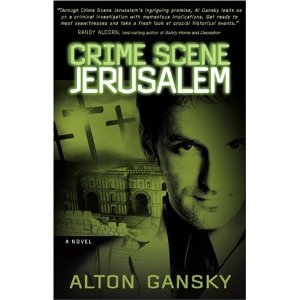
Crime Scene Jerusalem: A Novel by Alton Gansky (published by David C. Cook, 2007) does a masterful job of pulling off a peculiar premise: Max Odom, a forensics expert, is taken back in time to investigate the crucifixion and resurrection of Jesus Christ. Gansky makes the story much more than believable– he makes it gut-wrenching. The forensics expert doesn’t want to be there, and expresses all of the sarcastic humor of a jaded American man. But when he comes face-to-face with the cross, and sees how Jesus’ death speaks to the pain in his own life, he… well, read the book yourself. You will not be able to put it down, and you’ll be changed by the experience. Gansky describes life and culture in first-century Jerusalem vividly, and Gansky keeps the reader guessing what hurt Max Odom experienced that must come to the surface as he witnesses the Passion of Christ. A fascinating read for the Easter season or any season.
Book review: The Cross of Christ by John R. W. Stott
Copyright 2013 by Bob Rogers
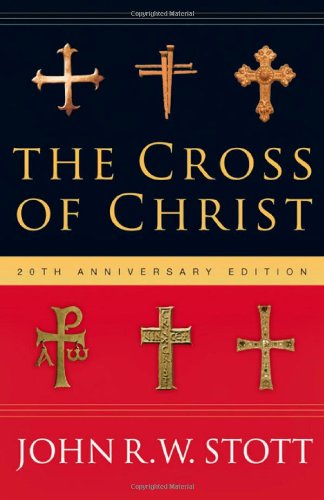
John R. W. Stott, who was pastor of All Soul’s Anglican Church in London before passing away in 2011, was one of the most respected evangelical writers in Great Britain. I thoroughly enjoyed his classic book, The Cross of Christ (InterVarsity Press, 1986, 2006). I found it to be the best book I have ever read about the Cross. I’m not surprised that it received the 1988 Evangelical Christian Publishers Association Gold Medallion Award.
Stott wrote as an evangelical pastor and scholar. While he thought deeply, he wrote with clarity and frequent illustrations. In fact, I used his book as the basis for a series of sermons on the cross.
Stott’s book begins by making a passionate argument for the centrality of the cross to the Christian gospel. Then he explores the reasons for the crucifixion, and while describing many “images” of atonement, he zeros in on Christ as a substitutionary sacrifice to satisfy both the holiness and love of God. His discussion in chapter seven of propitiation, redemption, justification and reconciliation is perhaps the best chapter of the book. The book concludes with chapters on what it means to live as followers of the One who died on the cross, with excellent explanations of service, overcoming evil, and understanding suffering.
Stott has read widely on the subject and he graciously comments on opposing views from liberal scholars and Roman Catholic scholars. He takes other views seriously, but he is faithful to an orthodox evangelical interpretation of scripture. I found it interesting that he disagrees with the popular view of Jesus’ death as a “ransom” paid to the devil in a strictly literal sense. His discussion on the distinctions between Protestant and Roman Catholic views of justification is particularly insightful. Stott rejects the doctrine that God does not suffer, maintaining in chapter 13 that it is precisely because God did suffer on the cross that we are able to bear our suffering.
Many parts of the book read as if they were sermons. This is not surprising, since Stott was a pastor. Yet it comes together as a systematic theology of the cross. His conclusion makes an excellent sermon on how central the cross is to Paul’s Letter to the Galatians.
This is a book that I will read again and again in the years to come.

Book review of Mother Teresa: A Simple Path
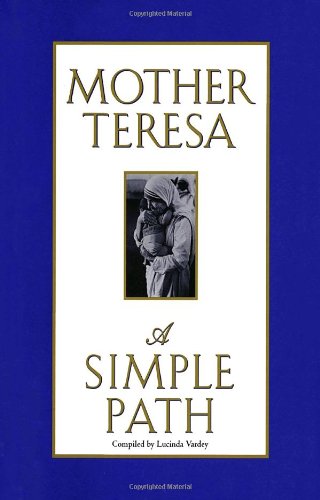 I was asked to read Mother Teresa: A Simple Path, to see if it should be placed in our church library. I am recommending that we do put it in the library because of its positive elements and for the Christian reader to be informed about her historical work, but with a statement of caution in the flyleaf. Why is that?
Mother Teresa is well known for her work with “the poorest of the poor” in Calcutta, India and around the world, for which she received the Nobel Peace Prize in 1979. This book is a collection of thoughts by Mother Teresa and her followers on her philosophy of life and ministry. This path is summed up on page 1 of the book this way: “The fruit of silence is prayer, the fruit of prayer is faith, the fruit of faith is love, the fruit of love is service, and the fruit of service is peace.”
The book is inspiring in its devotion to love the poor by loving Jesus Christ through the poor. There are many inspiring testimonies from volunteers, prayers, and simple statements that show how she kept her focus on her mission. She had a wonderful appreciation for the value of every human life, including the unborn. On p. 55 she asks why people worry about children being killed in wars but do not oppose mothers killing their own children.
I hesitate to say anything critical about Mother Teresa, because she has done far more for the needy in the name of Jesus than I have. However, I must point out that while she was a devoted follower of Christ, she encouraged people to follow whatever religion they were in, rather than convert to Christianity. For example, on p. 31 she says, “I’ve always said we should help a Hindu become a better Hindu, a Muslim become a better Muslim, a Catholic become a better Catholic.” This same philosophy is found throughout her book:
“I have never found a problem with people from different religions praying together. What I have found is that people are just hungry for God, and be they Christian or Muslim we invite them to pray with us…”
“God is not separate from the Church as He is everywhere and in everything and we are all His children– Hindu, Muslim, or Christian…”
“Anyone is capable of going to Heaven…” In this passage, she does not clarify that going to Heaven is by faith in Christ.
(Mother Teresa, A Simple Path, p. 31-32, 59, 73.)
Mother Teresa says that she is saved through Jesus, but she believed that Muslims and Hindus can be saved through Jesus, while remaining Muslims and Hindus.
This contradicts the words of Jesus, who said He was the only way to the Father (John 14:6), and the words of the apostle Paul, who said that there is salvation in no other name than the name of Jesus (Acts 4:12). We should not be surprised that Mother Teresa takes this viewpoint, as Roman Catholic theology generally teaches that the cross of Jesus Christ saves people who follow their own consciences and own religions, even if they never declare faith in Christ. (See statement by Pope John Paul II in Pontifical Council for Interreligious Dialogue – Congregation for the Evangelization of Peoples, Instruction Dialogue and Proclamation, 19 May 1991, n. 29; L’Osservatore Romano English edition, 1 July 1991, p. III; and Catechism #841.)
Mother Teresa’s work is truly inspiring and deserving of recognition. However, her teaching about salvation sadly follows the typical Roman Catholic viewpoint of salvation, a viewpoint that falls short of the teachings of the Bible. Let us be inspired by Mother Teresa’s devotion, but cautious of her as a theologian.
Why Men Hate Going to Church
 It has always concerned me that there are more women than men in church, which is why I was eager to read Why Men Hate Going to Church by David Murrow.
Murrow says that men like challenge and taking risks, but Christians have made church a place of nurturing and building relationships.
Murrow says that there are three gender gaps in the church: the gap of presence, the gap of participation, and the gap of personality.
The Gap of Presence: He says that in the USA, 61% of the church attendees are women, but only 39% are men. This trend is also found in other nations around the world. Interestingly, nondenominational churches had the smallest gap, while the biggest gap was found in Episcopal Churches.
The Gap of Participation: He says that women are 57% more likely to participate in Sunday School, and 33% more likely to volunteer for a church than men. Christian book sales are 75% to women, and the Christian radio audience is 63% female.
The Gap of Personality: He says that while 62% of the general population has a passive personality, 85% of Christians have passive personalities. There are greater numbers of artistic and homosexual men in church than the general population, but lower numbers of what he calls “risk takers, fun lovers and dangerous men.”
After I read this book a few years ago, I asked readers on a previous blog to tell me why they thought fewer men went to church. I received over 100 comments in one week! Here are the top reasons they gave:
1) Failure to let men lead. This may be controversial, but it was the most-often mentioned reason, both from men and women who commented. Many blamed women who would not let men be leaders in church. Others, especially men, blamed the men for not taking their leadership role.
2) Overemphasis on relationships. Women are social beings who cherish relationships; men not so much. It is interesting that this was the most common answer given by women who shared why their husbands did not come, but it was also mentioned by several men. Telling men they need a “personal relationship” with Jesus and “fall in love with Jesus” does not appeal to men as much as it does to women.
3) Overemphasis on sensitivity. “Gentle Jesus, meek and mild” and “sharing what’s on your heart” may make a man feel like he is stripped of his masculinity.
4) Not enough action. Most men want to be active; they don’t want to just sit and listen to a long sermon. They want to do things. David Murrow says, “men learn side by side, women learn face to face.” That’s why he recommends women have a conference to learn together, but men go fishing or hiking or build something together.
5) Men lack spirituality. Several who gave comments, mostly men, seem to blame men for lacking spirituality.
6) Need a challenge. This answer came almost exclusively from men. Several men mentioned that men need to be challenged.
7) Music is too feminine. This was another answer given by men themselves. They feel that too many songs are about “loving Jesus” in ways that are very feminine and the lyrics are words men would never say to another man.
So what do you think? Leave me a comment and join the conversation.
Why I am changing Bible translations

(UPDATE: In 2017, the HCSB, reviewed below, underwent a radical revision and name change to CSB. Read my review of that revision here: https://bobrogers.me/2017/05/21/the-hcsb-is-now-the-csb-whats-the-difference/.)
The New International Version (NIV) of the Bible was published in 1979, the same year that I became pastor of my first church. Immediately, I liked how it was easy to read, yet more accurate than other popular, easy-to-read Bibles of the time, like The Living Bible and the Good News Bible. The NIV went through a minor revision in 1984, and I have been preaching primarily from the NIV ever since then, although I often quote other translations. However, beginning in the summer of 2012, I will change to the Holman Christian Standard Bible (HCSB). Why the change, after all these years? The answer is simple: I’m changing, because the NIV changed.
In 2011, the NIV went through a major revision, and the 1984 edition will no longer be sold in stores. The 1984 edition is not even available in digital form any longer for e-books like Kindle or Bible apps like YouVersion for your smartphone. If you buy a new NIV Bible or download the NIV, it will be the 2011 edition. The revision is more accurate in many places, correcting some translation errors of the old edition. However, the 2011 revision also chose to use gender-neutral language when referring to people, following the model of the New Revised Standard Version (NRSV), a translation that is owned by the liberal National Council of Churches. In some cases, the gender-neutral language is justified, as when the word “man” refers to all of humanity or when Paul addresses the “brothers” but clearly means all believers, “brothers and sisters.” But the 2011 revision of the NIV goes much farther than this, consistently using gender-neutral language even when the context does not necessarily call for it.
I spent about a year carefully studying the 2011 revision, and although I liked some of the improvements in accuracy, the extremes of gender-neutral language outweighed the other improvements. Thus, I began to prayerfully look for another translation to use in my preaching.
There were two main options I considered, because both are accurate translations, readable, and they avoid gender-neutral language unless the context clearly calls for it: the English Standard Version (ESV) and the Holman Christian Standard Bible (HCSB). The ESV is a great translation. It is a conservative response to the New Revised Standard Version (NRSV). The NRSV uses gender-neutral language, while the ESV does not. The ESV is very close to the New American Standard Bible (NASB) in accuracy, and it flows better than the NASB.
However, I chose the Holman Christian Standard Bible (HCSB) over the ESV, because the HCSB uses more contemporary language than the ESV. For example, while the ESV uses “behold,” the HCSB says “look!” and while the ESV says “made manifest” the HCSB says “made evident.” The HCSB is as readable as the NIV, while it is more accurate than the NIV. The HCSB translates the name of Yahweh in the Old Testament in places where the context implies God’s name (rather than the all capital “LORD” used in other translations). It translates “Christ” as “Messiah” in the New Testament when the context is referring to Jesus’ title as Messiah. It shows respect for deity by capitalizing pronouns when referring to God. That is why I have been using the HCSB in Wednesday night prayer meeting for several years, and beginning in the summer of 2012, the HCSB will become my primary Bible when preaching on Sundays.
Am I saying that I expect my congregation to go out and buy a Holman Christian Standard Bible? No, I am not. This decision is for my own preaching, as I feel a responsibility to preach from a Bible that best communicates God’s Word with clarity and faithfulness to the original languages. Everybody is welcome to bring to our church whatever translation of the Bible you prefer. If you want to continue using your NIV Bible or other favorite translation, you are welcome to do so. It is useful to compare various Bible translations, and although I will primarily preach from the HCSB, I will continue to quote other translations of the Bible in my sermons whenever it sheds light on the meaning of God’s Word.
If you wish to sample the HCSB, you can download it for free on the Kindle at amazon.com and the Nook at BarnesandNoble.com, and the application “You Version” has the HCSB available for free on smart phones and iPads, available at http://www.youversion.com. The website http://www.mystudybible.com is a free website using the text of the HCSB, including excellent Bible study notes in the margin. The HCSB translation is used in Sunday School literature printed by LifeWay. Our church will also place HCSB pew Bibles in the worship center for the convenience of those who wish to follow the same translation as the pastor.
Here are some sample comparisons of the 1984 NIV, 2011 NIV, and the HCSB.
Genesis 4:26 (The context refers to all people.)
1984 NIV: “At that time men began to call on the name of the LORD.”
2011 NIV: “At that time people began to call on the name of the LORD.”
HCSB: “At that time people began to call on the name of Yahweh.”
Esther 3:6 (The context is explaining why Haman wanted to kill all the Jewish people.)
1984 NIV: “Yet having learned who Mordecai’s people were, he scorned the idea of killing only Mordecai.”
2011 NIV: “Yet having learned who Mordecai’s people were, he scorned the idea of killing only Mordecai.”
HCSB: “And when he learned of Mordecai’s ethnic identity, Haman decided not to do away with Mordecai alone.”
Psalm 1:1 (It is debatable whether the context refers to people in general.)
1984 NIV: “Blessed is the man who does not walk in the counsel of the wicked.”
2011 NIV: “Blessed is the one who does not walk in step with the wicked.”
HCSB: “How happy is the man who does not follow the advice of the wicked.”
Psalm 23:4 (“valley of the shadow of death” was a Hebrew idiom for a dark valley)
1984 NIV: “Even though I walk through the valley of the shadow of death, I will fear no evil, for you are with me; your rod and your staff, they comfort me.”
2011 NIV: “Even though I walk through the darkest valley, I will fear no evil, for you are with me, your rod and your staff, they comfort me.”
HCSB: “Even when I go through the darkest valley, I fear no danger, for You are with me; Your rod and Your staff—they comfort me.”
Psalm 90:2
1984 NIV “… from everlasting to everlasting you are God.”
2011 NIV “… from everlasting to everlasting you are God.”
HCSB: “… from eternity to eternity, You are God.”
Proverbs 27:17 (It is debatable whether the context refers to people in general.)
1984 NIV: “As iron sharpens iron, so one man sharpens another.”
2011 NIV: “As iron sharpens iron, so one person sharpens another.”
HCSB: “Iron sharpens iron, and one man sharpens another.”
Malachi 4:6 (The Hebrew word here is “fathers.”)
1984 NIV: “He will turn the hearts of the fathers to their children…”
2011 NIV: “He will turn the hearts of the parents to their children…”
HCSB: “And he will turn the hearts of the fathers to their children…”
Matthew 5:19 (The context refers to all people.)
1984 NIV: “’Come, follow me,’ Jesus said, ‘and I will make you fishers of men.’”
2011 NIV: “’Come, follow me,’ Jesus said, ‘and I will send you out to fish for people.’”
HCSB: “Follow Me,’ He told them, ‘and I will make you fish for people!’”
John 11:27
1984 NIV: “’Yes, Lord,’ she told him, ‘I believe that you are the Christ, the Son of God, who was to come into the world.’”
2011 NIV: “’Yes, Lord,’ she replied, ‘I believe that you are the Messiah, the Son of God, who is to come into the world.’”
HCSB: “’Yes, Lord,’ she told Him, ‘I believe that You are the Messiah, the Son of God, who comes into the world.’”
Romans 16:1
1984 NIV: “I commend to you our sister Phoebe, a servant of the church in Cenchrea.”
2011 NIV: “I commend to you our sister Phoebe, a deacon of the church in Cenchreae.”
HCSB: “I commend to you our sister Phoebe, who is a servant of the church in Cenchreae.”
Romans 16:14 (All of the names listed are male names in Greek.)
1984 NIV: “Greet Asyncritus, Phlegon, Hermes, Patrobas, Hermas and the brothers with them.”
2011 NIV: “Greet Asyncritus, Phlegon, Hermes, Patrobas, Hermas and the other brothers and sisters with them.”
HCSB: “Greet Asyncritus, Phlegon, Hermes, Patrobas, Hermas, and the brothers who are with them.”
Ephesians 5:18
1984 NIV: “Do not get drunk on wine, which leads to debauchery. Instead, be filled with the Spirit.”
2011 NIV: “Do not get drunk on wine, which leads to debauchery. Instead, be filled with the Spirit.”
HCSB: “And don’t get drunk with wine, which leads to reckless actions, but be filled by the Spirit.”
Hebrews 12:7 (After Hebrews 12:5 comments that Proverbs 3:11-12 addresses us as “sons” when referring to God’s discipline.)
1984 NIV: “Endure hardship as discipline; God is treating you as sons.”
2011 NIV: “Endure hardship as discipline; God is treating you as his children.”
HCSB: “Endure suffering as discipline; God is dealing with you as sons.”
I John 3:16 (The context is referring to all Christians.)
1984 NIV: “… And we ought to lay down our lives for our brothers.”
2011 NIV: “… And we ought to lay down our lives for our brothers and sisters.”
HCSB: “We should also lay down our lives for our brothers.”
NOTE: If you would like to continue keeping up with the HCSB, there is a Facebook Group for HCSB fans here: https://www.facebook.com/groups/289605548301539.
How an atheist changed his mind
 I have heard Antony Flew’s name many times over the years, because every time that I would read about a Christian apologist, it seemed that Antony Flew’s name would come up as his atheist antagonist. So you can imagine my surprise when I opened my newspaper in December 2004 and read the news that Antony Flew had changed his mind and decided that he DID believe in God. What a Christmas gift to the Christian world! But was it really true? I later read that while Flew now believes in God, he has not accepted Christianity. I wondered, what caused this change, and where was he now in his thinking?
Thus I read Flew’s book There Is A God (HarperOne, 2007), with great interest to know what caused such an outspoken atheist scholar to change his mind. I was not disappointed.
While the book is only 160 pages (plus two appendices by other authors), it is thorough and deep in its content. Flew tells his own story of how he, the son of a Methodist minister in Britain, became an atheist out of disillusionment with how God could allow evil, particularly as he saw the atrocities in Nazi Germany in World War II. Flew went on to become a professor of philosophy and a writer of many influential books espousing atheism, teaching in universities in Great Britain, Canada, and finally in the United States, where he now resides. He followed the thinking of skeptics like David Hume, arguing that we must presume atheism is true and believers must prove there is a God.
So how did this atheist scholar convert to theism? Flew explains that one belief he has always held led to the change– his belief in the words of Socrates: “We must follow the argument wherever it leads.” (p. 22). As he debated and argued the issues with Christians, he gradually changed his mind as he “followed the argument” for three basic reasons, which form three of the chapters of the book:
1) The laws of nature indicate they were designed by the Mind of God. Flew quotes Paul Davies: “even the most atheistic scientist accepts as an act of faith the existence of a lawlike order in nature” (p. 107).
2) The finely-tuned universe that delicately balances life indicates it was designed by a Creator for us. He points out, for example, that if the speed of light or the mass of an electron had been the slightest degree different, then no planet would be capable of human life (p. 115).
3) The origin of life itself, with the amazingly complex communication systems of DNA cannot be explained by materialistic evolution, and only make sense if designed by God.
In addition to these three major reasons, Flew also cites the big-bang theory as scientific evidence that the universe had a beginning (p. 136). As for the problem of evil, Flew leaves the question open, but prefers the popular Christian explanation that “evil is always a possibility if human beings are truly free” (p. 156).
So has Antony Flew become a Christian? The best answer is not yet, but he is leaning that way. He says, “I am entirely open to learning more about the divine” (p. 156) and then he expresses his admiration for the person of Jesus Christ and the intellect of the apostle Paul, saying that if you want an omnipotent God “to set up a religion, it seems to me that this is the one to beat!” (p. 157).
The book has an appendix by Roy Abraham Varghese, giving a critique of the “new atheism” of bold writers such as Richard Dawkins. Appendix A is good, but even better is Appendix B by N. T. Wright, which explains why we should believe in Jesus Christ. Wright convincingly argues for belief in the authenticity of the Gospel accounts of the resurrection of Jesus Christ in a way that impresses Flew himself as “absolutely fresh.” (p. 213).
I would agree. As much as I enjoyed Flew’s book, I must say that Appendix B by N.T. Wright was worth the price of the book. My prayer is that Antony Flew will finally follow the argument of Wright as it leads him to embrace the claims of Jesus Christ on his life.
“Prayer” by Philip Yancey is honest and inspiring
 Philip Yancey did it again with his book on prayer. His book The Jesus I Never Knew is the best book I have read on Jesus. His book, What’s So Amazing About Grace? is the best book I have read about grace. His book, Prayer: Does it make any difference? (Zondervan, 2006) is the best book I have read on prayer. That is a strong statement for me to make, even as a person who loves the writings of Philip Yancey. I have read dozens of great books on prayer, including great books by people like Richard Foster, Ole Hallesby, Bill Hybels and Oswald Chambers.
What sets Yancey’s book apart is his brutal honesty about the struggles people have with prayer, balanced with inspiring stories of how prayer has changed people’s lives. Yancey is particularly self-effacing about his own struggles with prayer and his feelings of inadequacy in failing to pray. Yet by the end of the book, it is apparent that Yancey is much more of a prayer warrior than he admits at first.
The books’ 22 chapters are divided into five parts. Part One, “Keeping Company with God,” explores what prayer is. He points out that Jesus “virtually invented private prayer” (p. 63).
Part Two, “Unraveling the Mysteries,” discusses frustrations and questions that people have about the effectiveness of prayer. He gives a disarmingly profound answer to those who ask why we should bother to pray when some prayers seem unanswered: “Why pray? Because Jesus did” (p. 78). Later in the book he gives another simple but true answer: “Why pray? God likes to be asked” (p. 143).
Part Three, “The Language of Prayer,” discusses how to pray. He gives great practical advice on handling distractions to prayer, and reminds the reader that there is no right way to pray, because different styles of prayer fit different personalities. “Keep it simple, keep it honest, and keep it up” he advises (p. 191).
Part Four, “Prayer Dilemmas,” returns to questions people have about prayer, especially unanswered prayer. I would disagree slightly with his defintion of “unanswered prayer,” as he includes in that definition prayers that receive a “no” answer. Yancey’s approach to prayer for physical healing is balanced and insightful, as he reveals scientific research showing healing that cannot be explained, while recognizing the importance of using medicine and how God usually works through natural processes.
Part Five, “The Practice of Prayer,” provides motivation for faithful praying.
Yancey’s writing includes frequent illustrations from a variety of sources, from popular culture to literature to world history. Being a famous author and editor for Christianity Today magazine, Yancey has received many letters about prayer, and he shares this correspondence throughout the book. One unique quality about this book is that each chapter includes a couple of sidebars written by others, sharing personal experiences in prayer. For example, on p. 224-225 a prostitute whose prayer for deliverence resulted in her miraculous salvation. Although each sidebar story can be read alone, they relate to the chapters where they are inserted.
I disagree with Yancey in chapter 7, when he discusses Abraham’s prayer that “changed” God’s mind. Yancey does not notice that Genesis 18:33 says that it is God who ended the conversation with Abraham, not Abraham with God, so God did not change His mind.
Also, I believe that Yancey misinterprets Job 21:15 on p. 95. There he says that Job asks “What would we gain by praying to him?” However, the context of the chapter implies that Job quotes the wicked in this passage; Job does not say that he himself questions prayer.
It is remarkable that these were the only two places that I disagreed with Yancey, because he makes bold and strong statements throughout the book. I am sure many people will be offended or disagree with some things he said, just because he asserts so many strong opinions. But this is one of the values of the book: Yancey stimulates you to think deeply about prayer, and challenges your preconceived notions. Yet he does so while remaining fiercely loyal to the Bible’s teachings on prayer.
In summary, this book is destined to be a classic book on prayer, useful for group study or personal review and study over and over again.
HCSB Study Bible is outstanding
 The Holman Christian Standard Bible (HCSB) is an excellent Bible translation that premiered in 2004. It is more readable than the New American Standard Bible (NASB), but more accurate than the New International Version (NIV). However, until now there has not been a really good study Bible available in the HCSB, with the exception of the Apologetics Study Bible, which is really intended for scholarly readers. The HCSB Illustrated Study Bible was not really a study Bible, but more of a Bible with a lot of illustrations. The absence of a good popular study Bible in this good translation is about to change in October 2010.
The HCSB Study Bible was published in October 2010. I had the opportunity to study a preview copy and later I reviewed a hardbound copy.
As a busy pastor, I love the rich resources available all in one volume in the HCSB Study Bible. This study Bible takes some of the good qualities of both the HCSB Illustrated Study Bible and the HCSB Apologetics Study Bible, but much more. The Apologetics Study Bible is more scholarly, whereas the HCSB Study Bible takes a more popular approach. However, don’t let that statement mislead you. The HCSB Study Bible is very thorough in dealing with all kinds of issues of Bible interpretation and the footnotes do an excellent job of discussing the important issues of interpretation, historical background and theology. It has all of the things one would expect in a study Bible, including center column cross-references, helpful notes at the bottom of the page, maps, introductions to each book of the Bible and a concordance in the back (one negative is that the concordance is not a full concordance, but only a 12-page topical concordance; I hope this will be corrected in future editions). But it also has some extras that set it apart from any other study Bible I have seen: word studies of Hebrew and Greek words, time lines to place events in their historical chronology, a Bible reading plan and essays on theological issues. It has an abundance of full-color photographs to illustrate Bible times and places. I particularly like the word studies. When Luke’s gospel mentions that Jesus was born of a virgin, at the bottom of the page there is a text box with a more detailed explanation of the Greek word “parthenos,” translated “virgin.” The footnotes also make frequent explanation of Hebrew and Greek words used and their translation, which is not often found in study Bible footnotes.
The hardbound volume is well-made. It lies open on the desk, even if is open to Genesis or Revelation. The paper quality is thick enough to write on. I love the use of color in the text: chapters numbers and section headings are in brown, and verse numberings are in blue. This is easier on the eye and helps the reader find his or her place. At the bottom of the page, the textual notes have a tan background, which separates them from the study notes below which have a white background, again making it easier on the eye to find. This study Bible also makes generous use of full-color maps and illustrations. For example, at 2 Chronicles 12 the description of Shishak king of Egypt’s invasion of Israel is illustrated with a full-color map of the battles on the facing page; at John 9 there is a photograph of the Pool of Siloam where the blind man in John 9 washed his eyes.
While it is not perfect, this may very well be the best study Bible available to date.

2011 revision of NIV Bible both pleasing and disappointing
In March 2011, the copyright owners of the most popular modern translation of the Bible in English, the New International Version (NIV), published the first revision of the NIV since 1984.
As a pastor who did not like the over-reaching political correctness of the Today’s New International Version (TNIV, copyright 2002), I was concerned when I heard that the NIV itself was going to be revised. But after studying the digital early release version in numerous passages, I have been pleased that it is more accurate, but disappointed that while the use of gender-neutral language does not go as far as the TNIV, it still goes too far.
The new NIV retains 95% of the words of the 1984 edition, but where there are changes, it communicates the original meaning better to modern readers and more accurately than before.
Let me address several issues: gender-neutral language, omission of words, and accuracy of translation.
Gender-neutral language
First, the most controversial issue of the TNIV (the earlier failed attempt to revise the NIV) was its gender-neutral language. The Southern Baptist Convention passed a resolution in June 2011 saying they “cannot commend” the 2011 NIV. Why is that? The 2011 NIV does not go as far as the TNIV. In Hebrews 12, where scripture speaks of God disciplining us like a father, the TNIV changed “father” to “parent.” This implied that God was a gender-neutral “parent” rather than our “heavenly Father.” I’m glad to report that the new NIV has “father,” just as the 1984 edition had. However, the new NIV, like the TNIV, does use gender-neutral “brothers and sisters” when the context clearly means all believers. Since modern English speakers use both genders, “brothers and sisters,” when addressing all believers, not just the masculine “brothers,” it makes sense that the Bible they are reading do the same. However, this may not be acceptable to all readers, particularly in passages like Psalm 1, where the masculine pronoun is often associated with a reference to manhood. In the 1984 NIV, Psalm 1 says, “Blessed is the man who does not walk in the counsel of the wicked… He is like a tree planted by streams of water…” but the 2011 NIV renders it, “Blessed is the one who does not walk in step with the wicked…That person is like a tree planted by steams of water…”
The 2011 NIV changes “fathers” to “parents” in Malachi 4:6, although the Hebrew word is ab, fathers. Also, Ezekiel 22:30, the famous “stand in the gap” passage used by Promise Keepers to challenge men, has been changed from “man” to “someone.” A favorite verse of the men’s group, Promise Keepers, was Proverbs 27:17, because it said that as iron sharpens iron, so one man sharpens another. However, the 2011 NIV changes “man” to “person.” These kind of changes can be found hundreds of times throughout the Old and New Testaments in the 2011 NIV.
However, the 2011 NIV continues to say “sons” in Romans 8:14 and “sonship” in Romans 8:15 in a discussion of spiritual adoption which refers to the male heir. Thus it does not use gender-neutral language in places where it would impact theology, but it does use gender-neutral language in some places that have traditionally been interpreted as references to manhood. The revised NIV also continues to maintain clear sexual distinctions between the genders in passages like Genesis 1:27, which reads, “So God created mankind in his own image…male and female he created them.”
Omission of words
The second translation issue is the omission of words. One of the biggest criticisms of the 1984 NIV was that sometimes words in the Greek text simply were not translated. The most notorious example was the Gospel of Mark, which makes frequent use of the Greek word euthus, “immediately.” For some reason, there were many verses in the 1984 NIV that simply ignored this word. But the 2011 NIV is careful to translate it as “immediately” or “as soon” etc. in every place where it is used. I have been doing a verse-by-verse study of Romans in the Greek, and comparing the old and new versions of the NIV, I found that where the old NIV omitted the word “or” at the beginning of Romans 3:29, the new NIV restored the word. And in Romans 4:1, the old NIV omitted the words “according to the flesh,” but the new NIV put the phrase back in.
Accuracy of translation
The third translation issue is the accuracy of translation. In an attempt to be easy to read, the NIV has been less precise in translating words and phrases. It’s a difficult balance for any translation, but sometimes the 1984 NIV paraphrased the text in places that caused the reader to miss the technical point that the Biblical writer was making. For example, the 1984 NIV translates Romans 3:28, “observing the law.” But the 2011 NIV translates it, “works of the law.” The Greek phrase is literally, “works of the law.”
In Romans chapter 8, Paul uses the word “flesh” as a metaphor for the sinful nature. The 1984 NIV translates it “sinful nature,” which gets the idea across, but thereby obscures the deliberate play on words in Romans 8:3 when Paul says that when we were weakened by the flesh, God sent Jesus in the flesh. The 1984 NIV has “sinful nature” in these verses, but the 2011 NIV uses the literal word “flesh.”
In Romans 8:4, the 1984 NIV says that Jesus’ sacrifice satisfied the “righteous requirements” of the law. However, the Greek word translated “requirements” is singular. The 2011 NIV changes it to the singular “requirement.” This might seem a minor distinction, but theologically the singular implies that God covers the entirety of our sin, not just some sins.
In Romans 10:4, the 1984 NIV reads, “Christ is the end of the law…” The Greek word translated “end” is telos, which means completion. Paul does not mean the law will stop, but that it will be fulfilled. Thus the 2011 NIV reads,”Christ is the culmination of the law…”
Another example is Galatians 5:22, where the 1984 NIV lists “patience” among the fruit of the Spirit. The problem is, that there are two Greek words for patience: one word means patience with circumstances, and one word means patience with people. The word used in Galatians 5:22 means patience with people, so the 2011 NIV translates it “forbearance.”
The 2011 NIV has improved the accuracy of many passages in the Old Testament, as well. Psalm 93:1 reads in the 1984 NIV, “The world is firmly established; it cannot be moved.” This is similar to the KJV, which was misinterpreted centuries ago to mean the universe revolved around the earth. But the Hebrew word means stability, and so the 2011 NIV translates it, “The world is established; firm and secure.” Psalm 107 gives four stories of people who have reason to thank the Lord. Thus Psalm 107:2 reads in the 2011 NIV, “Let the redeemed of the Lord tell their story,” which is an improvement of the 1984 “Let the redeemed of the Lord say this.”
Summary
Different readers will have different opinions about the appropriateness of gender-neutral language in the revised NIV. Some will like it, and others will not. Personally, I can understand the change to “brothers and sisters” or “mankind” when the context clearly refers to all people, but when the context is not clearly gender-neutral, the translation should not be gender-neutral. It is unfortunate that this issue may cloud the discussion of this revision, which is otherwise more accurate than before. People who love the NIV and do not object to gender-neutral language should embrace this revision with even more confidence in its accuracy, and people who object to the gender-neutral language will prefer translations such as the Holman Christian Standard Bible (HCSB) or English Standard Version (ESV).


 Bob Rogers