Author Archives: Bob Rogers
Is God a psychotic mass-murderer? A reply to Bill Maher

Copyright 2013 by Bob Rogers
Recently, TV talk-show host Bill Maher said, “God in the Old Testament is a psychotic mass murderer.”
Is this true? Many people think so, because of passages in the Old Testament where God allows people to be destroyed, such as Noah and the flood, the plagues on Egypt, and the many wars that Israel fought with their enemies.
There are three things we need to understand, in order to understand the God in the Old Testament.
I. We need to understand what actually happened
Many people are disturbed by the command of God for the destruction of people and cities in the Old Testament, but they are unaware of the culture and history of the time and the Hebrew words used to describe what actually happened. When one takes a closer look at all this, a completely different picture comes to light.
In some cases, the Old Testament is merely reporting what people did, not saying that God commanded that it be done. For example, King Jehu destroyed all of the worshipers of Baal (2 Kings 10:18-27), but the prophet Hosea said that God would punish King Jehu for this act of brutality (Hosea 1:4). So don’t assume that just because the Bible reports acts of cruelty that it means God endorsed those actions.
But the conquest of Canaan was clearly commanded by God. So how do we justify that?
The Canaanites were not innocent. They defiled the land with detestable practices that included incest, pedophilia, bestiality and homosexuality. (Leviticus 18:24-25)
Deuteronomy 20:16-18 gives the invasion policy for when Joshua was to conquer the land of Canaan. God commanded their destruction (herem, devotion to the ban), because of their wickedness. However, when we study the events of conquest of Canaan more closely, we see that it was not the kind of genocide some have made it out to be.
The word translated “city” in Deuteronomy 20:16 and in Joshua is ‘ir, which can mean a walled fortress, like Jerusalem was when David attacked it in 2 Samuel 5:7, 9. We know from history that in ancient times, the ‘ir was like a walled fort. It was an agricultural society, in which the people lived on farms around the ‘ir, but the military stayed in the ‘ir, which was primarily a military citadel, not an urban city as we think of it today. So when the Book of Joshua says that they conquered city after city, they were actually destroying the walled cities, or forts, of the Canaanites. They were taking military targets.
So when Deuteronomy 20:16 says not to let any living thing survive among each “city,” or ‘ir, of the land, God was ordering a military conquest of an evil empire, not a genocide of an innocent people.
II. We need to understand God’s mercy
Notice how the Old Testament describes God’s mercy.
God waited 100 years in Noah’s day for the people to repent. (Genesis 5:32; 7:6)
God waited 400 years to judge Canaan because “the iniquity of the Amorites has not yet reached its full measure.” (Genesis 15:16)
God waited for generations for Israel to repent, sending them prophets to warn them. “But Yahweh, the God of their ancestors sent word against them by the hand of His messengers, sending them time and time again, for He had compassion on His people and on His dwelling place.” (2 Chronicles 36:15) It was only after they failed to repent that God allowed the Jews to be taken into exile in Babylon.
God takes no pleasure in the death of the wicked. (Ezekiel 33:11) God is patient, not wanting any to perish. (2 Peter 3:9)
Romans 2:4 turns the question on our own generation: “Or do you despise the riches of His kindness, restraint, and patience, not recognizing that God’s kindness is intended to lead you to repentance?”
III. We need to understand God’s justice
We just read 2 Chronicles 36:15, which said that God had compassion on His people “time and time again.” But the next verse, 2 Chronicles 36:16, says, “But they kept ridiculing God’s messengers, despising His words, and scoffing at his prophets, until the LORD’s wrath was so stirred up against His people that there was no remedy.”
The other thing we need to understand about God in the Old Testament is that while He is a God of mercy and grace, He is also a God of justice.
Leviticus 18:24-25 explains that God drove the Canaanites out of the land because they had defiled the land with their sinful lifestyles, and God said, “the land will vomit out its inhabitants.” God is a God of mercy, but eventually if we do not repent, His patience will run out, and His moral stomach will be turned against sin until He can hold it back no longer.
In Genesis 6:3, the LORD said, “My Spirit will not remain with mankind forever, because they are corrupt.” God is merciful, but when mankind continues to reject God’s mercy, God will judge.
As we have seen already, the punishment of the Canaanites was anticipated by God long before it happened, as God told Abraham in Genesis 15:16 that the sin of the Amorites had not reached its full measure. The implication was that when it did reach its full measure, it would then be too late. Throughout the Old and New Testament, we see this pattern: God is a God of grace and mercy who does not wish to punish. But if we continue in rebellion and refuse to repent, eventually God’s patience will run out, and He will execute His justice. We see this with Noah and the flood: God waited 100 years for them to repent, but when they refused, God sent the flood. God waited 400 years for the people in Canaan to repent, but when they refused, He sent Israel to conquer the land. God waited hundreds of years for Israel to repent, but when they refused to listen to the prophets, He allowed them to go into exile. The conquest of Canaan by Joshua and all of the other stories of punishment are not only history, they are also prophecy. It points to the final judgment that we all must face. Hebrews 9:27 says, “It is appointed for people to die once—and after this, judgment.” But God has also provided a way to escape Judgment Day, by sending Jesus as a personal sacrifice for our sins.
God is not a bloodthirsty bully at all. God is a blood-giving Savior, who gave the blood of His own Son Jesus on the cross that we might be saved from judgment and spend eternity with Him in Heaven. This is the God of the Bible, both Old and New Testament.
Wow! I like that surgery!
 Copyright 2013 by Bob Rogers
As a pastor, I visit people who are in the hospital for all kinds of reasons: surgeries, childbirths, injuries and sickness. I have learned to always knock before entering a hospital room, because one never knows what might be behind that door. Hospital gowns are not designed for fashion or full covering, and I certainly don’t want to invade somebody’s privacy.
But one man who goes to my church saw something that he never dreamed he would see in a hospital room.
His wife, who was about 45 years old, went to the hospital for surgery. After a few hours, a nurse came to the waiting room and called the husband’s name. He stood, and she took him by the arm and said, “Come with me. We’re going to see your wife.”
Imagine his surprise when the nurse opened the door to a recovery room, and he saw a beautiful, 22-year-old blond in a hospital bed. Immediately he said, “Wow! I like that surgery!” Later, the man told me, “I’m just glad the young lady was asleep and didn’t hear the nurse tell her that I was her husband!”
Unfortunately, there are a lot of people who go through wrong doors.
Some go through wrong decision doors, rushing into poor choices about important matters such as marrying a spouse or buying a house without stopping to pray for God’s guidance first. Others get sucked into trap doors, as they are enticed into bad habits and unhealthy addictions that leave them feeling like the door was locked behind them and the key thrown away.
But Jesus said, “I am the door” (John 10:7, 9). He didn’t say it would be easy to enter that door. It requires heart surgery—a changed heart by repenting of our sin and trusting in Jesus’ sacrificial death on the cross for our salvation. But the end result is worth it. If we will enter by His door, we will find abundant life here on earth and eternal life in heaven. Like my church member said, “Wow! I like that surgery!”
Why do you go to church?
Sunday, August 11, is “Back to Church Sunday” at the church where I pastor, First Baptist Church of Rincon, Georgia. Thousands of churches across America will observe “Back to Church Sunday” sometime this fall.
We know that many people get out of the habit of going to church during the summer, and many have dropped out altogether. But we want to encourage you to come back! This is a good time, as the church begins its fall activities. Take my poll above, feel free to leave your comments, and watch for more posts about reasons to get back in church.
FREE BOOK GIVEAWAY- Discipling New Church Members
 I am giving away a free copy of Thom Rainer’s book, I Am a Church Member, this week on my blog. Here’s what you need to do to win:
1. Follow my blog. If you are not already following, click on the link at the right and sign up.
2. Leave a comment below telling me what your church does, or what you wish it would do, to disciple new members. You must leave me an email address in the comment, so that I can contact the winner.
I will select a winner based on the comments (the person must also be a follower of my blog), and I will announce the winner on Friday afternoon. LifeWay will mail the book directly to you. (By the way, the winner must live in the United States or Canada.)
Free book giveaway
I WILL BE GIVING AWAY A FREE BOOK NEXT WEEK TO SOMEBODY WHO VISITS MY BLOG.
WATCH FOR DETAILS ON MONDAY!
A collection of Christian thoughts on the Supreme Court ruling on same-sex marriage
 In June 2013, the U.S. Supreme Court struck down the Federal Defense of Marriage Act, allowing federal benefits for same-sex marriage partners in States that already have legalized same-sex marriage.
How should we respond to this? Here are a some brief thoughts of my own, and links to what other Christian bloggers are saying:
1) We must respond with Christ-like love. Ranting and raving on Facebook and Twitter and angry words to our friends and family will only confirm the unbeliever’s preconceived notion that Christians are judgmental and narrow-minded.
LifeWay researcher and Southern Baptist author Ed Stetzer calls for gracious, Christ-like responses in his blog: http://www.christianitytoday.com/edstetzer/2013/june/prop-8-doma-and-christian-response.html.
2) We must prepare to live in a non-Christian culture. Our parents lived in a generation where Judeo-Christian values were the norm. That is no longer the case. We will need to stand by Christian values that are at odds with our culture, and be prepared to graciously endure persecution, if needed, when submission to anti-Biblical standards are demanded of us. Do not conform to this world, but be transformed (Romans 12:1-2).
Sylvania, Georgia youth pastor Steve Dresen reminds us of how the early church responded in a culture that did not share our values: http://stevendresen.wordpress.com/2013/06/27/scotus-same-sex-marriage-and-the-churchs-identity
3) We must not give up. Don’t forget that the majority of States still do not allow same-sex “marriage.” In many nations around the world, such as Africa and Eastern Europe, homosexuality is still considered sinful by the overwhelming majority of people. Just as the prophets in the Old Testament boldy spoke truth to their culture, we too must proclaim the truth, rather than concede defeat. Last year I preached a sermon entitled, “What the Bible teaches about homosexuality may surprise you.” You can read it here: https://bobrogers.me/2012/07/09/what-the-bible-says-about-homosexuality-may-surprise-you/
Roman Catholic scholars make some good points about how the Supreme Court decision does not end the debate and that “gay marriage” is not inevitable. Here is the report from the Catholic News Agency: http://www.catholicnewsagency.com/news/gay-marriage-is-not-inevitable-analysts-say/.
4) We must remember that God is on His throne. God was still on His throne when Noah built the ark, when Moses fled from Pharaoh, when Jerusalem was destroyed by the Babylonians, and when Jesus died on the cross. The demise of God and godliness has been overstated many times before, and God always turns it around for good. Rather than despair, Christian, let us get on our needs and pray for a new movement of God that is totally dependent upon the power of God, not the power of politics.
Book Review: “I Am a Church Member”
If you are looking for a resource for your church’s new member class, this is a book you will want to read.
Thom Rainer, CEO of LifeWay Christian Resources, has written I Am a Church Member: Discovering the Attitude that Makes the Difference. It is a short book that can easily be read in one sitting, but it has the potential of making a big impact in local churches.
The book opens with a story about two members of the same church with completely opposite attitudes about church. Then he zooms in on the Biblical attitude members should have in six short chapters, based on Rainer’s extensive research in attitudes among church members. These chapters teach members to be active, bring unity, avoid the tendency to insist on personal preferences, pray for leaders, lead their own families to be involved, and to treasure church membership as a gift. The main point of the book is that church membership is not like a country-club membership with perks and privileges.
There are some churches that reject the term “membership,” saying it is an unbiblical modern term. Rainer disagrees, pointing out that 1 Corinthians 12:27-28 speaks of the “individual members” of the church. Rather than reject the term, Rainer seeks to give a Biblical definition of the term “membership.” He emphasizes that Biblical church membership is a treasured gift, just as our salvation is a gift, and thus we should serve in our churches gladly, not begrudgingly.
One of the strengths of this little book is that each chapter includes a pledge of loyalty for members to make. This requires the reader to respond to the challenge of the book. Each chapter also includes discussion questions, making this book an outstanding resource for small group or one-on-one study for church members, both new and old.
Guest blog: Georgia Baptist president’s observations on the 2013 Southern Baptist Convention
 (Below is a guest blog by Dr. John Waters, pastor of First Baptist Church, Statesboro, Georgia, and president of the Georgia Baptist Convention. He shares his personal observations about the 2013 Southern Baptist Convention, which met last week in Houston, Texas.)
Southern Baptists gathered in Houston, Texas, this month for our annual convention meeting. Controversy or unsettled issues often marked previous conventions, so the annual meetings usually morphed into an annual show down, with messengers already having made up their minds regarding a particular issue weeks before their arrival.
This year’s Southern Baptist Convention, however, seemed to mark a course correction. With a shockingly low attendance barely breaking the 5,000 mark, not many Southern Baptists made the trek to the Lone Star state for this annual meeting, but those who attended participated in a well-planned and effective event.
Having attended this year’s annual gathering, I offer the following four observations about this year’s Southern Baptist Convention:
1. Baptists are beginning to favor cooperation over conflict.
With several potentially divisive issues before us, Baptists chose to respond with wisdom, grace, and a plea for unity. The theme of “Revive Us: That We May Be One” set the stage for a spirit of cooperation that sadly has been absent in many of the previous conventions. The report regarding Calvinism and the resolution about Boys Scouts of America were characterized more by their thoughtfulness than their abrasiveness, and messengers seem to be resisting the urge to fight, choosing instead to make strong statements tempered by love and the spirit of Christ.
2. Previous “hot issues” seemed noticeably absent.
With the commotion caused in recent conventions about the Great Commission Resurgence (Orlando, 2010) and the descriptor name of “Great Commission Baptists” (New Orleans, 2012), it was remarkable how these hot topics seemed to be long forgotten. Even though these issues were passionately debated and subsequently approved, Southern Baptists seemed to have put them in the past, relegating them to the historical archives of the Convention for anyone who wants to search for them. But did the adoption of these quasi-controversial matters substantively change the make up and DNA of Southern Baptists? Given the deafening silence about these issues only a few years after their acceptance, they apparently were forgotten as quickly as they were adopted.
3. The call for global missions has been re-ignited among Baptists.
It was difficult to miss the mandate to get the Gospel to the nations, and rightly so. Over the past 30 years or so, Southern Baptists privately swelled with pride when talking about our global mission strategies and our thousands of fully funded missionaries around the globe. But the growing statistics of lostness among the nations and the fatness among Southern Baptist churches have been a wake up call. Danny Akin’s closing sermon was particularly insightful, as he reminded messengers that they could be parachuted into places on the globe and walk for weeks on end without ever meeting a single believer or seeing a single church. They would find, instead, countless people groups representing millions of souls that have never once heard the name of Jesus. In an over-saturated America with churches on every proverbial street corner, maybe it is time we managed with less at home so that we can poke deeper and wider holes in the darkness in parts of the world that don’t even have access to the Gospel.
4. Fred Luter’s genuine spirit set the right temperature for Baptists.
Noticeably uncomfortable in certain settings requiring parliamentary finesse, president Fred Luter displayed an affable and infectious spirit that endeared him even more to Baptists, if that is even possible. He capably handled all of the business required of any SBC president, but his love for churches and pastors was apparent and set a gracious tone for the entire meeting. His gregarious manner was perhaps best displayed after he struck the gavel for the close of the annual meeting and then looked into the crowd and shouted, “Love y’all!” With men like Fred Luter leading the Southern Baptist Convention, the days ahead will be good ones indeed.
The Top Ten Gifts NOT to give on Father’s Day
Copyright 2013 by Bob Rogers

What are the top ten gifts NOT to give on Father’s Day?
Here’s my list:
10. Necktie
9. “World’s Best Dad” coffee mug
8. “World’s Best Dad” t-shirt with a picture of Darth Vader
7. “World’s Best Dad” certificate signed by a Lazy Son or Daughter
6. The book, Fatherhood for Dummies.
5. A text message saying “Happy Father’s Day.”
4. Nose and ear hair trimmer
3. Big Mouth Billy the Bass singing fish
2. Book a cruise and charge it to Dad’s credit card.
1. Nothing.
Yep. Nothing. The worst gift of all is to forget Father’s Day and fail to call or say anything about it. Even a text message is better than nothing at all.
“Honor your father and your mother so that you may have a long life in the land that the Lord your God is giving you.” (Exodus 20:12, HCSB)
Book review: “The Founding Fathers and the Place of Religon in America”
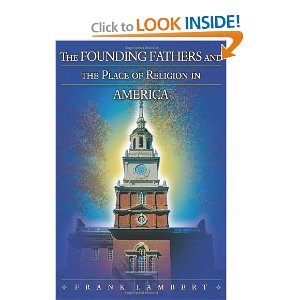
Frank Lambert, professor of history at Purdue University, does an excellent job of surveying this complex topic over a 200-year period. He does so thoroughly, yet concisely, in only 296 pages. While making generalizations at times, he often illustrates his points with quotations from original sources of the time period.
He begins by criticizing extremists on both sides of the issue, and proceeds to present a balanced approach. However, as I will explain at the end of this review, he shows his bias at the end.
Lambert’s thesis is this: America WAS first settled by people who wanted to make it a Christian nation, whether Puritans in New England, Anglicans in Virginia, or Quakers and others in Pennsylvania. These early founders had a vision of making America “a city on a hill,” a model Christian commonwealth. However, two major influences led the founding fathers to establish a government that separated church and state. These two influences were the Enlightenment and the Great Awakening. Men like Thomas Jefferson and Thomas Paine, who were influenced by the Enlightenment, felt that men should be free to use their own reason in matters of religion. The Baptists and others who benefitted from the rapid growth of “free” churches in the Great Awakening were persecuted by established churches and wished to have no established church, so they joined with men like Jefferson in calling for separation of church and state.
Lambert shows that there was great division over these issues, and gives interesting anecdotes and quotations from both sides. He quotes frequently from religious leaders on both sides of the issue. However, near the end of the book he spends much more time quoting Republicans like Thomas Jefferson and James Madison, and gives little space to Federalists like George Washington and John Adams. At one point, on page 161, Lambert implies that John Adams was a deist, even though biographies of Adams have shown him to be a devout Christian with a Puritan heritage.
Lambert shows his view in his conclusion, as he criticizes accomodationists such as Judge William Rehnquist and “religious right” preachers like Pat Robertson.
While Lambert gives both sides of the argument, he clearly leads the reader to his own separationist interpretation. Because the book is so full of useful information, I highly recommend it as a textbook on the subject, but let the reader understand that Lambert has his own bias, too.
Book review: “Multiply” by Francis Chan
 Francis Chan, author of the influential books Crazy Love and Erasing Hell, has written Multiply: Disciples Making Disciples for the purpose of multiplying disciples in the church.
The book has some excellent material; however, I was disappointed in the book, because it was not what I expected. I downloaded the book and read it on my Kindle, deceived by the title into thinking it was about how to make disciples. While the introduction and first three chapters (about 40 pages) discuss how to use the book for discipleship, that’s about it. The rest of the book is an overview of the teachings of the Bible.
Don’t misunderstand me. The overview of the Bible is excellent. It’s well-written, and has good support material with questions for discussion and videos available to watch online. If you are a mature Christian, you will find very little new information here, but it is a good, solid summary of what the Bible teaches. If a person goes through this material with a new believer, that person will be very well-founded in a biblical worldview.
The bottom line: if you are looking for material for an in-depth teaching of the basics of Christianity for a small group or one-on-one, this is a great book. But if you are looking for a book on how to organize your church for the purpose of multiplying disciples, you will probably find more help elsewhere, such as Real-Life Discipleship by Jim Putman.
10 Biblical steps to getting out of debt
 Back at the beginning of “The Great Recession” in early 2009, our church went through a study on how to get out of debt, using the teaching materials of Crown Financial Ministry. Here is a summary of 10 wise and Bible-based principles for getting out of debt:
1. Pray for God’s provision (see 2 Kings 4:1-7 for an example).
2. Start giving regularly (Malachi 3:8-10).
3. Don’t go further into debt. Stop charging with credit cards!
4. Establish a written spending plan by writing down every penny that you spend for a month, and then developing a spending plan that is realistic and living within your means.
5. Open a savings account and contribute faithfully to it until you have $1,000 in savings for emergencies. (This prevents further debt because you can use your savings for unexpected expenses.)
6. List everything you own and see if you can sell unnecessary assets to eliminate debt (Proverbs 27:23).
7. Make a list of everything you owe.
8. Establish a debt repayment schedule. Pay off the smallest debts with the highest interest first. When that debt is paid, apply that payment amount to the next second debt, and so on. See Crown Financial Ministries for free calculators and tools that can help at www.crown.org/Tools/Calculators.
9. Consider earning additional income.
10. Consider a radical change in your lifestyle (Romans 12:1-2).
Guest blog: “Lunch Encounters of a Spiritual Kind”
 (The guest blog below is a touching story with a practical lesson for believers, written by Biblical Counselor Sherri Edenfield Hall, from Macon, Georgia. You may email her at sj.hall77@gmail.com.)
Her name is Sabrina. I don’t even know her last name. My two children and I were enjoying lunch at a local restaurant, when this attractive, beautifully dressed woman of color entered with her little girl.
Something more than her appearance struck me. Her girl (perhaps 3 years old) tried desperately to capture her mother’s attention, but to no avail. “Something is wrong with this picture,” I thought.
Understanding suffering helps to identify it, perhaps. I recognize it well. So, I began to pray for an opportunity to speak with this lady, whose daughter was now twirling down the aisle in a ruffled dress.
We finished lunch. The kids took my keys and headed to the van to read. My plan was to initiate conversation with this new friend who had spoken to me when I went to the counter. She liked my “Fruit of the Spirit” bracelet. I thanked her, and began to listen to her story.
I learned that Sabrina had flown back home to Georgia for a funeral that very day. One of her parents died years ago. Now the other was gone, too. Then she said, “Two weeks ago, I buried my husband. He committed suicide.”
There was a long silence. Sabrina motioned toward her precious little girl and continued, “She doesn’t even know her daddy’s gone.”
We sat there for what seemed an eternity, saying nothing.
For years I have shared my faith in Christ, and knew countless methods by which to do so. At that moment I felt compelled to simply tell my story.
Although very different, our stories had one thing in common. We both realized that sometimes life comes at you. Before you can catch your breath, the wind is knocked out of you.
Sabrina wanted to hear. So, I shared wave after wave of painful events I experienced as a young person. That was the hard part. Then, I was able to share the good news!
One night in my apartment in Athens, Georgia, I gave my life (and all my hurt) to the Lord. A poem called “Surrender” in a Home Life magazine riveted my heart. Immediately, it was as if my Heavenly Father whispered, “Baby girl, I know all your hurts. You are trying to be strong. Just give up. Rely on Me. Surrender everything to Me.”
The flood gates opened! I got on my knees. I gave Christ control of my life. Running from God was wearing me out, anyway! No longer desiring to lead my own life and make poor decisions, I surrendered my past, present, and future to Christ in a radical abandonment of self.
I told Sabrina that although I knew nothing about living the exchanged life with Christ, as Galatians 2:20 offers, this is exactly what occurred. I have never been the same! There was an unexplainable freedom and joy. Christ overwhelmed me with His love and peace.
I will never forget the hopelessness in her eyes when she asked, “What does it mean to surrender?” I told her about God’s love for us through Christ’s death on the cross and His power over death in His resurrection. To my amazement, I found myself offering my treasured bracelet to Sabrina. Tears filled her eyes as we parted ways.
Sabrina’s question haunted me for days. “What does it mean to surrender?” At that time, I only understood what it meant to me personally. It was a radical abandonment of self to Christ. As I searched Scripture, words like “submit,” “yield,” and “offer up” ourselves took on deeper meaning. Ultimately, surrender is the posture of our heart humbled before Christ’s Lordship.
Because Sabrina was experiencing complicated grief, and was still somewhat in shock, I did not expect her to make a decision to follow Christ immediately. I did, however, envision that she would benefit greatly from our divinely-orchestrated conversation later in her journey.
Although there are many benefits to a “Surrendered life” to Christ, three obvious benefits are:
Healing Begins – We literally change focus from self to Christ, and He sets us free! John Piper says, “The healing of the soul begins by restoring the glory of God to its flaming, all-attracting place at the center. We are all starved for the glory of God, not self.”
1 Peter 5:6-7 (NASB) encourages to “Humble yourselves, therefore, under the mighty hand of God… casting all your anxiety (cares) upon Him, because He cares for you.”
In the gospel, we “see and savor the glory of God in the face of Christ” (2 Corinthians 4:6). This kind of “seeing” is literally the healing of our disordered lives.
Maximizes Study of God’s Word – The attitude and posture of our hearts, a “yieldedness” to Christ through faith, increases our receptivity of God’s Word. When our hearts are receptive, we gain clearer understanding.
In Romans 12: 1-2, we are encouraged to “Offer yourselves to God” first, that we may be “transformed by the renewing of our minds.”
Overcomes Deceptive Thinking – Truth always trumps deceptive thinking. Jesus, in fact, defines reality! For years I have had a front row seat in the counseling office to witness the truth of God’s Word (when applied to receptive hearts) expose and overcome deceptive thinking.
Submission is a protection against deception. “Submit therefore to God. Resist the devil and he will flee from you” (James 4:7, NASB).
Christ transforms people by exposing the blind spots and disconnects in our lives and relationships. Our goal is not to overcome our issues necessarily, but rather to engage them with a growing knowledge of Christ. It begins by bowing to Christ’s Lordship.
Although we may never meet again here on this earth, I hope to see Sabrina again one day! She’ll probably be wearing the bracelet I gave, or should I say, that I “surrendered,” to her.
Question: How would you have answered Sabrina’s question, “What does it mean to surrender?” Do you remember your own radical abandonment of “self” to Christ’s Lordship?
~~~~~~~~~~~~~~~~~~~~~~~~~~~~~~~~~~~~~~~~~~~~~~~~~~~
(Sherri Edenfield Hall is a Biblical Counselor with Creative Counseling Solutions for Women, and Inspirational Speaker, who resides in Macon, GA. To inquire for speaking engagements, please email her at sj.hall77@gmail.com.)
Taking it to the bank
 Copyright 2013 by Bob Rogers
When I went off to seminary, I moved from Woodville, Mississippi, to New Orleans, Louisiana. It was only a few hours’ drive, but the two cultures were light-years apart.
I had been serving Woodville Baptist Church as their youth minister. Woodville was, and still is, a small county-seat town located south of Natchez in the extreme southwest corner of the state. Woodville’s claim to fame was that it was the boyhood home of Jefferson Davis. Woodville also boasts the first standard-sized railroad line ever built in America, which once was used to ship cotton down to the Mississippi River at St. Francisville, Louisiana. Although it was a tiny town, they had very active Baptist, Methodist, Presbyterian, Episcopalian and Catholic churches, each one claiming to be the oldest of their denomination in the state. You could leave your house unlocked in Woodville and not worry about anybody breaking in.
I took my new bride from Woodville to New Orleans. We settled into an apartment belonging to New Orleans Baptist Theological Seminary, and I promptly went to a big New Orleans bank to open a checking account.
The bank clerk took one look at my check from Woodville, and said, “I can’t deposit this check. It doesn’t have an account number.” I said, “That bank doesn’t use account numbers. They go by your name.” The clerk sarcastically replied, “This is 1980. Nobody does that anymore.”
I just shrugged and said, “They do. Why don’t you call them and ask them?”
So the bank clerk took my challenge and left me sitting at his desk while he went off to another room and called. In a few minutes, he came back with a sheepish grin on his face.
I asked, “Well, did they tell you that my check was good?”
He said, “Yeah, and the guy also said to tell you hello.”
It’s nice to be known by your name rather than just a number, isn’t it?
God knows your name. Revelation 10:15 tells us that he has the names of all who believe in Jesus Christ written in his Book of Life. And beside the name of each believer, that book has these words written: “Paid in Full,” because Christ made full payment for our sins upon the cross (1 Corinthians 6:20). That’s one book that I’ve made sure has my name. And you can take that to the bank!
Why I am praying for President Obama

Copyright 2013 by Bob Rogers
Thursday, May 2, is the National Day of Prayer, a day when Christians gather to pray for the president and all of our nation’s leaders. However, many Christians express more anger than prayer for President Obama. The same was true when President Bush was in office. Just as much vitriol was poured out against him from the left as is now being poured out against President Obama from the right. Yet it is my duty to pray for my president daily.
This fuzzy photo is a picture of President George W. Bush. On August 21, 2006, I led a public prayer for President George W. Bush at a campaign rally. After the president spoke, he went through the crowd shaking hands, and I grabbed my camera and took this picture in such a hurry that it came out so fuzzy.
As Mr. Bush greeted the crowd and shook my hand, I said, “I pray for you every day.” He looked me in the eye, and exclaimed, “Thanks, it’s working!” A priest who disliked President Bush’s policies later told me, “It must not be working.” Because he disagreed with the politician, he dismissed the prayer. How short-sighted! Scripture commands us to pray for our leaders. The apostle Paul said, “I urge that petitions, prayers, intercessions and thanksgivings be made for everyone, for kings and for all those who are in authority…” (1 Timothy 2:1-2, HCSB).
The Old Testament prophets modeled this kind of praying for us. Isaiah said that the Lord “wondered that there was no intercessor” (Isaiah 49:16), Jeremiah wept over the nation, and Ezekiel called for someone to “stand in the gap” (Ezekiel 22:30) on behalf of the nation.
So I must pray for President Obama, just as I prayed for President Bush.
After all, if first century Christians could pray for a Roman emperor who threw them to the lions, cannot we pray for an elected president with whom we may disagree? Notice that when Paul urged us to pray for political leaders, he also gave us a reason: “… so that we may lead a tranquil and quiet life in all godliness and dignity” (1 Timothy 2:2b). African-American pastor Tony Evans points out, “What many conservative Christians fail to realize … is that when our first black president, Barack Obama, is dishonored through caricatures, name-calling, or disrespectful talk by white Americans, it merely creates a greater chasm between the races.” (Tony Evans, Oneness Embraced, p. 52). Evans illustrates what the apostle Paul was talking about– angry words instead of words of prayer for President Obama create chaotic lives, not tranquil lives. One preacher pointed that that if we would pray for the president instead of complain about the president, maybe he would do better.
So I am praying for President Obama. Will you join me this Thursday and every day?


 Bob Rogers