Category Archives: Books
Book review: “Crusaders” by Dan Jones

Dan Jones. Crusaders: The Epic History of the Wars for the Holy Lands. Viking, 2019.
I have read several books on the Crusades, but this is the best I’ve read so far. Dan Jones has written numerous books on the Europeans in the Middle Ages, so this is his area of expertise. His work is thoroughly researched, but he also writes in an engaging style, opening most chapters with vignettes about colorful personalities, and he peppers the book with fascinating quotes and interesting details.
The title Crusaders (instead of “Crusades”) is deliberate, because, as Jones explains in his preface, he focuses on the personalities like Richard the Lionheart, telling stories of the combatants (mostly Christian, but he also gives coverage to prominent Muslim warriors, including a chapter on Saladin). Yet he tells the story in chronological order, which helps the reader to follow the facts.
With so much blood and horrendous violence, Jones could easily depict the Crusaders as pure evil, but as a good historian he leaves it to the reader to make moral judgments, even reminding the reader at times that as bad as the violence was, it was normal for all sides at that time in history. He simply tells the facts and quotes the sources that describe the characters, whether evil or holy, or, as many were, a mixture of both. The book truly helps the reader understand the reasons why the Crusades happened as they did by helping the reader understand life in the Middle Ages. Until I read this book, I didn’t fully understand why the Fourth Crusaders plundered Constantinople instead of invading Muslim territory, but now I understand the economic motivations of the Venetians.
The old adages about history repeating itself and not learning lessons from history are evident in these stories. One example is the defeat of the Fifth Crusade on the Nile River because they didn’t consider the geography of when the Nile would flood and stop their advance. Another example was how Emperor Frederick II was able to gain more by negotiation than the previous Crusaders had gained by war, because he spoke Arabic and was able to gain their trust.
Jones explains that the Crusades included the “Reconquista,” the seven hundred years of battles for Spain to retake the Iberian Peninsula from the Muslims, which finally ended in 1492. Thus, instead of seeing the Crusades as a total failure, since the Crusaders were expelled from the Holy Land after the fall of Acre in 1291, he sees the battle for Spain as a success for the crusaders. He even cities numerous occasions when crusaders on their way to the Holy Land would stop off in Spain and help them win a battle, then sail on for Jerusalem. The author explains how, even as Europe lost interest in raising large international armies to fight Muslims in the Holy Land, the crusading spirit continued and degenerated into hunting down heretics in southern France, fighting pagan tribes in the Balkans, and even papal battles against Christian rulers who refused to submit to the pope.
I wish that Jones had explained more of the results of the Crusades. He does allude to how it gave power to the pope, and he ends the book by explaining the anti-Christian bitterness that remains among Muslims in the Middle East. He could have said more about how it affected Muslim treatment of Christian minorities in the Middle East, and how the contact opened doors of economic, cultural, and intellectual trade between East and West, even helping bring Arabic numerals and Aristotle’s philosophy to the West.
Sadly, Jones points out that the Crusades never fully ended, as Osama bin Laden referred to President George W. Bush as “the Chief Crusader… under the banner of the cross.” As ISIS leader Abu Bakr al-Baghdadi said, “the battle of Islam and its people against the crusaders and their followers is a long battle.”
My new Miss. Baptist history book is now available!

My new book, Mississippi Baptists: A History of Southern Baptists in the Magnolia State, has been published by the Mississippi Baptist Convention Board, and is now available to the public. It is a hardback book, 300 pages of text, plus four appendices, notes, and an index in the back.
In 2021, I signed a contract with the Mississippi Baptist Convention Board and Mississippi Baptist Historical Commission to revise and update R.A. McLemore’s book published in 1971, A History of Mississippi Baptists. While the new work is based on McLemore’s history, it has many more new features than simply the addition of a half century of recent history. I have included new research from the beginning. For example, I discovered evidence that the mother church of Mississippi Baptists was Ebenezer Baptist Church, Florence, South Carolina. Other new research includes the declaration of religious liberty by Richard Curtis, Jr., the first Baptist pastor in Mississippi; social and cultural information on typical Baptist life during different time periods; trends in Baptist theology; and details of the previously untold story of the McCall controversy of 1948-49. Throughout the book, I sought to write in a narrative style, including anecdotes that reflected the flavor of Baptist life.
You can get a book by making a donation to the Mississippi Baptist Historical Commission at the link below. Click on “Donate to the Historical Commission,” then fill out the form, select “MS Baptist Historical Commission” and how much you will donate (I suggest at least $15 to cover their costs), and how many copies of the book you want.
Here is the link: https://mbcb.org/historicalcommission/
Book review: “Baptist Successionism: A Critical Review”
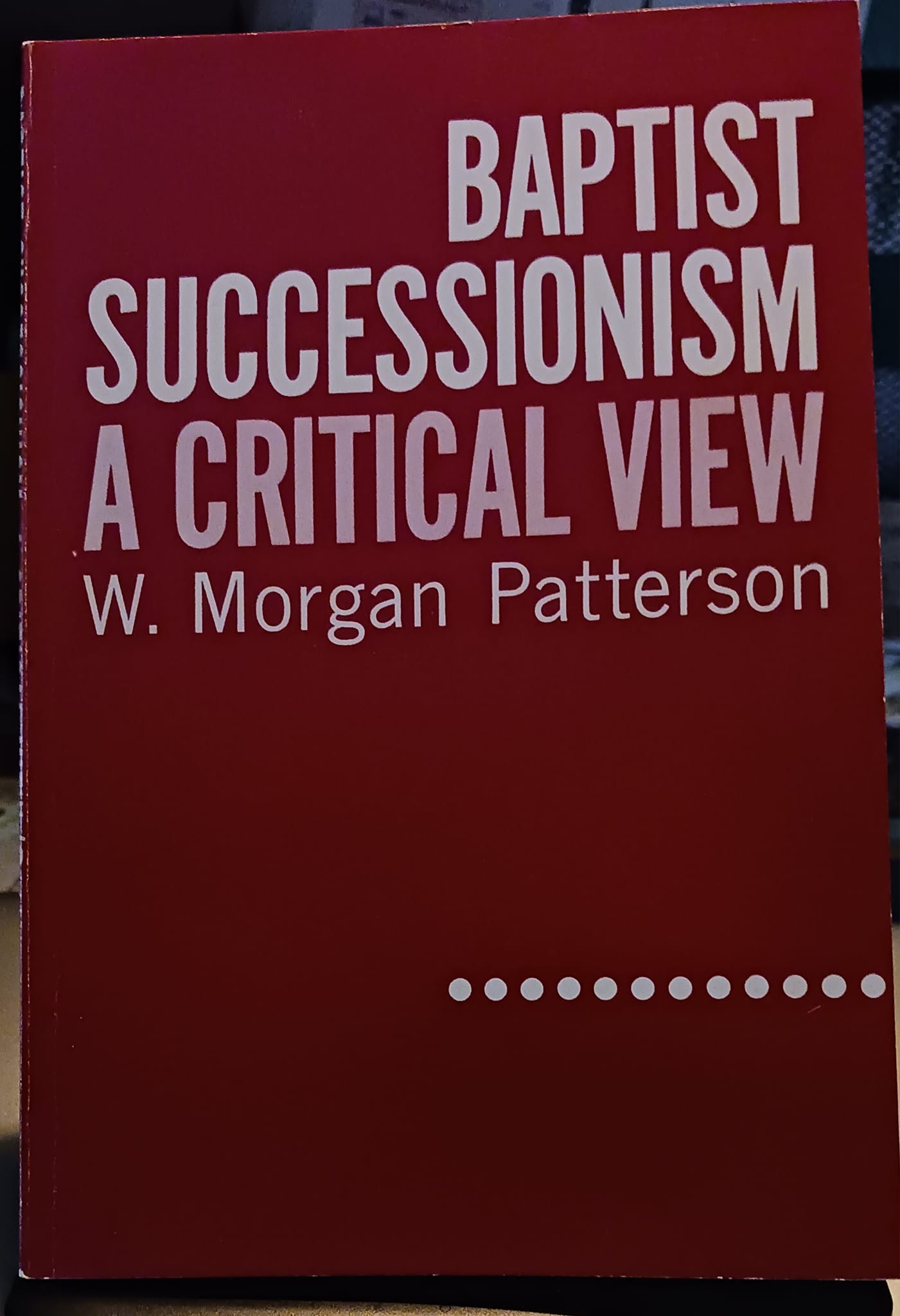
W. Morgan Patterson is a Southern Baptist historian, educated at Stetson University, New Orleans Baptist Theological Seminary, and Oxford University. This book was published in 1979, but I recently picked it up and read it in one day.
This is a concise book (four chapters, 75 pages) that analyzes the failures of the sloppy historical research of Baptists, such as Landmarkists, who believe Baptist churches are in a direct line of succession from New Testament times. The introduction explains there are four different variations of successionist writers, from those who believe they can demonstrate it and that is necessary, to those who believe neither. Chapter one explains how the successionist view was not that of the earliest Baptists, but in the 19th century it was formulated by G.H. Orchard and popularized by J.R. Graves. Chapter two shows how the successionist writers misused their sources. Chapter three shows their poor logic. Chapter four exams some of the motivations behind this erroneous view. The conclusion sums up the book, noting that the successionist view was predominant in the 19th century, but thanks to bold historians like William Whitsitt, whose research debunked the theory in the 1890s, the successionist view became a minority position among Baptist historians in the 20th century.
Patterson is scholarly historian, and he may assume a little too much about the historical knowledge of the reader when he refers to the Münster incident on page 22 without explaining that this was a violent takeover of the city of Münster, Germany in 1534 by an Anabaptist fringe group that came to be associated with Anabaptists and Baptists in the minds of their opponents, and he refers to the Whitsitt controversy on page 24 without explaining the controversy until later.
Patterson could have made his argument stronger by giving more specific details about the heretical beliefs of groups claimed by successionist writers to be Baptists, such as the Donatists, Paulicians, Cathari, etc.
While Patterson’s book is concise, it is substantive, and his reasons are sound. This is an effective critique.
Book Review: “Love Does” by Bob Goff
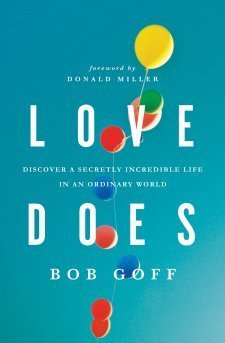
Bob Goff is a lawyer who loves the word “whimsy,” a word he uses constantly. His whimsical book starts each chapter by stating what he used to think and how he changed his mind (generally along the lines of how he used to think love was a feeling but now he thinks it is an action), followed by a whimsical true story from his life to illustrate his point. His stories are full of whimsical humor and talk about Jesus as his motivation for doing good deeds– and Goff does amazing deeds, particularly in Uganda, where he helped end injustice in the prison system and provided an education for countless children who were former fighters in the civil war.
His Christian motivation is inspiring, but his theology is shallow. He calls “missing the mark” a “stupid analogy” in chapter 16, and ridicules Bible teachers who use the term. One wonders if he even knows that “missing the mark” is the literal translation for the Greek word for sin, since in chapter 29 he ridicules people who study the Hebrew and Greek background of scripture.
Goff’s love in action is admirable– but his whimsy can be annoying if you value hard work and organization, such as when he tells how he got into law school by pestering the dean instead of doing the hard work to pass the entrance exam, and how he lied to get in a friend’s hotel room and ran up a $400 room service bill before the guy arrived as a “prank.” He describes many such adventures, never with a plan, but always with whimsy. He certainly gets a lot of good things done, but he swings the pendulum so far away from planning toward risk-taking that one wonders when one of his unplanned adventures will eventually cause some regrettable disaster. So far, so good– but I won’t risk reading any more of his books.
Book review: The Burdens of Disease: Epidemics and Human Response in Western History

J. N. Hays. The Burdens of Disease: Epidemics and Human Response in Western History. Rutgers, 2003.
During the coronavirus epidemic of 2020, I decided to pull this book off my shelf and read it. I’m glad I did, since it approaches the history of epidemics and disease in Western civilization from a historical and social perspective, explaining how society reacted to such epidemics as the Black Death, leprosy, typhus, cholera, tuberculosis, smallpox, polio, the flu epidemic of 1918, and AIDS. Hays traces the history of how physicians, governments, religion and common people responded to these epidemics. In particular, he gives a history of the development of modern medical science.
Although the book was written long before the international crisis of COVID-19, many lessons in his book will be of interest to readers today. He sees epidemic as a social issue, not just a medical issue, because it affects all of society.
Religious views toward disease have often been a factor. During the bubonic plague (Black Death) of the late Middle Ages, people often thought God was punishing them, and groups of “flagellants” even drew their own blood to atone for sins, assuming the role of Jesus’ sacrifice. Diseases like syphilis and AIDS were especially associated with sexual sin, but also tuberculosis (formerly called “consumption”) and polio were associated with the immorality in filthy slums, until the presence of these diseases among the rich and famous reframed attitudes. Hays tends to be negative toward religious faith, saying the scientific revolution “undercut traditional Christian orthodoxy” (p. 88), although he does not explain how, and later admits that the devout Christian scientist, Isaac Newton, appealed to “the very first Cause, which certainly is not mechanical” (p. 99). On the other hand, Hays also points out the limitations of science, holding in the mirror of irony the bold claims of scientists in 1872 that “men will master the forces of Nature” (p. 213) and in 1955 a news writer’s claim that “man one day may be armed with vaccine shields against every infectious ill that besets him” (p. 240).
Hays shows how disease was used and abused by the powerful, particularly governments, sometimes to protect, and sometimes to control. Italian city-states often quarantined people during the bubonic plague in an attempt to stop the spread of disease, much to the chagrin of businessmen and churches not allowed to meet or trade. Governments cleaned up slums, installed sanitary running water and garbage collection, and required vaccinations, all with a view to better health. However, democracies that valued personal freedoms struggled with this approach, as cities like Hamburg, Germany about 1900 were reluctant to impose vaccinations against the liberties of its people, until the city saw evidence of its effectiveness. City officials in San Francisco denied the existence of plague in Chinatown in 1900, calling it a “scare” and made it a felony to tell the news (p. 183). Governments fighting in World War I suppressed the news stories of the flu epidemic of 1918-19, so as not to divert attention from the war effort, thus it was nicknamed “Spanish flu” because Spain, a non-combatant in the war, reported on it freely. The darkest story of disease was the use of eugenics and euthanasia by Nazi Germany, which considered Jews “diseased” and also exterminated “the tubercular, the homeless, those unwilling or unable to work, and criminals of many sorts” (p. 287). Perhaps the most sinister destruction was the elimination of most of the Native American population by diseases that were brought by Europeans to the New World.
Socially, Hays discusses how social isolation protected people from epidemics in the Middle Ages, when people rarely travelled outside their own villages, and the Black Death only occured after cities arose in Europe and trade developed from nation to nation. He notes that major advances in transportation such as steamships and railroads provided opportunities for plagues to spread rapidly as travel from continent to continent was reduced to days, not giving viruses time to die before they spread to new victims.
Social changes also occurred for the better to prevent disease, as it became socially accepted to take baths, wash hands frequently, drink pastuerized milk, and it became socially unacceptable to spit or sneeze in public, or smoke tobacco in public. One wonders what social changes may occur after our current epidemic, but that is likely the subject of another book.
Book review: God’s Wisdom for Navigating Life by Timothy Keller

Keller, Timothy. God’s Wisdom for Navigating Life: A Year of Daily Devotionals in the Book of Proverbs. New York: Viking, 2017. I loved this daily devotional! I have read Keller’s devotional through Psalms, and I find this one to be an excellent companion to it. Keller wisely (pun intended) groups the devotionals into topics, rather than trying to go through Proverbs chapter by chapter. By including verses from different parts of the book in a day’s devotional, he gives a greater balance and thoroughness to each, as he often includes wisdom sayings that give different perspectives on the same topic, or give further elaboration and illustration on the same topic. Keller also includes some selections from other wisdom books, especially Ecclesiastes and Job, and ends during the Christmas season with insights from the New Testament and how Jesus is our ultimate source of wisdom. I highly recommend this daily devotional! It will challenge you to think deeply and live wisely. |
Book review: “A History of the Modern Middle East”
A
A History of the Modern Middle East by William L. Cleveland and Martin Bunton, 6th ed., (Westview Press, 2016).
This history does as the title promises, focusing more on the modern period of the Middle East, especially from the Ottoman Empire through 2015. The book covers the rise of ISIS but was written before the downfall of ISIS. It includes the Arab Spring of 2011, which Cleveland prefers to call the “Arab Uprisings.” It includes balanced discussions of areas from Turkey to Iran to the Arabian Peninsula to Egypt. It does not include neighboring countries such as the Sudan, North Africa or Afghanistan in the discussion, except where events there affect the Middle East proper, such as the Egyptian war in Sudan, the harboring of Osama bin Laden by the Taliban in Afghanistan, and the Arab uprisings that began in Tunisia and led to the downfall of Libya’s dictator, too.
The book gives much attention to the Arab-Israeli conflict, which is appropriate, as well as thorough coverage of the Kurdish problem of being a people without a homeland.
Perhaps due to his focus on the modern period, Cleveland passes over the Crusades with barely a mention, which I found peculiar, since modern Arabs like Osama bin Laden referred to Christians as the “Crusaders.”
While Cleveland strives to present a balanced report of both the positive and negative traits of each people and each personality, he appears to have certain biases. He clearly is sympathetic to the plight of the Palestinians verses the Jews, and is favorable to the Muslim worldview (for example, he blames Islam’s low view of women on the influences of the cultures neighboring the Arabs, and refers to the Muslim Brotherhood as “moderate”). Nevertheless, he does a good job of explaining the various sectarian and ethnic groups, such as the Sunni and Shi’a, and minority groups like Arab Christians, Assyrians, Yazidis, Druze, Alawites, etc.
Book review: The Best Yearly Devotionals

Many people like to get a book with devotional readings for the entire year. If you are shopping for an annual devotional book, the two classic, all-time best, in my opinion, are Experiencing God Day-by-Day, by Henry T. Blackaby and Richard Blackaby, and My Utmost for His Highest, by Oswald Chambers (I recommend spending a little extra to get the updated edition of Chambers, because his work was originally written in 1917, and the language of the original can be difficult to follow.) Both of these devotionals are strongly rooted in the scripture, with penetrating insights that will drive you to deeper prayer and faithfulness.
Another excellent classic, Morning and Evening, by Charles Spurgeon, provides readings for morning and evening every day. A Year with C.S. Lewis provides great selections from Lewis’s writings for every day of the year. The Songs of Jesus, by Timothy Keller, has a year of brief, Christ-centered daily devotionals through the Psalms. The prayers Keller offers are particularly inspiring. Keller has also published a devotional on the Proverbs (which includes some passages from Ecclesiastes and Job), God’s Wisdom for Navigating Life. It groups wisdom sayings by topics, and does an excellent job of balancing different perspectives of practical, moral, and social issues. New Morning Mercies, by Paul David Tripp, takes daily tweets and elaborates with wise, biblical words on living in God’s grace; although Tripp’s devotions are longer than most, it’s well worth your time. All of the above devotionals will cause you to think deeply and inspire you.
My brother Todd highly recommends the two-volumes of devotionals by D.A. Carson, For the Love of God. It is designed to go with a two-year daily Bible reading plan, and goes into depth. It is not light reading.
If you want a lighter devotional, Daily Guideposts, published annually by Guideposts magazine, include many inspiring stories by a different author every day. They are well-written, although they lack as much substance as the other devotionals mentioned above.
My Daily Pursuit by A.W. Tozer is a collection of thoughts from Tozer’s sermons, which I plan to read through in 2021, so look for an update next year.
Jesus Calling by Sarah Young is an extremely popular devotional that uses the literary device of speaking to the reader as if it is the words of Jesus Himself. The devotionals in Jesus Calling are brief but quite encouraging, especially to those who need to find peace in their lives. However, the devotional has been criticized because the author claims she received the messages directly from Jesus, and some authors have pointed out minor errors in her book that prove not all messages were directly from God. (For more on this controversy, check the excellent book review by Tim Challies here.) Despite these criticisms, I think her devotional is very helpful, and to her credit, Young includes scripture references at the end of each devotional. Young also has published spin-off devotionals that are similar, such as Dear Jesus.
Voices of the Faithful, edited by Beth Moore, has devotional stories by missionaries.
If you are looking for a devotional for married couples, Our Love Is Here to Stay: A Daily Devotional for Couples, by Tony and Lois Evans, is the best one I have read on the subject. It is well-written, interesting, and full of practical wisdom.
Favorite children’s Christmas books: “All Is Well” by Frank E. Peretti
 Frank Peretti is the best-selling author of the Christian thriller This Present Darkness, but he is also the author of one of the most touching Christmas books for children that I have ever read.
All Is Well: A Story for Christmas is different from other children’s Christmas books for several reasons. It is on the reading level of an older child, perhaps about fifth grade. It is on the emotional level of a single mom who is struggling to make ends meet at Christmas. The story takes place in July, not during the Christmas season. Yet is most certainly a Christmas story, especially for those who going through tough times during the holidays.
If you are looking for a cute Christmas book for your child, this is not your book. But if you need encouragement to make it through Christmas, this may be the best book you could read, especially to a child who doesn’t understand why God is allows suffering and hard times.
Book review: “Rooms” by James Rubart
 Rooms by James Rubart is a Christian novel about a wealthy young Seattle software developer who gets a cryptic note saying that he has inherited a house on the Oregon coast from an uncle he doesn’t remember. When he goes to claim his house, he finds that he has inherited a house with weird rooms that God is using to change his life.
Some people have compared this book to The Shack, since both books call a man to a house and force him to deal with the pain of his past. However, there are many differences between the two books. Rubart is a more experienced and better writer. He uses vivid descriptions that paint a clear picture of the characters and events. Rubart does not delve into any questionable theological teachings, the way the author of The Shack does. However, The Shack is more emotionally satisfying as an answer to the problem of suffering. Rooms deals with pain, forgiveness, and includes a good romantic story, but it reads more like a science fiction novel, and for some reason, I found it harder to suspend belief and accept the alternate lives and time travel that takes place in the novel. Rooms is also very long, but I’m glad I stayed with it to the end, as the plot picks up pace, and comes to a fascinating and satisfying conclusion.
I listened to the audio version of the book, which was 9 CD’s. It made a good book to pass the time on long trips from Georgia to Mississippi.
X
X
X
X
(If you see an ad below this post, please understand that I have no control over these ads, and that I do not necessarily endorse the product.)
Book review: “Immersed: 40 Days to a Deeper Faith”

Immersed: 40 Days to a Deeper Faith, is a daily devotional designed to develop deeper Christian disciples, written by Doug Munton, pastor of First Baptist Church of O’Fallon, Illinois. It is divided into six chapters designed for each week, and each chapter has seven daily readings, except the last chapter, which has five readings, bringing the total to 40 daily readings. Each reading is about two and a quarter pages in length. The book may be read alone as a daily devotional, or read in conjunction with a small group discussion or church-wide campaign. I read one reading each day for 40 days, as suggested, but on my own without a group discussion. Each daily reading comments on a particular scripture verse, which he explains and applies to daily life, and concludes with points to ponder and reference to two chapters of the Bible as a suggested daily Bible reading. The seven weeks of devotionals cover the subjects of God’s Word, personal renewal, following Christ in difficult times, recognizing blessings and blessing others, choosing a missional life, and living out your faith in the real world.
Munton writes in a conversational style, filled with everyday illustrations, making it easy to read. However, don’t assume this is just light reading. He has many keen insights that often sent me to my knees in prayer, reflection, and got me on my feet to take action.
Munton has a gift for memorable illustrations. The story on Day 22 is a beautiful example. Munton tells how his father learned to count his blessings, while alone on a mountain during the Korean War. Then (spoiler alert) Munton shares how after his father died, they found a photo of his Dad in uniform in Korea. His mother pointed to the mountain behind him in the photo and said, “that is the hill where your father counted his blessings” (p. 110). Munton also knows how to turn a phrase and is full of provocative quotations. He says, “our hope is not that our problems will be absent but that our Lord will be present” (p. 80). He says, “the mission of Jesus– and, therefore, the mission of His disciples– is about more than helping nice people be nicer. It is about helping dead people find life” (p. 140). He says, “We can never be worthy of salvation but we can live worthily in salvation” (p. 176).
Each daily reading ends with reference to two chapters of the Bible suggested for daily scripture reading, designed to take the reader through The Gospel of John, The Acts of the Apostles, and Proverbs. While I agree that it is an important part of discipleship to read through books of the Bible, I wonder if it might have been better to if Munton had done the daily Bible readings differently. Most of his assigned daily Bible readings do not relate to the daily devotionals. However, since each daily devotional is built around a key Bible verse, it seems to me it would have been better to assign the reader to read the whole Biblical chapter that includes the focus verse of each day’s devotional, giving greater context to the excellent devotionals that Munton writes.
Despite that minor critique, this book is one of the best resources I have read for personal discipleship. I highly recommend it.
Copies can be found online at amazon.com, or at discounted bulk prices directly from the author at http://www.dougmunton.com.
In the interest of full disclosure, Munton is a personal friend of mine, and I received a complimentary copy of his book, but I was under no obligation to write a favorable review.
Book review: “Dead Lawyers Tell No Tales”
 If you like John Grisham, you will probably like Randy Singer. I have read many of Singer’s legal suspense novels, and I found his plot twists to be consistently good, often better than Grisham. Singer is a Christian writer who avoids profanity and has a Christian worldview to his books. As a Christian myself, I really like that. But if you are not a Christian, don’t let that put you off, especially in Dead Lawyers Tell No Tales. Although his previous novels are not “preachy,” this novel is even less so. Singer simply weaves a captivating story of redemption. Landon Reed, a former SEC football quarterback who went to jail for taking a bribe to throw a game, wants to redeem himself by becoming a lawyer and helping others. He is an imperfect man who nearly falls again, and then gets caught up in a law firm where somebody is slowly killing every lawyer at the firm.
From beginning to end the plot kept my interest. Each short chapter seemed to end with something that made me want to read the next chapter and learn how the plot would resolve. Singer is a lawyer himself, and is able to describe complicated legal situations with clarity and detail. But what made this story engrossing in the first half was the theme of forgiveness and a second chance. In the second half, the plot accelerated and I couldn’t put down the book until I finished. This is probably Randy Singer’s best book to date.
X
X
X
(If you see an ad below this post, please understand that I have no control over these ads, and that I do not necessarily endorse the product.)
Book review: Joe McKeever, “101 Cartoons”
 Recently, I had the pleasure of enjoying some pancakes with Joe McKeever. When he noticed that the waitress was friendly, he immediately pulled out a pad and pencil, asked her to stand still and smile, and in a few moments he had drawn a wonderful cartoon of her likeness. She was so excited, another waiter came to ask about it, and he gladly drew another one. Everywhere he goes, Joe draws pictures of people. You might say that he’s the quickest draw in the West.
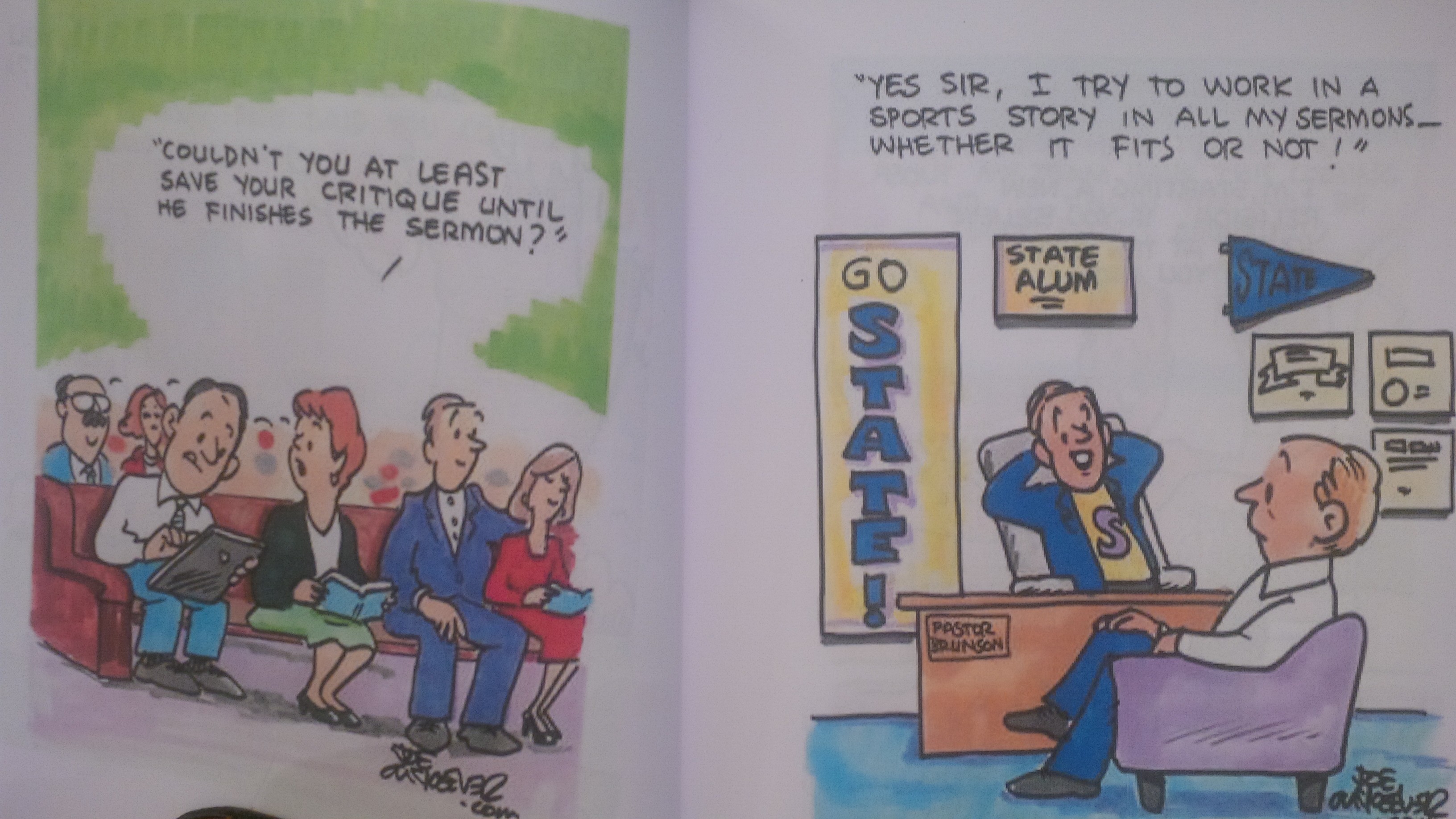
McKeever’s cartoons were published for years in Pulpit Helps and are still a regular feature in various Baptist newspapers through Baptist Press. Now McKeever has published a great collection of some recent favorites, entitled 101 Cartoons. Each cartoon is a full page, and nearly all are in full color. Most of the cartoons poke fun at religious subjects, as is illustrated by the photo at the bottom of this review. Others, like the cover photo above, poke fun at life in general.
McKeever has a corny sense of humor, which I like. He pokes fun at pastors, deacons, pastor search committees, hypocrites in church, seeker-sensitive churches, Calvinism, fickle church members, Facebook, smart phones, politicians, TV, the lottery, sports, health and exercise, among other things. Some of the cartoons make a serious point, such as the one that shows a man in a wheelchair in front of a church with inaccessible steps, who says, “I’ll bet this is a real pretty church on the inside.”
The print is large and easy to read, and as you can see from the photos, they are very colorful. It makes a great coffee table book for enjoyable conversation with family and visitors.
101 Cartoons is available from Amazon.com or you may purchase it directly from the author and he will inscribe a personal greeting and cartoon inside the front cover for you. Send a check for $15 for one or $27 for two, to Joe McKeever, P. O. Box 855, Kenner, LA 70063. In the interest of full disclosure, Brother Joe gave me a complimentary copy of his book along with the pancakes; however, he did not ask me to write this review– I was glad to do that myself!
 X
X
X
X
X
X
X
(If you see a video ad below this post, please understand that I have no control over these ads, and that I do not necessarily endorse the product.)
Book review: Max Lucado, “Outlive Your Life”
 I have read about 20 books by Max Lucado. I love his gift for telling a story and turning a phrase. However, after reading so many of his works, I began to feel that if I’ve read one of his books, I’ve read them all. So when I got a copy of Outlive Your Life: You Were Made to Make a Difference, I let it sit on my bookshelf for over three years.
Recently, some circumstances in my own life drew me again to the title. I’d like for my life to make more of a difference, so I decided to see what Max had to say. I was deeply moved– to take action.
This book uses the familiar writing style of Lucado that has made him one of the bestselling Christian authors of modern times: vivid storytelling with a surprise ending, and clever, poetic phraseology. For example, he described the apostle Peter’s reaction to the vision to eat unclean food by saying, “Peter was pondering the pigs in the blanket when he heard a knock at the door” (p. 146). He also follows a Biblical theme, as he does in most of his books. This one focuses on stories in the Acts of the Apostles to encourage Christian readers to make a difference in their world, the way the early disciples did.
What really stands out in this book, however, is how boldly Lucado calls on Christians to be involved in social action. Again and again, he urges Christians to help the poor, care for orphans, feed the hungry, etc. He is very specific in examples of how to do that, more so than any other book of his that I have read to date. He does so without abandoning the gospel message. In fact, chapter four, “Don’t Forget the Bread,” stresses that if we help the needy and don’t share the gospel, we are like he was when his wife sent him to buy bread at the grocery store and he came home with everything else and forgot the main thing: the bread.
Each of Lucado’s books include a discussion guide at the end, but this book has a “Discussion and Action Guide” (emphasis mine). America’s most inspirational author intends not only to inspire, but to move the reader to action. For this reader, he succeeded.
X
X
X
X
(If you see a video ad below this post, please understand that I have no control over these ads, and that I do not necessarily endorse the product.)
Book review: “Lord, Show Me Your Glory”
 I was attending a writer’s conference, and a publisher who was speaking to us said that books often sell well because of marketing and famous authors, not because of the quality of the books. Someone asked the publisher to name a book that did not sell well but was such a quality book that he was glad it was published. The publisher said, “Yes, the book is Lord, Show Me Your Glory by Ethel Herr.”
The book was out of print, so I ordered it from amazon.com. I’m glad that I did.
I spent the year of 2008 going through this devotional. A wonderful journey it was. The book is divided into 52 chapters to be used as 52 weeks of devotions. But each “Week” actually has two or three qualities of God to study, so it really amounts to about two or three devotionals for each week. For example, Week Four is a devotional on God is Carpenter, Potter, and a Working God, Week Twelve is on God as Living Bread and Manna, and Week Twenty is on Discipliner, Teacher/Master and Rabbi. You get the idea.
Herr has a very descriptive writing style. For example, in Week Eleven she describes God’s omniscience by saying, “grace without God’s omniscience would be as elusive as a hollow wind whistling through the broken window panes of an empty church” (p. 72). She also has keen insights into the character of God. In Week Eighteen, she says this about God’s as Resurrection and the Life: “So, when He chooses to let our dreams die so He can give us a resurrection rather than a healing, we sometimes feel abandoned” (p. 114). Each section lists scripture readings for further meditation on that particular quality of God. I found that looking up those scriptures was almost as enriching as the text of her book.
The experience of going through this book will help you understand the character of God in a powerful way. If you are looking for a practical devotional that is all about you and how you live your Christian life, this is not it. But if you are looking for a devotional that will make you forget yourself and will leave you in awe of our wondrous God, bowing before Him in worship, then find a used copy of this rare gem of a book online and order it.
X
X
X
(If you see a video ad below this post, please be aware that I have no control over these ads, and that I do not necessarily endorse the product.)


 Bob Rogers