Blog Archives
The first Baptist missions to Native Americans in Mississippi

Copyright by Robert C. Rogers and the Mississippi Baptist Convention Board.
Native Americans were an area of concern for Mississippi Baptists. The white man wanted the Indian lands, and but the Baptists desired the conversion of their souls. In 1817, the Mississippi Baptist Association began an aggressive policy by sending Thomas Mercer and Benjamin Davis to visit the Creek Indians and see what cold be done to establish the gospel among them. The missionaries started out on their mission, but the project collapsed when Mercer died. Baptists in Kentucky started an academy for Choctaws in that State in 1819, but it closed in 1821. Richard Johnson, a Baptist leader in Kentucky, then opened an academy for Mississippi Choctaws in 1825 in the district of Choctaw chief Mushulatubbee, which was approximately the area between the modern cities of Columbus and Meridian. This school’s curriculum was secular, but the teachers hoped to “civilize” the Choctaws and lead them to faith in Christ. They met with some success among students, but the missionaries had little impact on adults in the tribe. A young female student wrote: “I do not know that one adult Choctaw has become a Christian. We all pray for them, but we cannot save them; and if they die where will they go? May the Lord pour out his Spirit upon the poor Choctaw people.” It would be many years before missions to the Choctaw tribe would have much impact.
This is one in a series of blog posts about Mississippi Baptist history. Click the links on this blog to read other posts on Mississippi Baptist history. More stories to come.
(Source: T. M. Bond, A Republication of the Minutes of the Mississippi Baptist Association (New Orleans: Hinton & Co., 1849), 60, 71; Clara Sue Kidwell, Choctaws and Missionaries in Mississippi, 1818-1918 (Norman, OK: University of Oklahoma Press, 1995), 100-113.)
The first African-American Baptists in Mississippi
Copyright by Robert C. Rogers and the Mississippi Baptist Convention Board.
From the start, many of the Baptists of Mississippi were African-American. Only a few of the white Baptists owned slaves, but slaves who belonged to non-Baptist slaveowners were welcomed to worship as fellow members alongside whites in Baptist churches. From 1806 to 1813, Ebenezer Baptist in Amite County listed four “Africans” who joined, out of about 50 members. For instance, on December 8, 1815, the minutes of Ebenezer read, “Received by experience an African Ben belonging to Samuel Harrell.” (Samuel Harrell does not appear in the list of church members.) In 1821, Salem Baptist on Cole’s Creek had 28 white members, listed by full name, and 32 “black” members, listed by first name only, under the names of their owners. None of the slaveowners were members of the Salem church. The common practice was for slaveowners to give a written pass for slaves to attend worship. For example, the minutes at Salem on May 3, 1816 read, “Captain Doherty’s Phil came forward with his master’s written permission to join the church by experience.” (Doherty was not a member of the church.) Although slaves were bought and sold and transported from state to state, Baptist churches still received them by letter from their former churches. In November 1816, the minutes of Sarepta Church in Franklin County read, “Bob & Ferrby servants of Walter Sellers presented letters from Cape Fear Church in N. Carolina & was received.” Slave members were disciplined, as well, as Sarepta minutes of December 1822 read, “Bro. Prather’s Rose (a servant) excluded by taking that which was not her own.” From this wording, it is likely that Walter Sellers was a slaveowner but not a Baptist, whereas “Bro. Prather” likely was a member of the Sarepta church, who had a slave named Rose.
During the antebellum era until the end of slavery, most African-Americans worshiped with whites. However, there were a few Baptist churches that were exclusively for blacks. One such church was in the Mississippi Association. Called the “African Church,” it first appeared in the minutes of the association as a member church in 1813. It met at a sawmill belonging to Josiah Flowers, pastor of Bayou Pierre Church. In 1814, the African Church sent a letter to the association, and in 1815 the association called on the various white pastors to take turns preaching to the African Church, which was then using the meeting house of Bayou Pierre church. Every year from 1816-1819, the African Church sent two messengers to the associational meeting, by the names of Levi Thompson, Hezekiah Harmon (messenger twice), E. Flower (messenger three times), William Cox, S. Goodwin, J. Flower and W. Breazeale. They never appeared in the associational minutes in any leadership position, but they did attend as duly registered representatives of the African Church, and they were given a seat alongside their white brothers in Christ. There were other African churches, as well. In 1818, members of Bogue Chitto Church granted “the Request of the Black Brethren to be constituted into a church.” In 1822, members of Zion Hill Church in Mississippi Association considered licensing Smart, a slave, to “exercise his gift” to preach, but delayed their decision “in consequences of an Act passed in the legislature.”
The situation had suddenly changed. Fearing a slave insurrection, the new state of Mississippi’s legislature enacted a law prohibiting slaves or even free people of color from assembling except under certain restricted conditions. This brought the Mississippi Baptist Association into conflict with the state legislature. When the law was applied to the African church, it forced them to discontinue meeting for a time. The association took up the cause of the African church and appointed a committee to prepare a memorial to be “laid before the next legislature of this State, praying the repeal of such parts of a state law thereof, as deprives the African churches, under the patronage of this association, of their religious privileges and that Elder S. Marsh wait on the legislature with said memorial.” The legislature did not agree with the association, and the African stopped meeting for a time, although the members were still welcome in the other churches led by whites.
In 1824, the state legislature heeded the complaints of the churches, and revised the code to permit slaves to preach to other slaves, as long as the service was overseen by a white minister or attended by at least two white people appointed by the white church. Thanks to this revision in the law, African churches could meet again, and in 1826, Zion Hill Church allowed Smart to preach. The African Church at Bayou Pierre joined the new Union Association after 1820, meeting as a separate congregation from Bayou Pierre church. In 1828, the African Church reported 75 members (its sponsor church at Bayou Pierre had 48 members). The African Church was tied with Clear Creek Church in Adams County for the largest church in the association.
The Mississippi Baptist revival during the War of 1812

Copyright by Robert C. Rogers and the Mississippi Baptist Convention Board.
On December 16, 1811, the New Madrid earthquake, with its epicenter in New Madrid in southeast Missouri Territory, was felt over a million square miles, including Natchez, where clocks stopped, houses were damaged, and the river rose and fell rapidly. A New Orleans writer said, “the shake which the Natchezians have felt may be a mysterious visitation from the Author of all nature, on them for their sins.” It would seem that many people were truly shaken to their core, not only by the earthquake, but also the War of 1812. The United States declared war on Great Britain in June 1812. In Mississippi the focus of the conflict was on the Indian tribes, especially the Creeks, who were supported by the British. In 1813, the Creeks attacked Fort Mims, north of Mobile, and massacred at least 250 people. The Creeks were eventually crushed by an army under General Andrew Jackson, but these dramatic events shook the souls of Mississippians. The annual Circular Letter of the Mississippi Baptist Association of October 1813, was on the subject of “The War.” It was a circular letter received from Ocmulgee Association in Georgia, republished with edits made by Mississippi pastors Ezra Courtney and Moses Hadley, because of “the distressed situation of our territory, and the nation in general.” It warned readers that perhaps “Divine Providence” had allowed Europe to “invade our rights” because of “our ingratitude, our avarice, and abuse of the rich blessings we have enjoyed.” It declared the war to be “a war of just and necessary defence [sic]; justifiable on every sound political and moral principle.” It called for unity to defend “the rich inheritance of freedom we possess,” and stressed how American liberty was unlike that of France, which had fallen into ungodly apostasy and lost its freedoms. “If history ever proved any one truth clearly, it is this: that no nation, without public and private virtue, ever retained its freedom long.” The message was clear: their freedoms were in danger, and if they wanted to keep their freedoms, Mississippians needed a fervent devotion to both God and country. It is not known how many people in the town of Natchez were shaken from their sins, but we do know that the territory experienced a religious revival. In 1813, 246 people were baptized into membership in the churches of the Mississippi Baptist Association, far more than any year in the decade before or after, and the total membership nearly doubled that year, from 494 to 914!
The first Baptist churches of Mississippi

Copyright by Robert C. Rogers and the Mississippi Baptist Convention Board.
During the two decades prior to the Second Great Awakening that began about 1800, there had only been one Baptist congregation in the Natchez District, Salem Baptist on Cole’s Creek in Jefferson County, which met informally in the 1780s, then organized in 1791 under the leadership of Richard Curtis, Jr. But the triple blessings of religious liberty, population growth and spiritual renewal certainly aided in the formation of five new churches from 1798 to 1806. The second Mississippi Baptist church was on Bayou Pierre, which was the river near the town of Port Gibson in Claiborne County. This location was the same river where Richard Curtis, Jr. and his friends had first hid from Spanish arrest in 1795. How appropriate that in the same year of his return, 1798, Curtis, along with William Thompson, John Stampley, Benjamin Curtis, Jacob Stampley, Joseph Perkins and William Thomas assisted in the constitution of the new church on Bayou Pierre. It is interesting to note that most of the members of this committee were among the arrivals in the 1780s. The Bayou Pierre church was organized in the home of Thomas Hubbards. It is unclear whether Richard Curtis left Salem to pastor Bayou Pierre, or whether he preached at both churches.
In 1800, two more churches were organized: the third Baptist church was New Hope on Second Creek in Adams County just south of Natchez, and the fourth was Bethel on Bayou Sara, four miles southwest of the town of Woodville in Wilkinson County. The fifth was New Providence in Amite County in 1805, and the sixth was Ebenezer in Amite County, near the Louisiana line, started by Richard Curtis in 1806. Curtis was likely involved in starting many, if not all of these new churches, for the records show that after Curtis started Ebenezer in May 1806, he then turned over the pastorate of Ebenezer to a South Carolina friend, Ezra Courtney, in November 1808, and Curtis became pastor of New Hope until the year of his death in 1811. Ebenezer Baptist in Amite County is the only one of these churches that continues to exist to this day, making it the oldest continually meeting Baptist church in Mississippi.
How a Baptist preacher helped America take Natchez from the Spanish
Copyright by Robert C. Rogers and the Mississippi Baptist Convention Board.
(In previous posts, I told the stories of how Baptists from South Carolina settled the Natchez District about the same time that the Spanish took control of the area from the British, and how the Baptists started Salem Baptist Church on Cole’s Creek, 20 miles north of Natchez.)
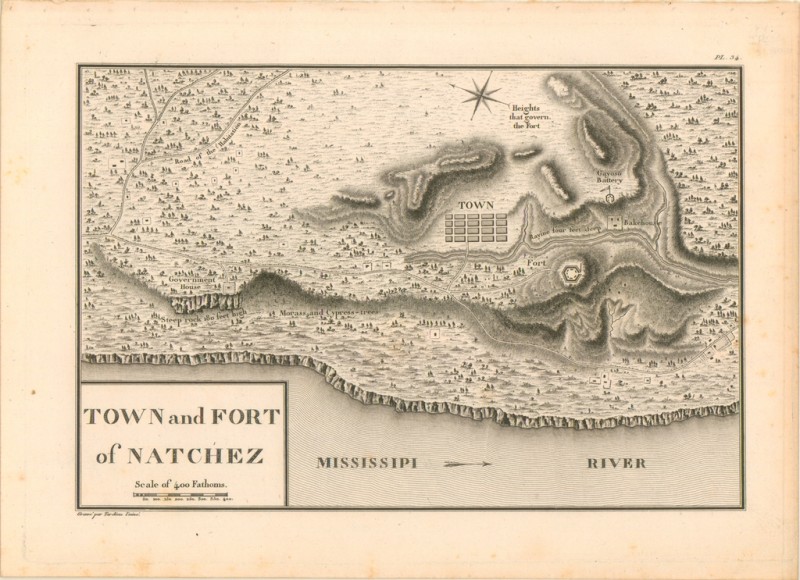
Concerned about so many English-speaking American emigrants to the Natchez District, who were not Catholic, the Spanish issued a religious edict in 1795. It declared “that if nine persons were found worshiping together, except according to the forms of the Catholic Church, they should suffer imprisonment.” They sent a man named Ebenezer Dayton to spy on the Baptists, pretending to be in sympathy with them as he was Presbyterian, and Dayton reported that their pastor, Richard Curtis, Jr. continued defend his right to preach the gospel and obey God rather than man. The Spanish Governor, Manuel Gayoso, arrested Curtis in April 1795, and forced him to sign a pledge not to preach. At the urging of his congregation, Curtis continued to preach, so Gayoso sent an armed posse to break up the house church in August 1795, but this time Curtis fled to South Carolina.
Meanwhile, the American government began the process of taking control of the Natchez District. The months between the signing of the Pinckney’s Treaty of San Lorenzo in October 1795, until the surrender of the area to the United States on March 30, 1798, were a period of turbulence and disorder in the Natchez region. The Spanish authorities controlled the government and exercised the legal authority that existed. The control of the Spanish was weakened by a large influx of American settlers and by the knowledge that the Spanish authority was of a temporary nature.
In February 1797, Louisiana’s governor sent orders to Gayoso to prepare dismantling the fort at Natchez in compliance with the treaty, but soon afterward, Gayoso received orders from Spain to postpone the departure, as Spain hoped to talk to the Americans about alterations to the treaty. The same month, Andrew Ellicott arrived with a commission from the American president to mark the southern boundary of the United States at the 31st parallel, which was about 30 miles south of Natchez, in accordance with the treaty to give to America all lands on the east side of the Mississippi River, north of the 31st parallel. He had a small army escort under Lieutenant Percy Smith Pope, and two dozen woodsmen from Fort Pitt. Ellicott, Pope and their party of Americans docked at Natchez on February 24, 1797. They camped on a knoll overlooking the town. At Patrick Connelly’s tavern atop the hill, the Americans boldly raised the United States flag, so that it could be seen by the Spanish in their fort. Gayoso and his garrison of 60 Spanish soldiers refused to leave. Ellicott and Gayoso wrote letters back and forth, neither party willing to give in, as the standoff continued for months. Lt. Pope preferred a direct attack, and even recruited 200 men from Cole’s Creek, which likely included some of the Baptists, to assault the Spanish fort, but Gayoso arrested the leaders and broke up the plot. Commissioner Ellicott, who was a Quaker, preferred negotiation and political maneuver to get the Spanish to leave. He counted on the loyalty of the majority of the American settlers, since it was only a few wealthy landowners who were solidly loyal to the Spanish. He got the leverage he needed from a Baptist preacher.
The Baptist preacher whom Ellicott needed was named Barton Hannan, who had previously been active at Salem Church on Cole’s Creek. Hannan arrived in Natchez preaching fiery words, damning the pope and recruiting volunteers for a revolt. Hannan got into a drunken brawl with some Irish Catholics on June 9, 1797, and the irate Irish Catholics mauled him. Governor Gayoso arrested Hannan for disturbing the peace, which only led to more disturbances. His wife marched to Natchez, baby in her arms, and demanded that Governor Gayoso release him. Gayoso tried to calm her by caressing the baby and giving her presents. “I don’t want your presents; I want my husband,” she said. He replied, “I cannot grant your request, madam.” She answered, “I will have him before tomorrow morning, or this place shall be deluged in blood; for there are men enough who have pledged themselves to release him before morning, or die in the attempt, to overcome any force you have here.” She was not making an idle threat, for on June 12, over 300 armed men assembled at William Belk’s tavern on the Natchez Trace to organize a rebellion. The governor released Hannan, and from that point forward, the Spanish lost real control of Natchez. In December 1797, Captain Isaac Guion arrived in Natchez with a large unit of American troops, and put greater pressure on Gayoso to leave. The Spanish finally departed on March 30, 1798.
Immediately after the Spanish had withdrawn, the American officials raised the “Stars and Stripes” over Natchez, and invited Bailey E. Chaney preach. He was the son of William Chaney, the deacon who, in Richard Curtis’s absence, was leading Salem Baptist on Cole’s Creek. Chaney preached before a large gathering, the very first sermon under the United States flag in the new Mississippi Territory. At long last, religious freedom was allowed in Natchez, and a Baptist was called on to celebrate it with God’s Word.
The first Baptist church in Mississippi
Article copyright by Robert C. Rogers and the Mississippi Baptist Convention Board.
(In a previous blog post, I told the story of how a group of Baptists emigrated to the Natchez District in 1780-81. This post tells how they started the first Baptist church in Mississippi.)
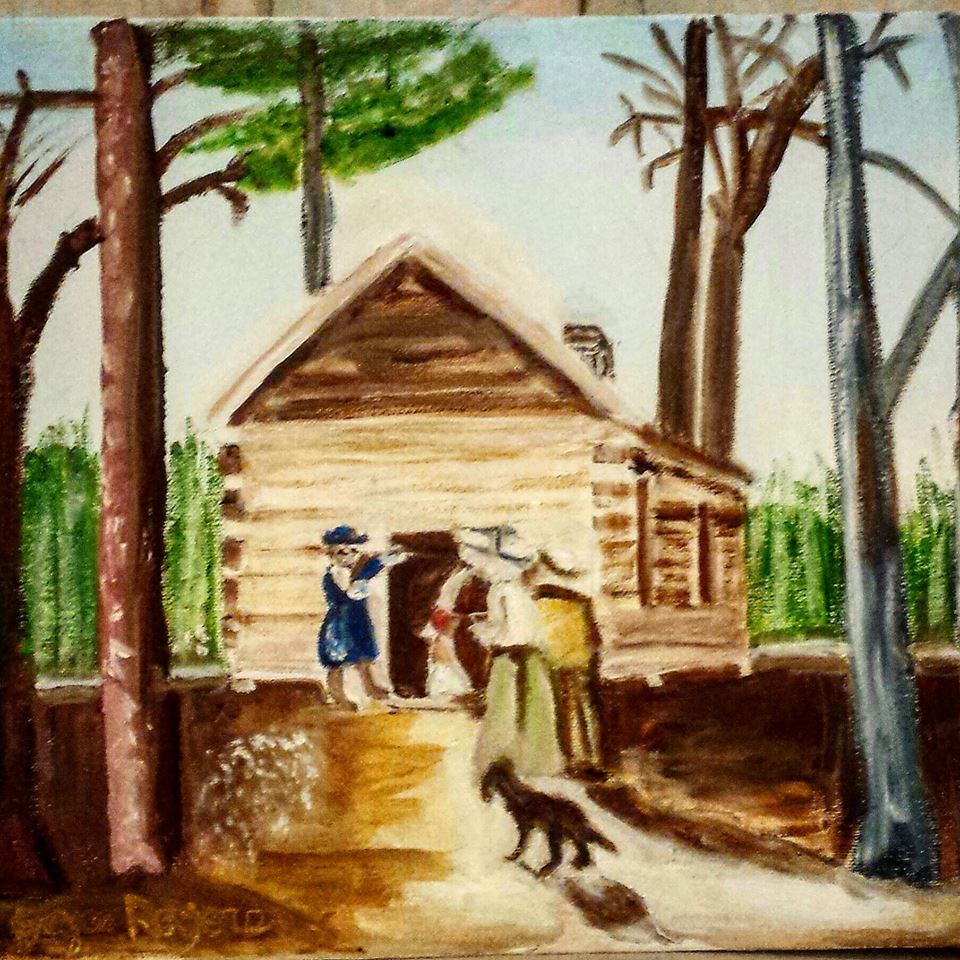
The Spaniards had taken control of the Natchez District from the British in October 1779, shortly before the emigrants arrived, but the Spanish had not established an efficient government or any control over land sales or occupation by adventurers. The first objective of the newly arrived settlers was to earn a livelihood. In this new land they were dependent upon themselves for supplying all of their needs. As they had likely arrived in the spring of 1781, they began to plant crops, as well as devote themselves to the construction of houses. They built for their protection the usual log houses from the abundant materials that were available. The experience of one of these settlers has been described by a descendant of John Jones:
“He found rich land… a plentiful supply of game in the woods and fish and water-fowl in the creek, with plenty of spring and creek water convenient for man and beast. He soon put up a log cabin, cut and burned the cane and undergrowth… and by doling out a scanty supply of seed-corn by the grain, soon had it planted… For a time, bread was not to be had, but Mr. Jones, with his trusty rifle… kept his family supplied with game, principally venison and wild turkeys.”
This patriotic band of Americans was living in an area conquered by Spain during the Revolutionary War but which was ceded to the United States by the Treaty of Paris in 1783 with Great Britain. Spain was determined to hold the territories she had captured, because of their intrinsic worth and because they afforded protection for her holdings south of the 31st parallel and the great Louisiana territory west of the river. The basic Spanish policy was to win the loyalty of those who resided in the territory and to increase the migration of Americans into the Ohio and Mississippi river valleys. The Spanish modified their traditional colonial policy by permitting the toleration of “heretics,” the admission of foreign immigrants, and the granting of a considerable degree of commercial freedom. These policies failed to win the ultimate allegiance of the settlers in the Natchez region.
Meanwhile, on Cole’s Creek, the group of settlers, most of whom were Baptists, met privately in their homes for Bible study and prayer, but did not worship publicly, thus avoiding attention from the Roman Catholic authorities. They lost their patriarch, Richard Curtis, Sr., who died on November 10, 1784, at age 56, but the embers of his faith were fanning to flame in the next generation. His young son Richard Curtis, Jr., was already a licensed preacher, though only 25 years old when they left South Carolina. Young Richard was 29 years old at the time of his father’s death; however, he was becoming known as a good preacher, and his brothers-in-law, John and Jacob Stampley, were also gifted at teaching the scriptures. Richard’s older brother William and step-brother John Jones were known for their prayers. By 1790, other American settlers were inviting them to visit their homes and share their faith. Whatever they may have lacked in education, they seemed to make up for in zeal. The conditions prevailing in 1791 thus were favorable for the establishment of formal Baptist religious worship. A group of seven people met at Margaret Stampley’s home on Cole’s Creek in what is now Jefferson County to organize themselves for religious worship. The members of this group of pioneers were: Richard Curtis, Jr., pastor; William Thompson, recording clerk; William Curtis; John Jones; Benjamin Curtis; Ealiff Lanier; and Margaret Stampley. Ealiff Lanier is the only name of this group whose name does not appear in the list of those making the journey from South Carolina in 1780-81. Notably missing are several male members of the first settlers, including Margaret Stampley’s husband, who may have died. The church was informally called Cole’s Creek Church, as late as 1806. They finally settled on the name Salem Baptist by the time the church name appears in the minutes of the Mississippi Baptist Association in 1807.
Dr. Rogers is writing a new history of Mississippi Baptists.
The Baptist pioneer trek to Mississippi
Copyright by Robert C. Rogers and the Missississippi Baptist Convention Board
(In a previous post, I told how a group of South Carolina Baptists decided to flee the devastation of the Revolutionary War and make a new life in Mississippi. This post tells the story of how they got to Mississippi.)
The Curtis family decided to establish their new homes along the Mississippi River near Natchez, in what was then called West Florida. After the French and Indian War in 1763, the British took Florida from Spain, (West Florida included the panhandle of modern Florida and the areas now in southern Mississippi and Alabama), and Englishmen from the colonies had begun to settle there. The stories of productive farmlands that were free to all settlers and the peace they would have from the turmoil of the fratricidal strife in South Carolina must have made the prospects of beginning again very enticing. In 1779, Spain took advantage of the British distraction with the American Revolution, and Spain conquered the Natchez district from the British and added it to West Florida. Despite this, the emigrants did not anticipate any difficulty from this source. As we shall see, they were wrong.
The route the migrants followed to their new homes was the familiar one used by many who were a part of the great westward migration, but it was not an easy trek. Our source for this journey is John Griffing Jones, a direct descendant of one of the travelers, John Jones. He writes that they left their homes in South Carolina early in 1780, loading their horses with their clothes, furniture and tools, and traveled north by land, crossing the Appalachian Mountains, and arrived on the banks of the Holston River near the present location of Kingsport, Tennessee, a trip of about 300 miles. Primitive roads and mountains made the trip difficult, as they carried their supplies on pack horses, the men traveling by foot. They arrived on the Holston River in the early spring and immediately began the task of raising a crop of corn, hunting game to salt and preserve, while building flatboats for the river journey that lay ahead.
In the fall of 1780, the travelers were ready to begin their voyage downriver. The party included Richard Curtis, Sr., and his wife Phoebe; two brothers William and Benjamin Curtis and their wives; Richard Curtis, Jr. and his wife Patsy; John Courtney and John Stampley and their wives (Hannah Curtis Courtney and Phoebe Curtis Stampley, respectively, daughters of Richard Curtis, Sr.); John Jones, his wife, and son William; and others whose names are unknown. On the second boat were Daniel and William Ogden and their families, and a Mr. Perkins and his family. The records do not reveal the names of the occupants of the third boat.
The emigrants knew from the experience of other travelers that they might have trouble with the Indian tribes. After all, they were planning to take lands formerly occupied by the Indians and make permanent homes for themselves. The natives did not want to give up their lands. The French had virtually exterminated the Natchez tribe in 1732, although other tribes such as the Choctaws were still in the area, but they knew they would encounter other tribes along the way, especially since the hostility of the Indians was encouraged and supported by the British against Americans during the Revolutionary War. In order to protect themselves, the emigrants always traveled in as large groups as possible.
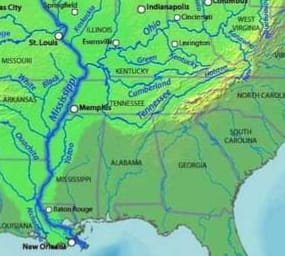
The migrants’ travel took them down the Holston River for 87 miles to what is now Knoxville. There, they entered the Tennessee River. The three boats had only traveled about 40 miles downriver, when they faced their greatest danger. This was the country of the Cherokees, who had been faithful allies of the British during the Revolution. These Indians attacked the flotilla on a bend in the Tennessee near the mouth of the Clinch River, near present-day Kingston. The Cherokee attack focused on the first flatboat, occupied by the Curtis and Jones families. Some of the women and children took over the oars while the men fired their rifles in defense. Hannah Courtney was grazed on the head by a ball, and Jonathan Curtis was slightly wounded on the wrist. While John Jones fired his rifle, his 12-year-old son worked the oars and his wife held up a thick stool made of poplar wood as a shield. A bullet hit her stool, and later Mrs. Jones laughingly remarked that “their guns were very weak, as they did not make a very deep impression on the stool.” The second boat floated by the point of attack unharmed, but the third boat was far behind, and became an easy target for the Indians. The occupants of the third boat had contracted smallpox, and so they were floating in the rear and camping at a separate place each night. The Cherokees killed everybody on the third boat except one woman whom they captured, thereby also contracting smallpox, which took the lives of many in the tribe.
The survivors made the rest of their trip without further molestation. They traveled about 600 miles down the winding Tennessee River, riddled with rocky shoals and swift currents, until they met the Ohio River near the city of Paducah, Kentucky. A short trip of 44 miles on the Ohio River brought them to the mighty Mississippi River at Cairo, Illinois. Then they traveled another 450 miles down the Mississippi River. They landed near the mouth of Cole’s Creek, about twenty miles north of Natchez, settling 3.5 miles eastward on the creek at “Curtis Landing,” and established a village known as Uniontown, west of the present town of Fayette. Given the distance they traveled, at the mercy of the flow of the rivers and resting each night, the trip should have taken several months. Jack Curtis, a descendant of Richard Curtis who has done extensive research on the family, estimates that they arrived in the Natchez District about March, 1781. By the grace of God, they had survived a trek through the mountains, an Indian attack and navigated over 1,000 miles of rivers to reach their new home.
Dr. Rogers is revising and updating A History of Mississippi Baptists.
The Mississippi Baptist story begins in South Carolina

Copyright by Robert C. Rogers and the Mississippi Baptist Convention Board.
The story of Mississippi Baptists begins in South Carolina. The Baptists of South Carolina furnished the first Baptist migrants to Mississippi and thus are of special importance in the history of Mississippi Baptists. Historians record that Rev. Richard Curtis, Jr. was 25 years old when he traveled with his parents and a group of fellow Baptists, who migrated from the Pee Dee River Valley of South Carolina in 1780 to settle on Cole’s Creek, about 20 miles north of Natchez, which at the time was controlled by Spain as part of West Florida. The precise location in South Carolina where these Baptists came from is unclear. One theory seeks to connect Richard Curtis and Mississippi Baptists to the historic Welsh Neck Baptist Church in Society Hill, in what is now in Darlington County, South Carolina. However, the church minutes of Welsh Neck Baptist Church from the time period are available for examination, and they never mention any of the Baptists who first settled in Mississippi. It seems more likely that they came from the region of Florence, South Carolina. There Richard Curtis, Sr., father of Richard Curtis, Jr., lived on Lake Swamp of Lynches Creek, near modern Florence, South Carolina, in 1766. In addition, Richard Curtis, Jr. was ordained by Benjamin Mosely when he fled back to South Carolina in the 1790s; Mosely was pastor of Ebenezer Baptist Church in Florence, South Carolina from 1784-1794.
The Revolutionary War period was one of great disturbance throughout South Carolina. There was a large group of Tories who were fanatical in support of England, but there was an equally powerful and more numerous citizenry who were American patriots. The conflict of these two groups stifled the economic development of South Carolina and brought fear and frustration into many parts of the colony. Over a hundred battles between American patriots and the British were fought in South Carolina alone. In 1774, Richard Curtis, Sr., and two of his sons, Benjamin and William Curtis, and his step-son, John Jones, enlisted with the American forces of Francis Marion, nicknamed the “Swamp Fox.” The records reveal that they served in three campaigns against the British, and then they were mustered out in 1779. In 1779 conditions had become almost unbearable, especially when British forces occupied Charleston. From this center, the British began a campaign to bring all of the colony under their control. The British were eventually overcome by General Nathanael Greene and his forces, but the turmoil and distress created by the war were undoubtedly a factor in encouraging some South Carolinians to seek a more peaceful place to live.
The Curtis family decided to establish their new homes along the Mississippi River near Natchez, in what was then called West Florida. After the French and Indian War in 1763, the British took Florida from Spain, and Englishmen from the colonies had begun to settle there. The stories of productive farmlands that were free to all settlers and the peace they would have from the turmoil of the fratricidal strife in South Carolina must have made the prospects of beginning again very enticing. In 1779, Spain took advantage of the British distraction with the American Revolution, and Spain conquered the Natchez district from the British and added it to West Florida. Despite this, the emigrants did not anticipate any difficulty from this source. As we shall see, they were wrong.
Dr. Rogers is writing a new history of Mississippi Baptists.
The Mississippi Baptist heritage of survival amidst persecution

Copyright by Robert C. Rogers and the Mississippi Baptist Convention Board.
Baptists have been the predominant faith in Mississippi so long, that nearly a century ago historian Jesse L. Boyd referred to Mississippi as a “Baptist empire.” Today, it is difficult for Baptists in the Magnolia State to imagine a time when their spiritual ancestors suffered hardships and persecution for their faith, but they did, even in Mississippi.
John Smyth established the first Baptist church in Amsterdam, Holland in 1609, after he fled persecution in England for being a Separatist Puritan. Thomas Helwys founded the first Baptist Church in England at London in 1611, and he landed in jail shortly thereafter for speaking out for religious freedom [McBeth, 38]. Roger Williams fled persecution in Massachusetts when he opposed the Congregationalist state church, so he started a new colony in Rhode Island with complete religious liberty, where he established the first Baptist church in America at Providence, Rhode Island in 1639. William Screven was banished from Maine for his Baptist faith, and he established the first Baptist church in the South at Charleston, South Carolina in 1696. Richard Curtis, Jr., migrated from South Carolina to the Natchez area in 1780, where he established the first Mississippi Baptist church in 1791, but he was arrested by Spanish authorities who only tolerated Catholicism, and he had to flee the region for three years.
Read this blog, as I will continue to unfold the story.
Announcement: I will be revising and updating A History of Mississippi Baptists
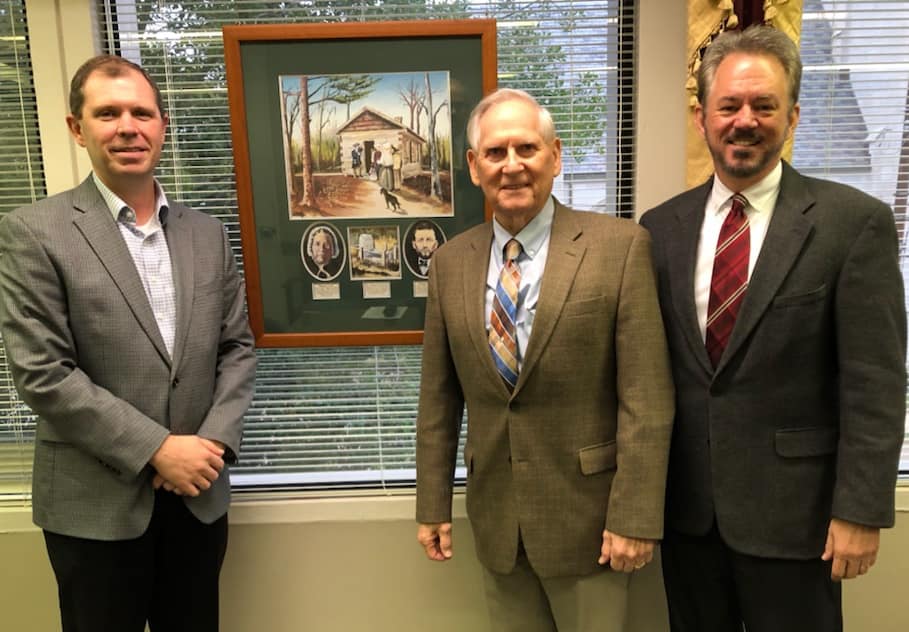
I am pleased to announce that on November 3, 2021, I signed a contract with the Mississippi Baptist Convention to revise and update A History of Mississippi Baptists by Richard Aubrey McLemore. The book was published by the convention, which holds the copyright, in 1971.
I expect the project to take a few years, as I will be doing a thorough revision of the original work, checking it for accuracy and rewriting in a more narrative style. After the revision is done, I will add two more chapters to update the last 50 years. You can read the full news story about the book here.
Follow his blog for stories that I learn and share along the way!
Houses of worship: Providence Baptist Church, Hattiesburg, Mississippi
 Copyright 2014 by Bob Rogers
Continuing my series of photo blogs on houses of worship, I share a photo that is one of my most recent, but one of my favorites. Providence Baptist Church is an historic congregation that dates back to 1818, yet this church in rural Forrest County, north of the city of Hattiesburg, Mississippi, has a worship center that blends the classic and contemporary. On the classic side, there is the red brick and columns in front, with a white steeple. But the high pitch of the roof in front that juts forward, and the columns rising to meet it, give just the right contemporary touch. Add to that the curb appeal of a country church standing proudly on a hill, and this church building is an amazing eye-catcher.
What is a healthy church?

Copyright 2012 by Bob Rogers
Recently, Outreach magazine published its list of the 100 largest churches in America and the 100 fastest-growing churches in America.
But when we read about the church in the New Testament, we do not find a list of fastest-growing churches. Not many numerical reports are even given, other than the 3,000 baptized at Pentecost (Acts 2:41) and the fact that the number had grown to 5,000 a little while later (Acts 4:4). After that, numbers are rarely given. We don’t read Paul reporting to the church that when he left Ephesus they were running 200 in Sunday worship. Instead of talking about numerical growth, he emphasizes spiritual growth. So why don’t we?
It’s time to change our terminology. Instead of so much emphasis on church growth, we should talk about church health. So what makes a church healthy, anyway? Paul gives us a full description in Ephesians 4:11-16.
1. Leaders who equip
“And He personally gave some to be apostles, some prophets, some evangelists, some pastors and teachers…” (Ephesians 4:11, HCSB)
Healthy churches have leaders who equip their members. The best test of the leader is that he has followers who learn from his teaching and example. Healthy churches have leadership that inspires the overall congregation to follow Christ and serve their community.
In this verse, the last two leadership gifts are indispensable to local church health. In Greek, the terms go together, “pastor-teacher.”
Pastors (translated “shepherds” in the ESV) bring guidance and comfort to the flock of God.
Teachers instruct the church in correct understanding of the Bible and Christian living.
Notice in verse 12 that these leaders have the purpose of training, or equipping, the church to do their work.
If a church is going to be healthy, it must have a pastor/teacher who is feeding the congregation God’s Word on a consistent basis.
2. Members who serve
“… for the training of the saints in the work of ministry, to build up the body of Christ…” (Ephesians 4:12, HCSB)
Healthy churches have members who serve. Don’t join this church to sit back and be entertained. If that’s what you are looking for, please go somewhere else. We need members who serve.
The “saints” are all the believers. “Saint” means a “holy one,” and every believer is called to be holy and set aside for God’s service.
It says the saints are trained by the leaders so that the saints can do the work of the ministry. So all members are called to serve.
Rick Warren asks, “If you are not involved in service or ministry, what excuse have you been using?
Abraham was old; Jacob was insecure, Leah was unattractive; Joseph was abused; Moses stuttered. Gideon was poor; Samson was codependent; Rahab was immoral; David had an affair; Elijah was suicidal; Jeremiah was depressed; Jonah was reluctant; Naomi was a widow. John the Baptist was eccentric; Peter was impulsive; Martha worried a lot; the Samaritan woman had five failed marriages; Zacchaeus was unpopular; Thomas had doubts; Paul had poor health; and Timothy was timid. God used each of them in his service. He will use you, too, if you stop making excuses.” (Rick Warren’s Daily Devotional, Day 357)
Healthy churches have members who serve.
3. Unity in the faith
“… until we all reach unity in the faith and in the knowledge of God’s Son…” (Ephesians 4:13a, HCSB)
Healthy churches are united. Unhealthy churches are divided. Notice the two ways he says we are to be united: by doctrinal faith (“in the faith”) and by personal faith (“and in the knowledge of God’s Son”). I heard about a pastor who was called to a church with only 51% voting in favor of his call. A year later, they fired him. It was a unanimous. The pastor said, “I finally united the church.” Of course, that’s not the way we want to unify the church, but the church does need to be united.
Remember the lesson from Noah’s Ark. It may stink sometimes, but we have to stay together, because we’re all in the same boat!
4. Growth measured by Christ-likeness
“… growing into a mature man with a stature measured by Christ’s fullness.” (Ephesians 4:13b, HCSB)
Too often, churches measure themselves by numerical growth. And it is true that healthy churches should have numerical growth. However, there are churches that have numerical growth but they are not healthy. A tumor can grow, but it isn’t healthy. And some churches explode and then die down. Others grow and grow in numbers, but they are attracting people for entertainment or because their standards are lax, and people are not being discipled.
Imagine a church board meeting with Jesus. Pete calls the meeting to order, and says, “Jesus, we’ve been following you around for some time, and we are getting concerned about the attendance figures. Tom, how many were on the hill yesterday?”
Tom answers, “Thirty-seven.”
Pete says, “It’s getting ridiculous. You’re going to have to pep things up.”
John says, “I’d like to suggest you pull off more miracles, but more people need to see it so our crowds will get bigger.”
Pete agrees, and adds, “Publicity is essential, and you tell half the people you cure to keep it quiet. Let the word get around.”
Toward the end of the meeting, Judas adds, “I’d like tos ay that if we are going to continue to meet in this upper room, we ought to do something about the carpet…” (Adapted from Richard K. Wallarab, Christianity Today, January 17, 1979.)
Notice that verse 13 gives the correct measurement of real growth: “a stature measured by Christ’s fullness.” That is our measurement of growth: are we like Christ? If our budget grows but we spend our budget on a bowling alley for church members instead of helping the hurting and sharing the gospel, we may be growing in numbers but not in Christ-likeness.
Healthy churches measure growth by being more like Christ.
5. Teaching that provides stability
“Then we will no longer be little children, tossed by the waves and blown around by every wind of teaching, by human cunning with cleverness in the techniques of deceit.” (Ephesians 5:14, HCSB)
Another great sign of a healthy church is that the Bible is so consistently taught, that the members aren’t tricked by heresy and false teaching. If some clever teacher comes into the church and tries to lead people astray, a healthy church recognizes it right away and puts a stop to it.
A decade ago, we had a powerful wind storm blow an oak tree on our youth building. The tree had shallow roots, and when the winds came, it fell. A healthy church that teaches the Bible is like a healthy tree with deep roots. It doesn’t fall under the pressure of false teaching.
6. Honest and loving relationships
“But speaking the truth in love, let us grow in every way into Him who is the head– Christ.” (Ephesians 4:15, HCSB)
Healthy churches have honest and loving relationships. “Speaking the truth in love” means that we are honest with each other, we speak the truth, but we are also loving when we do it. We don’t just try to please each other. If something’s wrong, we deal with it, but we always seek to deal with it in love. That’s challenging, but it’s vital to having a healthy church.
Years ago, The Betty Ford Story aired on television. It was a movie that told the story of the addiction and recovery of Betty Ford, the wife of President Gerald Ford. At one point in the film, there is an emotional scene where the family is sitting together confronting Betty Ford. Her son says, “Mother, you are destroying yourself; you are destroying this family, and you are killing yourself. Mother, you are a drunk; you are an addict.” His mother was infuriated. She told her son he was being very disrespectful and said, “How can you say these things to me? I am your mother!” Her son said, “Mother, I can say it because it is the truth.” As hard as it was, this confrontation was the catalyst for the establishment of the Betty Ford Clinic. (Tony Evans’ Book of Illustrations, p. 333-334)
A healthy church is a place where people speak the truth in love. Relationships are honest and loving. We don’t play games or try to please people, but we go out of our way to love people.
7. An environment that encourages involvement
“From Him the whole body, fitted and knit together by every supporting ligament, promotes the growth of the body for building up itself in love by the proper working of each individual part.” (Ephesians 4:16, HCSB)
Healthy churches create an environment that encourages involvement. “From Him (Jesus) the whole body, fitted and knit together… promotes the growth of the body…”
Many people think that it doesn’t matter if they are involved in the church or not, that the church won’t miss them if they are gone. Nothing could be farther from the truth.
On January 28, 1986, the space shuttle Challenger exploded just 73 seconds into flight. The whole nation was shocked. An investigation revealed that it happened because of one inexpensive O-ring. There were one million components in the space shuttle, but that one part destroyed the whole. Like the seemingly insignificant O-ring, one person failing to take his place in the church keeps the whole from being healthy. (Richard Swenson, Margin, 1992, p. 48)
A healthy church is a church where misfits can fit in. A healthy church is a place where the displaced can find a place.
This world is in desperate need of healthy churches in every community. Christian, are you allowing God’s Spirit to work through you to make and keep your church healthy?
Reflections on the 2012 Southern Baptist Convention in New Orleans
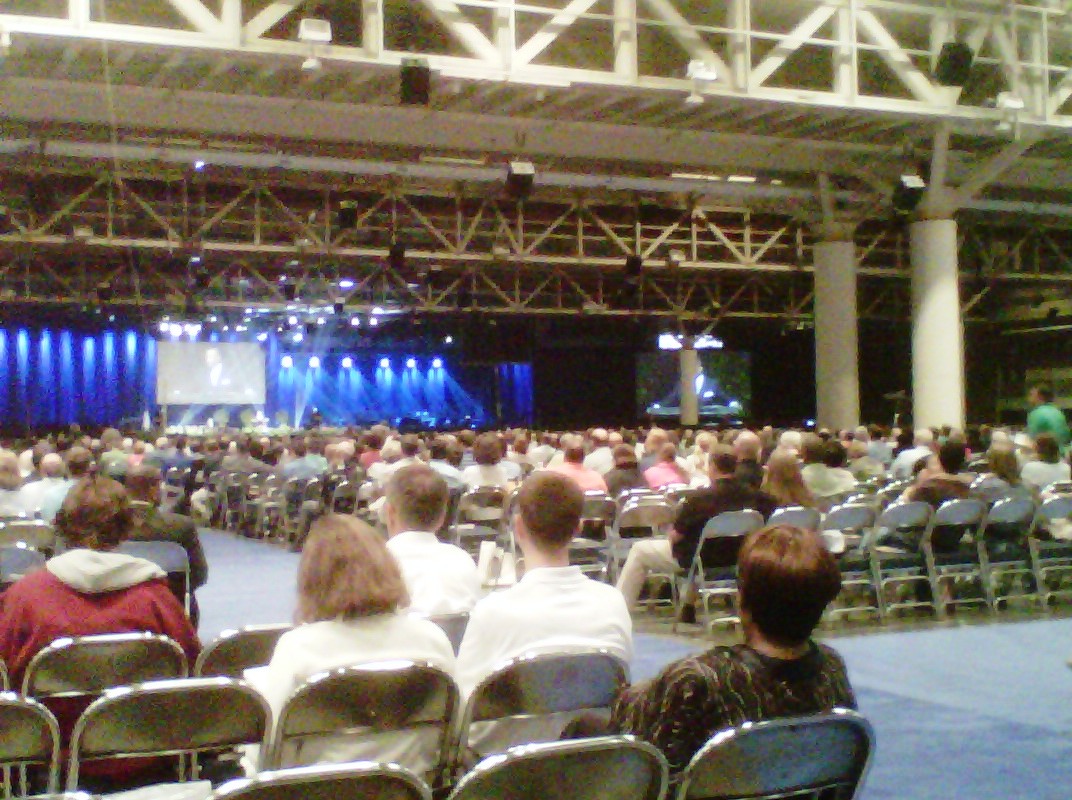 I recently attended the Southern Baptist Convention in New Orleans, where we elected our first African-American SBC president: Dr. Fred Luter, pastor of Franklin Ave. Baptist Church in New Orleans. Dr. Luter is an outstanding pastor, preacher and Southern Baptist leader. He took a congregation of 65 people and built it to thousands of members, only to see the membership decimated by Hurricane Katrina. He returned to rebuild the membership to over 4,500 in weekly attendance today. His church is a leading supporter of Southern Baptist missions. I am very excited that we have elected Dr. Luter, and I hope you will join me in praying for God to bless his leadership of our convention.
The convention also voted on changing the name of our denomination. By a 54-46% vote, messengers approved the proposal to keep the legal name Southern Baptist Convention, while at the same time encouraging anybody who wants to use a different name to call themselves “Great Commission Baptists.” I voted against this. The name “Southern Baptist” has come to stand for who we are. Changing actions is more important than changing our name. I felt that it was an unnecessary proposal, since churches do not have to use the name “Southern Baptist” in their local church name anyway to be affiliated with us, and even though the other name is just an alternative option, I feel that it will be confusing for us to be using two different names to refer to our denomination.
The convention passed nine resolutions and declined to bring forward some proposed resolutions. Resolution #3 was a hotly debated resolution affirming the use of a “sinner’s prayer” to express repentance and faith. Some people, such as David Platt, have criticized the use of a “sinner’s prayer” to give people a false hope that they are saved simply by saying a prayer, even when they have not repented of sin. The resolution affirmed that the Bible often speaks of crying out to God in faith, and that there is nothing wrong with asking people to repeat a “sinner’s prayer” of faith, as long as it is not used as manipulation or an incantation that does not include a full explanation of the gospel and expression of repentance. Makes sense, right? However, two amendments were proposed to this resolution, both of which failed. One amendment tried to completely delete the term “a sinner’s prayer.” This amendment was defeated. The other amendment tried to add specific language saying that salvation is available to all who hear and all may respond. This amendment was also defeated, since the resolution already said the gospel is offered to anyone who repents and trusts in Christ. Then the overall resolution was adopted. Apparently, the two amendments that were offered came from opposite camps in the debate over Calvinism. Some Calvinists have criticized the use of a “sinner’s prayer,” since they feel it is manipulative, and cannot bring salvation to a person unless that person is first chosen and called to faith by God. The other amendment, which stressed the availability of the gospel to all to hear and respond, seemed to be a direct attack on the Calvinist doctrine of limited atonement (the belief that Christ only died for the elect), since it was stressing a general appeal to all to believe. It is very interesting that both amendments were defeated; despite the controversy, the convention and most convention speakers seemed to desire to steer a middle course that is inclusive to both Calvinists and non-Calvinists.
Resolution #5 spoke out against the Obama administration’s violations and potential violations of religious liberty on several issues, such as the health care mandate for that violates the consciences of the Catholic church and other religious groups that do not wish to pay for contraceptives and abortion-causing drugs, and the threat to the ministry of military chaplains who do not believe in homosexuality, now that homosexuality is being approved by the military.
One resolution was of particular interest because it was not brought up for a vote. Dwight McKissic, an African-American pastor in Texas, had proposed a resolution against the racist statements in Mormon source documents. He was concerned that Mormons have been evangelizing people of color, without those people knowing that passages in the Book of Mormon such as 2 Nephi 5:21, Alma 3:6, 14 say that people with dark skin are cursed by God. An African-American member of the Resolutions Committee (I failed to get his name), said that the SBC has not been in the habit of speaking against specific religions, and implied that we didn’t want to set that precedent. He also said that since the Mormon church now allows people of color to be elders, we want to make sure we get our facts right before speaking on this issue. McKissic insisted that he still wanted the resolution to be brought up for a vote, because he said the Mormon church has never repented of these passages in their books, and the racist implications remain in Mormon “scripture.” However, the convention defeated Rev. McKissic’s motion to bring up his resolution.
Overall, it was a lively convention, attended by a little less than 8,000 registered messengers, full of inspirational reports from our International Mission Board and North American Misssion Board, great preaching and music. And of course, since it was a Baptist business meeting, there were as many different opinions as there were people in the room.
What really needs to change about Southern Baptists
 In 1845, the Southern Baptist Convention (SBC) was organized in Augusta, Georgia, just a couple hours’ drive north of where I now live. However, we’ve come a long way since then, not just in miles or time.
In 1845, one of the main reasons why Southern Baptists split from the North was that the SBC wanted to appoint slaveholders as missionaries. Today, many SBC churches are integrated, including my own, African-American pastor Fred Luter is our vice-president, and Luter will probably be elected president this year at the convention meeting in New Orleans.
In 1845, all of our churches were in the South. Today, we are still concentrated in the South, but we have churches in all 50 states. One of our largest churches is in California.
The idea of changing the name, particularly dropping the word “Southern” in favor of something else, has come up many times in the past century, and has always been voted down. Now the Executive Committee of the SBC is passing along the following recommendation to the annual meeting of the Southern Baptist Convention: to keep the legal name Southern Baptist, while at the same time encouraging churches that do not wish to use that name to adopt the informal name “Great Commission Baptists.”
I have mixed feelings about this recommendation. Although this is not officially a name change proposal, it could lead to name “erosion” and confusion. Imagine two Baptists who meet and ask about each other’s churches. One says, “I’m a Southern Baptist.” The other says, “I’m a Great Commission Baptist.” They have no idea their churches are affiliated with one another. How does that unify us?
While the name “Southern Baptist” is negative for some, it has positive connotations for others, such as those who received assistance in SBC disaster relief efforts after 9/11 and Hurricane Katrina, and for millions who found faith and Christian nurture in an SBC church.
I am a Southerner, but I grew up an Army chaplain’s son, and lived outside the South, as well. I remember that while attending a Southern Baptist church on Staten Island, New York, that “Southern” was not considered helpful to evangelism. After all, what New Yorker wants to join a “Southern” church? However, the church simply used the name “Baptist,” just as most SBC churches do in the South, including my own. My former youth minister, Jason McNair, who now serves in the Utah-Idaho convention, feels that a name change is a waste of time and energy and doesn’t address the most important issues.
If we earn a good reputation, people don’t care as much about the name. The Lutheran Church-Missouri Synod is the name of a conservative Lutheran denomination. Lutherans looking for a conservative church are glad to find a church by that name, even if they are not in Missouri. It’s not the name that matters; it’s the reputation behind the name. After all, New York Life Insurance sells in Georgia, and Kentucky Fried Chicken sells in California.
Some claim that “Southern” is offensive to African-Americans. I asked this question of my former classmate Cathy McNair, an African-American who graduated with me from Petal High School in Petal, Mississippi. She said, “Well….used to…back in the stone age…it was pretty much understood that Southern Baptist was a synonym for Blacks need not attend….nowadays…not so much.” (By the way, Cathy said about the same thing as Jason, that spending time on a name change was ignoring “weightier matters.”)
Cathy makes an important point about the “used to” and “nowadays” of the Southern Baptist name. Although the name remained the same, the name gained a new reputation over the years, as Southern Baptists repented of the racial sins of the past and many SBC churches opened their doors to all races.
And here is the key: we must be known for what we are for instead of what we are against. Too often we are known as those people who boycott Disney and hate gays. We should be known as the people who love all people (gays included) enough to show them how to change. Our logo says it all. The cross, Bible and globe show what we are for: the gospel of forgiveness by faith in Jesus’ death on the cross, faithfulness to the Bible, and sharing this good news with the whole world. If we are known for these things, we will please our Lord, whatever name we choose to use.
I may vote in favor of the recommendation, since it keeps the legal name and only encourages those who already don’t want to use the SBC name to at least use the same name (“Great Commission Baptist”). But for me, the bottom line is, that it’s far more important for us to change our ways than to change our name.
(The Southern Baptist Convention will hear this proposal at its meeting in New Orleans on June 19-20, 2012.)
To read more on this subject, read these reports and blogs:
http://www.bpnews.net/bpnews.asp?id=37224
Official recommendation from the task force on a name change.
http://www.edstetzer.com/2012/02/the-sbc-changing-names-is-good.html
by Ed Stetzer, researcher with LifeWay Christian Resources, favors a name change, but feels changing our actions is more important. Many comments on his blog, many of them with objections to the name change.
http://loomnwheel.wordpress.com/2012/02/28/whats-in-a-name/
by Benjie Potter, feels the name change proposal is silly, and offers a Southern Baptist revision of Shakespeare’s “Wherefore art thou Romeo?”
(Below is a photograph of the historical marker in Augusta, Georgia, where the Southern Baptist Convention was organized in 1845.)

Busy Monday for French youth group
Today, Monday, October 24, the church youth group from Centre Evangelique Protestant of Colombes France had a busy day visiting local schools in Rincon, Georgia.
On Monday morning, they visited Effingham Christian School. The French students sang and shared, and the American students asked questions about life and religion in France.
The rest of the morning and in the afternoon, the French students visited Ebenezer Middle School, a public school north of Rincon. They visited many classes and answered many questions about French culture. They also sang Christian songs in French.
At both schools, the French students were able to invite students to visit the youth rally on Wednesday night at First Baptist Church of Rincon.
Pastor Thierry says that they experienced a warm welcome in both schools and were very happy by how friendly everybody was. He also was impressed with the modern equipment and how clean the schools were. He said that he could tell the students showed respect for their school.


 Bob Rogers