Category Archives: Citizenship
In these strange political times, be a patriotic prayer warrior!
Christians are commanded in scripture (1Timothy 2:1-4) to pray for the president and all of our nation’s leaders. However, many conservative believers expressed more anger than prayer for President Obama, and many liberal people of faith are doing the same today for President Trump. The same was true when President Bush was in office. Yet it is my duty to pray for my president daily.
My friend and fellow hospital chaplain, Dick Allison, usually votes for Democrats. He tells me that during the Watergate scandal that plagued Republican President Richard Nixon, he would often complain about Nixon’s failures. He didn’t vote for Nixon, and he didn’t like him. One day he realized that he had failed to pray for Nixon. “Since that day, hardly a day has gone by that I have not prayed for the president, whoever it was,” says Chaplain Allison.
I have a fuzzy photo of President George W. Bush taken on August 21, 2006, when President Bush spoke in Savannah, Georgia. After speaking, he went through the crowd shaking hands, and I grabbed my camera and took this picture in such a hurry that it came out fuzzy. As Mr. Bush greeted the crowd and shook my hand, I said, “I pray for you every day.” He looked me in the eye, and exclaimed, “Thanks, it’s working!” A priest who disliked President Bush’s policies later told me, “It must not be working.” Because he disagreed with the politician, he dismissed the prayer. How short-sighted! Scripture commands us to pray for our leaders (1 Timothy 2:1-4), and the Old Testament prophets modeled this kind of praying for us. Isaiah said that the Lord “wondered that there was no intercessor” (Isaiah 49:16), Jeremiah wept over the nation, and Ezekiel called for someone to “stand in the gap” (Ezekiel 22:30) on behalf of the nation. Whatever our political persuasion, we can be patriotic prayer warriors. If the praying prophets of ancient Israel could pray for their nation, even when they had evil rulers, can we do less? Will we stand in the gap for America?
What kind of leaders make the best presidents? Lessons from history

Copyright 2016 by Bob Rogers
In such a weird presidential election year, I had a weird idea.
With so much discussion in both parties about experience vs. revolution and “Washington outsiders” versus “The Establishment,” I wondered if we could learn a lesson from history. You see, psychologists and economists agree that the best predictor of future behavior is past behavior. So perhaps if I looked at the 43 men who have already been president, I could see if we have learned something from the last 43 guys who were president that could help us pick the next gal or guy for the job. In particular, I had two questions in mind: 1) What kind of leadership positions did our past presidents have before they became president? 2) What kind of leaders seemed to make the best presidents? Here is what I learned:
Leadership positions of our past presidents
All of our presidents have had at least one of five kinds of leadership experience before becoming president. Of the 43 men, 13 were vice-president, ten were governors, seven were in the cabinet of the president, seven were generals in the Army, and six were in Congress (House or Senate). None of them– not a single one— lacked major experience in American government, unless you can call a general in the U.S. Army outside of the government. That isn’t to say that we cannot elect a businessman or businesswoman or a surgeon as president. It’s just that we have never done that in all of American history. It makes me wonder if there is a good reason for that. (Before somebody says, “Ronald Reagan was an actor,” let me remind you he was governor of California before he became president.)
The kind of leaders who made good presidents
The second question is more difficult to discern. More presidents came to the presidency from the vice-presidency (13), but that’s mostly because being president endangers your life. Of those 13, only five of them got the office on their own. The other eight former vice-presidents came to the office by virtue of the fact that the president died. Ten governors have been president, seven generals, seven in the presidential cabinet, and six came from Congress. But simply counting what position is the most common stepping-stone makes no sense, because some of them were terrible presidents. So why don’t we look at our very best presidents and our worst presidents? This is very subjective, but most scholars and popular opinion polls agree that our best presidents were George Washington, Abraham Lincoln, Franklin Delano Roosevelt, Theodore Roosevelt and Thomas Jefferson. So what leadership positions did they hold before becoming president? Washington was a general, Lincoln served in Congress, FDR was a governor, Teddy Roosevelt was vice-president, and Thomas Jefferson was secretary of state. They were all different! If the list of great presidents doesn’t give us any help, then what about the list of worst presidents? I’ll save you the time– the terrible presidents came from every different background, too, with one exception: governors. We had some governors who were pretty bad, but none of the really, really disastrous presidents came to the White House from a Governor’s Mansion.
The lessons learned
So what does all of this teach us? Great presidents have come from all kinds of different backgrounds, but they have had one thing in common: they had some kind of significant experience that could test their mettle and prepare them for the most challenging leadership job in the world. It doesn’t matter so much what experience they had; it matters more what kind of person they became because of that experience. But maybe, just maybe, all other things being equal, being the chief executive of a state is one of the best preparations for being chief executive of the nation.
Thoughts on going to jail over same-sex marriage
Unless you have been living in a cave somewhere, you probably already know that Rowan County, Kentucky clerk Kim Davis has been sent to jail by a judge for refusing to issue any marriage license since the Supreme Court imposed same-sex marriage on all 50 states, causing an eruption of opinions on both sides of this issue.
On one side are those who would make her into a martyr for the faith. While I believe the judge could have been far less harsh (a gay couple in Kentucky who acted in civil disobedience in 2013 against the law were only fined one penny), we should remember that Mrs. Davis is not a private citizen; she is a government official who has sworn to uphold the law, and she could have resigned her position and advocated for change as a private citizen.
On the other side are those who mock her as hypocrite, especially since she has been divorced multiple times. This ignores the fact that Mrs. Davis only recently became a Christian in 2011, and her multiple divorces happened before she had a life-changing conversion to Christ. Now she openly acknowledges her sinful past, says that Jesus has changed her life, and she sincerely wants to obey Him now, no matter how hard that may be. That is not hypocrisy; that is honesty and courage.
Much more could be said about it, but Russell Moore has written by far the best blog that I have read on this subject. Please read this link to his blog before making any comments here.
Why Christians are deeply offended by President Obama’s remarks
Yesterday, President Obama spoke at the National Prayer Breakfast. You can read the text of his speech here.
In that speech, he said many good things. He spoke out against terrorist attacks from Paris to Pakistan “by those who profess… to stand up for Islam,” and especially the “brutal, vicious death cult” ISIS, which he calls ISIL. He also spoke up for Iran to release Pastor Saeed Abedini, and he praised the release of Christian missionary Kenneth Bae from North Korea. Unfortunately, when he got to the subject of Nigeria, he only referred to “the murder of Muslims and Christians in Nigeria.” By mentioning Muslims first and Christians second, he played down the reality that it is an Islamic terrorist group, Boko Haram, that is wreaking havoc all over northern Nigeria, and that the killings in Nigeria are overwhelmingly done by Muslims, killing Christians and sometimes killing other Muslims, as well.
However, I was especially troubled by the way he focused on violence done in the name of Christ to imply that Christians were really no better than Muslims. Twice he mentioned violence done “in the name of Christ”– once in reference to the Crusades and the Inquisition, and then again in reference to slavery and Jim Crow. He said, “There is a tendency in us, a sinful tendency, that can pervert and distort our faith.” To sum it up, President Obama clearly implied that Christians are really no different from Muslims, because all religions have people who distort their faith.
So why do I find this so offensive?
1) To have a fair discussion of any religion, we should judge that religion by it’s true followers, not blame it for it’s misguided followers. President Obama, by his own words, appears to agree. So let’s look at the founders of Islam and Christianity. Muhammad was a man of the sword, who sought an earthly kingdom. He wrote in the Qur’an, “Fight against such of those to whom the Scriptures were given as believe neither in Allah nor the Last Day… until they pay tribute out of hand and are utterly subdued” (Sura 9). Through countless sayings attributed to Muhammad in the Hadith, he left them a heritage of permanent war against the “infidels.” In a short time after his life, Muslims conquered the Middle East, Northern Africa, and eventually conquered parts of southern and eastern Europe, forcing non-Muslims into second-class status under their rule. In contrast, Jesus was a man of peace, who rode into Jerusalem on a donkey, a symbol of peace, and allowed His life to be sacrificed to forgive sins. He said, “Put away your sword” (Matthew 26:52), and “My kingdom is not of this world” (John 18:36). In a short time after His life, Christians spread their peaceful message all over the Roman empire, without fighting any wars, at all.
2) To have a fair discussion, we should look at things in balance. It is a fact that the followers of Muhammad, be they misguided or not, sought to conquer the territory of the known world, and nearly succeeded. It is also a fact that the misguided Crusaders sought only to conquer the Holy Land. (See the map below.) The Crusades and other wrongs done by people in the name of Christ are inexcusable, but they are not the norm of the Christian faith, nor can they compare with what was done in the name of Muhammad.
3) To have a fair discussion, we should not blame people today for what their ancestors have done in the past. When I meet a Japanese person today, I do not hold him personally responsible for the attack at Pearl Harbor, which happened less than a century ago. Obama wants to blame Christians for the Crusades that happened ten centuries ago, but does he see roving bands of fundamentalist Christians beheading people, flying planes into buildings, and conquering vast sections of territory today in the name of Jesus? No? Does he see anybody doing anything today in the name of Muhammad? Louisiana Governor Bobby Jindal said it well: “The medieval Christian threat is under control, Mr. President. Please look out for the radical Islamic threat today.”

A collection of Christian thoughts on the Supreme Court ruling on same-sex marriage
 In June 2013, the U.S. Supreme Court struck down the Federal Defense of Marriage Act, allowing federal benefits for same-sex marriage partners in States that already have legalized same-sex marriage.
How should we respond to this? Here are a some brief thoughts of my own, and links to what other Christian bloggers are saying:
1) We must respond with Christ-like love. Ranting and raving on Facebook and Twitter and angry words to our friends and family will only confirm the unbeliever’s preconceived notion that Christians are judgmental and narrow-minded.
LifeWay researcher and Southern Baptist author Ed Stetzer calls for gracious, Christ-like responses in his blog: http://www.christianitytoday.com/edstetzer/2013/june/prop-8-doma-and-christian-response.html.
2) We must prepare to live in a non-Christian culture. Our parents lived in a generation where Judeo-Christian values were the norm. That is no longer the case. We will need to stand by Christian values that are at odds with our culture, and be prepared to graciously endure persecution, if needed, when submission to anti-Biblical standards are demanded of us. Do not conform to this world, but be transformed (Romans 12:1-2).
Sylvania, Georgia youth pastor Steve Dresen reminds us of how the early church responded in a culture that did not share our values: http://stevendresen.wordpress.com/2013/06/27/scotus-same-sex-marriage-and-the-churchs-identity
3) We must not give up. Don’t forget that the majority of States still do not allow same-sex “marriage.” In many nations around the world, such as Africa and Eastern Europe, homosexuality is still considered sinful by the overwhelming majority of people. Just as the prophets in the Old Testament boldy spoke truth to their culture, we too must proclaim the truth, rather than concede defeat. Last year I preached a sermon entitled, “What the Bible teaches about homosexuality may surprise you.” You can read it here: https://bobrogers.me/2012/07/09/what-the-bible-says-about-homosexuality-may-surprise-you/
Roman Catholic scholars make some good points about how the Supreme Court decision does not end the debate and that “gay marriage” is not inevitable. Here is the report from the Catholic News Agency: http://www.catholicnewsagency.com/news/gay-marriage-is-not-inevitable-analysts-say/.
4) We must remember that God is on His throne. God was still on His throne when Noah built the ark, when Moses fled from Pharaoh, when Jerusalem was destroyed by the Babylonians, and when Jesus died on the cross. The demise of God and godliness has been overstated many times before, and God always turns it around for good. Rather than despair, Christian, let us get on our needs and pray for a new movement of God that is totally dependent upon the power of God, not the power of politics.
Book review: “The Founding Fathers and the Place of Religon in America”
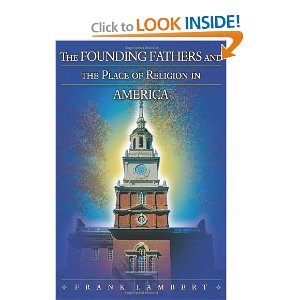
Frank Lambert, professor of history at Purdue University, does an excellent job of surveying this complex topic over a 200-year period. He does so thoroughly, yet concisely, in only 296 pages. While making generalizations at times, he often illustrates his points with quotations from original sources of the time period.
He begins by criticizing extremists on both sides of the issue, and proceeds to present a balanced approach. However, as I will explain at the end of this review, he shows his bias at the end.
Lambert’s thesis is this: America WAS first settled by people who wanted to make it a Christian nation, whether Puritans in New England, Anglicans in Virginia, or Quakers and others in Pennsylvania. These early founders had a vision of making America “a city on a hill,” a model Christian commonwealth. However, two major influences led the founding fathers to establish a government that separated church and state. These two influences were the Enlightenment and the Great Awakening. Men like Thomas Jefferson and Thomas Paine, who were influenced by the Enlightenment, felt that men should be free to use their own reason in matters of religion. The Baptists and others who benefitted from the rapid growth of “free” churches in the Great Awakening were persecuted by established churches and wished to have no established church, so they joined with men like Jefferson in calling for separation of church and state.
Lambert shows that there was great division over these issues, and gives interesting anecdotes and quotations from both sides. He quotes frequently from religious leaders on both sides of the issue. However, near the end of the book he spends much more time quoting Republicans like Thomas Jefferson and James Madison, and gives little space to Federalists like George Washington and John Adams. At one point, on page 161, Lambert implies that John Adams was a deist, even though biographies of Adams have shown him to be a devout Christian with a Puritan heritage.
Lambert shows his view in his conclusion, as he criticizes accomodationists such as Judge William Rehnquist and “religious right” preachers like Pat Robertson.
While Lambert gives both sides of the argument, he clearly leads the reader to his own separationist interpretation. Because the book is so full of useful information, I highly recommend it as a textbook on the subject, but let the reader understand that Lambert has his own bias, too.
Why I am praying for President Obama
Copyright 2013 by Bob Rogers
Thursday, May 2, is the National Day of Prayer, a day when Christians gather to pray for the president and all of our nation’s leaders. However, many Christians express more anger than prayer for President Obama. The same was true when President Bush was in office. Just as much vitriol was poured out against him from the left as is now being poured out against President Obama from the right. Yet it is my duty to pray for my president daily.
This fuzzy photo is a picture of President George W. Bush. On August 21, 2006, I led a public prayer for President George W. Bush at a campaign rally. After the president spoke, he went through the crowd shaking hands, and I grabbed my camera and took this picture in such a hurry that it came out so fuzzy.
As Mr. Bush greeted the crowd and shook my hand, I said, “I pray for you every day.” He looked me in the eye, and exclaimed, “Thanks, it’s working!” A priest who disliked President Bush’s policies later told me, “It must not be working.” Because he disagreed with the politician, he dismissed the prayer. How short-sighted! Scripture commands us to pray for our leaders. The apostle Paul said, “I urge that petitions, prayers, intercessions and thanksgivings be made for everyone, for kings and for all those who are in authority…” (1 Timothy 2:1-2, HCSB).
The Old Testament prophets modeled this kind of praying for us. Isaiah said that the Lord “wondered that there was no intercessor” (Isaiah 49:16), Jeremiah wept over the nation, and Ezekiel called for someone to “stand in the gap” (Ezekiel 22:30) on behalf of the nation.
So I must pray for President Obama, just as I prayed for President Bush.
After all, if first century Christians could pray for a Roman emperor who threw them to the lions, cannot we pray for an elected president with whom we may disagree? Notice that when Paul urged us to pray for political leaders, he also gave us a reason: “… so that we may lead a tranquil and quiet life in all godliness and dignity” (1 Timothy 2:2b). African-American pastor Tony Evans points out, “What many conservative Christians fail to realize … is that when our first black president, Barack Obama, is dishonored through caricatures, name-calling, or disrespectful talk by white Americans, it merely creates a greater chasm between the races.” (Tony Evans, Oneness Embraced, p. 52). Evans illustrates what the apostle Paul was talking about– angry words instead of words of prayer for President Obama create chaotic lives, not tranquil lives. One preacher pointed that that if we would pray for the president instead of complain about the president, maybe he would do better.
So I am praying for President Obama. Will you join me this Thursday and every day?
Guest blog: Thoughts on President Obama’s re-election
 (In the guest blog below, Bobby Braswell reminds Christians of some important truths we need to hear, regarding the re-election of President Obama. Rev. Braswell is the associational missionary of Middle Baptist Association in Sylvania, Georgia, where he ministers to pastors and churches in Screven County, Jenkins County and northern Effingham County. Bobby his wife Frankie (pictured with him here) live in Guyton, Georgia. They have two children: Emma, 22, and J.B., 20. You can read his blog at www.brotherbobbysblog.blogspot.com.)
Watching the returns and waiting to see who will become the next president is about as compelling as TV viewing gets. It’s no secret that millions of Christians went to bed with sour stomachs last night. Many, though I am sure not all, who would identify themselves as social conservatives and followers of Jesus were outspoken in our hopes that the incumbent president would have a new career beginning in January. Since that didn’t happen, what are some appropriate responses to a second term for Barrack Obama?
Pray for the president – 1 Timothy 2:1-2 (NKJV) 1 Therefore I exhort first of all that supplications, prayers, intercessions, and giving of thanks be made for all men, 2 for kings and all who are in authority, that we may lead a quiet and peaceable life in all godliness and reverence.
Preach the Gospel – A concern I have had for some time is that a lot of Christians behave as though getting the “right person” elected is THE ANSWER for America. Hello! It’s not! It never was! God changes people from the inside out. He changes the heart. I am not aware of anything that the government can do that can bring spiritual regeneration to people. Only the Gospel of Jesus Christ can do that (Titus 3:5). People who have experienced the grace of God through Jesus Christ can be a powerful force for transforming North American culture by radical obediennce to the Great Commission (Matthew 28:18-20). That is really the only way that God has ordained to change societies. I want upright legislators and leaders, but if the Gospel is not the focal point of the energy of Christians we will share the largest part of the blame for the disintegration of North American culture (Matthew 5:13-16).
See People through God’s Eyes – I think a less angry, less shrill, less paranoid perspective of our fellow human being would be extraordinarily helpful. It is easy to have a hateful attitude toward people who don’t share our worldview and our faith, but where in Scripture are we given permission to think and act that way? And what is the good in that? The truth about me is that I was a wreck of a person before God’s grace found me, and I still struggle and fail and have absolutely no right to look at anyone else’s failures as being more scandalous or wretched than mine. We are all in the same messed up situation–that is not to minimize sin, or to deny it’s severity–just to say that I don’t belong to God by my right but by His mercy!
Share hope – I woke up today, November 7, 2012 with hope, because God is Great and greatly to be praised (Psalm 48:1)! I woke up determined to have my life count for a great purpose because God is a great God! I woke up today convinced that America’s greatness has more to do with the faithfulness of me and all the other Christians I know and churches they are part of and our obedience to God and commitment to the truth of Gospel than what transpired in the presidential election.
Two interesting maps of the USA
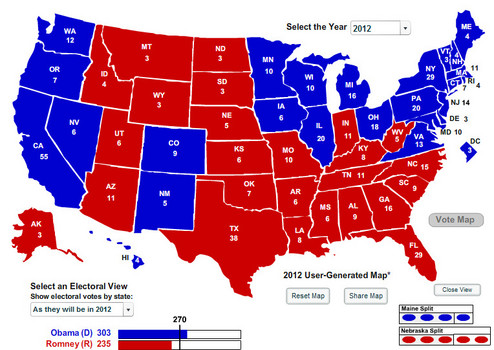 Here are two maps of the USA. The first compares the states that voted for Obama (blue) and Romney (red) in the 2012 presidential election. The second shows states that are very religious (dark green), average (green) and below average in religiosity (light green).

It is interesting that 100% of the “above average” religious states went for Romney, and 14 out of 16 “below average” religious states went for Obama. Exit polls show that people who go to church regularly supported Romney by large margins, and people who never go to church supported Obama by large margins.
Religion was not the only factor in the election, as there were many “average” religious states that went for Romney and two “below average” states (Wyoming and Alaska) that went for Romney. This is because there are two kinds of conservatives: social conservatives and fiscal conservatives. Wyoming and Alaska are definitely independent-minded, fiscally conservative states. But the map does indicate that despite all the focus on the economy in this election, the differences between the candidates on the social issues that religious people care about, especially abortion and traditional marriage, made a huge difference in how people voted.
Guest blog: Vietnam vet reflects on Memorial Day
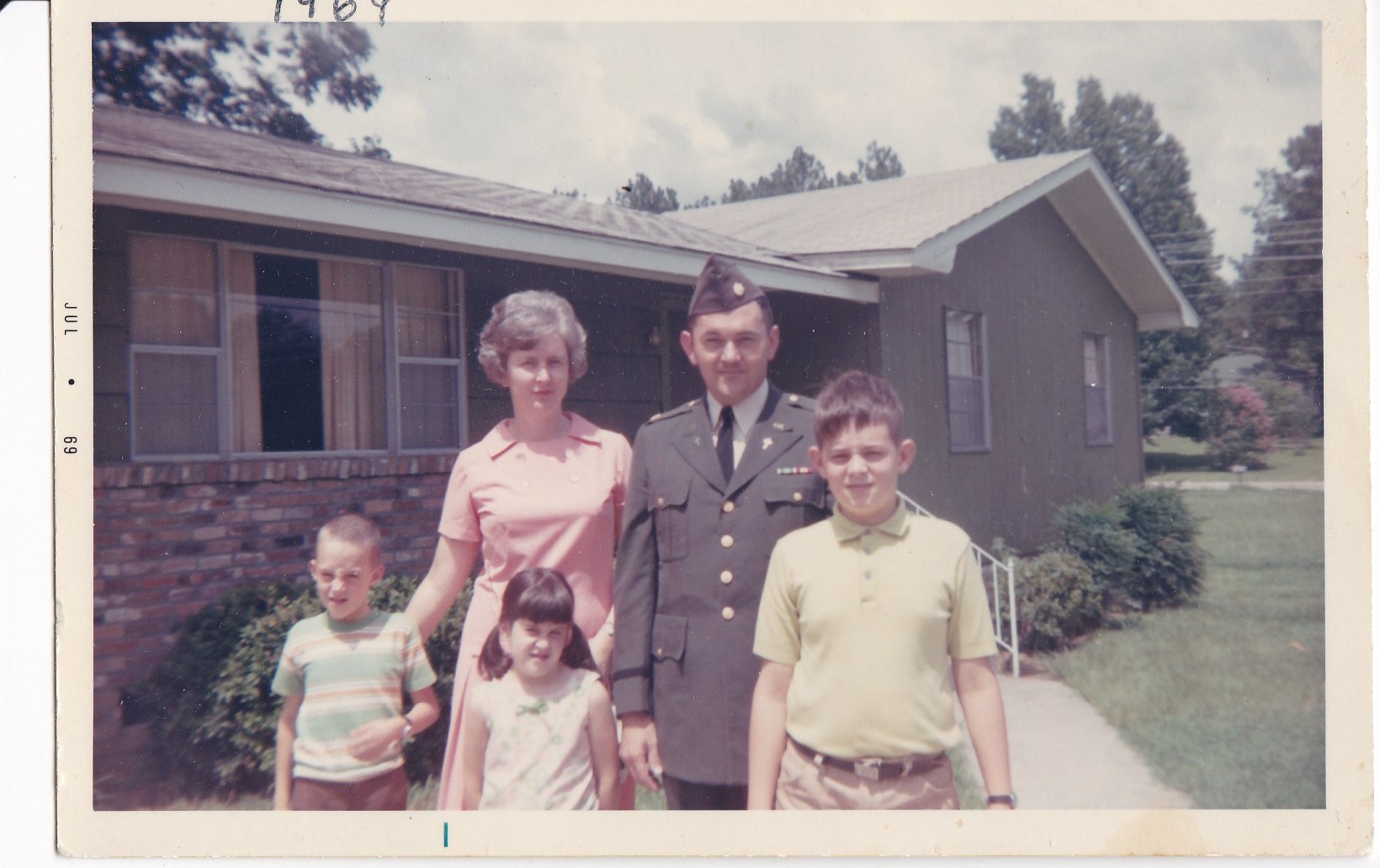
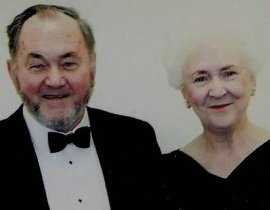 (This guest blog is by my father, retired Chaplain (Lt. Col.) Robert H. Rogers, pictured here in 1969 with our family before he left for Vietnam, and as he looks today, with my mother. Here my Dad reflects upon Memorial Day through the harsh experiences of his first days as a chaplain in the Vietnam War. I appreciate my father’s service to our country. It was a great sacrifice for him and our family, as we spent a year apart from him while he was at war, and my mom had to take care of me, in the sixth grade, and my younger brother, Todd, and sister, Nancy. It was 1969-1970.)

What does Memorial Day mean to me? It is a time to remember those who have served, but especially those who have given their lives in defense of our country.
I have many memories. Just a few days after I had arrived in Vietnam as a relatively young Army Chaplain, I was introduced to the reality of war. I flew out to a forward base in a helicopter and was dropped off with the expectation that I would come back to our base on the resupply helicopter later that day. But that helicopter never came because of a fire fight the company got into with a contingent of the North Vietnamese army. It was away from the compound where I and a few of the company waited. During this fight, the company commander and several others were killed. So after spending the night there I was asked to have a memorial service for those who had lost their lives. I did so even though I was totally unprepared both mentally and emotionally. That was the first of many memorial services I conducted during my year in Vietnam. I remember these and those who have died in all of our wars.
I also remember the sacrifice of those who fought but survived. I have some church friends who are veterans of Word War II. One of them spent about 24 hours floating with his life jacket after the ship he was on was shot out from under him. I remember his service and many others like him. I am grateful to them and to God for the free country we live in.


 Bob Rogers