Blog Archives
Mississippi Baptist responses to natural disasters in late 20th century

Article copyright by Robert C. Rogers and the Mississippi Baptist Convention Board.
Hardly a year passed without a story of a natural disaster or fire destroying a church in Mississippi in the late 20th century, yet each time Baptists responded with a helping hand. Mississippi Baptists began to organize and prepare themselves to respond to disasters. Soon after Hurricane Camille in 1969, Southern Baptists began discussing a more efficient way to respond to disasters. The Mississippi Baptist Convention put together a van with supplies in the 1970s, and assigned the work to the Brotherhood Department.
The Pearl River “Easter Flood” shut down the city of Jackson in April 1979. Some 15,000 residents had to be evacuated by Thursday, April 17, and downtown was cordoned off. Although no Mississippi Baptist churches were flooded, the Baptist Building in Jackson had to close for a time. At least 500 Baptist families had flooded homes, particularly members of Colonial Heights, Broadmoor, First Baptist, Northminster and Woodland Hills Baptist churches. Several hundred male student volunteers from Mississippi College were bussed from their dorms in Clinton to Flowood to work on the levee. The Mississippi Baptist Disaster Relief van was on the scene, serving hot meals to 1,500 people. For weeks, volunteers met every Saturday to do repairs, and the MBCB executive committee endorsed a statewide offering for churches to aid in flood relief.1
Hurricane Frederic damaged churches in the Pascagoula area in September 1979. In September 1985, Hurricane Elena did damage estimated at $3 million to churches and Baptist facilities all over the Gulf Coast. Griffin Street Baptist Church in Moss Point had its back wall blown out. The pastor, Athens McNeil, quipped, “We’re open to the public… literally.” Elena also damaged Gulfshore Baptist Assembly, the seamen’s center, and it caused $1.5 million in damage to William Carey College on the Coast. Baptist relief units were on the scene right away, working in conjunction with the Red Cross. A number of Baptist churches served as shelters; some 250 people stayed at First Baptist Church, Pascagoula.2
A deadly tornado hit churches in Pike and Lincoln counties in January 1975, and another twister damaged churches in Water Valley in April 1984. The most destructive tornado during this time was the one that hit Jones County on Saturday, February 28, 1987. Five Baptist churches had property damage, and members of five other Baptist churches had personal property damage. “I have never seen such damage since I left the battlefield in Europe as I saw in Jones County,” wrote Don McGregor, editor of The Baptist Record. Immediately, the Mississippi Baptist Brotherhood Department began calling churches across the State for volunteers. The day after the Jones tornado hit, 325 volunteers, representing 55 churches, arrived at the Jones County Baptist Association to serve. Hundreds more volunteers arrived during the week; eventually 1,000 people helped with clean-up and relief supplies.3
SOURCES:
1 The Baptist Record, April 19, 1979, 1; April 26, 1979, 1; May 10, 1979, 1; May 17, 1979, 1; Author’s personal memory as a student at Mississippi College working on the levee for 17 hours in one day to stop floodwaters.
2 The Baptist Record, September 12, 1985, 3; September 20, 1979, 1; September 29, 1979, 1; September 19, 1985, 1, 3, 5.
3 The Baptist Record, January 16, 1975, 1, 2; March 5, 1987, 3; March 12, 1987, 3, 4; March 19, 1987, 2.
Dr. Rogers is currently writing a history of Mississippi Baptists.
Movie review: “Free State of Jones”

“Ever heard of the ‘Free State of Jones?'” my father asked me when I was a boy. “When Mississippi seceded from the Union, Jones County seceded from Mississippi, but Mississippi forced Jones County back into the state, and the Yankees forced Mississippi back into the Union.”
It wasn’t quite so simple as that, but Dad had the basic story right. Now this little-known (but well-known in south Mississippi) and strange piece of Civil War history is on the big screen, in Free State of Jones.
My wife and I saw the film in Hattiesburg, Mississippi, which is in the county immediately south of Jones. The theater was packed for an afternoon matinee, as people are fascinated by a film about local history. Some people personally knew minor actors in the film. Behind us, someone whispered in a swamp scene, “That must be the Okatoma.”
What they saw was an mostly accurate, violent film about the stubborn, tragic character of Newton Knight, who led a band of escaped slaves and poor white deserters, at times numbering in the hundreds, that literally took control of Jones, Jasper and part of Smith Counties in south Mississippi late in the Civil War, and rebelled against the Confederacy.

(Above: Newt Knight, played by Matthew McConaughey, leads his band of rebels.)
Why did they do it? Jones County had the lowest percentage of slaves in the state of Mississippi. A law passed during the war allowed whites who owned 20 or more slaves to be exempt from fighting. Poor white farmers in south Mississippi had no interest in the war and resented being forced to fight. As Newt Knight famously said, “This is a rich man’s war and a poor man’s fight.”
Notice that I said the film is mostly accurate. There are some dramatized scenes based on the true story, of details that we cannot know, such as some of the interactions between Newt Knight, his wife Serena, and his common-law African-American wife, Rachel. Also, the film takes major liberties with Newt’s killing of the Confederate officer who was trying to capture Knight. The movie invents a dramatic scene involving an ambush at a funeral and shows Newt killing the officer in a church. The historical records indicate that what really happened was that Newt hunted down Major Amos McLemore at the Deason home in Ellisville, killed the colonel in the house, and then fled. This scene is the only major departure from the historical record that I saw in the film, and even though the film took liberty with the events for the sake of drama, at least got it right that Knight hunted down and killed the man who was trying to capture him.
Matthew McConaughey’s portrayal of Newt Knight is convincing, as is all of the acting. The costumes and cinematography are realistic and gripping. Little details are correct, such as names of places, and the correct Mississippi flag of that era. The plot appears to reach a climax of victory and then it feels like an alligator painfully dragging you into the swamp. That is because this is not fiction, this is history. History doesn’t always fit into neat plots with satisfying endings. But the adage applies here: truth is stranger than fiction.
Caution: Free State of Jones is rated R for graphic war violence.
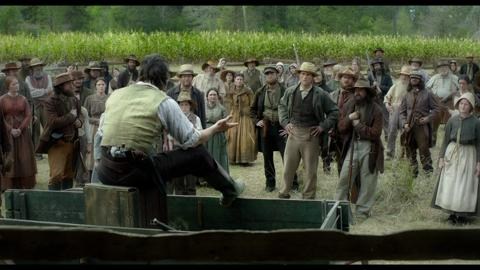
(Above: Newt Knight rallies poor people of Jones County to fight.)


 Bob Rogers