Blog Archives
What is a healthy church?

Copyright 2012 by Bob Rogers
Recently, Outreach magazine published its list of the 100 largest churches in America and the 100 fastest-growing churches in America.
But when we read about the church in the New Testament, we do not find a list of fastest-growing churches. Not many numerical reports are even given, other than the 3,000 baptized at Pentecost (Acts 2:41) and the fact that the number had grown to 5,000 a little while later (Acts 4:4). After that, numbers are rarely given. We don’t read Paul reporting to the church that when he left Ephesus they were running 200 in Sunday worship. Instead of talking about numerical growth, he emphasizes spiritual growth. So why don’t we?
It’s time to change our terminology. Instead of so much emphasis on church growth, we should talk about church health. So what makes a church healthy, anyway? Paul gives us a full description in Ephesians 4:11-16.
1. Leaders who equip
“And He personally gave some to be apostles, some prophets, some evangelists, some pastors and teachers…” (Ephesians 4:11, HCSB)
Healthy churches have leaders who equip their members. The best test of the leader is that he has followers who learn from his teaching and example. Healthy churches have leadership that inspires the overall congregation to follow Christ and serve their community.
In this verse, the last two leadership gifts are indispensable to local church health. In Greek, the terms go together, “pastor-teacher.”
Pastors (translated “shepherds” in the ESV) bring guidance and comfort to the flock of God.
Teachers instruct the church in correct understanding of the Bible and Christian living.
Notice in verse 12 that these leaders have the purpose of training, or equipping, the church to do their work.
If a church is going to be healthy, it must have a pastor/teacher who is feeding the congregation God’s Word on a consistent basis.
2. Members who serve
“… for the training of the saints in the work of ministry, to build up the body of Christ…” (Ephesians 4:12, HCSB)
Healthy churches have members who serve. Don’t join this church to sit back and be entertained. If that’s what you are looking for, please go somewhere else. We need members who serve.
The “saints” are all the believers. “Saint” means a “holy one,” and every believer is called to be holy and set aside for God’s service.
It says the saints are trained by the leaders so that the saints can do the work of the ministry. So all members are called to serve.
Rick Warren asks, “If you are not involved in service or ministry, what excuse have you been using?
Abraham was old; Jacob was insecure, Leah was unattractive; Joseph was abused; Moses stuttered. Gideon was poor; Samson was codependent; Rahab was immoral; David had an affair; Elijah was suicidal; Jeremiah was depressed; Jonah was reluctant; Naomi was a widow. John the Baptist was eccentric; Peter was impulsive; Martha worried a lot; the Samaritan woman had five failed marriages; Zacchaeus was unpopular; Thomas had doubts; Paul had poor health; and Timothy was timid. God used each of them in his service. He will use you, too, if you stop making excuses.” (Rick Warren’s Daily Devotional, Day 357)
Healthy churches have members who serve.
3. Unity in the faith
“… until we all reach unity in the faith and in the knowledge of God’s Son…” (Ephesians 4:13a, HCSB)
Healthy churches are united. Unhealthy churches are divided. Notice the two ways he says we are to be united: by doctrinal faith (“in the faith”) and by personal faith (“and in the knowledge of God’s Son”). I heard about a pastor who was called to a church with only 51% voting in favor of his call. A year later, they fired him. It was a unanimous. The pastor said, “I finally united the church.” Of course, that’s not the way we want to unify the church, but the church does need to be united.
Remember the lesson from Noah’s Ark. It may stink sometimes, but we have to stay together, because we’re all in the same boat!
4. Growth measured by Christ-likeness
“… growing into a mature man with a stature measured by Christ’s fullness.” (Ephesians 4:13b, HCSB)
Too often, churches measure themselves by numerical growth. And it is true that healthy churches should have numerical growth. However, there are churches that have numerical growth but they are not healthy. A tumor can grow, but it isn’t healthy. And some churches explode and then die down. Others grow and grow in numbers, but they are attracting people for entertainment or because their standards are lax, and people are not being discipled.
Imagine a church board meeting with Jesus. Pete calls the meeting to order, and says, “Jesus, we’ve been following you around for some time, and we are getting concerned about the attendance figures. Tom, how many were on the hill yesterday?”
Tom answers, “Thirty-seven.”
Pete says, “It’s getting ridiculous. You’re going to have to pep things up.”
John says, “I’d like to suggest you pull off more miracles, but more people need to see it so our crowds will get bigger.”
Pete agrees, and adds, “Publicity is essential, and you tell half the people you cure to keep it quiet. Let the word get around.”
Toward the end of the meeting, Judas adds, “I’d like tos ay that if we are going to continue to meet in this upper room, we ought to do something about the carpet…” (Adapted from Richard K. Wallarab, Christianity Today, January 17, 1979.)
Notice that verse 13 gives the correct measurement of real growth: “a stature measured by Christ’s fullness.” That is our measurement of growth: are we like Christ? If our budget grows but we spend our budget on a bowling alley for church members instead of helping the hurting and sharing the gospel, we may be growing in numbers but not in Christ-likeness.
Healthy churches measure growth by being more like Christ.
5. Teaching that provides stability
“Then we will no longer be little children, tossed by the waves and blown around by every wind of teaching, by human cunning with cleverness in the techniques of deceit.” (Ephesians 5:14, HCSB)
Another great sign of a healthy church is that the Bible is so consistently taught, that the members aren’t tricked by heresy and false teaching. If some clever teacher comes into the church and tries to lead people astray, a healthy church recognizes it right away and puts a stop to it.
A decade ago, we had a powerful wind storm blow an oak tree on our youth building. The tree had shallow roots, and when the winds came, it fell. A healthy church that teaches the Bible is like a healthy tree with deep roots. It doesn’t fall under the pressure of false teaching.
6. Honest and loving relationships
“But speaking the truth in love, let us grow in every way into Him who is the head– Christ.” (Ephesians 4:15, HCSB)
Healthy churches have honest and loving relationships. “Speaking the truth in love” means that we are honest with each other, we speak the truth, but we are also loving when we do it. We don’t just try to please each other. If something’s wrong, we deal with it, but we always seek to deal with it in love. That’s challenging, but it’s vital to having a healthy church.
Years ago, The Betty Ford Story aired on television. It was a movie that told the story of the addiction and recovery of Betty Ford, the wife of President Gerald Ford. At one point in the film, there is an emotional scene where the family is sitting together confronting Betty Ford. Her son says, “Mother, you are destroying yourself; you are destroying this family, and you are killing yourself. Mother, you are a drunk; you are an addict.” His mother was infuriated. She told her son he was being very disrespectful and said, “How can you say these things to me? I am your mother!” Her son said, “Mother, I can say it because it is the truth.” As hard as it was, this confrontation was the catalyst for the establishment of the Betty Ford Clinic. (Tony Evans’ Book of Illustrations, p. 333-334)
A healthy church is a place where people speak the truth in love. Relationships are honest and loving. We don’t play games or try to please people, but we go out of our way to love people.
7. An environment that encourages involvement
“From Him the whole body, fitted and knit together by every supporting ligament, promotes the growth of the body for building up itself in love by the proper working of each individual part.” (Ephesians 4:16, HCSB)
Healthy churches create an environment that encourages involvement. “From Him (Jesus) the whole body, fitted and knit together… promotes the growth of the body…”
Many people think that it doesn’t matter if they are involved in the church or not, that the church won’t miss them if they are gone. Nothing could be farther from the truth.
On January 28, 1986, the space shuttle Challenger exploded just 73 seconds into flight. The whole nation was shocked. An investigation revealed that it happened because of one inexpensive O-ring. There were one million components in the space shuttle, but that one part destroyed the whole. Like the seemingly insignificant O-ring, one person failing to take his place in the church keeps the whole from being healthy. (Richard Swenson, Margin, 1992, p. 48)
A healthy church is a church where misfits can fit in. A healthy church is a place where the displaced can find a place.
This world is in desperate need of healthy churches in every community. Christian, are you allowing God’s Spirit to work through you to make and keep your church healthy?
Doing church New York style

Copyright 2012 by Bob Rogers
Years ago when I lived in Mississippi, I visited the Empire State Building in New York City, and I heard a Southern accent from some young ladies. They asked me and my wife, “Are y’all from the South?” We said, “Yes, we’re from Mississippi,” and they said, “Well, we’re from Georgia, and it sounds so good to hear somebody from the South.”Actually, they didn’t say “Georgia,” they said “JAW-ja.” (And I didn’t say, “Mississippi,” I said “Miss-IP-y.”)
I was thinking, how would I feel if I was from New York and came to church down South? There are some great churches in New York; in fact, the Brooklyn Tabernacle is one of the greatest churches in America. But New Yorkers and Southerners have a different culture altogether. I wonder how we could make them feel at home? My sister lived in Manhattan for years, and now lives in Brooklyn. She says a “New York minute” actually lasts 19 seconds. I believe her. So read this rapidly, and maybe you’ll get some ideas for doing church “New York style.”
1. Everybody would have to line up outside the church, and when the doors opened, they would have to rush in as fast as they could and get a seat or find something to hold on to, because the ushers would shut the doors behind them in 10 seconds. Then the pastor would announce in garbled English, “The J-train is leaving the station now. Do not block the entrances!”
2. There would be different seating for Yankees and Mets fans, with armed uniformed policemen separating them.
3. Each member of the congregation would be given a headset so he or she could listen to the sermon in traditional or contemporary English, Spanish, Romanian, Korean, Vietnamese, Italian, Mandarin or Cantonese Chinese, Swahili or Yiddish. This would allow them to understand the service without having to actually talk to anybody else.
4. If somebody tried to sit in your pew, you would block his way and say, “Don’t play with me, man.”
5. The pastor would begin his sermon with, “Yo! Youse guys! I’m TALKIN’ to you!”
Our New York friends then could visit JAW-ja or Miss-IP-y or Luzy-anna and feel right at home. After all, didn’t the apostle Paul say, “I have become all things to all people, so that I may by all means save some”? (1 Corinthians 9:22, HCSB).
Getting the wrong buzz in worship
 Copyright 2012 by Bob Rogers
At our church, we regularly remind people to turn off cell phones in worship. Nevertheless, cell phones can go off at the most inopportune times, even during funerals. Once, I was giving the invitation at the end of the service, when a cell phone rang. I asked the congregation, “Are we as quick to respond to God as we are to a cell phone?”
On one particular Sunday evening, a cell phone went off that I never expected. Normally, before the service begins, I take my cell phone off my belt, turn it off, and give it to my wife to put it in her purse. But for some reason, I forgot to do that. Thankfully, my phone is always set to vibrate, so it never rings. But in the middle of my sermon, I suddenly felt my left hip vibrate. I could hear the gentle “bzzz” sound. I tried to ignore it, but the “bzzz” continued. I often make a habit of walking among the congregation as I preach, and at that moment I was standing near the front pew, just inches away from some of the people, and I was sure they heard the “bzzz” too.
What should I do? I could continue to ignore it, but it was distracting me so much that I couldn’t concentrate on my sermon. So I stopped preaching, reached down, slipped the phone off my belt, and threw the phone down on the front pew, while saying, “My cell phone is going off.” After a few chuckles from the congregation, I went on and finished my sermon.
After the service, several people said, “We would never have known your cell phone was going off if you hadn’t said anything.” True. They didn’t know, but I knew, and I couldn’t think straight until I got rid of it.
What do you do when you get a sudden call during worship? Acts 2:38-39 says that the promise of forgiveness of sins is available “for all whom the Lord our God will call.” So if the call is from God, you’d better answer it. But if it’s a distraction from the devil, you’d better get rid of it. Wisdom is in recognizing whose ring tone you are receiving– or who is shaking your hip.
“Love Out Loud: Face to Face”


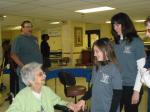


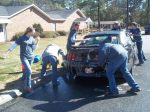
Some 400 members of First Baptist Church of Rincon wore their blue jeans and t-shirts to Sunday morning worship on February 12, because they came ready to go out and work in the community that afternoon.
Members spent the afternoon doing 15 different community service projects that touched over a thousand lives all over Effingham County, Georgia. “Too often, the world hears what we are against,” said the pastor, Dr. Bob Rogers. “We want them to hear loud and clear what we are for. We are for Jesus, we are for love and we are for loving our community personally in the name of Jesus. That’s why this is called ‘Love Out Loud: Face to Face.'”
With that in mind, everything was done for free. Free food was distributed to first responders. There was a free car wash and vehicle safety check on the church grounds– no money accepted. Several people offered the volunteers money, but they politely refused, explaining it was an illustration of God’s grace, that we cannot earn.
Some members went to local laundromats and offered to pay for people’s laundry, while others washed windshields for free at a local drive-in restaurant. Still others grabbed rakes and gloves and cleaned the yards of the sick and elderly, or took their tools to do minor repairs in homes of those in need. Back at the church, a group of volunteers were giving a party for special needs children, while a large host of volunteers descended on the local nursing home and retirement home, visiting the residents, and giving cards and goody bags to the workers.
Some volunteers focused specifically on spiritual and emotional needs, praying with people in homes where volunteer work was being done, as well as making numerous visits to the homebound. One family who has to stay at home due to illness was visited, and said, “We are blessed to be members of such an awesome church who reaches out to our community.” Free Bibles were given away in many different sites, both in English and Spanish. Volunteers from the church’s Hispanic mission participated in several of the projects.
Even though this is the third year that the church has done a “Love Out Loud” day near Valentine’s, it still required weeks of preparation, led by coordinators Beth Pye and Sherri Gordy. A group of volunteers who gave away handmade cards and goody bags, spent hours in preparation before the day of distribution. Organizers had to prepare hundreds of box lunches that could be distributed quickly, so that volunteers had time to eat and go out to serve.
Members of First Baptist Rincon who participated seemed to feel as blessed as those they helped. Kim Callahan said, “First time doing Love Out Loud. It was awesome.” Angie Griffin said, “Our trip to the nursing home was so amazing. Our grandson Carson said after we left, ‘Meme, I feel so good coming here today and spreading Gods love.'” Leonard Zeigler visited the county jail to pray with inmates, and found he was deeply moved by one inmate as they stood on opposite sides of the glass, hands touching the same window, until he saw condensation start rolling down the window.
Kim Weaver, a beautician who helped cut hair for free that day, said, “We let God out of the box.” Joseph Douberly drove around with a team that randomly approached people and offered to pray for them. While some people refused, others were eager for prayer, even calling family out of their homes to join them in prayer. Douberly said that he got “way outside my comfort zone.”
A teenager who participated was inspired to keep serving even after the day was over. Ryan Cole shared, “I had fun washing cars, trucks and our two fire trucks. At the end of church on my way home I saw a lady who needed help. No one stopped to help so I stopped; she was very nice.”
Team coordinator Beth Pye said, “It’s exciting to be part of a church family that actively takes Christ into the community. When we get out there and get involved in other people’s lives, share their pain and their joy, we’re giving them a glimpse of how God can be the fundamental source of their strength and life.”
Logistics coordinator Sherri Gordy said, “It is one thing to talk about “helping people” but that never compares with the feeling of actually reaching down, out, and over to help another person. Love out Loud crosses age, race, denomination, and does exactly what Jesus does for us, if we let Him work in our lives.”
At least five people allowed God to work in their lives in a very personal way, praying to receive Jesus Christ as their Savior and Lord.
Mrs. Irby comes to the wrong church — or comes to the church wrong

Copyright 2012 by Bob Rogers
A Baptist pastor accepted the call to a church in Sledge, Mississippi. The day that he moved in, a 90-year-old woman drove up and greeted him in his driveway. “I’m Mrs. Irby,” she said. “I was a Presbyterian until my husband died, then I went back to the Methodist Church. But I don’t ever intend on coming to your church. I just came by to say welcome to the community.” With that, she drove off, spinning wheels and throwing dirt and rocks all over the new pastor.
So the pastor was surprised months later, when Mrs. Irby showed up one Sunday morning at the Baptist church. Early in the service, the pastor asked everybody to stand and greet one another. Mrs. Irby started to head out the door. The Baptists asked her where she was going, and she said, “In my church, when you stand, it’s time to go.” They helped her back to her pew to stay for the rest of the service. The pastor began to preach, and Mrs. Irby shouted loudly to the young lady beside her, “When is he ever gonna quit?” The congregation chuckled, and the pastor wrapped up his sermon quickly. Mrs. Irby stood to go. As she greeted the pastor at the door, she said, “The only reason I came here today is that the Methodists didn’t have church because their pipes busted. But I didn’t get a thing out of your sermon. Next time I’ll have to remember to bring my hearing aids.” And with that, she was out the door, never to return.
Which reminds me: you only get out of church what you put into it. The psalmist says, “Serve the Lord with gladness! Come into his presence with singing! Enter his gates with thanksgiving, and his courts with praise!” (Psalm 100:2, 4, ESV). Come to church with a prayer in your heart, a smile on your face, a Bible in your hand, and if you need them, glasses on your eyes and hearing aids in your ears, so that you don’t miss what God wants to say to you.
Divided vote eventually unites church
 Copyright 2012 by Bob Rogers
I heard about a church that called a pastor with a vote of 200-3. The pastor spent his first six months trying to find out the names of the three who voted against him. Then he spent the next six months trying to please those three. At the end of the year, the church voted to fire the pastor. The vote was three to keep him, and 200 to get rid of him!
There’s an old saying that you can’t please everybody, and that is certainly true in church, which is why we need to try to please the Lord first. However, if the church is evenly divided, it is wise to back off a decision and seek to bring spiritual unity before proceeding, especially when voting on a pastor.
A pastor told me an interesting story about a close vote to call a pastor in a rural Baptist church near Claxton, Georgia. The church voted 51% in favor and 49% against calling a man as their pastor. Ignoring conventional wisdom, the preacher accepted the call, and came to the church as their pastor. After a couple of years, however, he resigned. Upon his resignation, he said, “I have unified the church. When I came, half of them were against me. Now all of them are against me.”
Elections can either unite people or divide people. Unfortunately, our country is pretty divided over politics. But as Christians, God calls us to be uniters, not dividers. In fact, however we voted, we are called upon to pray for those in leadership. Scripture says, “I urge, then, first of all, that requests, prayers, intercession and thanksgiving be made for everyone– for kings and all those in authority, that we may live peaceful and quiet lives in all godliness and holiness” (1 Timothy 2:1-2, NIV). Someone might say, “Yeah, but our politicians are so bad these days.” I would remind that person that in New Testament days, the politicians threw the Christians to the lions, but the Christians still prayed for them.
We can do no less.


