Blog Archives
Taking it to the bank
 Copyright 2013 by Bob Rogers
When I went off to seminary, I moved from Woodville, Mississippi, to New Orleans, Louisiana. It was only a few hours’ drive, but the two cultures were light-years apart.
I had been serving Woodville Baptist Church as their youth minister. Woodville was, and still is, a small county-seat town located south of Natchez in the extreme southwest corner of the state. Woodville’s claim to fame was that it was the boyhood home of Jefferson Davis. Woodville also boasts the first standard-sized railroad line ever built in America, which once was used to ship cotton down to the Mississippi River at St. Francisville, Louisiana. Although it was a tiny town, they had very active Baptist, Methodist, Presbyterian, Episcopalian and Catholic churches, each one claiming to be the oldest of their denomination in the state. You could leave your house unlocked in Woodville and not worry about anybody breaking in.
I took my new bride from Woodville to New Orleans. We settled into an apartment belonging to New Orleans Baptist Theological Seminary, and I promptly went to a big New Orleans bank to open a checking account.
The bank clerk took one look at my check from Woodville, and said, “I can’t deposit this check. It doesn’t have an account number.” I said, “That bank doesn’t use account numbers. They go by your name.” The clerk sarcastically replied, “This is 1980. Nobody does that anymore.”
I just shrugged and said, “They do. Why don’t you call them and ask them?”
So the bank clerk took my challenge and left me sitting at his desk while he went off to another room and called. In a few minutes, he came back with a sheepish grin on his face.
I asked, “Well, did they tell you that my check was good?”
He said, “Yeah, and the guy also said to tell you hello.”
It’s nice to be known by your name rather than just a number, isn’t it?
God knows your name. Revelation 10:15 tells us that he has the names of all who believe in Jesus Christ written in his Book of Life. And beside the name of each believer, that book has these words written: “Paid in Full,” because Christ made full payment for our sins upon the cross (1 Corinthians 6:20). That’s one book that I’ve made sure has my name. And you can take that to the bank!
Book review of Mother Teresa: A Simple Path
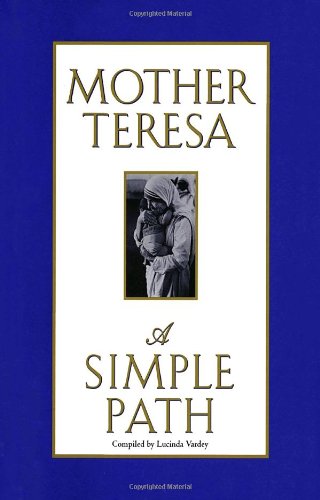 I was asked to read Mother Teresa: A Simple Path, to see if it should be placed in our church library. I am recommending that we do put it in the library because of its positive elements and for the Christian reader to be informed about her historical work, but with a statement of caution in the flyleaf. Why is that?
Mother Teresa is well known for her work with “the poorest of the poor” in Calcutta, India and around the world, for which she received the Nobel Peace Prize in 1979. This book is a collection of thoughts by Mother Teresa and her followers on her philosophy of life and ministry. This path is summed up on page 1 of the book this way: “The fruit of silence is prayer, the fruit of prayer is faith, the fruit of faith is love, the fruit of love is service, and the fruit of service is peace.”
The book is inspiring in its devotion to love the poor by loving Jesus Christ through the poor. There are many inspiring testimonies from volunteers, prayers, and simple statements that show how she kept her focus on her mission. She had a wonderful appreciation for the value of every human life, including the unborn. On p. 55 she asks why people worry about children being killed in wars but do not oppose mothers killing their own children.
I hesitate to say anything critical about Mother Teresa, because she has done far more for the needy in the name of Jesus than I have. However, I must point out that while she was a devoted follower of Christ, she encouraged people to follow whatever religion they were in, rather than convert to Christianity. For example, on p. 31 she says, “I’ve always said we should help a Hindu become a better Hindu, a Muslim become a better Muslim, a Catholic become a better Catholic.” This same philosophy is found throughout her book:
“I have never found a problem with people from different religions praying together. What I have found is that people are just hungry for God, and be they Christian or Muslim we invite them to pray with us…”
“God is not separate from the Church as He is everywhere and in everything and we are all His children– Hindu, Muslim, or Christian…”
“Anyone is capable of going to Heaven…” In this passage, she does not clarify that going to Heaven is by faith in Christ.
(Mother Teresa, A Simple Path, p. 31-32, 59, 73.)
Mother Teresa says that she is saved through Jesus, but she believed that Muslims and Hindus can be saved through Jesus, while remaining Muslims and Hindus.
This contradicts the words of Jesus, who said He was the only way to the Father (John 14:6), and the words of the apostle Paul, who said that there is salvation in no other name than the name of Jesus (Acts 4:12). We should not be surprised that Mother Teresa takes this viewpoint, as Roman Catholic theology generally teaches that the cross of Jesus Christ saves people who follow their own consciences and own religions, even if they never declare faith in Christ. (See statement by Pope John Paul II in Pontifical Council for Interreligious Dialogue – Congregation for the Evangelization of Peoples, Instruction Dialogue and Proclamation, 19 May 1991, n. 29; L’Osservatore Romano English edition, 1 July 1991, p. III; and Catechism #841.)
Mother Teresa’s work is truly inspiring and deserving of recognition. However, her teaching about salvation sadly follows the typical Roman Catholic viewpoint of salvation, a viewpoint that falls short of the teachings of the Bible. Let us be inspired by Mother Teresa’s devotion, but cautious of her as a theologian.
Who is to blame for the theater shooting in Colorado?
 Copyright 2012 by Bob Rogers
The Dark Knight Rises is the name of the much-anticipated third Batman movie in the wildly popular films produced by Christopher Nolan. But it was a dark night in a different sense in a theater in Aurora, Colorado, where gunman James Holmes took to the stage himself and shot 70 people, killing at least 12.
When such horrific tragedies happen, we gasp, we hug our children, we lower our flags, we pray, and we ask, “Why?”
Soon a number of scapegoats will be brought forth to be sacrificed at the altar of our need to blame someone or something.
Some will blame a lack of gun control. They will say that if we had stricter gun control, this man could not have obtained so many weapons. However, mass shootings have occurred in other nations that have strict gun control.
Some will blame a lack of security, since the gunman carried so much artillery into the theater. Perhaps improvements in security can be made but the police and security guards cannot be everywhere.
Some will blame violence in the movies, saying that it desensitizes the viewer and can lead to copy-cat actions. Some news reports today say that the shooter was dressed as the Joker, lending some credence to this theory. However, millions of other people have seen the Batman films without having an urge to hurt anybody.
Others will blame the man’s upbringing, environment, how he may have been treated at the school where he dropped out, and so on.
But in playing the “blame game,” we often fail to look at the greatest reason for the actions of James Holmes and for each of us: the human heart.
Jeremiah 17:9 (ESV) says, “The heart is deceitful above all things, and desperately sick; who can understand it?” Jesus said that evil comes from within, out of the heart (Mark 7:21).
When the Gospel of John describes how Judas Iscariot got up from the Last Supper, left Jesus and the other disciples, and stepped outside to betray Christ, John adds this short sentence: “And it was night.” (John 13:30). John was speaking of the spiritual darkness of that moment. But after that dark night, a light arose, because this Jesus who died on the cross also arose from the dead to defeat evil and give us hope.
The greatest need that mankind has is not gun control, more police, controls over movies, or psychologists. Our greatest need is for a Savior who can change the heart. He alone can change our dark nights into bright mornings.


 Bob Rogers