Blog Archives
Natchez to New Orleans: How those “country Baptists” of Mississippi sought to reach the cities in the antebellum era

Copyright by Robert C. Rogers and the Mississippi Baptist Convention Board.
Although Mississippi had grown to a population of nearly 800,000 by the Civil War, the vast majority lived in rural areas. Like the citizens, Mississippi Baptist churches were more often in rural settlements than towns, and few were on the Gulf Coast. Pearl River Baptist Association only had one church in a coastal county, Red Creek Baptist Church (Harrison), and Red Creek was a rural area inland from the coast. By 1860, though, several towns in Mississippi had over 1,000 residents: Natchez was the largest, with 6,619 residents, followed by Vicksburg with 4,591, Columbus with 3,308, Jackson with 3,199, Holly Springs with 2,987, and Port Gibson with 1,453. Clinton, home of Mississippi College, had 289 citizens.1
Although the Columbus Baptist Church, Columbus (Lowndes) was thriving, the Mississippi Baptist Convention recognized the need to plant churches in many of the other emerging cities and towns. In 1848, the convention gave $100 each to pastors in Yazoo City, Jackson, Vicksburg and Grenada. That year, S.I. Caldwell, pastor of First Baptist Church, Jackson (Hinds), reported the house of worship had been completed and that the membership had increased by 15 White members and 11 Black members. In 1853, I.T. Hinton, in the report of the Southern Baptist Domestic Mission Board, pointed out the need for placing missionaries in the state capital and the chief commercial towns, including Jackson, Vicksburg, Natchez, Biloxi and the Gulf Coast, all of which received aid. The Domestic Mission Board reported that the minister of the “church in Jackson, the capital received a commission from this Board. A large revival of religion has added very greatly to the strength of the church, however, rendering our aid unnecessary.”2
Natchez Baptist Church, Natchez (Adams) was restarted by Ashley Vaughn in 1837 and began to prosper under the pastorate of W.H. Anderson in the 1840s, but they were never able to build a meeting place of their own. They met at a Presbyterian church, at the courthouse, and at the Natchez Institute. In 1848, they called Rev. T.G. Freeman as pastor, but the church underwent a bitter split in 1849, and Freeman led in the formation of a new Baptist congregation, Wall Street Baptist, Natchez (Adams) in April 1850. The new congregation moved rapidly to build a sanctuary, breaking ground a month later at the corner of Wall Street and State Street, across from the Adams County Courthouse. They reported to the 1852 meeting of the Central Baptist Association that they had “erected a house of worship at a cost of $7,000 and paid for—the first ever owned by the Baptists in this city.” That year, Wall Street had 41 White members and three Black members, while Natchez Baptist Church had 34 White members and 412 Black members. Three years later, Wall Street had grown to 131 White and 105 Black members and held services four Sundays a month. Wall Street continued to grow, and proudly hosted the 1860 Mississippi Baptist Convention, whereas Natchez Baptist Church dissolved in 1857; its Black members were absorbed into Rose Hill Baptist Church, Natchez (Adams) an independent Black congregation that met on Madison Street. In 1918, Wall Street Baptist Church adopted the name First Baptist Church, Natchez, which remains to this day.3
By 1859, several town churches reported strong membership numbers to the state convention, including First Baptist Church, Jackson (Hinds) with 309 members, Canton Baptist Church, Canton (Madison) with 197 members, and Vicksburg Baptist Church, Vicksburg (Warren) with 160 members. An indirect result of the Baptists taking control of Mississippi College in 1850 was that a Baptist church was developed in Clinton. In the nine years afterward, Clinton Baptist Church, Clinton (Hinds) became the second largest of the five churches in the town. In May 1860, W. Jordan Denson described the church this way: “At present the Baptist Church of Clinton is enjoying one of those powerful revivals of religion, that she has so frequently been blessed with since the location of the college in that village. Last Sunday twenty-two were baptized, a large part students. Others will be baptized in two weeks—many others, we have reason to hope.”4
Although outside of the state, Mississippi Baptists took a special interest in reaching the city of New Orleans. The earliest Baptist churches in Louisiana were started by ministers from Mississippi, and those churches were affiliated with associations in Mississippi. New Orleans was an international port and was important to the entire Mississippi River Valley. In 1843, First Baptist Church, New Orleans was organized there with 10 members. It had great difficulty maintaining itself until Isaac T. Hinton became pastor. Under his leadership, the church made remarkable progress, increasing its membership from 27 to 122 members. A yellow fever epidemic in 1847 took the life of the pastor and many members, after which the church declined rapidly, and in 1851 the congregation lost its building to its creditors. The Mississippi Baptist Convention was distressed at this news and adopted resolutions urging the Southern Baptist Convention to help raise funds for a new church building in New Orleans. Several members of the convention made donations or pledges for this project. Finally, in 1861, First Baptist Church, New Orleans had another sanctuary.5
Dr. Rogers is the author of Mississippi Baptists: A History of Southern Baptists in the Magnolia State, to be published in 2025.
SOURCES:
1 Minutes, Pearl River Baptist Association, 1860; U.S. Census, “Population of the United States in 1860: Mississippi,” accessed on the Internet 30 April 2022 at https://www2.census.gov/library/publications/decennial/1860/population/1860a-22.pdf.
2 Minutes, Mississippi Baptist Convention, 1848, 13.
3 Robert C. Rogers, “From Alienation to Integration: A Social History of Baptists in Antebellum Natchez, Mississippi” (Th.D. diss.,, New Orleans Baptist Theological Seminary, 1990), 53-59.
4 Minutes, Mississippi Baptist Convention, 1859, 14-15; 1860, 37.
5 Glen Lee Greene, House Upon a Rock: About Southern Baptists in Louisiana (Alexandria, LA: Executive Board of the Louisiana Baptist Convention, 1973), 41-51, 81-84; Minutes, Mississippi Baptist Convention, 1852, 31; Baptist Record, June 5, 1969.
The Baptist pioneer trek to Mississippi
Copyright by Robert C. Rogers and the Missississippi Baptist Convention Board
(In a previous post, I told how a group of South Carolina Baptists decided to flee the devastation of the Revolutionary War and make a new life in Mississippi. This post tells the story of how they got to Mississippi.)
The Curtis family decided to establish their new homes along the Mississippi River near Natchez, in what was then called West Florida. After the French and Indian War in 1763, the British took Florida from Spain, (West Florida included the panhandle of modern Florida and the areas now in southern Mississippi and Alabama), and Englishmen from the colonies had begun to settle there. The stories of productive farmlands that were free to all settlers and the peace they would have from the turmoil of the fratricidal strife in South Carolina must have made the prospects of beginning again very enticing. In 1779, Spain took advantage of the British distraction with the American Revolution, and Spain conquered the Natchez district from the British and added it to West Florida. Despite this, the emigrants did not anticipate any difficulty from this source. As we shall see, they were wrong.
The route the migrants followed to their new homes was the familiar one used by many who were a part of the great westward migration, but it was not an easy trek. Our source for this journey is John Griffing Jones, a direct descendant of one of the travelers, John Jones. He writes that they left their homes in South Carolina early in 1780, loading their horses with their clothes, furniture and tools, and traveled north by land, crossing the Appalachian Mountains, and arrived on the banks of the Holston River near the present location of Kingsport, Tennessee, a trip of about 300 miles. Primitive roads and mountains made the trip difficult, as they carried their supplies on pack horses, the men traveling by foot. They arrived on the Holston River in the early spring and immediately began the task of raising a crop of corn, hunting game to salt and preserve, while building flatboats for the river journey that lay ahead.
In the fall of 1780, the travelers were ready to begin their voyage downriver. The party included Richard Curtis, Sr., and his wife Phoebe; two brothers William and Benjamin Curtis and their wives; Richard Curtis, Jr. and his wife Patsy; John Courtney and John Stampley and their wives (Hannah Curtis Courtney and Phoebe Curtis Stampley, respectively, daughters of Richard Curtis, Sr.); John Jones, his wife, and son William; and others whose names are unknown. On the second boat were Daniel and William Ogden and their families, and a Mr. Perkins and his family. The records do not reveal the names of the occupants of the third boat.
The emigrants knew from the experience of other travelers that they might have trouble with the Indian tribes. After all, they were planning to take lands formerly occupied by the Indians and make permanent homes for themselves. The natives did not want to give up their lands. The French had virtually exterminated the Natchez tribe in 1732, although other tribes such as the Choctaws were still in the area, but they knew they would encounter other tribes along the way, especially since the hostility of the Indians was encouraged and supported by the British against Americans during the Revolutionary War. In order to protect themselves, the emigrants always traveled in as large groups as possible.
The migrants’ travel took them down the Holston River for 87 miles to what is now Knoxville. There, they entered the Tennessee River. The three boats had only traveled about 40 miles downriver, when they faced their greatest danger. This was the country of the Cherokees, who had been faithful allies of the British during the Revolution. These Indians attacked the flotilla on a bend in the Tennessee near the mouth of the Clinch River, near present-day Kingston. The Cherokee attack focused on the first flatboat, occupied by the Curtis and Jones families. Some of the women and children took over the oars while the men fired their rifles in defense. Hannah Courtney was grazed on the head by a ball, and Jonathan Curtis was slightly wounded on the wrist. While John Jones fired his rifle, his 12-year-old son worked the oars and his wife held up a thick stool made of poplar wood as a shield. A bullet hit her stool, and later Mrs. Jones laughingly remarked that “their guns were very weak, as they did not make a very deep impression on the stool.” The second boat floated by the point of attack unharmed, but the third boat was far behind, and became an easy target for the Indians. The occupants of the third boat had contracted smallpox, and so they were floating in the rear and camping at a separate place each night. The Cherokees killed everybody on the third boat except one woman whom they captured, thereby also contracting smallpox, which took the lives of many in the tribe.
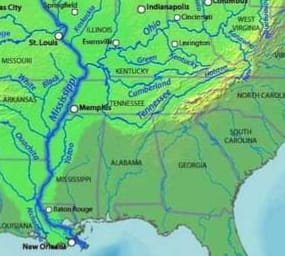
The survivors made the rest of their trip without further molestation. They traveled about 600 miles down the winding Tennessee River, riddled with rocky shoals and swift currents, until they met the Ohio River near the city of Paducah, Kentucky. A short trip of 44 miles on the Ohio River brought them to the mighty Mississippi River at Cairo, Illinois. Then they traveled another 450 miles down the Mississippi River. They landed near the mouth of Cole’s Creek, about twenty miles north of Natchez, settling 3.5 miles eastward on the creek at “Curtis Landing,” and established a village known as Uniontown, west of the present town of Fayette. Given the distance they traveled, at the mercy of the flow of the rivers and resting each night, the trip should have taken several months. Jack Curtis, a descendant of Richard Curtis who has done extensive research on the family, estimates that they arrived in the Natchez District about March, 1781. By the grace of God, they had survived a trek through the mountains, an Indian attack and navigated over 1,000 miles of rivers to reach their new home.
Dr. Rogers is revising and updating A History of Mississippi Baptists.


 Bob Rogers