Blog Archives
Breaking Barriers: The story of the first Black students at a Mississippi Baptist college
Copyright by Robert C. Rogers
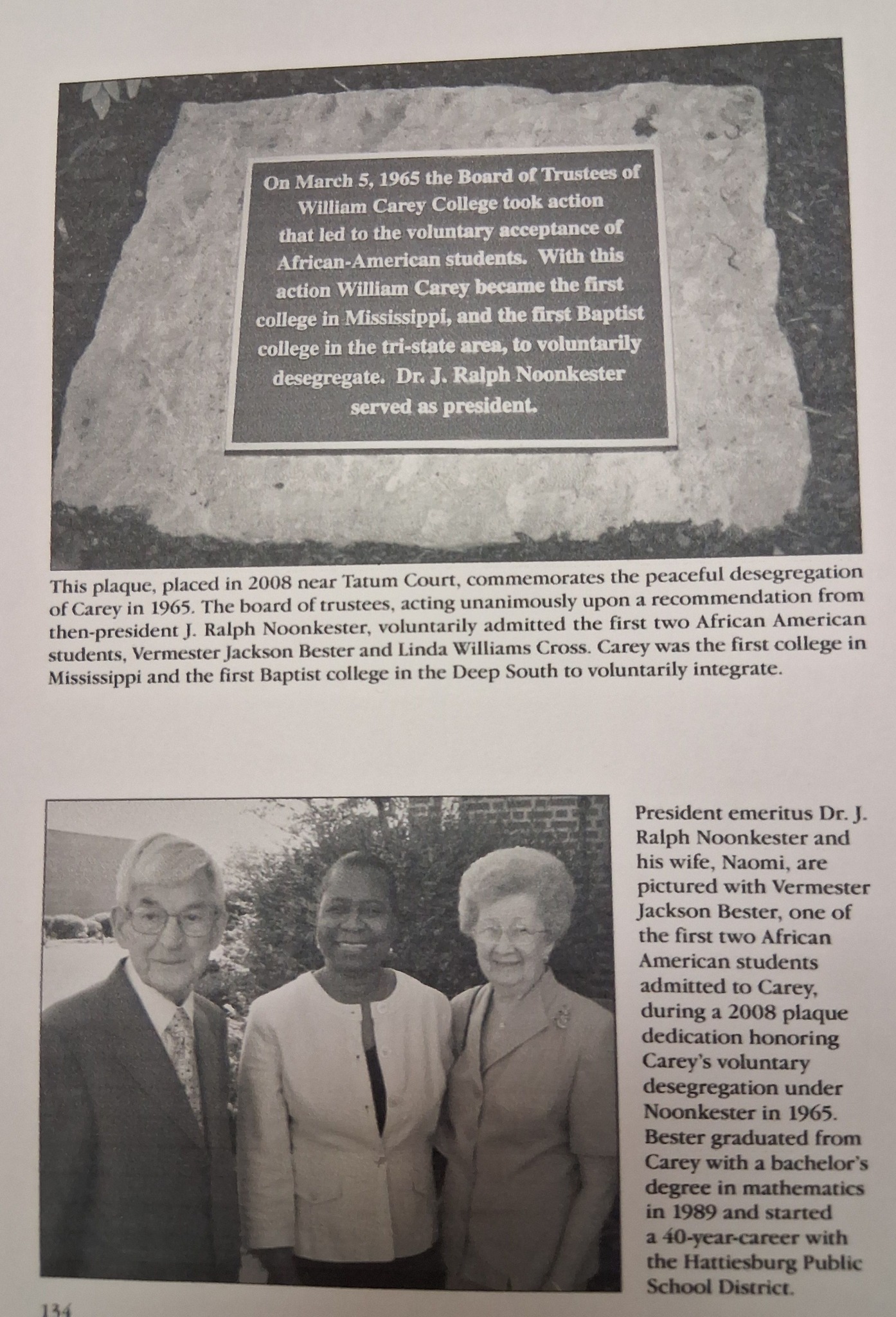
On March 5, 1965, the trustees of William Carey College (now William Carey University) voted to comply with the Civil Rights Act of 1964, promising not to discriminate based on “race, color, or national origin.” Thus, the Baptist college became the first Southern Baptist institution in Mississippi to racially integrate.
Carey’s president, Dr. J. Ralph Noonkester, contacted the principal of Hattiesburg’s Rowan High School to recruit the first Black students. The principal spoke to the parents of Linda Williams and Vermester Jackson, two honors graduates, and their parents approached each young lady about the possibility of becoming the first Black students at Carey.
Neither Linda nor Vermester had considered the possibility. Although her own grandmother had been a housekeeper at the college for years, it never occurred to Linda that she would be a student there. Linda responded to her parents, “We go where?” She had planned to go to Mississippi Valley State, a historically Black college where she had friends.
Vermester already had a scholarship to Southern Illinois University in Carbondale, Illinois, when her parents approached her about going to college at Carey. “My mother said, there are lots of kids who can’t go anywhere with a scholarship like you can,” implying that she could break the color barrier for other students if she went to Carey. “We decided to do it.”
“We had no idea what danger we were in,” said Linda. Unknown to either girl, the night before their first day at school, the Ku Klux Klan burned a cross on the lawn of President Noonkester. That night, Black residents in their neighborhood slept with shotguns by their beds, something Vermester’s parents only told her later. Linda said, “My Dad was apprehensive; he feared a firebombing of our yard.”
Linda and Vermester lived near the campus, on opposite ends of Royal Street. Linda said, “I lived on the west end, and she lived on the east end of the street, so we met up at Tuscan Avenue and we both walked to school.” Vermester remembered smelling something, but didn’t know about the cross-burning, as it had been cleaned up. As they walked up to Tatum Court on the Carey campus, Linda asked her, “Girl, are you scared?” Right then, they saw a Black maid cleaning the stairs, who said, “We’re watching out for y’all.” The maid was right. In fact, Linda says, “We had five young Christian women [students] who met us on campus and led us around to show us our buildings. It was very comforting to know we didn’t have to do it alone. That made the transition pretty easy.” Vermester added, “That first day, every time I turned around, I could see Dr. Noonkester. He would stop and ask how things were going.”
At the same time, their friend Gwendolyn Elaine Armstrong was one of two Black students integrating Hattiesburg’s other college, Southern Miss. Armstrong and the other Black students at Southern Miss had to have protection from the National Guard, and she told Vermester that students were spitting on them. “But we didn’t have any group that showed hatred or disapproval,” said Linda. “I remember some heckling,” she added, but compared to their high school classmates’ experience at Southern Miss, they would say to each other, “Girl, we’re blessed.”
Vermester was a math and English major, and Linda was a business major, so they only had one or two classes together, including an English composition class. When they walked into that classroom, a young man got up and left. Years later, Linda met the same man when he came to pay his bill at Mississippi Power Company where she was working. Recognizing her, he apologized. Another memory both Linda and Vermester had of that class together was how their teacher pronounced the word “Negro” in a short story she was reading, so it sounded more like the N-word.
Despite having few classes together, both girls studied hard and were encouraged by the faculty to join organizations and get involved. Their greatest encouragement, however, came from their families and the Black community. Their parents made sacrifices for them, such as relieving them of chores, so they could study. Neighbors would ask, “Do you need any help?” The second semester some Black students transferred in from Prentiss Institute and Mississippi Valley State, making at least five Black students on campus. The following year, Black enrollment increased a good bit, and some of their classmates from Rowan High School came.
Their junior year, Linda transferred to Mississippi Valley State “to experience dorm life,” but she decided she wasn’t going to let Vermester walk across the stage at graduation by herself, so she returned to Carey for graduation. By the time they graduated in 1969, there were photographs of 76 Black students in the Carey yearbook. They were from all of Mississippi, but most were from Hattiesburg.
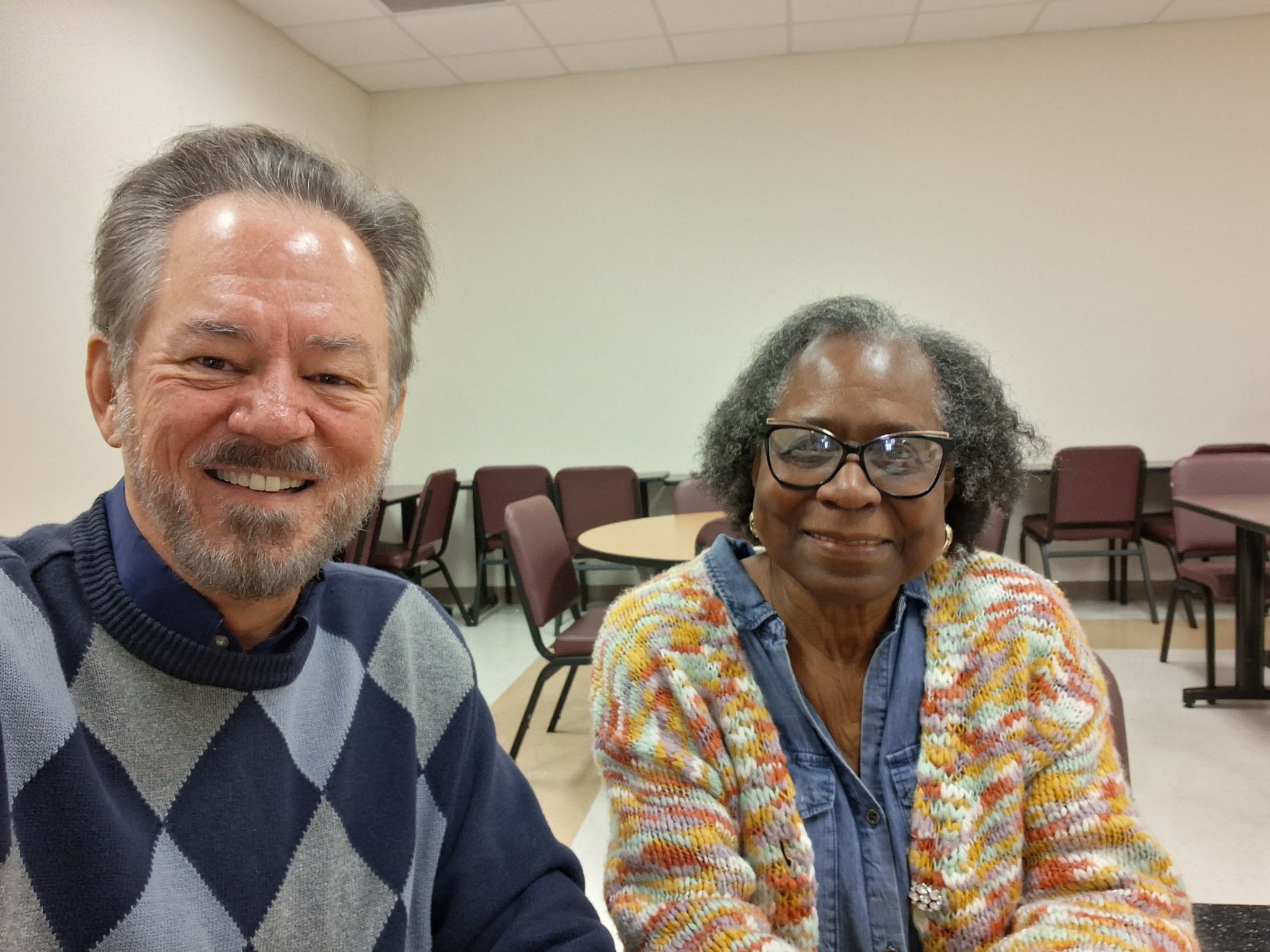
After college, Linda and Vermester went separate ways. Vermester married Mr. Bester and taught math in the Hattiesburg Public Schools, retiring from Hattiesburg High School. She never talked about being one of the first Black students at William Carey University. She said, “For the longest time, it didn’t occur to me what Linda and I had done.” Other people talked about it, though. “I’ve had people come up to me and say, ‘If it hadn’t been for you and Linda, I wouldn’t have been able to go to school.’ It warms my heart.” She is proud to say that her grandson, Cory Bester, graduated from Carey.
Linda eventually moved out of state, living many years in Minnesota before retiring in Pensacola, Florida, where she resides today. “I’ve had men and women tell us, if you had not done this, we would not have gotten our degrees. I had a young lady I babysat, who later got her doctorate there. I have a niece and a nephew who went to Carey,” says Linda. Two scholarships to William Carey University have been established in their names, one a partial scholarship and the other a full scholarship.
However, Linda did not receive her own diploma. A mix-up over her transfer to Valley State and back to Carey somehow caused her to miss 3 hours credit that she thought she had when she walked across the graduation stage in 1969. Back then, they would mail the real diploma after graduation, but she never received it. In 2024, she and her son were on the Carey campus and met the current president, Dr. Ben Burnett. When they explained what happened, he said, “We’re going to fix that.” On May 10, 2024, Linda Williams was the last person to walk across the stage of the graduation ceremony at William Carey University, and she received her diploma at last. “They gave me two standing ovations. It was like I was graduating all over again! It was so surreal. Dr. Noonkester’s son, Myron, had the honor of giving me the diploma his Dad would have given me,” said Linda. Linda thought of her grandmother, who was a housekeeper at the college when it was known as Mississippi Woman’s College. “She would have loved to have seen that happen to me.”
Vermester says, “What I treasure most is that William Carey College lived up to the Christian spirit. Somehow, they managed to make it happen, in a way that benefitted us and our community.”
SOURCES: Linda Williams, telephone interview by author, February 7, 2026; Vermester Jackson Bester, in-person interview by author, February 4, 2026; Robert C. Rogers, Mississippi Baptists: A History of Southern Baptists in the Magnolia State (Mississippi Baptist Convention Board, 2025), 224-225.
Mississippi Baptists and the civil rights struggle in the 1950s and 1960s
Copyright by Robert C. Rogers and the Mississippi Baptist Convention Board.
On May 17, 1954, the Supreme Court struck down public school segregation in Brown v. Board of Education, saying, “Separate educational facilities are inherently unequal.” The Southern Baptist Convention, meeting only weeks later, became the first major religious denomination to endorse the decision, saying, “This Supreme Court decision is in harmony with the constitutional guarantee of equal freedom to all citizens, and with the Christian principles of equal justice and love for all men.” Mississippi Baptists, however, would have none of it. A.L. Goodrich, editor of The Baptist Record, accused the Southern Baptist Convention of inconsistency on the issue for not endorsing other types of integration as well. Goodrich was “indignant” at this example of “the church putting its finger in state matters,” but he told Mississippi Baptist readers that they “need not fear any results from this action.” First Baptist Church, Grenada (Grenada) made a statement condemning the Supreme Court decision. The Mississippi Baptist Convention, meeting November 16-18, 1954, passed several resolutions, but it made no mention of the Supreme Court decision.1
The Supreme Court deferred application of integration, and Mississippi’s governor, Hugh White, met with Black leaders, expecting that they would agree to maintain segregated schools if the state improved funding for Black schools. H.H. Humes represented the largest Black denomination in the state, as president of the 400,000-member General Missionary Baptist Convention. He responded to the governor, “the real trouble is that for too long you have given us schools in which we could study the earth through the floor and the stars through the roof.”2
In the 1950s, most White Baptists were content with a paternalistic approach of sponsoring ministry to Black Baptists, while keeping their schools, churches and social interaction segregated. There were some rare exceptions. Ken West recalls attending Gunnison Baptist Church, (Bolivar) in the 1950s, when the congregation had several Black members of the church, mostly women, who actively participated in WMU. However, most White Baptists agreed with W. Douglas Hudgins, pastor of First Baptist Church, Jackson (Hinds), who told reporters that he did not expect “Negroes” to try to join his church. When pressed specifically about the Brown v. Board of Education decision of the Supreme Court, Douglas evasively called it “a political question and not a religious question.” Alex McKeigney, a deacon from First Baptist Church, Jackson, was more direct, saying that “the facts of history make it plain that the development of civilization and of Christianity itself has rested in the hands of the white race” and that support of school desegregation “is a direct contribution to the efforts of those groups advocating intermarriage between the races.” Dr. D.M. Nelson, president of Mississippi College, wrote a tract in support of segregation that was published by the White Citizens’ Council in 1954. In the tract, Nelson said that in part, the purpose of integration was “to mongrelize the two dominant races of the South.” Baptist lay leader Owen Cooper recalled that during the 1950s, he avoided the moral issue that troubled him later: “To be quite honest I did not ask myself what Jesus Christ would have done had He been on earth at the time. I didn’t ask because I already knew the answer.”3
In 1960, Baptist home missionary Victor M. Kaneubbe sparked controversy over segregated schools for another racial group in Mississippi, the American Indians. Kaneubbe was a member of the Choctaw Nation of Oklahoma, who came to Mississippi to do mission work with the Mississippi Band of Choctaw Indians. However, since his wife was White, no public schools would admit their daughter, Vicki. The White schools denied Vicki because she was Choctaw, and the Choctaw schools denied her because she was White. Kaneubbe enlisted the support of many White Baptists who campaigned for Vicki. This eventually led to the establishment Choctaw Central High School on the Pearl River Reservation in Neshoba County, an integrated school that admitted students with partial Choctaw blood.4
The minutes of Woodville Heights Baptist Church, Jackson (Hinds) illustrate how local churches began to struggle with the issue of integration in the 1960s. At the monthly business meeting of Woodville Heights in August 1961, the issue of racial integration came up. The minutes read, “Bro. Magee gave a short talk on integration attempts. Bro. Sullivan gave his opinion on this subject. Bro. Sullivan said he would contact Sheriff Gilfoy concerning the furnishing of a Deputy during our services.” Interestingly, the very next month, the pastor, Dr. Percy F. Herring, resigned, and so did one of the trustees, Samuel Norris. In his resignation letter, Herring did not make a direct reference to the integration issue, only saying, “My personal circumstances and the situation here in the community have combined to bring me to the conclusion that I should submit my resignation as Pastor of this church.”5
Woodville Heights was not alone in the struggle. Throughout the 1960s, many Mississippi Baptists wrestled with racism in their local churches, associations, and the state convention. In the early part of the decade, it was common for Southern Baptist churches in Mississippi to have what was called a “closed door policy” against attendance by Black people. White Baptists were known to be active in the Ku Klux Klan, such as Sam Bowers, leader of the White Knights of the KKK, who taught a men’s Sunday school class at a Baptist church in Jones County. Some Baptist leaders were disturbed by the violence of the KKK. In November 1964, a few months after the murders of civil rights workers in Neshoba County, Owen Cooper presented a resolution on racism at the state convention. Cooper’s resolution, which was adopted, recognized that “serious racial problems now beset our state,” and said, “we deplore every action of violence… We would urge all Baptists in the state to refrain from participating in or approval of any such acts of lawlessness.” In 1965, it was front-page news in The Baptist Record when First Baptist Church, Richmond, Virginia admitted two Nigerian college students as members. When First Baptist Church, Montgomery, Alabama adopted an “open door policy” toward all races the same year, it was again news in The Baptist Record. Clearly, it was not yet the norm in White Mississippi Baptist churches.6
As the decade progressed, some Mississippi Baptists began to accept integration and work toward racial justice and reconciliation. Tom Landrum, a Baptist layman in Jones County, secretly spied on the White Knights of the Ku Klux Klan. Landrum’s reports to the Federal Bureau of Investigation (FBI) were instrumental in the arrest of the Klansmen who killed civil rights leader Vernon Dahmer in 1965. Earl Kelly, in his presidential address in 1966, told the Mississippi Baptist Convention that “the race question” had to be faced. Baptist deacon Owen Cooper took this challenge seriously, helping to charter and becoming chairman of Mississippi Action for Progress (MAP) on September 13, 1966; MAP was able to secure millions of dollars to keep alive Head Start programs, which primarily benefitted impoverished Black children, that were in danger of losing their funds. When civil rights leader Martin Luther King, Jr. was assassinated in 1968, The Baptist Record quoted Baptist leaders who expressed “shock, grief and dismay at the murder” of King. In 1969, Jerry Clower, the popular Mississippi entertainer and member of First Baptist Church, Yazoo City (Yazoo), was speaking out against racism at Baptist events. Clower confessed that as a child, he was taught that “a Negro did not have a soul, but he found out he was wrong when he became a Christian.” By that year, 1969, all the state colleges and hospitals had agreed to sign an assurance of compliance with racial integration.7
(Dr. Rogers is the author of Mississippi Baptists: A History of Southern Baptists in the Magnolia State, to be published in 2025.)
SOURCES:
1 Jesse C. Fletcher, The Southern Baptist Convention: A Sesquicentennial History (Nashville: Broadman and Holman Publishers, 1994), 200; Annual, Southern Baptist Convention, 1954, 36; Minutes, Mississippi Baptist Convention, 1954, 45-49; The Baptist Record, June 10, 1954, 1, 3; July 8, 1954, 4.
3 Ibid, 62-63; Letter from Ken West, Leland, Mississippi, to Bob Rogers, Hattiesburg, Mississippi, 28 January 2022, Original in the hand of Robert C. Rogers; D. M. Nelson, Conflicting Views on Segregation (Greenwood, MS: Educational Fund of the Citizens’ Council, 1954), 5, 10; The Clarion-Ledger, April 4, 1982, cited in Dittmer, 63.
4 Jamie Henton, “Their Culture Against Them: The Assimilation of Native American Children Through Progressive Education, 1930-1960s,” Master’s Theses, University of Southern Mississippi, 2019, 85-92.
5 Minutes, Woodville Heights Baptist Church, Jackson, Mississippi, August 9, 1961; September 6, 1961.
6 Curtis Wilkie, When Evil Lived in Laurel: The ‘White Knights’ and the Murder of Vernon Dahmer (New York: W.W. North & Company, 2021), 26, 43-51; Minutes, Mississippi Baptist Convention, 1964, 43-44; The Baptist Record, January 28, 1965, 1; April 29, 1965, 2.
7 Wilkie, 20, 138; Dittmer, 377-378; The Baptist Record, November 17, 1966, 1, 3; December 21, 1967; April 11, 1968, 1; July 17, 1969, 1, 2; November 29, 1969, 1.
The racial segregation in Mississippi Baptist churches after the Civil War

Copyright by Robert C. Rogers and the Mississippi Baptist Convention Board.
One the most significant social changes among Mississippi Baptists after the Civil War was the racial segregation of churches. Before the war, African people who were enslaved constituted a substantial portion of Mississippi Baptist congregations, as I have discussed in previous blog posts. In the decade after the war, Black Baptists gradually celebrated their new freedom by separating into independent, self-governing churches. In some areas this happened suddenly, and in other areas of the state it was more gradual. The First Baptist Church of Clinton, for example, had a membership of 283 in 1860, including 113 Black members. In 1866, with the absence of college students and withdrawal of Black members, the Clinton church was reduced to 36 members, and worship was only held once a month, led by a pastor from Raymond. In 1864, Jerusalem Baptist Church had 65 Black members, but all of them were gone by 1866. Bethesda Church in Hinds County agreed in 1867 to allow Black members to hold a separate revival meeting, and later in the same year the church granted the following request: “The colored members signified a desire to withdraw from the church to organize an independent church and asked permission for the use of the church house one sabbath each month.” Likewise, Black members of Academy Baptist Church in Tippah County met separately after the war, and had a Black preacher, but used the Academy church building until the 1870s. Charles Moore, a preacher who had been enslaved, expressed the common desire of Black Baptists after the war, “I didn’t expect nothing out of freedom excepting peace and happiness and the right to go my way as I please. And that is the way the Almighty wants it.”1
In other areas, Black members continued to worship alongside Whites in the same churches for a decade or more. Ebenezer Baptist Church in Amite County continued to refer to “colored” members frequently through 1874, and then there was one more mention in 1877 of a “colored” member who asked to be restored so that he could join New Hope Baptist Church. Although most churches remained integrated for several years, tensions began to arise, sometimes fueled by resentment over events of the war. For instance, in September 1865, five months after the war ended, “Eliza a colored woman” joined Sarepta Baptist Church in Franklin County by her experience of faith, and “it was moved and seconded that the right hand of fellowship be extended which was done with the exception of one brother who refused to give the right hand of fellowship to the colored woman Eliza.”2
Despite this occasional White resentment, most White Baptist leaders expressed goodwill to Black Baptists. In 1870, Salem Baptist Association in Jasper County recommended that if Black members “wish to form churches of their own, that they should be dismissed in order and assisted in doing so, but where they wish to remain with us as heretofore and are orderly, we think they should be allowed to do so.” Black membership in Salem Association declined from 206 in 1865 to 122 in 1870. As late as 1872, 81 Black people continued to worship in biracial churches in the association, and Black people continued in the records of Fellowship Baptist Church as late as 1876. The Mississippi Baptist Association reported 131 Black members in 1874.3
Segregation of Mississippi Baptist churches started out as a celebration of freedom for Black people, but by the 1890s, it had also become an expectation of Whites. The Mississippi Baptist Convention assumed that their churches were made up of White members only. For instance, the 1890 state convention referred to itself as: “The Mississippi Baptist Convention… representing a denomination of 80,000 white Christians…” However, the state convention maintained friendly relations with “colored” Baptists, a term considered polite at the time. When the General Baptist Convention of Mississippi, made up of African Americans, met at the same time as the Mississippi Baptist Convention, they frequently exchanged telegrams of Christian greetings. Mississippi Baptist pastors frequently led Bible institutes for Black Baptist pastors and deacons, and the state convention encouraged White pastors to donate their time to teach at these institutes across the state.4
SOURCES:
1 Charles E. Martin, A Heritage to Cherish: A History of First Baptist Church, Clinton, Mississippi, 1852-2002 (Nashville: Fields Publishing, Inc., 2001), 36; Randy J. Sparks, Religion in Mississippi (Jackson: University Press of Mississippi, 2001), 139.
2 Minutes, Ebenezer Church, Amite County. November 1, 1873, May 2, 1874, October 3, 1874, July 1, 1877; Minutes, Sarepta Church, Franklin County, September 1865.
3 Sparks, 139-140; Minutes, Mississippi Baptist Association, 1874.
4 Minutes, Mississippi Baptist Convention, 1890, 31; 1891, 14; 1897, 20-21.
Dr. Rogers is the author of Mississippi Baptists: A History of Southern Baptists in the Magnolia State, which was published in 2025. You can get a copy of his book by making a donation to the Mississippi Baptist Historical Commission at the following link and telling them how many copies of the book you wish: https://mbcb.org/historicalcommission/ (Suggested donation $15).


 Bob Rogers